Blog

Learn About Our Meetup

5000+ Members

MEETUPS

LEARN, CONNECT, SHARE

Join our meetup, learn, connect, share, and get to know your Toronto AI community. 

JOB POSTINGS

INDEED POSTINGS

Browse through the latest deep learning, ai, machine learning postings from Indeed for the GTA.

CONTACT

CONNECT WITH US

Are you looking to sponsor space, be a speaker, or volunteer, feel free to give us a shout.

Author: torontoai

Video Understanding Using Temporal Cycle-Consistency Learning

In the last few years there has been great progress in the field of video understanding. For example, supervised learning and powerful deep learning models can be used to classify a number of possible actions in videos, summarizing the entire clip with a single label. However, there exist many scenarios in which we need more than just one label for the entire clip. For example, if a robot is pouring water into a cup, simply recognizing the action of “pouring a liquid” is insufficient to predict when the water will overflow. For that, it is necessary to track frame-by-frame the amount of water in the cup as it is being filled. Similarly, a baseball coach who is comparing stances of pitchers may want to retrieve video frames from the precise moment that the ball leaves the pitchers’ hands. Such applications require models to understand each frame of a video.

However, applying supervised learning to understand each individual frame in a video is expensive, since per-frame labels in videos of the action of interest are needed. This requires that annotators apply fine-grained labels to videos by manually adding unambiguous labels to every frame in each video. Only then can the model be trained, and only on a single action. Training on new actions requires the process to be repeated. With the increasing demand for fine-grained labeling, necessary for applications ranging from robotics to sports analytics, this makes the need for scalable learning algorithms that can understand videos without the tedious labeling process increasingly pertinent.

We propose a potential solution using a self-supervised learning method called Temporal Cycle-Consistency Learning (TCC). This novel approach uses correspondences between examples of similar sequential processes to learn representations particularly well-suited for fine-grained temporal understanding of videos. We are also releasing our TCC codebase to enable end-users to apply our self-supervised learning algorithm to new and novel applications.

Representation Learning Using TCC
A plant growing from a seedling to a tree; the daily routine of getting up, going to work and coming back home; or a person pouring themselves a glass of water are all examples of events that happen in a particular order. Videos capturing such processes provide temporal correspondences across multiple instances of the same process. For example, when pouring a drink one could be reaching for a teapot, a bottle of wine, or a glass of water to pour from. Key moments are common to all pouring videos (e.g., the first touch to the container or the container being lifted from the ground) and exist independent of many varying factors, such as visual changes in viewpoint, scale, container style, or the speed of the event. TCC attempts to find such correspondences across videos of the same action by leveraging the principle of cycle-consistency, which has been applied successfully in many problems in computer vision, to learn useful visual representations by aligning videos.

The objective of this training algorithm is to learn a frame encoder, using any network architecture that processes images, such as ResNet. To do so, we pass all frames of the videos to be aligned through the encoder to produce their corresponding embeddings. We then select two videos for TCC learning, say video 1 (the reference video) and video 2. A reference frame is chosen from video 1 and its nearest neighbor frame (NN2) from video 2 is found in the embedding space (not pixel space). We then cycle back by finding the nearest neighbor of NN2 in video 1, which we call NN1. If the representations are cycle-consistent, then the nearest neighbor frame in video 1 (NN1) should refer back to the starting reference frame.
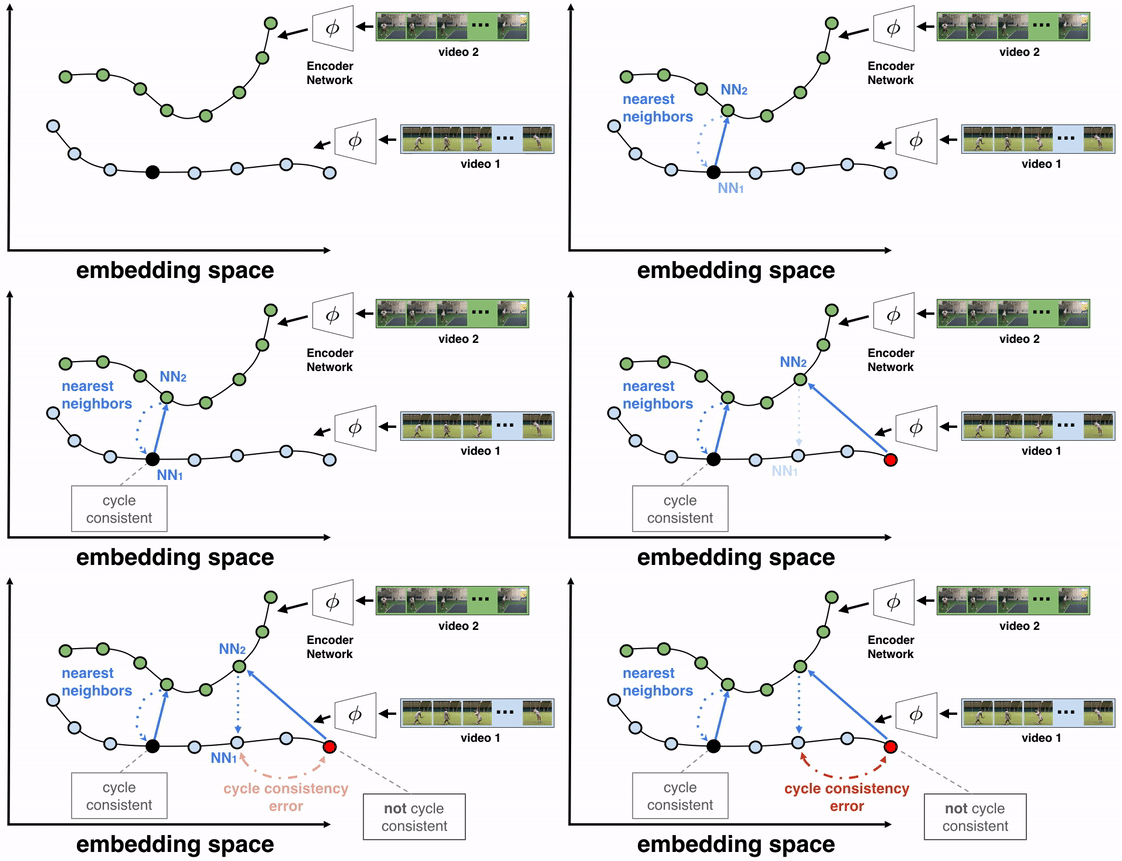
We train the embedder using the distance between the starting reference frame and NN1 as the training signal. As training proceeds, the embeddings improve and reduce the cycle-consistency loss by developing a semantic understanding of each video frame in the context of the action being performed.

Using TCC, we learn embeddings with temporally fine-grained understanding of an action by aligning related videos.

What Does TCC Learn?
In the following figure, we show a model trained using TCC on videos from the Penn Action Dataset of people performing squat exercises. Each point on the left corresponds to frame embeddings, with the highlighted points tracking the embedding of the current video frame. Notice how the embeddings move collectively in spite of many differences in pose, lighting, body and object type. TCC embeddings encode the different phases of squatting without being provided explicit labels.
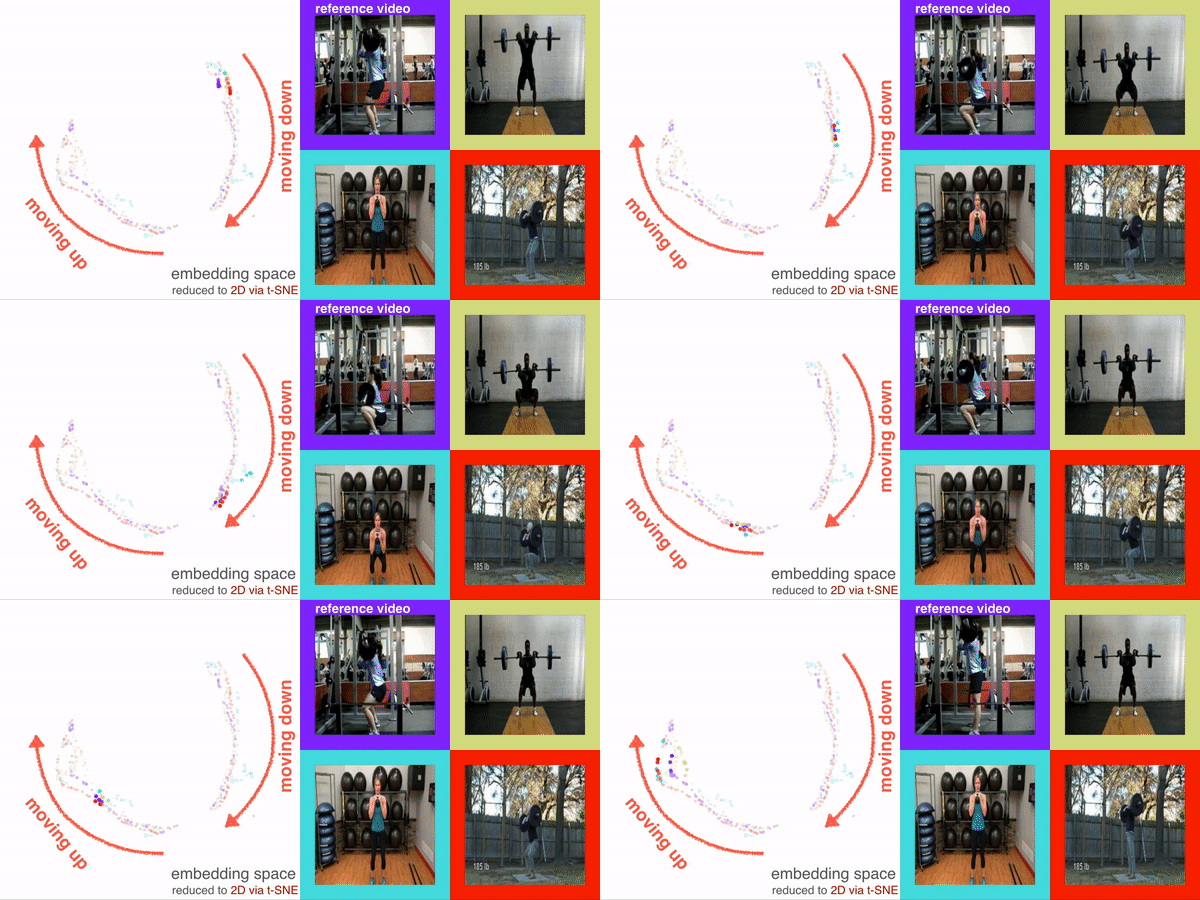
Right: Input videos of people performing a squat exercise. The video on the top left is the reference. The other videos show nearest neighbor frames (in the TCC embedding space) from other videos of people doing squats. Left: The corresponding frame embeddings move as the action is performed.

Applications of TCC
The learned per-frame embeddings enable an array of interesting applications:

  • Few-shot action phase classification
    When few labeled videos are available for training, the few-shot scenario, TCC performs very well. In fact, TCC can classify the phases of different actions with as few as a single labeled video. In the next figure we compare to other supervised and self-supervised learning approaches in the few-shot setting. We find that supervised learning requires about 50 videos with each frame labeled to achieve the same accuracy that self-supervised methods achieve with just one fully labeled video.
    Comparison of self-supervised and supervised learning for few-shot action phase classification.
  • Unsupervised video alignment
    Aligning or synchronizing videos manually becomes prohibitively difficult as the number of videos increases. Using TCC, many videos can be aligned by selecting the nearest neighbor to each frame in a reference video, without the need for additional labels, as demonstrated in the figure below.
    Results of unsupervised video alignment on videos of people pitching baseball using the distance between frames in the TCC space. The reference video used for alignment is shown in the upper left panel.
  • Label/modality transfer between videos
    Just as TCC finds similar frames by using a nearest neighbor search in the embedding space, it can transfer metadata associated with any frame in one video to its matching frame in another video. This metadata can be in the form of temporal semantic labels or other modalities, such as sound or text. In the video below we show two examples where we can transfer the sound of liquid being poured into a cup from one video to another.
  • Per-frame Retrieval
    With TCC, each frame in a video can be used as a query for retrieval of similar frames by looking up the nearest neighbors in the learned embedding space. The embeddings are powerful enough to differentiate between frames that look quite similar, such as frames just before or after the release of a bowling ball.
    We can perform retrieval from videos on a per-frame basis, i.e., any frame can be used to look up similar frames in a large collection of videos. The retrieved nearest neighbors show that the model captures fine-grained differences in the scene.

Release
We are releasing our codebase, which includes implementations of a number of state-of-the-art self-supervised learning methods, including TCC. This codebase will be useful for researchers working on video understanding, as well as artists looking to use machine learning to align videos to create mosaics of people, animals, and objects moving synchronously.

Acknowledgements
This is joint work with Yusuf Aytar, Jonathan Tompson, Pierre Sermanet, and Andrew Zisserman. The authors would like to thank Alexandre Passos, Allen Lavoie, Anelia Angelova, Bryan Seybold, Priya Gupta, Relja Arandjelović, Sergio Guadarrama, Sourish Chaudhuri, and Vincent Vanhoucke for their help with this project. The videos used in this project come from the PennAction dataset. We thank the creators of PennAction for curating such an interesting dataset.

[P] Web-based implementation of Deep Image Prior

[P] Web-based implementation of Deep Image Prior

https://warlock.ai/deepimageprior/

Using TensorFlow.js I implemented a client-side version of Deep Image Prior. It can be used for denoising, inpainting, super-resolution (not implemented yet) and more. It works by training a network to output a given image. More info about the algorithm can be found on the original authors’ project page.

There are still a couple of things that need to be resolved such as mask-drawing on mobile (the page scrolls when drawing right now) and the comparison view becoming stuck after the first image was selected. Also I’m not sure how well this works on devices without GPUs, although on my relatively old phone (Nexus 6) and my PC (GTX 1070) it worked reasonably well.

Inpainting example 1

Inpainting example 2

submitted by /u/ToraxXx
[link] [comments]

[D] It is absurd that an entire field devoted to automatic text summarization keeps all of its information in papers

  • I wonder what the most important advances in my field have been in the past month. I could go on arXiv and search every paper in ML… eff that noise. I’m going to arxiv-sanity and twitter! That’s sane! There’s no way I can miss anything important this way! Every company should track their changes through tweets!
  • Hey this paper sounds amazing. The abstract is great. All I need is the main algorithm with every variable clearly described, how it’s different from current techniques, and the results! Oh the algorithm they used is the one not in the box? And it’s described across four pages, and not in order of operations? Brilliant!

Papers are a great storage format for reference, but we’re all in CS. Why are we using the storage format as the information retrieval format?? That’s insane. It’s figuratively like we’re trying to understand code changes, but instead of documentation, we could use diff, but we don’t even do that and we just compare the old files and the new files by eye…

Are there any non-profits working on this? OpenAI, can you become non-sketchy for like 10 seconds again and get this thing hammered out? Anyone?

submitted by /u/thatguydr
[link] [comments]

Perfect Harmony: Pharma’s MELLODY Consortium Joins Forces with NVIDIA to Supercharge AI Drug Discovery

Pharmaceutical companies have traditionally kept their data close to the vest because collaboration’s side effects may include compromising intellectual property and losing the edge over competitors.

But sharing data has major perks: The more data a pharma company has at its disposal, the better equipped its researchers are to quickly identify and develop promising new drugs. This can ultimately improve drug candidate success rates and reduce treatment costs.

Bringing a drug to market takes on average 13 years and close to $2 billion, said Hugo Ceulemans, project leader of MELLODDY — a new drug-discovery consortium that hopes to eliminate the tradeoff between data sharing and security.

The project will use cloud-based NVIDIA GPUs and a distributed approach known as federated learning to train AI models on data from multiple pharmaceutical companies while preserving IP.

An acronym for Machine Learning Ledger Orchestration for Drug Discovery, MELLODDY brings together 17 partners: 10 leading pharmaceutical companies, such as Amgen, Bayer, GSK, Janssen Pharmaceutica and Novartis; top European universities KU Leuven and the Budapest University of Technology and Economics; four trailblazing startups; and NVIDIA’s AI computing platform.

Each pharmaceutical partner will use its own cluster of NVIDIA V100 Tensor Core GPUs hosted on Amazon Web Services. MELLODDY developers will create a distributed deep learning model that can travel among these distinct cloud clusters, training on annotated data for an unprecedented 10 million chemical compounds.

Individual pharmaceutical companies will be able to finetune the AI model, tailoring it to their specific field of inquiry. As part of the data security mission of MELLODDY, each organization will keep its research projects confidential.

“We’re looking forward to becoming better at virtualizing drug discovery to bring more efficient, efficacious and safer therapies to patients,” said Ceulemans, scientific director of Discovery Data Sciences at Janssen Pharmaceutica. “When it comes to machine learning and data science, there’s no single industry that can afford to stand on the sidelines.”

Federated Learning: A New Frontier

MELLODDY aims to demonstrate how federated learning techniques could give pharmaceutical partners the best of both worlds: the ability to leverage the world’s largest collaborative drug compound dataset for AI training without sacrificing data privacy.

The $20 million project will run for three years, at which point the consortium will share learnings with the public.

Federated learning is a method of decentralized machine learning in which training data doesn’t have to be pooled into a single aggregating server. Instead, the machine learning model learns from data stored at different geographic locations, ensuring that each pharmaceutical company’s private dataset stays within its own secure infrastructure.

“The data is never put at risk,” said Mathieu Galtier, project coordinator for Owkin, a startup developing MELLODDY’s federated learning system. “The data sits in its own GPU server, while the algorithms travel from one to the other for training.”

Pharmaceutical datasets consist of historical information about different chemical compounds and their attributes. With the versatile MELLODDY federated learning model, each partner will be able to create anonymized queries about specific drug compounds. The query will be sent to each of the organization’s data repositories to identify any potential matches.

MELLODDY will also employ a blockchain ledger system so pharmaceutical partners can maintain visibility and control over the use of their datasets.

By enabling pharmaceutical companies to learn from each other’s findings without providing traditional competitors direct access to proprietary datasets, the consortium aims to improve the predictive performance of AI-based drug discovery. With smarter models comes speedier and cheaper drug development.

The post Perfect Harmony: Pharma’s MELLODY Consortium Joins Forces with NVIDIA to Supercharge AI Drug Discovery appeared first on The Official NVIDIA Blog.

Perfect Harmony: Pharma’s MELLODDY Consortium Joins Forces with NVIDIA to Supercharge AI Drug Discovery

Pharmaceutical companies have traditionally kept their data close to the vest because collaboration’s side effects may include compromising intellectual property and losing the edge over competitors.

But sharing data has major perks: The more data a pharma company has at its disposal, the better equipped its researchers are to quickly identify and develop promising new drugs. This can ultimately improve drug candidate success rates and reduce treatment costs.

Bringing a drug to market takes on average 13 years and close to $2 billion, said Hugo Ceulemans, project leader of MELLODDY — a new drug-discovery consortium that hopes to eliminate the tradeoff between data sharing and security.

The project will use cloud-based NVIDIA GPUs and a distributed approach known as federated learning to train AI models on data from multiple pharmaceutical companies while preserving IP.

An acronym for Machine Learning Ledger Orchestration for Drug Discovery, MELLODDY brings together 17 partners: 10 leading pharmaceutical companies, such as Amgen, Bayer, GSK, Janssen Pharmaceutica and Novartis; top European universities KU Leuven and the Budapest University of Technology and Economics; four trailblazing startups; and NVIDIA’s AI computing platform.

Each pharmaceutical partner will use its own cluster of NVIDIA V100 Tensor Core GPUs hosted on Amazon Web Services. MELLODDY developers will create a distributed deep learning model that can travel among these distinct cloud clusters, training on annotated data for an unprecedented 10 million chemical compounds.

Individual pharmaceutical companies will be able to finetune the AI model, tailoring it to their specific field of inquiry. As part of the data security mission of MELLODDY, each organization will keep its research projects confidential.

“We’re looking forward to becoming better at virtualizing drug discovery to bring more efficient, efficacious and safer therapies to patients,” said Ceulemans, scientific director of Discovery Data Sciences at Janssen Pharmaceutica. “When it comes to machine learning and data science, there’s no single industry that can afford to stand on the sidelines.”

Federated Learning: A New Frontier

MELLODDY aims to demonstrate how federated learning techniques could give pharmaceutical partners the best of both worlds: the ability to leverage the world’s largest collaborative drug compound dataset for AI training without sacrificing data privacy.

The $20 million project will run for three years, at which point the consortium will share learnings with the public.

Federated learning is a method of decentralized machine learning in which training data doesn’t have to be pooled into a single aggregating server. Instead, the machine learning model learns from data stored at different geographic locations, ensuring that each pharmaceutical company’s private dataset stays within its own secure infrastructure.

“The data is never put at risk,” said Mathieu Galtier, project coordinator for Owkin, a startup developing MELLODDY’s federated learning system. “The data sits in its own GPU server, while the algorithms travel from one to the other for training.”

Pharmaceutical datasets consist of historical information about different chemical compounds and their attributes. With the versatile MELLODDY federated learning model, each partner will be able to create anonymized queries about specific drug compounds. The query will be sent to each of the organization’s data repositories to identify any potential matches.

MELLODDY will also employ a blockchain ledger system so pharmaceutical partners can maintain visibility and control over the use of their datasets.

By enabling pharmaceutical companies to learn from each other’s findings without providing traditional competitors direct access to proprietary datasets, the consortium aims to improve the predictive performance of AI-based drug discovery. With smarter models comes speedier and cheaper drug development.

The post Perfect Harmony: Pharma’s MELLODDY Consortium Joins Forces with NVIDIA to Supercharge AI Drug Discovery appeared first on The Official NVIDIA Blog.

[D] word2vec and context

In my company we do not train word2vec (or Glove or fastext) for each context separately (i.e. we use the same algorithm for movie reviews and for food reviews). as i think meaning changes based on context (go read the book is a good sentiment for a book review but bad one for movie review), I was wondering do you train your embedding algorithm for each context or not.

thanks!

submitted by /u/odna_adops
[link] [comments]

[D] The laboratory which is doing research different from the research subject I want to do.

may I ask you a question?

My lab research topic is CNN, but I want to study Stock time series prediction using RNN.

All six proposals were rejected in three months …

In conclusion, I think I should decide whether to study CNN or leave the lab.

Is it right to study RNN personally while studying CNN?

Or is it right to see another lab?

submitted by /u/GoBacksIn
[link] [comments]