Author: torontoai
[P] A Quantum Perceptron – First Steps in qML
![[P] A Quantum Perceptron - First Steps in qML](https://b.thumbs.redditmedia.com/U8KCr2GIGTGFpSOyUcQdKhUoFbSc46hR39kKNOZPh6s.jpg "[P] A Quantum Perceptron - First Steps in qML") |
An interactive demo showing how quantum machine learning works on a simple case https://www.reddit.com/r/QuantumComputing/comments/d93v8l/a_quantum_perceptron_first_steps_in_qml/ submitted by /u/joaquinkeller |
[R] 5 Types of Machine Learning Algorithms You Should Know
We all are living in a period of DEVELOPING. According to Eric Schmidt – “Machine Learning is the future of technology”. It is the major component of Artificial Intelligence. So, is it true that machine learning influences the performance of the business?
All your questions and doubts are answered in this article, you find three types of machine learning that useful to your business and the top 5 types of Machine learning Algorithms to make yourself more familiar with the concept of ML.
Introduction to Machine Learning
No doubt, machine learning has become a diverse business tool to enhance the numerous elements of business operations. Machine learning- “it is the method of data analysis which automates the analytical model.” As well as it is a branch of artificial intelligence based on the idea that the system can learn from data, identify the pattern and make decisions with minimal human interference.
Machine learning (ML) is the scientific study of algorithms and statistical models that the computer system used to perform a specific task without using explicit instructions, replying on pattern and inference instead. It is also a subset of artificial intelligence. -via Wikipedia
If you’re a beginner, machine learning can be confusing for you– how to choose which algorithms to use, from the apparently limitless options, and how to know which one will provide the right predictions (data outputs). The machine learning is a way for computers to run various algorithms without direct human oversight in order to learn from data.
Machine learning can include a variety of tasks in order for the machine to determine a high-probability result for different information, such as the functions between input and output or the hidden structures in unlabeled data.
So, just before starting with Machine learning algorithms, let’s have a look at types of Machine learning which clarify these algorithms.
For more details, you can see this ref link:- https://codersera.com/blog/5-types-of-machine-learning-algorithms-you-should-know/
submitted by /u/Jonwalterc46
[link] [comments]
[D] Learning Chinese for Chinese ML and DL
Hello! I’ve heard a lot about China trying to become a leader in machine learning and AI in general. A lot of research papers comes from China, a lot of Chinese scientists contribute to research in other countries. I often get Chinese articles when I google some question related to ML, although I live in Eastern Europe. I also saw a few articles about learning Chinese for ML and DL. So I begin to wonder, is it worth learning Chinese to advance in ML more quickly, get more info and maybe read untranslated Chinese research papers? What do you think about this? Did anyone learn Chinese for similar purpose – to have more opportunities to learn about new ML techniques etc. – and what was the outcome?
submitted by /u/emissaryo
[link] [comments]
TB or Not TB: AI-Powered App Aids Treatment of Tuberculosis
Despite being treatable, tuberculosis kills 1.6 million people every year.
This is because TB treatment is time- and cost-intensive, requiring extensive patient monitoring.
In developing countries, where the disease is most deadly, monitoring involves a form of testing that has been used for hundreds of years. Clinicians study samples of lung fluid (called sputum) under a microscope and manually count the number of TB bacteria present, which sometimes reach into the hundreds.
This method may be cheaper than other available tests, but it’s only accurate 50 percent of the time.
Cambridge Consultants, a U.K.-based consultancy, has set out to investigate whether an AI-powered monitoring system could provide a feasible alternative for keeping tabs on this killer.
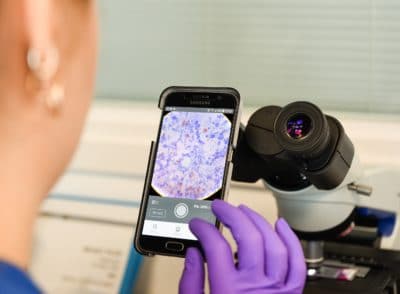
The result is BacillAi, a system that uses an AI-powered smartphone app and a standard-grade microscope to capture and analyze samples of sputum.
“With BacillAi, we wanted to tackle two main questions,” explained Richard Hammond, technology director of the Medical Technologies Division at Cambridge Consultants. “Can AI improve a labor-intensive, difficult process in healthcare diagnostics? And how could you go about making it available to those who need it most, even in the most remote and low-resource areas?”
Putting Manual Processes Under the Microscope
The current process for monitoring TB patients is inefficient and ineffective. Medical professionals review any number of patient samples a day, identifying and counting every single cell. This can take up to 40 minutes per case.
And the difficulty doesn’t stop there. Stains used to distinguish cells in the lung fluid can vary in strength between samples, and adjusting a microscope’s optical focus can alter colors.
Clinicians monitoring TB under these conditions face both mental and physical strain. With such a high risk of human error, patients often receive poor-quality results that arrive too late for them to start vital treatment.
To tackle this conundrum, Cambridge Consultants trained a deep learning system using data gathered from cultured surrogate bacteria and artificial sputum.
Developed on the NVIDIA DGX POD reference architecture with NetApp storage, known as ONTAP AI, the resulting convolutional neural network (CNN) can identify, count and classify TB cells in a matter of minutes.
The final BacillAi concept consists of a standard low-cost microscope, modified with a mount for a smartphone, and an app with the CNN at its heart.
A product like BacillAi could help clinicians determine the state of a patient’s health faster and more consistently than is currently possible. Patients would also have improved chances of fighting the disease.
Solving Challenges at Scale
A multidisciplinary team worked on developing BacillAi in Cambridge Consultants’ purpose-built deep learning research facility, which is powered by ONTAP AI. The space is designed specifically for discovering, developing and testing machine learning approaches in a secure environment.
The same research facility also developed Aficionado, an AI music classifier, Vincent, which turns your squiggles into art, and SharpWave, a tool that creates clear, undistorted views of the real world from a damaged or obscured moving image.
Discover Cambridge Consultants’ innovative approaches for yourself at The AI Summit, in San Francisco, Sept. 25-26.
The post TB or Not TB: AI-Powered App Aids Treatment of Tuberculosis appeared first on The Official NVIDIA Blog.
[D] Has Google Colab become stable enough to use?
I played for a bit a while go; it was extremely unstable and would crash randomly.
Has any one tried it recently? Is it usable enough for anyone to an extend, for example, training a YOLO network on the COCO dataset?
submitted by /u/RavlaAlvar
[link] [comments]
[D] What is the DeepMind for Google interview process like?
For Research Engineers. I see lots of interviewing details shared for DeepMind, but none for DeepMind for Google (DMG). It seems that DMG is pretty independent and their interview process is different than regular DeepMind. Any tips or details anyone can share?
submitted by /u/ThisIsMySeudonym
[link] [comments]
[D] SOTA Speech recognition/transcription
I’m working on a project with a speech transcription component. I tried using AWS and Azure speech recognition services and they are shockingly inaccurate. Can anyone recommend something better? Or is this just not possible yet.
What I tried:
https://azure.microsoft.com/en-us/services/cognitive-services/speech-to-text/
https://aws.amazon.com/transcribe/
Thanks!
submitted by /u/iocuydi
[link] [comments]