Author: torontoai
[D] What are the current major problems and limitations that face Machine Learning and Deep Learning in particular?
I’m almost a graduate student and looking forward to start thinking about the problems I want to tackle next in these fields.
I searched the r/MachineLearning subreddit for this discussion and I only found a discussion on an article related to computer vision. If this discussion already exists please link it to me so I could delete this post.
submitted by /u/mohd_sst
[link] [comments]
[Discussion] Wait for a unified company ML platform, and loose at least a year, if not more, before the project moves forward, or go with our own readily available tools, but incur a ton of technical debt in the process?
I work for a large company, with a centralized data science org, as well as several teams which are using or plan to use some machine learning or statistical modeling. The tools right now are disparate, but very little of it is in production, so it doesn’t matter that much.
(Some) Leaders are pushing for a unified ML platform to be used by all teams, and it will either be something built in house on top of AWS, or some sort of off the shelf tool like Databricks, or H2O, or what not. Based on the current level of discussion, the organization is at least a year out from now. We can wait for it, but we will essentially twiddle our fingers for a good part of our projects while waiting.
We have a project which is moving forward pretty fast, and we could just go ahead and build it using AzureML studio, with is what my team’s engineers are the most familiar with. But if the rest of the company gets their act together and eventually comes up with a unified ML platform, we will be completely out of synch with them, and we end up with a ton of technical debt.
Does anybody have experience with this dilemma? How do you keep your ability to move quickly with your own project, while still conforming to the company’s overall unified ML platform?
submitted by /u/AlexSnakeKing
[link] [comments]
Say Yes to the AI Dress: Entrepreneur Brings GPUs to Fashion
In the future imagined by Pinar Yanardag, a postdoctoral research associate at MIT Media Lab, AI will collaborate with humans, not replace them.
This is the concept behind her project, “How to Generate (Almost) Anything,” which she created with other students from the MIT Media Lab and professionals in the Boston area.
Yanardag sat down with AI Podcast host Noah Kravitz to talk about this project, along with her other new creations.
How to Generate (Almost) Anything tackles weekly projects that integrate human and AI creativity. “So these are artists and artisans from all walks of life. Sometimes, these people have no experience in AI, sometimes they’re a bit up to date,” Yanardag says.
Mystic PizzAI — Reinventing Gourmet Food with GPUs
The team starts with choosing something to generate — one of their first projects was pizza. Then they train a network using data they’ve collected. For their pizza project, they fed it a multitude of recipes. AI then generates its own content.
Yanardag and her colleagues find a human collaborator who evaluates the AI-generated idea and tweaks it. Their system produced a recipe for shrimp and jam pizza, a seemingly alarming combination.
But their collaborator, the chef of Crush Pizza in Boston, augmented with recipe with arugula. The result was so delicious that he’s considering adding it to his regular menu.
She’s proving that humans should be excited rather than fearful of job automation. “These are the tasks we shouldn’t have to do in the first place,” Yanardag says. Humans can now “focus on more important skills — our emotions, our creativity, our empathy.”
That sentiment also helped Yanardag start the world’s first AI fashion brand, Coven.ai. She and cofounder Emily Salvador, also from the MIT Media Lab, create dresses based on AI-generated designs.
The AI component invents outfits humans might not think of — in Coven.ai’s reimagining of the classic Little Black Dress, one arm of the dress is a bell sleeve, and the other is straight.
Yanardag and Salvador are releasing new dresses on their site, but they’re also designing a platform in which the public can interact with their AI system.
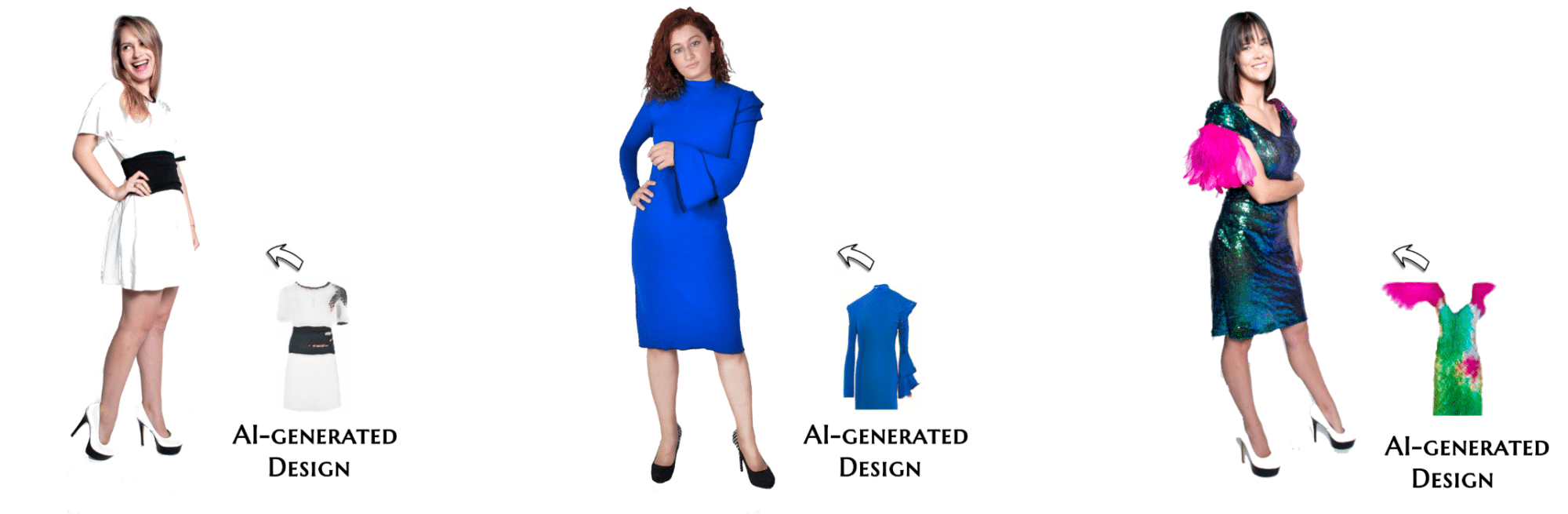
Caption: Success with a dress: Coven.ai shows how AI can generate appealing fashion.
“The idea is, you can just generate new designs on your own using our tool, and you can also finetune some of the details in the dress, like different colors or different styles or different textures,” Yanardag says. Users could send that design to a tailor, who would make the dress for them.
For Yanardag, the next step is the democratization of AI. She points out that right now, a powerful GPU is required to create these inventions. But by lowering the entry barrier, we can “empower people to create beautiful things.”
Help Make the AI Podcast Better
Have a few minutes to spare? Fill out this short listener survey. Your answers will help us make a better podcast.
How to Tune in to the AI Podcast
Get the AI Podcast through iTunes, Castbox, DoggCatcher, Overcast, PlayerFM, Podbay, PodBean, Pocket Casts, PodCruncher, PodKicker, Stitcher, Soundcloud and TuneIn. Your favorite not listed here? Email us at aipodcast [at] nvidia [dot] com.
The post Say Yes to the AI Dress: Entrepreneur Brings GPUs to Fashion appeared first on The Official NVIDIA Blog.
[D] Tensorflow GPU C API performance in C++
I recently wrote a wrapper for the Tensorflow GPU C API to run in a C++ project I’m working on. Since the library is in C, it can’t throw, and the only STL function I call is std::vector’s “push back”. Based on Herb Sutter’s recent talk, I thought, “hey, I might as well make this function noexcept”. Much to my surprise, the function (which took 40ms to run my CNN before) sped up to running in 19ms. Can anyone help me speculate why it’s that big of a performance difference? (Using Visual Studio 19, C++17, default optimization options)
submitted by /u/WalkingAFI
[link] [comments]
[D] How to handle noisy training labels in supervised learning?
In machine learning, it is often the case that training labels are subject to noise such as mislabelling. For neural networks that require large quantities of training data, this manifests as a trade-off between dataset quality and quantity. For instance, a model may have good performance on a training set (with noisy labels), but when we evaluate on a manually annotated test set, the model appears to generalize poorly.
What are some ways a machine learning practitioner can better deal with this problem?
submitted by /u/ProjectPsygma
[link] [comments]
[D] AMA: I’m Dr. Genevieve Patterson – cofounder and Chief Scientist at TRASH, a new app that uses computer vision and computational photography to intelligently edit together and set to music any videos you upload. Ask me anything!
![[D] AMA: I'm Dr. Genevieve Patterson - cofounder and Chief Scientist at TRASH, a new app that uses computer vision and computational photography to intelligently edit together and set to music any videos you upload. Ask me anything!](https://b.thumbs.redditmedia.com/nG_FeFbeiLyyZnHDXrS1tPIFSbaLZoGb5vm9W4GI7rA.jpg "[D] AMA: I'm Dr. Genevieve Patterson - cofounder and Chief Scientist at TRASH, a new app that uses computer vision and computational photography to intelligently edit together and set to music any videos you upload. Ask me anything!") |
Hi all! My name is Genevieve Patterson – I’m the Chief Scientist at TRASH, and a PhD in Computer Vision. I’ve been working on our AI, Otto, for over a year now, and it’s getting smarter with every release – here is a blog post about our latest version, and how it collaborates with user inputs. Otto is powered by supervised and unsupervised video attention, our internal active learning labeled social media video dataset, attribute and action recognition in video, custom multi-media embedding spaces, set-to-sequence conditional generator networks, and a suite of video retargeting techniques recently popularized in the computational video manipulation community. Otto trained in PyTorch and deployed on iOS using Core ML. My work is about creating dialog between AI and people. An initial description of Otto was accepted to the ICLR 2019 Debugging Machine Learning Workshop — “Building Models for Mobile Video Understanding”. Besides working at TRASH, I recently collaborated on a human + ML humor project, “Humor in Word Embeddings: Cockamamie Gobbledegook for Nincompoops,” ICML 2019. Please feel free to ask about anything I’ve worked on before (Google Scholar page). Before TRASH, I was Postdoctoral Researcher at Microsoft Research New England. I received my PhD from Brown University in 2016. I’ve published at and still review for CVPR, ICCV/ECCV, NeurIPS, CHI, HCOMP, and other CV and ML venues. I would be more than happy to answer any questions about CV and ML, computational photography, the TRASH app, how to finish a PhD, publishing in these fields, or anything about my own path. Opening this thread for your questions now, and will be here through Friday, September 27th answering them. https://i.redd.it/5rnp64p0dso31.jpg Thanks, and I look forward to your questions! Genevieve Patterson submitted by /u/TrashPHD |
[D] Fuel Accelerator (feedback requested)
Hello all, I am new to this Group. Mods- please delete if this isn’t acceptable.
I am facilitating year two, of the State of Arkansas’ “growth stage tech startup” accelerator program, dubbed Fuel. Fuel Accelerator
A few highlights for everyone (feedback and questions welcome!):
+12-weeks (Tue-Thu); Jan-May in Bentonville, Arkansas *Travel, Meals, ans Lodging (not currently included)
+1-on-1 mentorships with the area’s largest Enterprise players (i.e. Walmart, Tyson Foods, JB Hunt Transportation, University of Arkansas, Walton Family Foundation, Simmons Pet Food, WinRock/Heifer International are all headquartered in NW Arkansas).
+Dedicated mentorships- beyond a few working sessions and office hours. An ability to directly partner and scalably generate revenue.
+You’ll be working out of The Exchange office in downtown Bentonville (Walmart-owner) with a dynamic itinerary that’s fully catered towards matchmaking and partnership, to advance your purpose.
+Focused on AI/ML technology. However, this field is broad enough to encompass a lot of industries and applications.
+No equity exchange. The Fuel program is 100% free (less expenses)
+Weekly CEO Roundtables with successful start-up founders, including: Revunit, Startup Junkie, Slims Chicken, Onyx Coffee Labs
+Demo Day will include VCs and wealthy investors from across the Midwest, too. piggybacking off this event: Heartland Summit
Additional Links:
Top 10 Producer (USA) in: rice, timber, eggs, broilers (chicken) soybean, catfish, cotton.
submitted by /u/jaronhog
[link] [comments]
[P] My journey with Flow Generative Models and AI Residency in Poland
Hi guys,
I wanted to show you piece of a project I’ve been working on during my AI Residency in Tooploox. It is an adaptation of flow-based models to point cloud generation. Our work is based on the Real NVP (https://arxiv.org/abs/1605.08803).
One of the pros of our model is that we are able to obtain representation of point clouds which we can freely interpolate. Check out this video for visual.
In the blog post I wrote about basic concept of the project and my European AI Residency Experience.
We will be releasing paper on arXiv with code soon. Feel free to ask any questions.
Michał
submitted by /u/emke_es
[link] [comments]