The top of the SQuAD 2.0 leaderboard shows a new model from the Google Language Team called ALBERT. Based on the name, it seems to be an extension of BERT. It looks like a significant improvement on SOTA, but I can’t find anything about it online. Maybe a model soon to be released?
So I’m creating a weather forecast for a project and I need to analyze some historical data from a .json file. I want to create a list of daily summaries with the values from each dates. The .json layout looks like this:
Working with Genetic Learning as replacement for back propagation and just made a complex convolution network for a CIFAR-100 dataset with 100 classes and it started training immediately. No backprop
Training in progress and no stop at 10% so I guess its working. Will be fun to see where how good it will be but anyway. Its training ! Its giving results…
Posted by Nick Dufour, Google Research and Andrew Gully, Jigsaw
Deep learning has given rise to technologies that would have been thought impossible only a handful of years ago. Modern generative models are one example of these, capable of synthesizing hyperrealistic images, speech, music, and even video. These models have found use in a wide variety of applications, including making the world more accessible through text-to-speech, and helping generate training data for medical imaging.
Like any transformative technology, this has created new challenges. So-called “deepfakes“—produced by deep generative models that can manipulate video and audio clips—are one of these. Since their first appearance in late 2017, many open-source deepfake generation methods have emerged, leading to a growing number of synthesized media clips. While many are likely intended to be humorous, others could be harmful to individuals and society.
Google considers these issues seriously. As we published in our AI Principles last year, we are committed to developing AI best practices to mitigate the potential for harm and abuse. Last January, we announced our release of a dataset of synthetic speech in support of an international challenge to develop high-performance fake audio detectors. The dataset was downloaded by more than 150 research and industry organizations as part of the challenge, and is now freely available to the public.
Today, in collaboration with Jigsaw, we’re announcing the release of a large dataset of visual deepfakes we’ve produced that has been incorporated into the Technical University of Munich and the University Federico II of Naples’ new FaceForensics benchmark, an effort that Google co-sponsors. The incorporation of these data into the FaceForensics video benchmark is in partnership with leading researchers, including Prof. Matthias Niessner, Prof. Luisa Verdoliva and the FaceForensics team. You can download the data on the FaceForensics github page.
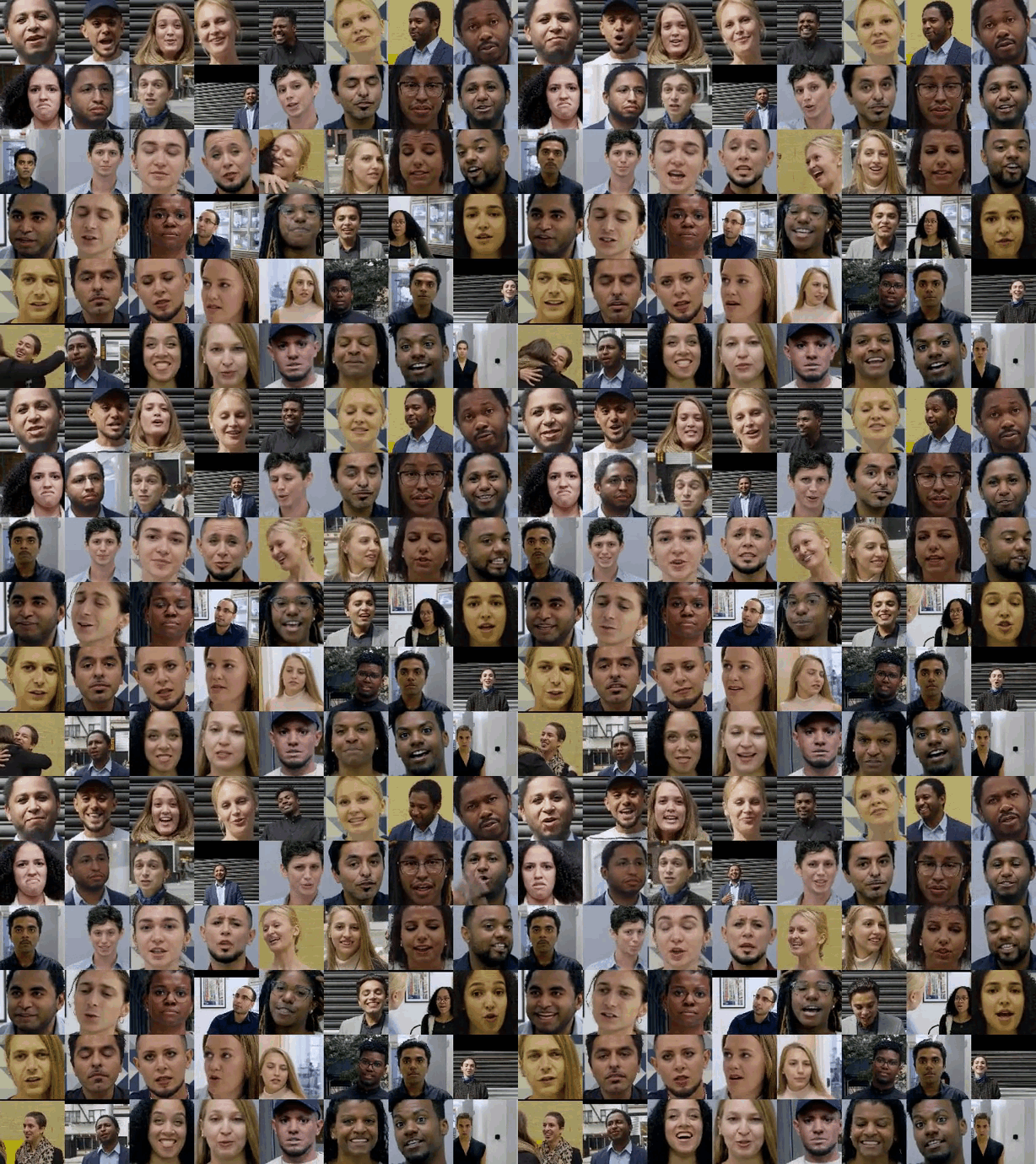
A sample of videos from Google’s contribution to the FaceForensics benchmark. To generate these, pairs of actors were selected randomly and deep neural networks swapped the face of one actor onto the head of another.
To make this dataset, over the past year we worked with paid and consenting actors to record hundreds of videos. Using publicly available deepfake generation methods, we then created thousands of deepfakes from these videos. The resulting videos, real and fake, comprise our contribution, which we created to directly support deepfake detection efforts. As part of the FaceForensics benchmark, this dataset is now available, free to the research community, for use in developing synthetic video detection methods.
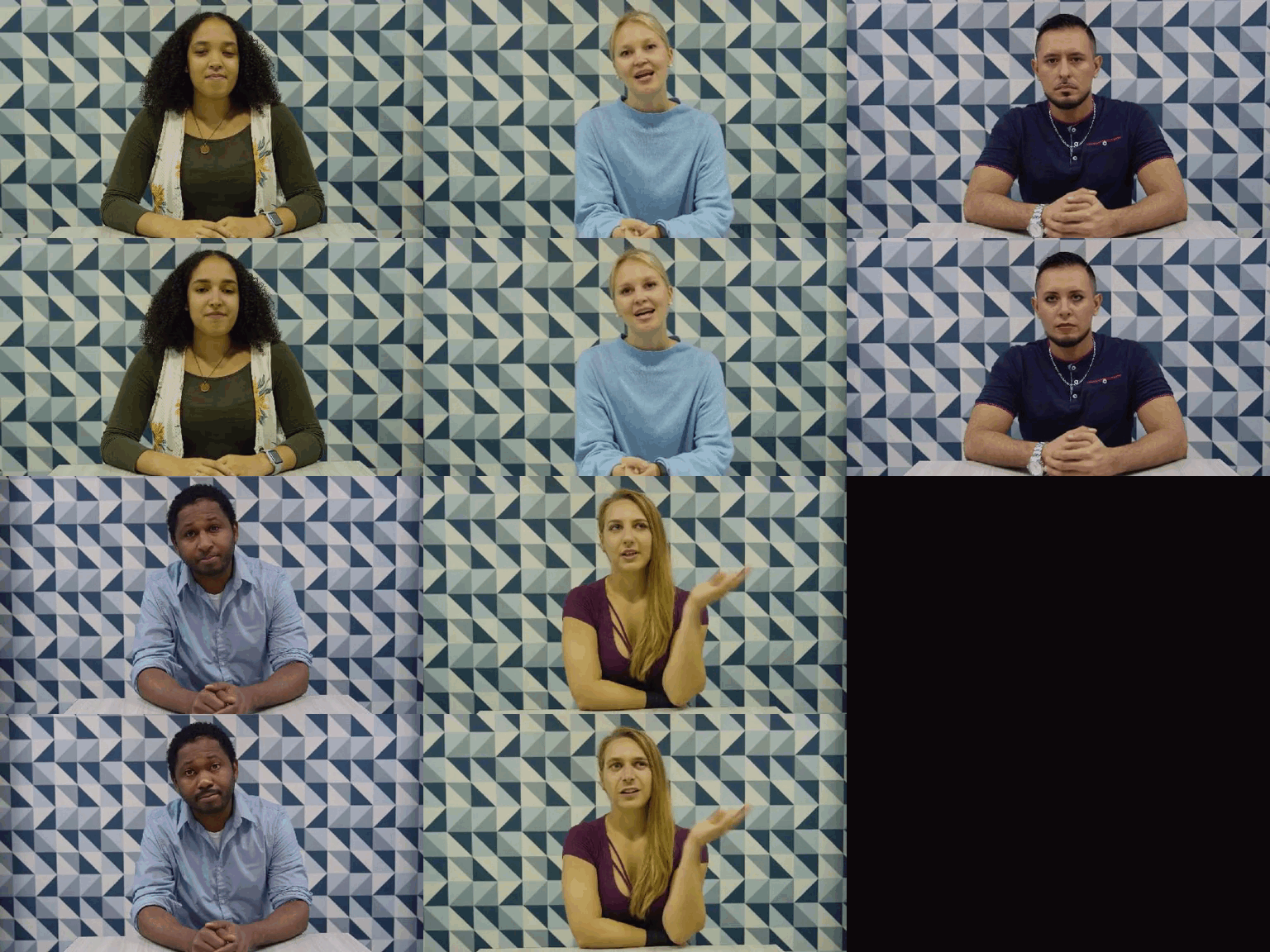
Actors were filmed in a variety of scenes. Some of these actors are pictured here (top) with an example deepfake (bottom), which can be a subtle or drastic change, depending on the other actor used to create them.
Since the field is moving quickly, we’ll add to this dataset as deepfake technology evolves over time, and we’ll continue to work with partners in this space. We firmly believe in supporting a thriving research community around mitigating potential harms from misuses of synthetic media, and today’s release of our deepfake dataset in the FaceForensics benchmark is an important step in that direction.
Acknowledgements Special thanks to all our team members and collaborators who work on this project with us: Daisy Stanton, Per Karlsson, Alexey Victor Vorobyov, Thomas Leung, Jeremiah “Spudde” Childs, Christoph Bregler, Andreas Roessler, Davide Cozzolino, Justus Thies, Luisa Verdoliva, Matthias Niessner, and the hard-working actors and film crew who helped make this dataset possible.
Bananas are the world’s favorite fruit. If you don’t count tomatoes as fruit. (And really, who does?)
But banana crops around the globe are afflicted by diseases and pests that threaten the livelihoods of small-scale farmers, most of whom rely on just one or two cash crops and lack the resources commercial farms use to monitor the health of their plants.
A new AI app aims to help resource-poor farmers more accurately identify and treat banana diseases, improving their crop yields. Called Tumaini, meaning “hope” in Swahili, the app could also give nonprofits and governments more information and tools to control disease outbreaks in bananas and other crops.
Trained using NVIDIA GPU technology, the convolutional neural networks behind Tumaini achieve around 90 percent accuracy in detecting five common banana diseases and one pest.
It’s easy for farmers diagnosing problems in their banana crop to confuse the symptoms of fungal, bacterial and viral diseases. Many cause similar patterns of yellow leaf spots and decay. Misinterpreting the signs can waste precious time and resources.
“Especially in developing countries, smallholder farmers have minimal resources to spend on fertilizer and treatments,” said Michael Selvaraj, who led the project at the International Center for Tropical Agriculture. “If you’re spraying fungicide over plants with a bacterial disease, you’re wasting your money.”
Based in Cali, Colombia, the nonprofit organization is a research center of the international agricultural innovation network CGIAR.
Scientists from the nonprofit Biodiversity International helped the team hand-label a dataset of 20,000 banana plant images collected from banana farms in southern India, Uganda, Burundi, Benin and the Democratic Republic of Congo. The team used field images for training to improve the AI’s ability to read low-quality images with background elements such as neighboring plants or leaves.
Bananas are a challenging crop to analyze for disease, because symptoms can appear in several different parts of the plant — from the fruit down to the trunk, known as the pseudostem.
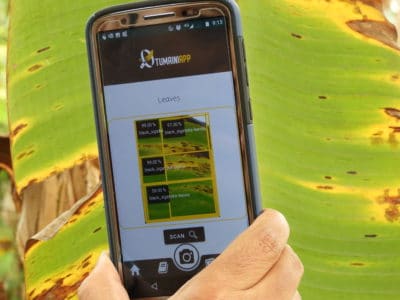
AI Goes Bananas: The Tumaini app analyzes different areas of the banana plant to diagnose crop disease. Image courtesy of the International Center for Tropical Agriculture.
“It may be that the leaf looks very healthy,” Selvaraj said, “but when you cut open the pseudostem you can find the disease.”
The dataset was used to train six different neural networks, each analyzing images from a different part of the banana plant. This way, farmers using the Tumaini app can take pictures of multiple parts of a diseased crop, like the leaf and the fruit, to double-check the results of the AI model.
After identifying the banana disease, Tumaini provides users with treatment guidance. To better serve farmers worldwide, the interface comes in five languages: English, French, Spanish, Swahili and Tamil — with translations in the works for two additional Indian languages, Hindi and Malayalam.
Spotting Banana Disease Early
Left unchecked, crop diseases can spread rapidly through infected tools, soil, water and insects. Some, like the major fungal disease Fusarium wilt, can survive for decades in soil.
Fusarium wilt has been affecting banana crops in Colombia for the last couple years — but at the start, local farmers were misidentifying the disease as viral. The misdiagnosis meant pathologists and government agencies were delayed in spotting the problem, which has since spread widely in the region.
“Monitoring and early detection is very important,” Selvaraj said. The app encourages farmers to geotag their pictures, so that researchers can flag when a disease shows up for the first time in a new area of the world. “If we had the app then, we would have gone earlier and taken some samples to confirm and avoid the outbreak.”
Pictures uploaded to Tumaini are sent to the researchers’ GPU system for inference, which takes just a few seconds depending on the user’s wireless connection. They’re also added to a database so the researchers can track global trends of banana disease.
Selvaraj and his team also plan to collect and analyze aerial images of banana crops captured by drones and the European Space Agency’s SENTINEL satellite program. By combining this remote data with GPS-tagged ground images from farmers using the app, the researchers can develop crop surveillance tools that monitor the global health of banana plants and alert local farming communities about outbreaks.
Deploying the AI tool in a smartphone app allows farmers to diagnose crop diseases in real-time in the field. Image courtesy of the International Center for Tropical Agriculture.
To broaden the scope of Tumaini, the scientists hope to add detection for additional banana diseases as well as other staple crops, like kidney beans. They’re also interested in adding resources and help lines to the app, so farmers can alert local governments about new crop diseases, contact pesticide and fungicide vendors, and learn about sustainable alternatives like biological pest control.
The team is additionally working to make the app available offline, so farmers can analyze crop images in the field, even without an internet connection.
Selvaraj says offline access and a multilingual, user-friendly interface are essential to make the app a viable solution for smallholder banana farmers. He expects demand for the app will grow further as smartphone adoption increases in Africa and India, two of the largest regions for banana production.
“AI in agriculture is still in an infant state,” he said. “We’re working today for an impact over the next 30 years.”
Main image by Wilfredo Rodríguez, licensed from Wikimedia Commons under CC BY-SA 3.0.
so I have a project I need to get done for University, in which I make a program, which skips Iteration steps for the Optimization of Mechanical Structures.
The Mechanical Structure is defined as follows:
You have nodes (in 3-D or 2-D) which are fully connected by beams. The Starting point is, that all beams have the same density and there are Loads, which are on some of the Nodes. Also there is an upper and lower bound for the densities of these beams (which is relevant for the conventional method)
In the Normal Process the density of the beams is tweaked Iteration by Iteration, depending on the different loads on the nodes to make the structure stiffer, also there is a certain volume fraction of the design space, which the sum of the beams has to reach.
Now I need to make a Neural Network which is capable of skipping Iterations, which are computationally expensive and I wanted to ask how I should start it.
The first file I received has 30 Nodes and 373 design variables (beams).
I don’t know what type of network I should use, since I’m not experienced in doing my own projects.
My first ideas were:
Neural network, which takes the beams and the loads (in coordinates) as features encodes them and decodes them.
Same as 1. , but with the nodes as Features
CNN Encoder Decoder Network, with a matrix of NxN, N being the Nodes and the entries in the Matrix being the density of the beams, which connect the nodes, then the other channels are the loads on the node, the colume fraction and maybe the different x,y and for 3-D z values of the node.
The university can generate the data needed for training the Neural Network (Different Loads and all the iterations of the different optimizations) and the target are 3-D structures with thousands of beams. Right now we are starting of easy with 2-D structures, but I don’t know how many beams option 1. and 2. can handle, before dimensionality becomes a problem. Also I don’t know if a CNN can learn from the node matrix.
I’m not a big expert in the field, but I read a lot of material on NNs and ML (e.g. Aurelien Geron Hands on machine learning) and I am eager to make this project work, but I need a little bit of help in starting off, so I would be really grateful, if some of you guys could help me with that 🙂
Siraj has a habit of stealing content and other people’s work. That he is allegedly scamming these students does not surprise me one bit. I hope people in the ML community stop working with him.
Oh no, not when working with us. We literally had an intervention meeting, involving multiple Directors, including myself, to explain to you how non-attribution was bad. Even the Director of Video Production was involved, it was so blatant that non-tech pointed it out.
If I remember correctly, in the same meeting we also had to explain why Pepe memes were not appropriate in an educational context. This was right around the time we told you there was absolutely no way your editing was happening and we required our own team to approve.
And then we also decided, internally, as soon as the contract ended; @MatDrinksTea would be redoing everything.


![[N] Udacity had an interventional meeting with Siraj Raval on content theft for his AI course](https://b.thumbs.redditmedia.com/K0AnZdh6hq6btb2PVPLU6uqGkZy64nY8gDumeP0y47o.jpg "[N] Udacity had an interventional meeting with Siraj Raval on content theft for his AI course")