Blog

Learn About Our Meetup

5000+ Members

MEETUPS

LEARN, CONNECT, SHARE

Join our meetup, learn, connect, share, and get to know your Toronto AI community. 

JOB POSTINGS

INDEED POSTINGS

Browse through the latest deep learning, ai, machine learning postings from Indeed for the GTA.

CONTACT

CONNECT WITH US

Are you looking to sponsor space, be a speaker, or volunteer, feel free to give us a shout.

Category: Global

Managing Amazon Lex session state using APIs on the client

Anyone who has tried building a bot to support interactions knows that managing the conversation flow can be tricky. Real users (people who obviously haven’t rehearsed your script) can digress in the middle of a conversation. They could ask a question related to the current topic or take the conversation in an entirely new direction. Natural conversations are dynamic and often cover multiple topics.

In this post, we review how APIs can be used to manage a conversation flow that contains switching to a new intent or returning to a prior intent. The following screenshot shows an example with a real user and a human customer service agent.

In the example above, the user query regarding the balance (“Wait – What’s the total balance on the card?”) is a digression from the main goal of making a payment. Changing topics comes easy to people. Bots have to store the state of the conversation when the digression occurs, answer the question, and then return to the original intent, reminding the user of what they’re waiting on.

For example, they have to remember that the user wants to make a payment on the card. After they store the data related to making a payment, they switch contexts to pull up the information on the total balance on the same card. After responding to the user, they continue with the payment. Here’s how the conversation can be broken down into two separate parts:

Figure 2: Digress and Resume

For a tastier example, consider how many times you’ve said, “Does that come with fries?” and think about the ensuing conversation.

Now, let’s be clear:  you could detect a digression with a well-constructed bot. You could switch intents on the server-side using Lambda functions, persist conversation state with Amazon ElastiCache or Amazon DynamoDB, or return to the previous intent with pre-filled slots and a new prompt. You could do all of this today. But you’d have to write and manage code for a real bot that does more than just check the weather, which is no easy task. (Not to pick on weather bots here, I find myself going on tangents just to find the right city!)

So, what are you saying?

Starting today, you can build your Amazon Lex bots to address these kinds of digressions and other interesting redirects using the new Session State API. With this API, you can now manage a session with your Amazon Lex bot directly from your client application for granular control over the conversation flow.

To implement the conversation in this post, you would issue a GetSession API call to Amazon Lex to retrieve the intent history for the previous turns in the conversation. Next, you would direct the Dialog Manager to use the correct intent to set the next dialog action using the PutSession operation. This would allow you to manage the dialog state, slot values, and attributes to return the conversation to a previous step.

In the earlier example, when the user queries about the total balance, the client can handle the digression by placing calls to GetSession followed by PutSession to continue the payment. The response from the GetSession operation includes a summary of the state of the last three intents that the user interacted with. This includes the intents MakePayment (accountType: credit, amount: $100), and AccountBalance. The following diagram shows the GetSession retrieval of the intent history.
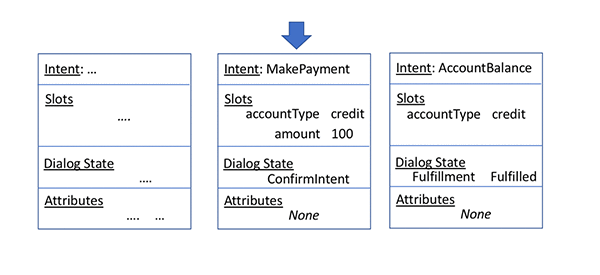
A  GetSession request object in Python contains the following attributes:

response = client.get_session(
 botName='BankBot',
 botAlias='Prod',
 userId='ae2763c4'
)

A GetSession response object in Python contains the following attributes:

{
 'recentIntentSummaryView': [
  {
   'intentName': 'AccountBalance',
   'slots': {
    'accountType': 'credit'
   },
   'confirmationStatus': 'None',
   'dialogActionType': 'Close',
   'fulfillmentState': 'Fulfilled'
  },
  {
   'intentName': 'MakePayment',
   'slots': {
    'accountType': 'credit',
    'amount': '100'
   },
   'confirmationStatus': 'None',
   'dialogActionType': 'ConfirmIntent'
  },
  {
   'intentName': 'Welcome',
   'slots': {},
   'confirmationStatus': 'None',
   'dialogActionType': 'Close',
   'fulfillmentState': 'Fulfilled'
  }
 ],
 'sessionAttributes': {},
 'sessionId': 'XXX',
 'dialogAction': {
  'type': 'Close',
  'intentName': 'AccountBalance',
  'slots': {
   'accountType': 'credit'
   },
  'fulfillmentState': 'Fulfilled'
 }
}

Then, the application selects the previous intent and calls PutSession for MakePayment followed by Delegate. The following diagram shows that PutSession resumes the conversation.

A PutSession request object in Python for the MakePayment intent contains the following attributes:

response = client.put_session(
 botName='BankBot',
 botAlias='Prod',
 userId='ae2763c4',
 dialogAction={
  'type':'ElicitSlot',
  'intentName':'MakePayment',
  'slots': {
   'accountType': 'credit'
  },
  'message': 'Ok, so let’s continue with the payment. How much would you like to pay?',
  'slotToElicit': 'amount',
  'messageFormat': 'PlainText'
 },
 accept = 'text/plain; charset=utf-8'
)

 A PutSession response object in Python contains the following attributes:

{
 'contentType': 'text/plain;charset=utf-8',
 'intentName': 'MakePayment',
 'slots': {
  'amount': None,
  'accountType': 'credit'
 },
 'message': 'Ok, so let’s continue with the payment. How much would you like to pay?',
 'messageFormat': 'PlainText',
 'dialogState': 'ElicitSlot',
 'slotToElicit': 'amount',
 'sessionId': 'XXX'
}

You can also use the Session State API operations to start a conversation. You can have the bot start the conversation. Create a “Welcome” intent with no slots and a response message that greets the user with “Welcome. How may I help you?” Then call the PutSession operation, set the intent to “Welcome” and set the dialog action to Delegate.

A PutSession request object in Python for the “Welcome” intent contains the following attributes:


response = client.put_session(
  botName='BankBot',
  botAlias='Prod',
  userId='ae2763c4',
  dialogAction={
    'type':'Delegate',
    'intentName':'Welcome'
  },
  accept='text/plain; charset=utf-8'
)

A PutSession response object in Python contains the following attributes:

{
 'contentType': 'text/plain;charset=utf-8',
 'intentName': 'Welcome',
 'message': 'Welcome to the Banking bot. How may I help you?',
 'messageFormat': 'PlainText',
 'dialogState': 'Fulfilled',
 'sessionId': 'XXX'
}

Session State API operations are now available using the SDK.

For more information about incorporating these techniques into real bots, see the Amazon Lex documentation and FAQ page. Want to learn more about designing bots using Amazon Lex? See the two-part tutorial, Building Better Bots Using Amazon Lex! Check out the Alexa Design Guide for tips and tricks. Got .NET?  Fret not. We’ve got you covered with Bots Just Got Better with .NET and the AWS Toolkit for Visual Studio.


About the Authors

Minaxi Singla works as a Software Development Engineer in Amazon AI contributing to microservices that enable human-like experience through chatbots. When not working, she can be found reading about software design or poring over Harry Potter series one more time.


Pratik Raichura is a Software Development Engineer with Amazon Lex team. He works on building scalable distributed systems that enhance Lex customer experience. Outside work, he likes to spend time reading books on software architecture and making his home smarter with AI.


Video Understanding Using Temporal Cycle-Consistency Learning

In the last few years there has been great progress in the field of video understanding. For example, supervised learning and powerful deep learning models can be used to classify a number of possible actions in videos, summarizing the entire clip with a single label. However, there exist many scenarios in which we need more than just one label for the entire clip. For example, if a robot is pouring water into a cup, simply recognizing the action of “pouring a liquid” is insufficient to predict when the water will overflow. For that, it is necessary to track frame-by-frame the amount of water in the cup as it is being filled. Similarly, a baseball coach who is comparing stances of pitchers may want to retrieve video frames from the precise moment that the ball leaves the pitchers’ hands. Such applications require models to understand each frame of a video.

However, applying supervised learning to understand each individual frame in a video is expensive, since per-frame labels in videos of the action of interest are needed. This requires that annotators apply fine-grained labels to videos by manually adding unambiguous labels to every frame in each video. Only then can the model be trained, and only on a single action. Training on new actions requires the process to be repeated. With the increasing demand for fine-grained labeling, necessary for applications ranging from robotics to sports analytics, this makes the need for scalable learning algorithms that can understand videos without the tedious labeling process increasingly pertinent.

We propose a potential solution using a self-supervised learning method called Temporal Cycle-Consistency Learning (TCC). This novel approach uses correspondences between examples of similar sequential processes to learn representations particularly well-suited for fine-grained temporal understanding of videos. We are also releasing our TCC codebase to enable end-users to apply our self-supervised learning algorithm to new and novel applications.

Representation Learning Using TCC
A plant growing from a seedling to a tree; the daily routine of getting up, going to work and coming back home; or a person pouring themselves a glass of water are all examples of events that happen in a particular order. Videos capturing such processes provide temporal correspondences across multiple instances of the same process. For example, when pouring a drink one could be reaching for a teapot, a bottle of wine, or a glass of water to pour from. Key moments are common to all pouring videos (e.g., the first touch to the container or the container being lifted from the ground) and exist independent of many varying factors, such as visual changes in viewpoint, scale, container style, or the speed of the event. TCC attempts to find such correspondences across videos of the same action by leveraging the principle of cycle-consistency, which has been applied successfully in many problems in computer vision, to learn useful visual representations by aligning videos.

The objective of this training algorithm is to learn a frame encoder, using any network architecture that processes images, such as ResNet. To do so, we pass all frames of the videos to be aligned through the encoder to produce their corresponding embeddings. We then select two videos for TCC learning, say video 1 (the reference video) and video 2. A reference frame is chosen from video 1 and its nearest neighbor frame (NN2) from video 2 is found in the embedding space (not pixel space). We then cycle back by finding the nearest neighbor of NN2 in video 1, which we call NN1. If the representations are cycle-consistent, then the nearest neighbor frame in video 1 (NN1) should refer back to the starting reference frame.

We train the embedder using the distance between the starting reference frame and NN1 as the training signal. As training proceeds, the embeddings improve and reduce the cycle-consistency loss by developing a semantic understanding of each video frame in the context of the action being performed.

Using TCC, we learn embeddings with temporally fine-grained understanding of an action by aligning related videos.

What Does TCC Learn?
In the following figure, we show a model trained using TCC on videos from the Penn Action Dataset of people performing squat exercises. Each point on the left corresponds to frame embeddings, with the highlighted points tracking the embedding of the current video frame. Notice how the embeddings move collectively in spite of many differences in pose, lighting, body and object type. TCC embeddings encode the different phases of squatting without being provided explicit labels.

Right: Input videos of people performing a squat exercise. The video on the top left is the reference. The other videos show nearest neighbor frames (in the TCC embedding space) from other videos of people doing squats. Left: The corresponding frame embeddings move as the action is performed.

Applications of TCC
The learned per-frame embeddings enable an array of interesting applications:

  • Few-shot action phase classification
    When few labeled videos are available for training, the few-shot scenario, TCC performs very well. In fact, TCC can classify the phases of different actions with as few as a single labeled video. In the next figure we compare to other supervised and self-supervised learning approaches in the few-shot setting. We find that supervised learning requires about 50 videos with each frame labeled to achieve the same accuracy that self-supervised methods achieve with just one fully labeled video.
    Comparison of self-supervised and supervised learning for few-shot action phase classification.
  • Unsupervised video alignment
    Aligning or synchronizing videos manually becomes prohibitively difficult as the number of videos increases. Using TCC, many videos can be aligned by selecting the nearest neighbor to each frame in a reference video, without the need for additional labels, as demonstrated in the figure below.
    Results of unsupervised video alignment on videos of people pitching baseball using the distance between frames in the TCC space. The reference video used for alignment is shown in the upper left panel.
  • Label/modality transfer between videos
    Just as TCC finds similar frames by using a nearest neighbor search in the embedding space, it can transfer metadata associated with any frame in one video to its matching frame in another video. This metadata can be in the form of temporal semantic labels or other modalities, such as sound or text. In the video below we show two examples where we can transfer the sound of liquid being poured into a cup from one video to another.
  • Per-frame Retrieval
    With TCC, each frame in a video can be used as a query for retrieval of similar frames by looking up the nearest neighbors in the learned embedding space. The embeddings are powerful enough to differentiate between frames that look quite similar, such as frames just before or after the release of a bowling ball.
    We can perform retrieval from videos on a per-frame basis, i.e., any frame can be used to look up similar frames in a large collection of videos. The retrieved nearest neighbors show that the model captures fine-grained differences in the scene.

Release
We are releasing our codebase, which includes implementations of a number of state-of-the-art self-supervised learning methods, including TCC. This codebase will be useful for researchers working on video understanding, as well as artists looking to use machine learning to align videos to create mosaics of people, animals, and objects moving synchronously.

Acknowledgements
This is joint work with Yusuf Aytar, Jonathan Tompson, Pierre Sermanet, and Andrew Zisserman. The authors would like to thank Alexandre Passos, Allen Lavoie, Anelia Angelova, Bryan Seybold, Priya Gupta, Relja Arandjelović, Sergio Guadarrama, Sourish Chaudhuri, and Vincent Vanhoucke for their help with this project. The videos used in this project come from the PennAction dataset. We thank the creators of PennAction for curating such an interesting dataset.

Perfect Harmony: Pharma’s MELLODDY Consortium Joins Forces with NVIDIA to Supercharge AI Drug Discovery

Pharmaceutical companies have traditionally kept their data close to the vest because collaboration’s side effects may include compromising intellectual property and losing the edge over competitors.

But sharing data has major perks: The more data a pharma company has at its disposal, the better equipped its researchers are to quickly identify and develop promising new drugs. This can ultimately improve drug candidate success rates and reduce treatment costs.

Bringing a drug to market takes on average 13 years and close to $2 billion, said Hugo Ceulemans, project leader of MELLODDY — a new drug-discovery consortium that hopes to eliminate the tradeoff between data sharing and security.

The project will use cloud-based NVIDIA GPUs and a distributed approach known as federated learning to train AI models on data from multiple pharmaceutical companies while preserving IP.

An acronym for Machine Learning Ledger Orchestration for Drug Discovery, MELLODDY brings together 17 partners: 10 leading pharmaceutical companies, such as Amgen, Bayer, GSK, Janssen Pharmaceutica and Novartis; top European universities KU Leuven and the Budapest University of Technology and Economics; four trailblazing startups; and NVIDIA’s AI computing platform.

Each pharmaceutical partner will use its own cluster of NVIDIA V100 Tensor Core GPUs hosted on Amazon Web Services. MELLODDY developers will create a distributed deep learning model that can travel among these distinct cloud clusters, training on annotated data for an unprecedented 10 million chemical compounds.

Individual pharmaceutical companies will be able to finetune the AI model, tailoring it to their specific field of inquiry. As part of the data security mission of MELLODDY, each organization will keep its research projects confidential.

“We’re looking forward to becoming better at virtualizing drug discovery to bring more efficient, efficacious and safer therapies to patients,” said Ceulemans, scientific director of Discovery Data Sciences at Janssen Pharmaceutica. “When it comes to machine learning and data science, there’s no single industry that can afford to stand on the sidelines.”

Federated Learning: A New Frontier

MELLODDY aims to demonstrate how federated learning techniques could give pharmaceutical partners the best of both worlds: the ability to leverage the world’s largest collaborative drug compound dataset for AI training without sacrificing data privacy.

The $20 million project will run for three years, at which point the consortium will share learnings with the public.

Federated learning is a method of decentralized machine learning in which training data doesn’t have to be pooled into a single aggregating server. Instead, the machine learning model learns from data stored at different geographic locations, ensuring that each pharmaceutical company’s private dataset stays within its own secure infrastructure.

“The data is never put at risk,” said Mathieu Galtier, project coordinator for Owkin, a startup developing MELLODDY’s federated learning system. “The data sits in its own GPU server, while the algorithms travel from one to the other for training.”

Pharmaceutical datasets consist of historical information about different chemical compounds and their attributes. With the versatile MELLODDY federated learning model, each partner will be able to create anonymized queries about specific drug compounds. The query will be sent to each of the organization’s data repositories to identify any potential matches.

MELLODDY will also employ a blockchain ledger system so pharmaceutical partners can maintain visibility and control over the use of their datasets.

By enabling pharmaceutical companies to learn from each other’s findings without providing traditional competitors direct access to proprietary datasets, the consortium aims to improve the predictive performance of AI-based drug discovery. With smarter models comes speedier and cheaper drug development.

The post Perfect Harmony: Pharma’s MELLODDY Consortium Joins Forces with NVIDIA to Supercharge AI Drug Discovery appeared first on The Official NVIDIA Blog.

Perfect Harmony: Pharma’s MELLODY Consortium Joins Forces with NVIDIA to Supercharge AI Drug Discovery

Pharmaceutical companies have traditionally kept their data close to the vest because collaboration’s side effects may include compromising intellectual property and losing the edge over competitors.

But sharing data has major perks: The more data a pharma company has at its disposal, the better equipped its researchers are to quickly identify and develop promising new drugs. This can ultimately improve drug candidate success rates and reduce treatment costs.

Bringing a drug to market takes on average 13 years and close to $2 billion, said Hugo Ceulemans, project leader of MELLODDY — a new drug-discovery consortium that hopes to eliminate the tradeoff between data sharing and security.

The project will use cloud-based NVIDIA GPUs and a distributed approach known as federated learning to train AI models on data from multiple pharmaceutical companies while preserving IP.

An acronym for Machine Learning Ledger Orchestration for Drug Discovery, MELLODDY brings together 17 partners: 10 leading pharmaceutical companies, such as Amgen, Bayer, GSK, Janssen Pharmaceutica and Novartis; top European universities KU Leuven and the Budapest University of Technology and Economics; four trailblazing startups; and NVIDIA’s AI computing platform.

Each pharmaceutical partner will use its own cluster of NVIDIA V100 Tensor Core GPUs hosted on Amazon Web Services. MELLODDY developers will create a distributed deep learning model that can travel among these distinct cloud clusters, training on annotated data for an unprecedented 10 million chemical compounds.

Individual pharmaceutical companies will be able to finetune the AI model, tailoring it to their specific field of inquiry. As part of the data security mission of MELLODDY, each organization will keep its research projects confidential.

“We’re looking forward to becoming better at virtualizing drug discovery to bring more efficient, efficacious and safer therapies to patients,” said Ceulemans, scientific director of Discovery Data Sciences at Janssen Pharmaceutica. “When it comes to machine learning and data science, there’s no single industry that can afford to stand on the sidelines.”

Federated Learning: A New Frontier

MELLODDY aims to demonstrate how federated learning techniques could give pharmaceutical partners the best of both worlds: the ability to leverage the world’s largest collaborative drug compound dataset for AI training without sacrificing data privacy.

The $20 million project will run for three years, at which point the consortium will share learnings with the public.

Federated learning is a method of decentralized machine learning in which training data doesn’t have to be pooled into a single aggregating server. Instead, the machine learning model learns from data stored at different geographic locations, ensuring that each pharmaceutical company’s private dataset stays within its own secure infrastructure.

“The data is never put at risk,” said Mathieu Galtier, project coordinator for Owkin, a startup developing MELLODDY’s federated learning system. “The data sits in its own GPU server, while the algorithms travel from one to the other for training.”

Pharmaceutical datasets consist of historical information about different chemical compounds and their attributes. With the versatile MELLODDY federated learning model, each partner will be able to create anonymized queries about specific drug compounds. The query will be sent to each of the organization’s data repositories to identify any potential matches.

MELLODDY will also employ a blockchain ledger system so pharmaceutical partners can maintain visibility and control over the use of their datasets.

By enabling pharmaceutical companies to learn from each other’s findings without providing traditional competitors direct access to proprietary datasets, the consortium aims to improve the predictive performance of AI-based drug discovery. With smarter models comes speedier and cheaper drug development.

The post Perfect Harmony: Pharma’s MELLODY Consortium Joins Forces with NVIDIA to Supercharge AI Drug Discovery appeared first on The Official NVIDIA Blog.

Adding a data labeling workflow for named entity recognition with Amazon SageMaker Ground Truth

Launched at AWS re:Invent 2018, Amazon SageMaker Ground Truth enables you to efficiently and accurately label the datasets required to train machine learning (ML) systems. Ground Truth provides built-in labeling workflows that take human labelers step-by-step through tasks and provide tools to help them produce good results. Built-in workflows are currently available for object detection, image classification, text classification, and semantic segmentation labeling jobs.

Today, AWS launched support for a new use case: named entity recognition (NER). NER involves sifting through text data to locate noun phrases called named entities, and categorizing each with a label, such as “person,” “organization,” or “brand.” So, in the statement “I recently subscribed to Amazon Prime,” “Amazon Prime” would be the named entity and could be categorized as a “brand.”

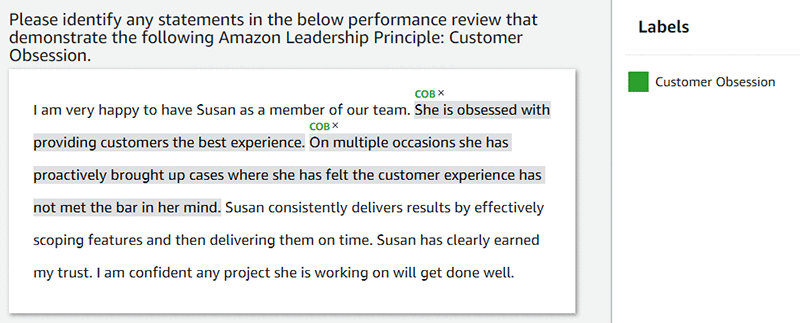
You can broaden this use case to label longer spans of text and categorize those sequences with any pre-specified labels. For example, the following screenshot identifies spans of text in a performance review that demonstrate the Amazon leadership principle “Customer Obsession.”

Overview

In this post, I walk you through the creation of a NER labeling job:

  1. Gather a dataset.
  2. Create the labeling job.
  3. Select a workforce.
  4. Create task instructions.

For this exercise, your NER labeling task is to identify brand names from a dataset. I have provided a sample dataset of ten tweets from the Amazon Twitter account. Alternatively, feel free to bring your own dataset, and define a specific NER labeling task that is relevant to your use case.

Prerequisites

To follow the steps outlined in this post, you need an AWS account and access to AWS services.

Step 1: Gather your dataset and store data in Amazon S3

Gather the dataset to label, save it to a text file, and upload the file to Amazon S3. For example, I gathered 10 tweets, saved them to a text file with one tweet per return-separated line, and uploaded the text file to an S3 bucket called “ner-blog.” For your reference, the following box contains the uploaded tweets from the text file.

Don’t miss the 200th episode of Today’s Deals Live TODAY! Tune in to watch our favorite moments and celebrate our 200th episode milestone! #AmazonLive (link: https://amzn.to/2JQ2vDm) amzn.to/2JQ2vDm
It's the thought that counts, but our Online Returns Center makes gift exchanges and returns simple (just in case!) https: (link: https://amzn.to/2l6qYKG) amzn.to/2l6qYKG
Did you know you can trade in select Apple, Samsung, and other tablets? With the Amazon Trade-in program, you can receive an Amazon Gift Card + 25% off toward a new Fire tablet when you trade in your used tablets. (link: https://amzn.to/2Ybdu1Y) amzn.to/2Ybdu1Y
Thank you, Prime members, for making this #PrimeDay the largest shopping event in our history! You purchased more than 175 million items, from devices to groceries!
Hip hip for our Belei charcoal mask! This staple in our skincare line is a @SELFMagazine 2019 Healthy Beauty Award winner.
Looking to take your photography skills to the next level? Check out (link: http://amazon.com/primeday) amazon.com/primeday for an amazing camera deal.
Is a TV on your #PrimeDay wish list? Keep your eyes on (link: http://amazon.com/primeday) amazon.com/primeday for a TV deal soon.
Improve your musical talents by staying in tune on (link: http://amazon.com/primeday) amazon.com/primeday for an acoustic guitar deal launching soon.
.@LadyGaga’s new makeup line, @HausLabs, is available now for pre-order! #PrimeDay (link: http://amazon.com/hauslabs) amazon.com/hauslabs
#PrimeDay ends tonight, but the parade of deals is still going strong. Get these deals while they’re still hot! (link: https://amzn.to/2lgqZM3) amzn.to/2lgqZM3

Step 2: Create a labeling job

  1. In the Amazon SageMaker console, choose Labeling jobs, Create labeling job.
  2. To set up the input dataset location, choose Create manifest file.
  3. Point to the S3 location of the text file that you uploaded in Step 1, and select Text, Create.
  4. After the creation process finishes, choose Use this manifest, and complete the following fields:
    • Job name—Custom value.
    • Input dataset location—S3 location of the text file to label. (The previous step should have populated this field.)
    • Output dataset location—S3 location to which Amazon SageMaker sends labels and job metadata.
    • IAM Role—A role that has read and write permissions for this task’s Input dataset and Output dataset locations in S3.
  5. Under Task type, for Task Category, choose Text.
  6. For Task selection, select Named entity recognition.

Step 3: Selecting a labeling workforce

The Workers interface offers three Worker types:

The console includes other Workers settings, including Price per task and the optional Number of workers per dataset.

For this demo, use Public. Set Price per task at $0.024. Mechanical Turk workers should complete the relatively straightforward task of identifying brands in a tweet in 5–7 seconds.

Use the default value for Number of workers per dataset object (in this case, a single tweet), which is 3. SageMaker Ground Truth asks three workers to label each tweet and then consolidates those three workers’ responses into one high-fidelity label. To learn more about consolidation approaches, see Annotation Consolidation.

Step 4: Creating the labeling task instructions

While critically important, effective labeling instructions often require significant iteration and experimentation. To learn about best practices for creating high-quality instructions, see Create high-quality instructions for Amazon SageMaker Ground Truth labeling jobs. Our exercise focuses on identifying brand names in tweets. If there are no brand names in a specific tweet, the labeler has the option of indicating there are no brands in the tweet.

An example of labeling instructions is shown on the following screenshot.

Conclusion

In this post, I introduced Amazon SageMaker Ground Truth data labeling. I showed you how to gather a dataset, create a NER labeling job, select a workforce, create instructions, and launch the job. This is a small labeling job with only 10 tweets and should be completed within one hour by Mechanical Turk workers. Visit the AWS Management Console to get started.

As always, AWS welcomes feedback. Please submit comments or questions below.


About the Author

Vikram Madan is the Product Manager for Amazon SageMaker Ground Truth. He focusing on delivering products that make it easier to build machine learning solutions. In his spare time, he enjoys running long distances and watching documentaries.


Forget Storming Area 51, AI’s Helping Astronomers Scour the Skies for Habitable Planets

Imagine staring into the high-beams of an oncoming car. Now imagine trying to pick out a speck of dust in the glare of the headlights.

That’s the challenge Olivier Guyon and Damien Gratadour face as they try to find the dull glint of an exoplanet — a planet orbiting a star outside our solar system — beside the bright light of its star.

The pair — Guyon is an instrument developer for Japan’s Subaru Telescope and an astronomer at the University of Arizona, and Gratadour is an associate professor at the Observatoire de Paris and an instrument scientist at the Australian National University — spoke with AI Podcast host Noah Kravitz about how they’re using GPU-powered extreme adaptive optics in very large telescopes to image nearby habitable planets.

Sighting an exoplanet is difficult because its light is “millions or a billion times fainter than the star around which it orbits,” according to Guyon.

Then comes the issue of the Earth’s atmosphere. The telescopes that Guyon and Gratadour work with are based on the ground. So their images experience atmospheric turbulence. The effect, Gratadour explains, is “similar to what you see above a hot road during the summer.”

Adaptive optics algorithms — accelerated by GPUs — can correct for this turbulence by using high performance computing, sharpening an image in real time. These corrections occur through a mechanical process called compensation, in which a deformable mirror behind the focus of the telescope is adjusted every millisecond. The result is a near-perfect image.

Astronomers can use this image to separate the faint light of an exoplanet from its star. Then, they can take a spectrum, or a graph of the different colors of light coming from the planet. Spectra can reveal the planet’s composition along with the presence of “water, methane and even plant life,” according to Guyon.

Guyon works on the Subaru Telescope in Japan, but this process is occurring at several very large telescopes. “Multiple teams are essentially racing,” he says. “We are all extremely impatient, because we know the planets are out there and we want to be able to image it.”

Gratadour is working on the next generation of telescopes, which should be ready for use in 2025. Today’s very large telescopes are 8 to 10 meters in length. The next generation of telescopes will be 4 to 5x as large, and will produce 25x as much computing power as their predecessors.

Temperate exoplanets bring up the possibility of extraterrestrial life. Asked about the existence of aliens, Guyon and Gratadour say there’s almost certainly life beyond our planet. The real questions to ask, Guyon says: “How frequent is it? How frequently does it evolve from bacteria or very simple forms of life to things that are much more complex like us? What does it become?”

To learn more about the work of scientists like Guyon and Gratadour, check out the websites of very large telescopes like the Subaru and Gemini.

Help Make the AI Podcast Better

Have a few minutes to spare? Fill out this short listener survey. Your answers will help us make a better podcast.

How to Tune in to the AI Podcast

Get the AI Podcast through iTunes, Castbox, DoggCatcher, Overcast, PlayerFM, Podbay, PodBean, Pocket Casts, PodCruncher, PodKicker, Stitcher, Soundcloud and TuneIn. Your favorite not listed here? Email us at aipodcast [at] nvidia [dot] com.

Featured image credit: NASA/JPL-Caltech

The post Forget Storming Area 51, AI’s Helping Astronomers Scour the Skies for Habitable Planets appeared first on The Official NVIDIA Blog.