Blog

Learn About Our Meetup

5000+ Members

MEETUPS

LEARN, CONNECT, SHARE

Join our meetup, learn, connect, share, and get to know your Toronto AI community. 

JOB POSTINGS

INDEED POSTINGS

Browse through the latest deep learning, ai, machine learning postings from Indeed for the GTA.

CONTACT

CONNECT WITH US

Are you looking to sponsor space, be a speaker, or volunteer, feel free to give us a shout.

Author: torontoai

[D] Over/Under/SMOTE sampling for EXTREMELY imbalanced data without getting data?

I am working on a case study where they gave me 3 text, 2 categorical, 1 numerical features to classify 6 classes.

However, the data is very imbalanced. Its splits like this:

Case_1: 5215/5899 = 88.4%

Case_2: 631/5899 = 10.7%

Case_3: 23/5899 = 0.39%

Case_4: 16/5899 = 0.27%

Case_5: 2/5899 = 0.03%

Case_6: 12/5899 = 0.2%

and Case_5 comes to only 1 observation after splitting data to training.

To me, it seems like over sampling minorities might result in serious overfitting. Undersampling from 5215 might result in some serious data loss. I don’t know what to do. I did do the bias to weights to log reg, but only got decent results:

normalized confusion matrix (True Positive percents):

Category_1: 96% which is 1.08 times better

Category_2: 86% which is 8.03 times better

Category_3: 100% which is 256 times better

Category_4: 80% 296 times better

Category_5: 0% since it was only 1 example in test data

Category_6: 75% which is 375 times better

submitted by /u/dattud
[link] [comments]

RecSim: A Configurable Simulation Platform for Recommender Systems

Significant advances in machine learning, speech recognition, and language technologies are rapidly transforming the way in which recommender systems engage with users. As a result, collaborative interactive recommenders (CIRs) recommender systems that engage in a deliberate sequence of interactions with a user to best meet that user’s needs have emerged as a tangible goal for online services.

Despite this, the deployment of CIRs has been limited by challenges in developing algorithms and models that reflect the qualitative characteristics of sequential user interaction. Reinforcement learning (RL) is the de facto standard ML approach for addressing sequential decision problems, and as such is a natural paradigm for modeling and optimizing sequential interaction in recommender systems. However, it remains under-investigated and under-utilized for use in CIRs in both research and practice. One major impediment is the lack of general-purpose simulation platforms for sequential recommender settings, whereas simulation has been one of the primary means for developing and evaluating RL algorithms in real-world applications like robotics.

To address this, we have developed RᴇᴄSɪᴍ (available here), a configurable platform for authoring simulation environments to facilitate the study of RL algorithms in recommender systems (and CIRs in particular). RᴇᴄSɪᴍ allows both researchers and practitioners to test the limits of existing RL methods in synthetic recommender settings. RecSim’s aim is to support simulations that mirror specific aspects of user behavior found in real recommender systems and serve as a controlled environment for developing, evaluating and comparing recommender models and algorithms, especially RL systems designed for sequential user-system interaction.

As an open-source platform, RᴇᴄSɪᴍ: (i) facilitates research at the intersection of RL and recommender systems; (ii) encourages reproducibility and model-sharing; (iii) aids the recommender-systems practitioner, interested in applying RL to rapidly test and refine models and algorithms in simulation, before incurring the potential cost (e.g., time, user impact) of live experiments; and (iv) serves as a resource for academic-industry collaboration through the release of “realistic” stylized models of user behavior without revealing user data or sensitive industry strategies.

Reinforcement Learning and Recommendation Systems
One challenge in applying RL to recommenders is that most recommender research is developed and evaluated using static datasets that do not reflect the sequential, repeated interaction a recommender has with its users. Even those with temporal extent, such as MovieLens 1M, do not (easily) support predictions about the long-term performance of novel recommender policies that differ significantly from those used to collect the data, as many of the factors that impact user choice are not recorded within the data. This makes the evaluation of even basic RL algorithms very difficult, especially when it comes to reasoning about the long-term consequences of some new recommendation policy — research shows changes in policy can have long-term, cumulative impact on user behavior. The ability to model such user behaviors in a simulated environment, and devise and test new recommendation algorithms, including those using RL, can greatly accelerate the research and development cycle for such problems.

Overview of RᴇᴄSɪᴍ
RᴇᴄSɪᴍ simulates a recommender agent’s interaction with an environment consisting of a user model, a document model and a user choice model. The agent interacts with the environment by recommending sets or lists of documents (known as slates) to users, and has access to observable features of simulated individual users and documents to make recommendations. The user model samples users from a distribution over (configurable) user features (e.g., latent features, like interests or satisfaction; observable features, like user demographic; and behavioral features, such as visit frequency or time budget). The document model samples items from a prior distribution over document features, both latent (e.g., quality) and observable (e.g., length, popularity). This prior, as all other components of RᴇᴄSɪᴍ, can be specified by the simulation developer, possibly informed (or learned) from application data.

The level of observability for both user and document features is customizable. When the agent recommends documents to a user, the response is determined by a user-choice model, which can access observable document features and all user features. Other aspects of a user’s response (e.g., time spent engaging with the recommendation) can depend on latent document features, such as document topic or quality. Once a document is consumed, the user state undergoes a transition through a configurable user transition model, since user satisfaction or interests might change.

We note that RᴇᴄSɪᴍ provides the ability to easily author specific aspects of user behavior of interest to the researcher or practitioner, while ignoring others. This can provide the critical ability to focus on modeling and algorithmic techniques designed for novel phenomena of interest (as we illustrate in two applications below). This type of abstraction is often critical to scientific modeling. Consequently, high-fidelity simulation of all elements of user behavior is not an explicit goal of RᴇᴄSɪᴍ. That said, we expect that it may also serve as a platform that supports “sim-to-real” transfer in certain cases (see below).
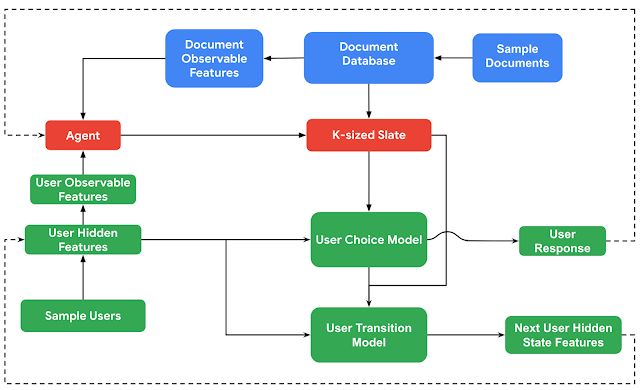
Data Flow through components of RᴇᴄSɪᴍ. Colors represent different model components — user and user-choice models (green), document model (blue), and the recommender agent (red).

Applications
We have used RᴇᴄSɪᴍ to investigate several key research problems that arise in the use of RL in recommender systems. For example, slate recommendations can result in RL problems, since the parameter space for action grows exponentially with slate size, posing challenges for exploration, generalization and action optimization. We used RᴇᴄSɪᴍ to develop a novel decomposition technique that exploits simple, widely applicable assumptions about user choice behavior to tractably compute Q-values of entire recommendation slates. In particular, RᴇᴄSɪᴍ was used to test a number of experimental hypotheses, such as algorithm performance and robustness to different assumptions about user behavior.

Future Work
While RᴇᴄSɪᴍ provides ample opportunity for researchers and practitioners to probe and question assumptions made by RL/recommender algorithms in stylized environments, we are developing several important extensions. These include: (i) methodologies to fit stylized user models to usage logs to partially address the “sim-to-real” gap; (ii) the development of natural APIs using TensorFlow’s probabilistic APIs to facilitate model specification and learning, as well as scaling up simulation and inference algorithms using accelerators and distributed execution; and (iii) the extension to full-factor, mixed-mode interaction models that will be the hallmark of modern CIRs — e.g., language-based dialogue, preference elicitation, explanations, etc.

Our hope is that RᴇᴄSɪᴍ will serve as a valuable resource that bridges the gap between recommender systems and RL research — the use cases above are examples of how it can be used in this fashion. We also plan to pursue it as a platform to support academic-industry collaborations, through the sharing of stylized models of user behavior that, at suitable levels of abstraction, reflect a degree of realism that can drive useful model and algorithm development.

Further details of the RᴇᴄSɪᴍ framework can be found in the white paper, while code and colabs/tutorials are available here.

Acknowledgements
We thank our collaborators and early adopters of RᴇᴄSɪᴍ, including the other members of the RᴇᴄSɪᴍ team: Eugene Ie, Vihan Jain, Sanmit Narvekar, Jing Wang, Rui Wu and Craig Boutilier.

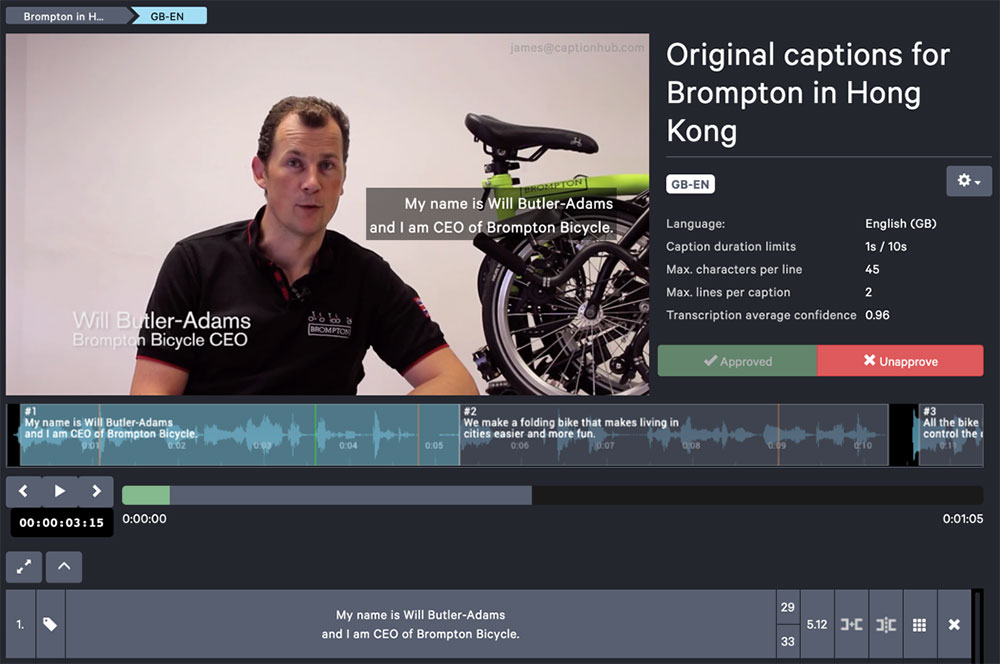
Subtitling videos accurately and easily with CaptionHub and AWS

This is a guest post from James Jameson, the Commercial Lead at CaptionHub. CaptionHub is a London-based company that focuses on video captioning and subtitling production for enterprise organizations.

While the act of captioning—that is, taking video files and making sure the text on the screen reflects what’s being said accurately and is timed appropriately—seems simple at the outset, there is more complexity than meets the eye.

When we embarked on building CaptionHub in 2015, we were a design agency producing video effects and commercials for clients, including a massive tech company in California. They wanted us to localize their video—to their high standards, of course—and do it on the tight schedule of a global consumer tech release.

To meet our client’s needs, we found ourselves building a new software tool to manage linguists, provide collaborative subtitling, and make subtitles frame-accurate. To speed up the process, we then added AI called Natural Captions Technology, an algorithmic approach to natural language processing that reflects the natural language of humans.

From this starting point, we recognized the ubiquitous needs for a solution like what we had created. We broadened the types of media we handled from simply marketing or internal communications assets to high-value global output ready for any viewer or listener worldwide.

With CaptionHub today, we take recorded video and create perfect subtitles, fast. We generate subtitles using automatic speech recognition to massively speed up the first cut. Then, we make sure that subtitles are timed perfectly (“frame-accurate,” in our lingo), on the belief that subtitling should be a seamless part of the production workflow. We also provide automated and human-enabled translation to localize video for any audience. Now, with the help of AWS, we can do that for live video streams and on-demand video.

With AWS, we can provide an enterprise localization platform for the most demanding of our clients, regardless of their use case. AWS technology spans our servers and low-level infrastructure decisions up to the engines we choose for speech recognition, machine translation, and the sharp-end value points that delight our customers.

On the artificial intelligence and machine learning side, we use Amazon Translate and Amazon Transcribe for smooth, real-time captioning across dozens of languages. AWS has been a crucial inspiration for our newest offerings.

We use a variety of other AWS services that are critical to our infrastructure and application architecture. AWS Elemental MediaPackage handles output streams from CaptionHub live, combining captions and video/audio, while AWS Elemental MediaLive handles the input streams for CaptionHub live. While all of this is orchestrated in perfect harmony, we use Amazon CloudWatch to monitor our AWS infrastructure.

With this AWS-based setup, we’re unstoppable. We’re able to scale up and down however and whenever we need to. AWS has allowed us to vastly accelerate our mission to help organizations localize their media.

Our customers have reported huge savings in workflow time, up to an 800% increase in production for captions and subtitles using automatic speech recognition, which takes advantage of the same tech behind Alexa. That amounts to a significant financial return, even for the world’s largest and best-funded production and marketing departments.

We live in a world that communicates with video. When our clients’ production values, combined with their potential to reach audiences, quite literally define their brand, it’s no wonder they want to maintain that winning edge. With CaptionHub’s captioning solutions, made possible by AWS, we can ensure that organizations reach audiences in their language, quickly and perfectly, on any device, wherever they are.

[D] Michael Kearns: Algorithmic Fairness, Bias, Privacy, and Ethics in Machine Learning | Artificial Intelligence Podcast

[D] Michael Kearns: Algorithmic Fairness, Bias, Privacy, and Ethics in Machine Learning | Artificial Intelligence Podcast

Michael Kearns is a professor at University of Pennsylvania and a co-author of the new book Ethical Algorithm that is the focus of much of our conversation, including algorithmic fairness, bias, privacy, and ethics in general. But, that is just one of many fields that Michael is a world-class researcher in, some of which we touch on quickly including learning theory or theoretical foundations of machine learning, game theory, algorithmic trading, quantitative finance, computational social science, and more.

Video: https://www.youtube.com/watch?v=AzdxbzHtjgs
Audio: https://lexfridman.com/michael-kearns

Outline:
(click on the timestamp to jump to that part of the video)

0:00 – Introduction
2:45 – Influence from literature and journalism
7:39 – Are most people good?
13:05 – Ethical algorithm
24:28 – Algorithmic fairness of groups vs individuals
33:36 – Fairness tradeoffs
46:29 – Facebook, social networks, and algorithmic ethics
58:05 – Machine learning
59:19 – Algorithm that determines what is fair
1:01:25 – Computer scientists should think about ethics
1:05:59 – Algorithmic privacy
1:11:50 – Differential privacy
1:19:10 – Privacy by misinformation
1:22:31 – Privacy of data in society
1:27:49 – Game theory
1:29:40 – Nash equilibrium
1:30:35 – Machine learning and game theory
1:34:52 – Mutual assured destruction
1:36:56 – Algorithmic trading
1:44:09 – Pivotal moment in graduate school

https://preview.redd.it/auuvygjlooz31.png?width=1280&format=png&auto=webp&s=5001b4f3493cb4aae67caa484fe32b4db0bde477

submitted by /u/UltraMarathonMan
[link] [comments]

[D] Which ML task(s) would you use to solve this problem?

Hi, I wanted to work with machine learning as a project task and I was able to get my hands on a real problem. As I’m still testing the waters with machine learning, I would like to get input of the experienced community here.

Someone used a drone to gather flight data, their overall goal is to find out what influences the network quality so that they can predict it in unknown territory.

I have flight data (time/coordinates,cell tower, network quality) for the territory A, however territory A is only a very small part of the overall territory.

So I have to predict the network quality of untested territories, with the help of the exisitng data. Fun!

So much about the problem, what I was trying to learn over the last week is what kind of machine learning task I could use for this.

It seems to me that I would need a supervised regression task. Am I correct in that assumption? Am I thinking to simple?

Thanks for any and all input.

submitted by /u/Falkenauge
[link] [comments]

[D] what are the current production and SOTA algorithms behind chatbots?

In many companies today there are talks about using chatbots, often that means using an existing framework. But what are the current parts and their algorithms that are used in those systems.

Intent detection and NER are the ones I am familiar with.

What are examples of common algorithms/papers used in production? What are the SOTA alternatives?

What else is part of the commercial chatbot pipelines besides intent and NER?

submitted by /u/mesmer_adama
[link] [comments]

[D] What is the state-of-the-art implementation for style transfer?

[D] What is the state-of-the-art implementation for style transfer?

Hello,

I’m having a hard time finding an implementation of style transfer that would work as well as an example like this :

Style transfer that works well

See how the details of the wave are well transferred to the hair and beard? I’m looking for an implementation of style transfer that is able to do this type of detail.

I have not been lucky in finding a style transfer algorithm that works like this. For instance a well cited paper like AdaIn style transfer typically yields something like this (see github implementation):

Style transfer that does not work that well

What I’m not looking for is this type of style transfer that only changes the colors and roughly the shapes of the image content. But in the end we cannot really find the “identity” of the style image (pencil drawing).

I suspect that the first image with pewdiepie might have used photoshop in some ways… But if you guys think it’s possible to have this type of output using only style transfer I would really like a bit of help here. Thanks!

submitted by /u/DependentSky6
[link] [comments]