Blog

Learn About Our Meetup

5000+ Members

MEETUPS

LEARN, CONNECT, SHARE

Join our meetup, learn, connect, share, and get to know your Toronto AI community. 

JOB POSTINGS

INDEED POSTINGS

Browse through the latest deep learning, ai, machine learning postings from Indeed for the GTA.

CONTACT

CONNECT WITH US

Are you looking to sponsor space, be a speaker, or volunteer, feel free to give us a shout.

Author: torontoai

[D] Keeping track of latest research

How do you monitor the progress made in your subfields of interest? I’m still studying and I’m not yet a researcher; my only experience was with Arxiv and I had a couple of problems: and there are a couple but when I delved deeper in Adversarial ML for a project I noticed two problems:

  1. There’s no notification system. I’d like to know when a new interesting paper get publish in the field I’m interested in but, at least on Arxiv, there’s no option for that.

  2. I’m not sure if that’s an issue with the field I was studying at the time (Adversarial ML) or if it’s a general issues but I happened to read papers of researchers claiming great descoveries for later being discredited by established authors. That was quite disappointing other than a waste of time.

Are those common problem? How do you keep yourself updated?

I found a partial solution in using twitter lists to group famous researchers and look at what they post but it’s not really optimal.

submitted by /u/Viecce
[link] [comments]

Food’s Flying Off the Shelves: Focal Systems Brings AI to Grocery Stores

We’ve all chosen the self-checkout stand over the human cashier, thinking it’ll take less time.

But somehow, things take a terrible turn. The barcodes aren’t scanning, there’s a pop-up scolding you for not placing the product in the bagging area (though you did, of course), and an employee is coming over to fix the chaos.

It would’ve taken less time to go to the cashier.

Focal Systems is applying deep learning and computer vision to automate portions of retail stores to streamline operations and get customers in and out more efficiently, without the pitfalls of the traditional self-checkout.

CEO Francois Chaubard sat down with AI Podcast host Noah Kravitz to talk about how the company is changing retailers.

As labor costs increase, the traditional solution is twofold: automation and human staff reduction. But Chaubard explains that self-checkout systems don’t actually compensate for fewer employees. Instead, “you get more out-of-stocks, because you’ve got less people,” he says.

Focal Systems started by applying AI to a different area of the store: shelves. Chaubard notes that, for store employees, one of the first tasks every day is checking what items are out of stock, and “knowing that answer takes about four hours a day.”

To prevent this, Focal Systems installs small, inexpensive cameras throughout the store, with a focus on high-moving areas like the soda aisle. The cameras “take an image once every half hour” and produce a chart that notes either “in” or “out.”

“Every single hour that you don’t have a product on the shelf is lost sales,” Chaubard emphasizes. This aspect of Focal Systems alerts employees that they need to restock, and helps identify common “out-of-stock hours” so that stores can recognize the pattern and avoid it altogether.

This shelf camera system is already in 11 major retailers across the world.

The other component to Focal Systems is the Focal Scan. While barcode scanning takes three seconds an item, on average, Focal Systems installs a camera on top of the conveyor belt. “You’re just using deep learning and computer vision to detect amongst a hundred thousand different SKUs in 0.1 seconds with 99.9 percent precision recall,” Chaubard explains.

The cashier can just focus on bagging, reducing the total time of the transaction by 60 percent.

Chaubard thinks that the future holds even more automation, but only where it would be cheaper than human labor. “People are hard to beat in certain tasks,” he laughs.

Visit Focal Systems’ website for more information and to find videos of their technology in action.

Help Make the AI Podcast Better

Have a few minutes to spare? Fill out this short listener survey. Your answers will help us make a better podcast.

How to Tune in to the AI Podcast

Get the AI Podcast through iTunesCastbox, DoggCatcher, Overcast, PlayerFM, Podbay, PodBean, Pocket Casts, PodCruncher, PodKicker, Stitcher, Soundcloud and TuneIn. Your favorite not listed here? Email us at aipodcast [at] nvidia [dot] com.

The post Food’s Flying Off the Shelves: Focal Systems Brings AI to Grocery Stores appeared first on The Official NVIDIA Blog.
Artist’s NVIDIA-Powered AI Images of New York City Blanket Manhattan Landmark

NVIDIA-developed AI — and NVIDIA GPUs — plays a starring role in the opening this month in New York City of a permanent venue for new media art.

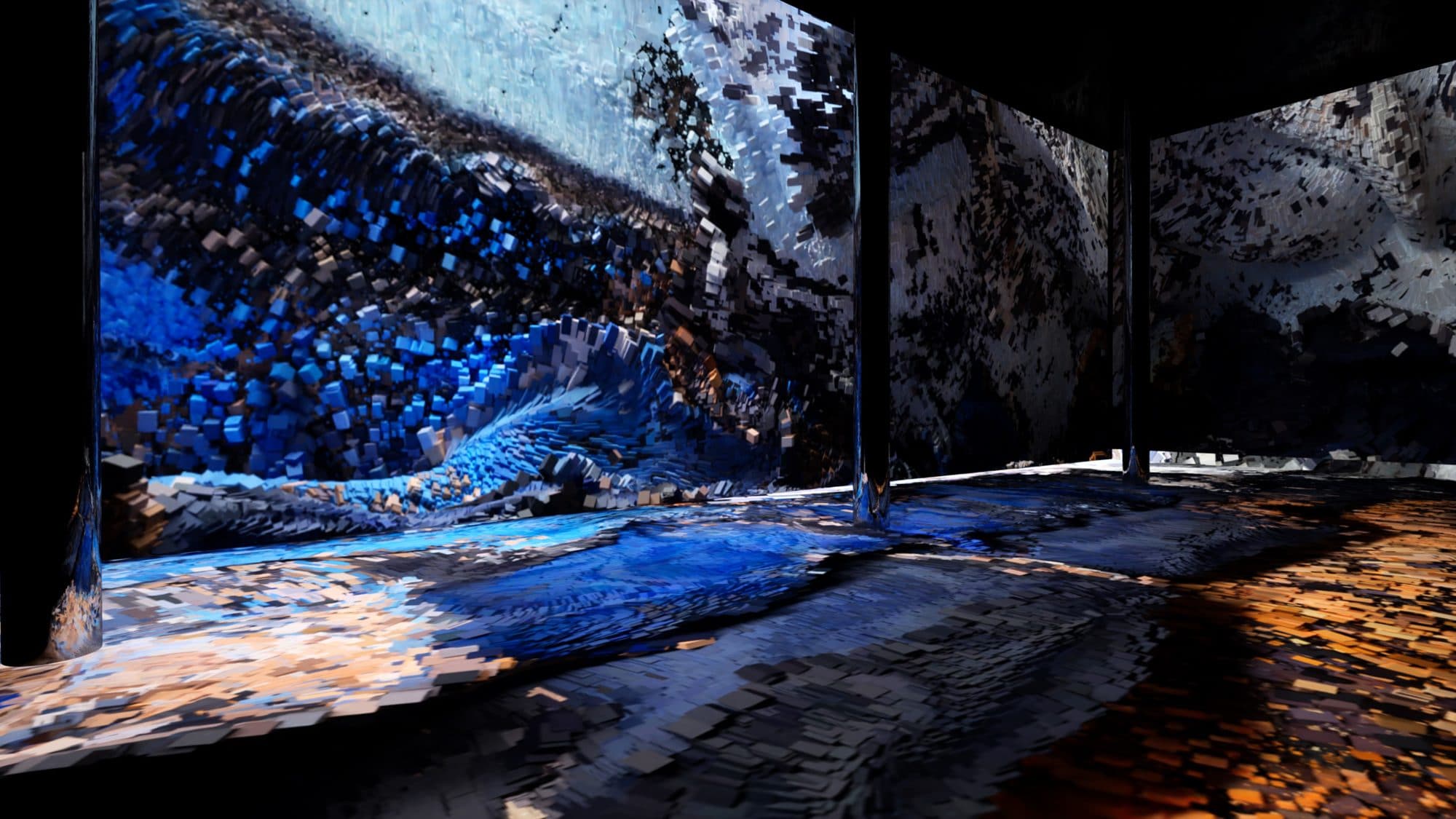
“Machine Hallucination” made its debut this month in the 6,000-square-foot Chelsea Market boiler room — an expansive space beneath the Manhattan landmark’s main concourse.

Created by Turkish media artist and director Refik Anadol and his studio, the installation uses six custom media servers powered by NVIDIA Quadro GPUs.

“People have never seen something like this before. It’s not  hyperbole to say it’s the future of cinema,” said Anadol.

These servers — paired with 18 4K projectors — splash stunning digital images based on some of New York’s most iconic architecture across the cavernous space’s brick walls and terracotta ceiling.  

The story behind the immersive spectacle involves even more NVIDIA technology.

Starting with more than 110 million images of New York — collected, prepared and sorted by an NVIDIA DGX Station — Anadol modified an NVIDIA-developed deep learning algorithm known as a StyleGAN.

“We wrote a latent space browser, a custom program to work with StyleGAN that has the capacity to animate every layer of the neural network and be able to choose latent coordinates to narrate our AI. Basically, we put a camera inside StyleGAN and allowed us to navigate latent space purposefully,” he said.

The exhibit — the inaugural exhibition for ARCTECHOUSE in New York — runs through Nov. 17. Admission is $24..

The post Artist’s NVIDIA-Powered AI Images of New York City Blanket Manhattan Landmark appeared first on The Official NVIDIA Blog.

[D] Instance weighting with soft labels.

Suppose you are given training instances with soft labels. I.e., your training instances are of the form (x,y,p), where x ins the input, y is the class and p is the probability that x is of class y.

Some classifiers allow you to specify an instance weight for each example in the training set. The idea is that a misprediction for a particular example is penalized proportionality to its weight, so instances with high weight are more important to get right and instances with a low weight are less important.

When examples are of the form (x,y,p), it’s clear that the class probabilities could be used as instance weights. A simple way to do this is to weight the loss for each instance by its probability, as suggested here:

https://stats.stackexchange.com/questions/277435/how-can-i-integrate-confidence-of-class-labels-into-my-classifier

Does anyone know of a paper/book where this simple weighting approach is discussed? I can’t find references on this simple idea.

submitted by /u/ockidocki
[link] [comments]

[P] LatentPainter. Paint with ideas instead of pixels!

Hey guys! Here’s a fun tool I hacked together by abusing spatialized adaptive instance normalization. You paint directly with the latent Z into different layers of the network (basically StyleGAN with some model surgery). The results are pretty cool! : link to the video

Have a lot of features planned including a “color picker” that’s just an encoder to encode the latent Z of an arbitrary image into your latent space so you can paint with it. Also going to be exposing sliders for which layers you’re painting on (earlier layers will be the coarse features like facial structure and later layers will be more textural).

submitted by /u/marshfellowML
[link] [comments]

[R] AdvFaces: Adversarial Face Synthesis for Attacking State-of-the-Art Face Recognition Systems

Hello Reddit! We successfully attacked 5 state-of-the-art Face ID systems – FaceNet, SphereFace, ArcFace, using synthesized adversarial faces via GAN. The adversarial faces look visually realistic and very similar to the original probes (to a human) while evading face matchers.

Our method is trained on FaceNet but via the attack transferability property, the pretrained model can be used to attack any face recognition system.

I eagerly look forward to your comments!

Paper: https://arxiv.org/abs/1908.05008

submitted by /u/debayandeb3050
[link] [comments]

[P] Using protein sequences to make better classifiers in bioinformatics

As a data scientist in the bioinformatics field, I often found it useful to add features describing proteins to my models. These were often manually engineered or based on heuristics and alignments, and lacked information on the structure of the protein, as that data is relatively sparse.

Recently I found a paper by Bepler and Berger, published at ICLR 2019, where they created a set of models that use weak supervision to create protein embeddings. In this blog post I take a look at the theory behind this paper and present an intermediate-level tutorial for people who want to include these embeddings in their own models. A comprehensive analysis of the predictive power of these embeddings is also included.

https://stephanheijl.com/protein_sequence_ml.html

submitted by /u/Yuras_Stephan
[link] [comments]

Project Ihmehimmeli: Temporal Coding in Spiking Neural Networks

The discoveries being made regularly in neuroscience are an ongoing source of inspiration for creating more efficient artificial neural networks that process information in the same way as biological organisms. These networks have recently achieved resounding success in domains ranging from playing board and video games to fine-grained understanding of video. However, there is one fundamental aspect of biological brains that artificial neural networks are not yet fully leveraging: temporal encoding of information. Preserving temporal information allows a better representation of dynamic features, such as sounds, and enables fast responses to events that may occur at any moment. Furthermore, despite the fact that biological systems can consist of billions of neurons, information can be carried by a single signal (‘spike’) fired by an individual neuron, with information encoded in the timing of the signal itself.

Based on this biological insight, project Ihmehimmeli explores how artificial spiking neural networks can exploit temporal dynamics using various architectures and learning settings. “Ihmehimmeli” is a Finnish tongue-in-cheek word for a complex tool or a machine element whose purpose is not immediately easy to grasp. The essence of this word captures our aim to build complex recurrent neural network architectures with temporal encoding of information. We use artificial spiking networks with a temporal coding scheme, in which more interesting or surprising information, such as louder sounds or brighter colours, causes earlier neuronal spikes. Along the information processing hierarchy, the winning neurons are those that spike first. Such an encoding can naturally implement a classification scheme where input features are encoded in the spike times of their corresponding input neurons, while the output class is encoded by the output neuron that spikes earliest.

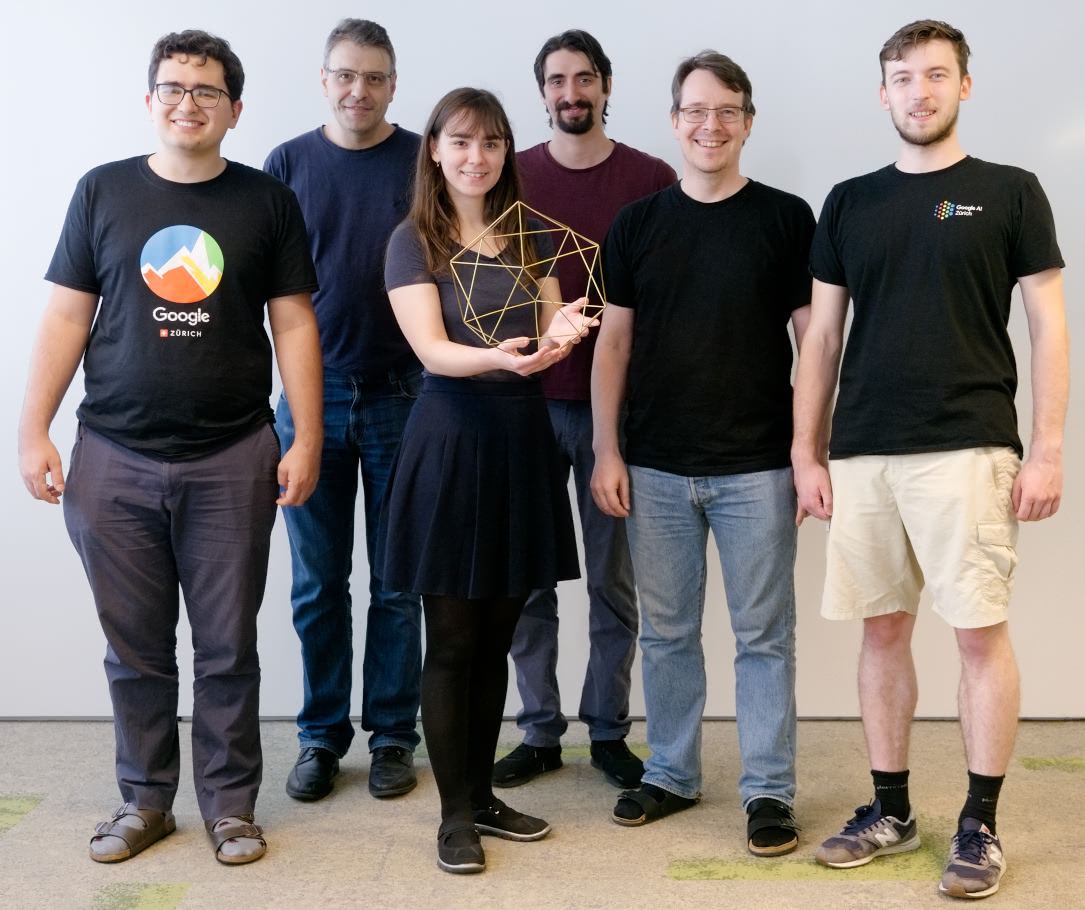
The Ihmehimmeli project team holding a himmeli, a symbol for the aim to build recurrent neural network architectures with temporal encoding of information.

We recently published and open-sourced a model in which we demonstrated the computational capabilities of fully connected spiking networks that operate using temporal coding. Our model uses a biologically-inspired synaptic transfer function, where the electric potential on the membrane of a neuron rises and gradually decays over time in response to an incoming signal, until there is a spike. The strength of the associated change is controlled by the “weight” of the connection, which represents the synapse efficiency. Crucially, this formulation allows exact derivatives of postsynaptic spike times with respect to presynaptic spike times and weights. The process of training the network consists of adjusting the weights between neurons, which in turn leads to adjusted spike times across the network. Much like in conventional artificial neural networks, this was done using backpropagation. We used synchronization pulses, whose timing is also learned with backpropagation, to provide a temporal reference to the network.

We trained the network on classic machine learning benchmarks, with features encoded in time. The spiking network successfully learned to solve noisy Boolean logic problems and achieved a test accuracy of 97.96% on MNIST, a result comparable to conventional fully connected networks with the same architecture. However, unlike conventional networks, our spiking network uses an encoding that is in general more biologically-plausible, and, for a small trade-off in accuracy, can compute the result in a highly energy-efficient manner, as detailed below.

While training the spiking network on MNIST, we observed the neural network spontaneously shift between two operating regimes. Early during training, the network exhibited a slow and highly accurate regime, where almost all neurons fired before the network made a decision. Later in training, the network spontaneously shifted into a fast but slightly less accurate regime. This behaviour was intriguing, as we did not optimize for it explicitly. Thus spiking networks can, in a sense, be “deliberative”, or make a snap decision on the spot. This is reminiscent of the trade-off between speed and accuracy in human decision-making.

A slow (“deliberative”) network (top) and a fast (“impulsive”) network (bottom) classifying the same MNIST digit. The figures show a raster plot of spike times of individual neurons in individual layers, with synchronization pulses shown in orange. In this example, both networks classify the digit correctly; overall, the “slow” network achieves better accuracy than the “fast” network.

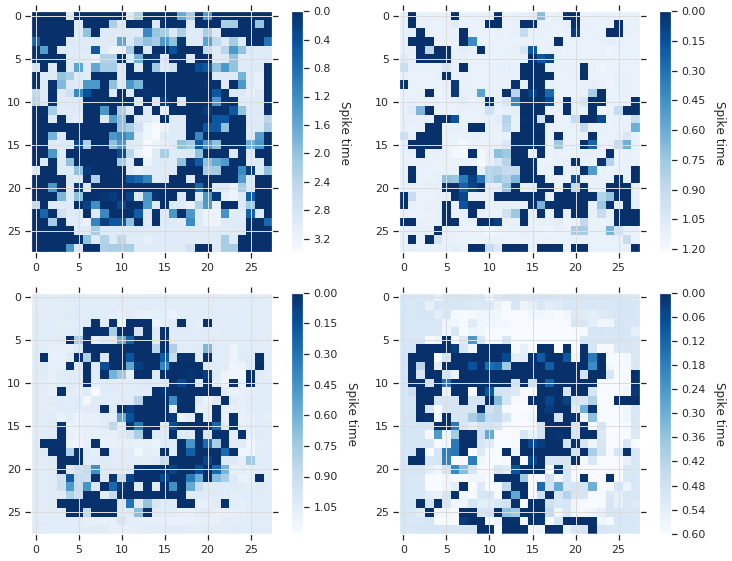
We were also able to recover representations of the digits learned by the spiking network by gradually adjusting a blank input image to maximize the response of a target output neuron. This indicates that the network learns human-like representations of the digits, as opposed to other possible combinations of pixels that might look “alien” to people. Having interpretable representations is important in order to understand what the network is truly learning and to prevent a small change in input from causing a large change in the result.

How the network “imagines” the digits 0, 1, 3 and 7.

This work is one example of an initial step that project Ihmehimmeli is taking in exploring the potential of time-based biology-inspired computing. In other on-going experiments, we are training spiking networks with temporal coding to control the walking of an artificial insect in a virtual environment, or taking inspiration from the development of the neural system to train a 2D spiking grid to predict words using axonal growth. Our goal is to increase our familiarity with the mechanisms that nature has evolved for natural intelligence, enabling the exploration of time-based artificial neural networks with varying internal states and state transitions.

Acknowledgements
The work described here was authored by Iulia Comsa, Krzysztof Potempa, Luca Versari, Thomas Fischbacher, Andrea Gesmundo and Jyrki Alakuijala. We are grateful for all discussions and feedback on this work that we received from our colleagues at Google.