Blog

Learn About Our Meetup

5000+ Members

MEETUPS

LEARN, CONNECT, SHARE

Join our meetup, learn, connect, share, and get to know your Toronto AI community. 

JOB POSTINGS

INDEED POSTINGS

Browse through the latest deep learning, ai, machine learning postings from Indeed for the GTA.

CONTACT

CONNECT WITH US

Are you looking to sponsor space, be a speaker, or volunteer, feel free to give us a shout.

Category: Global

Using Amazon Polly in Windows Applications

AWS offers a vast array of services that allow developers to build applications in the cloud. At the same time, Windows desktop applications can take advantage of these services as well. Today, we are releasing Amazon Polly for Windows, an open-source engine that allows users to take advantage of Amazon Polly voices in SAPI-compliant Windows applications.

What is SAPI? SAPI (Speech Application Programming Interface) is a Microsoft Windows API that allows desktop applications to implement speech synthesis. When an application supports SAPI, it can access any of the installed SAPI voices to generate speech.

Out of the box, Microsoft Windows provides one SAPI male and female voice that can be used in any supported voice application. With Amazon Polly for Windows, users can install over 50 additional voices across over 25 languages, paying only for what they use.  For more details, please visit the Amazon Polly documentation and check the full list of text-to-speech voices.

Create an AWS account

If you don’t already have an AWS account, you can sign up here, which gives you 12-months in our free tier. During the first 12 months, Amazon Polly is free for the first 5 million characters/month. How many characters is that? As an example, “Ulysses” by James Joyce is 730 pages and contains approximately 1.5 million characters. So you could have Amazon Polly read the entire book three times and still have an additional 500,000 free characters for the remainder of the month.

Configure your account

  1. Log in to your AWS account.
  2. After you’ve logged in, click Services from the top menu bar, then type IAM in the search box. Click IAM when it pops up.
  3. On the left, click Users
  4. Click Add User
  5. Type in polly-windows-user (you can use any name)
  6. Click the Programmatic access check box and leave AWS Management Console access unchecked
  7. Click Next: Permissions
  8. Click Attach existing policies directly
  9. At the bottom of the page, in the search box next to Filter: Policy type, type polly
  10. Click the check box next to AmazonPollyReadOnlyAccess
  11. Click Next: Review
  12. Click Create user

IMPORTANT: Don’t close the webpage. You’ll need both the access key ID and the secret access key in Step 3.

Step 2: Install the AWS CLI for Windows

Click here to download the AWS CLI for Windows.

Step 3: Configure the AWS client

Amazon Polly for Windows requires an AWS profile called polly-windows. This ensures that the Amazon Polly engine is using the correct account.

  1. Open a Windows command prompt
  2. Type this command:
    aws configure --profile polly-windows 

  3. When prompted for the AWS Access Key ID and AWS Secret Access Key, use the values from the previous step.
  4. For Default Region, you can hit Enter for the default (us-east-1) or enter a different Region. Make sure to use all lower-case.
  5. For Default output format, just hit Enter
  6. Verify this worked by running the following command. You should see a list of voices:
    aws --profile polly-windows polly describe-voices 

Step 4: Install Amazon Polly TTS Engine for Windows

Click here to download and run the installer. You can verify that the installer worked properly. Amazon Polly for Windows comes with PollyPlayer, an application that allows you to experiment with the voices without additional software. Simply pick a voice, enter text, and then click Say It.

Using Amazon Polly Voices in Applications

The Amazon Polly voices are accessible in any Windows application that implements Windows SAPI. This means that after the Amazon Polly voices are installed, you simply need to select the Amazon Polly voice that you want to use from the list of voices in the application.

Amazon Polly supports SSML (Speech Synthesis Markup Language), which allows users to add tags to customize the speech generation. With Amazon Polly for Windows, users can either use plaintext or SSML tags when submitting requests. The standard Amazon Polly limits apply of 3000 maximum billed characters per request, or 6000 characters total (SSML tags are not billed).

Example: Using Amazon Polly for Windows with Adobe Captivate

Building eLearning content is a great use case for generated speech. In the past, content managers would need to record voice content, and then re-record as content changes. Using an eLearning designer such as Adobe Captivate along with Amazon Polly voices allows you to easily create and dynamically update content whenever you need.

You can use any SAPI-enabled eLearning solution. In this demonstration, we walk through creating a simple slide with Captivate to show how quickly and easily you can add voice content. If you don’t already have Captivate, you can download a free trial here.

Step 1: Create a project

Start Captivate and click New Project / Blank Project to create a new project.

At this point, you have a new blank project with a single slide.

Step 2: Add speech content

From the Audio menu, click Speech Management.

This brings up a Speech Management modal window, where you can add speech content to the slide. Click on the Speech Agent drop-down and select Amazon Polly – US English – Salli (Neural).  By default, all slides to use this voice.

Click the + button to add content.

In the textbox, type My name is Salli. My speech is generated by Amazon Polly.

Now we must generate the audio. Behind the scenes, Captivate uses the Windows SAPI driver to call back to AWS to generate the speech. Click Save and Generate Audio.

After the speech is generated, you can preview the audio by clicking the Play button next to the Generate Audio button.

You hear Salli speaking the text. Click the Close button.

After closing the window, you can preview the entire project to hear the speech with the slide.

The wide selection of Amazon Polly voices allows a content manager to build and experiment with limitless combinations of speech. Because content and voice selections can be updated at any time, content managers can keep both the audio presentation and content fresh without ever having to go near a recording studio.

Now that you’ve installed Amazon Polly for Windows, you can have fun experimenting with different variations of speech using using SSML tags, which are all fully supported in Windows. And because Amazon Polly for Windows is open-source, you can feel free to contribute features and submit feature requests. You can share feedback at the Amazon Polly forum. We’d love to hear how you’re using Amazon Polly for Windows!


About the Author

Troy Larson is a Senior DevOPs Cloud Architect for AWS Professional Services.

 

A Stream Come True: NVIDIA RTX Broadcast Engine Brings Twitch Livestreams to Life with AI

Leading into TwitchCon — the world’s top gathering of livestreamers — we’re announcing the RTX Broadcast Engine, a new set of RTX-accelerated software development kits that use the AI capabilities of GeForce RTX GPUs to transform livestreams.

Powered by dedicated AI processors called Tensor Cores on RTX GPUs, the new SDKs enable virtual greenscreens, style filters and augmented reality effects — the kind of techniques used by major broadcast networks — all using AI and without the need for special equipment.

Livestreaming of video games has become a cultural phenomenon. Over 750 million people around the world tune in to watch people play video games. TwitchCon is where this global movement comes together. More than 50,000 streamers and fans will converge in San Diego this weekend to meet their favorite gamers and learn about the future of livestreaming.

RTX Brings AI to Livestreaming

NVIDIA GPUs are already the most popular choice to power the PC games played by streamers. They’re also used to encode and stream video to platforms such as Twitch, YouTube, Mixer, Huya and Douyu.

With the RTX Broadcast Engine’s AI-powered capabilities, NVIDIA is announcing a new way that RTX GPUs can enable more immersive livestreams — all without special cameras or physical props.

The new SDKs include:

  • RTX Greenscreen, to deliver real-time background removal of a webcam feed, so only your face and body show up on the livestream. The RTX Greenscreen AI model understands which part of an image is human and which is background, so gamers get the benefits of a greenscreen without needing to buy one.
  • RTX AR, which can detect faces, track facial features such as eyes and mouth, and even model the surface of a face, enabling real-time augmented reality effects using a standard web camera. Developers can use it to create fun, engaging AR effects, such as overlaying 3D content on a face or allowing a person to control 3D characters with their face.
  • RTX Style Filters, which use an AI technique called style transfer to transform the look and feel of a webcam feed based on the style of another image. With the press of a hotkey, you can style your video feed with your favorite painting or game art.

NVIDIA and OBS Bringing RTX Greenscreen to Gamers

In addition, we’re working with OBS, one of the leading livestreaming applications, to integrate RTX Greenscreen. With it, livestreamers will be able to remove their background environment or instantly teleport themselves anywhere — in this world or in virtual ones. This feature will be showcased at TwitchCon for the first time and available in the coming months.

“NVIDIA has been at the top of my list when it comes to streaming and recording equipment. I’m continually impressed with what they’re doing,” said Hugh Bailey, author, OBS. “And their technology is impressive with RTX features like RTX Greenscreen.”

Livestreaming Ecosystem Supports NVIDIA Broadcast SDKs

The RTX Broadcast Engine will enable streaming applications throughout the ecosystem to create immersive tools and effects for broadcasters to engage audiences and drive viewership.

“The new RTX Broadcast Engine is an exciting advancement that will allow developers in our app store to create powerful new tools for streamers with NVIDIA RTX GPUs,” said Ali Moiz, CEO of Streamlabs. “We’re thrilled to continue working with NVIDIA as they introduce new features to the Streamlabs developer community, and look forward to implementing this new technology.”

“We have collaborated with NVIDIA over the years on many projects and the introduction of the NVIDIA RTX Broadcast Engine is by far the most exciting,” said Miguel Molina, director of developer relations at XSplit. “For the XSplit team, we are excited to integrate these new tools into our suite of apps, enabling our users to create better content by maximizing the potential of NVIDIA GeForce RTX.”

In addition to RTX Broadcast Engine, leading applications such as OBS, XSplit, Huya, Douya and Streamlabs have deployed the NVIDIA Video Codec SDK for fast, high-quality streaming. Three new integrations made their debut this month:

  • Twitch Studio, a new, easy-to-use application for new livestreamers currently in beta, has integrated the Video Codec SDK to enable high-quality livestreaming.
  • Discord, the world’s leading gaming chat application, just released a new group broadcasting feature called “Go Live,” which uses NVIDIA GPUs and the Video Codec SDK to accelerate broadcasting games in Discord.
  • Elgato is one of the world’s leading manufacturers of video capture cards for gaming. It recently integrated the Video Codec SDK into the software of its new 4K60 Pro MK.2 capture card for recording 4K at 60fps video in High Dynamic Range.

Developers can learn more about the RTX Broadcast Engine and apply for early access at developer.nvidia.com/broadcastengine. Or stop by the OBS booth at TwitchCon, booth 1823, where we’ll be showing off RTX Greenscreen in OBS, new RTX Studio laptops and upcoming RTX games.

The post A Stream Come True: NVIDIA RTX Broadcast Engine Brings Twitch Livestreams to Life with AI appeared first on The Official NVIDIA Blog.

Say Yes to the AI Dress: Entrepreneur Brings GPUs to Fashion

In the future imagined by Pinar Yanardag, a postdoctoral research associate at MIT Media Lab, AI will collaborate with humans, not replace them.

This is the concept behind her project, “How to Generate (Almost) Anything,” which she created with other students from the MIT Media Lab and professionals in the Boston area.

Yanardag sat down with AI Podcast host Noah Kravitz to talk about this project, along with her other new creations.

How to Generate (Almost) Anything tackles weekly projects that integrate human and AI creativity. “So these are artists and artisans from all walks of life. Sometimes, these people have no experience in AI, sometimes they’re a bit up to date,” Yanardag says.

Mystic PizzAI — Reinventing Gourmet Food with GPUs

The team starts with choosing something to generate — one of their first projects was pizza. Then they train a network using data they’ve collected. For their pizza project, they fed it a multitude of recipes. AI then generates its own content.

Yanardag and her colleagues find a human collaborator who evaluates the AI-generated idea and tweaks it. Their system produced a recipe for shrimp and jam pizza, a seemingly alarming combination.

But their collaborator, the chef of Crush Pizza in Boston, augmented with recipe with arugula. The result was so delicious that he’s considering adding it to his regular menu.

She’s proving that humans should be excited rather than fearful of job automation. “These are the tasks we shouldn’t have to do in the first place,” Yanardag says. Humans can now “focus on more important skills — our emotions, our creativity, our empathy.”

That sentiment also helped Yanardag start the world’s first AI fashion brand, Coven.ai. She and cofounder Emily Salvador, also from the MIT Media Lab, create dresses based on AI-generated designs.

The AI component invents outfits humans might not think of — in Coven.ai’s reimagining of the classic Little Black Dress, one arm of the dress is a bell sleeve, and the other is straight.

Yanardag and Salvador are releasing new dresses on their site, but they’re also designing a platform in which the public can interact with their AI system.

Caption: Success with a dress: Coven.ai shows how AI can generate appealing fashion.

Caption: Success with a dress: Coven.ai shows how AI can generate appealing fashion.

“The idea is, you can just generate new designs on your own using our tool, and you can also finetune some of the details in the dress, like different colors or different styles or different textures,” Yanardag says. Users could send that design to a tailor, who would make the dress for them.

For Yanardag, the next step is the democratization of AI. She points out that right now, a powerful GPU is required to create these inventions. But by lowering the entry barrier, we can “empower people to create beautiful things.”

Help Make the AI Podcast Better

Have a few minutes to spare? Fill out this short listener survey. Your answers will help us make a better podcast.

How to Tune in to the AI Podcast

Get the AI Podcast through iTunes, Castbox, DoggCatcher, Overcast, PlayerFM, Podbay, PodBean, Pocket Casts, PodCruncher, PodKicker, Stitcher, Soundcloud and TuneIn. Your favorite not listed here? Email us at aipodcast [at] nvidia [dot] com.

The post Say Yes to the AI Dress: Entrepreneur Brings GPUs to Fashion appeared first on The Official NVIDIA Blog.

TB or Not TB: AI-Powered App Aids Treatment of Tuberculosis

Despite being treatable, tuberculosis kills 1.6 million people every year.

This is because TB treatment is time- and cost-intensive, requiring extensive patient monitoring.

In developing countries, where the disease is most deadly, monitoring involves a form of testing that has been used for hundreds of years. Clinicians study samples of lung fluid (called sputum) under a microscope and manually count the number of TB bacteria present, which sometimes reach into the hundreds.

This method may be cheaper than other available tests, but it’s only accurate 50 percent of the time.

Cambridge Consultants, a U.K.-based consultancy, has set out to investigate whether an AI-powered monitoring system could provide a feasible alternative for keeping tabs on this killer.

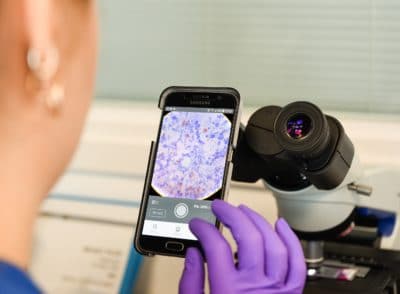
The result is BacillAi, a system that uses an AI-powered smartphone app and a standard-grade microscope to capture and analyze samples of sputum.

“With BacillAi, we wanted to tackle two main questions,” explained Richard Hammond, technology director of the Medical Technologies Division at Cambridge Consultants. “Can AI improve a labor-intensive, difficult process in healthcare diagnostics? And how could you go about making it available to those who need it most, even in the most remote and low-resource areas?”

Putting Manual Processes Under the Microscope

The current process for monitoring TB patients is inefficient and ineffective. Medical professionals review any number of patient samples a day, identifying and counting every single cell. This can take up to 40 minutes per case.

And the difficulty doesn’t stop there. Stains used to distinguish cells in the lung fluid can vary in strength between samples, and adjusting a microscope’s optical focus can alter colors.

The final BacillAi concept consists of a standard low-cost microscope, modified with a mount for a smartphone, and an AI app.

Clinicians monitoring TB under these conditions face both mental and physical strain. With such a high risk of human error, patients often receive poor-quality results that arrive too late for them to start vital treatment.

To tackle this conundrum, Cambridge Consultants trained a deep learning system using data gathered from cultured surrogate bacteria and artificial sputum.

Developed on the NVIDIA DGX POD reference architecture with NetApp storage, known as ONTAP AI, the resulting convolutional neural network (CNN) can identify, count and classify TB cells in a matter of minutes.

The final BacillAi concept consists of a standard low-cost microscope, modified with a mount for a smartphone, and an app with the CNN at its heart.

A product like BacillAi could help clinicians determine the state of a patient’s health faster and more consistently than is currently possible. Patients would also have improved chances of fighting the disease.

Solving Challenges at Scale

A multidisciplinary team worked on developing BacillAi in Cambridge Consultants’ purpose-built deep learning research facility, which is powered by ONTAP AI. The space is designed specifically for discovering, developing and testing machine learning approaches in a secure environment.

The same research facility also developed Aficionado, an AI music classifier, Vincent, which turns your squiggles into art, and SharpWave, a tool that creates clear, undistorted views of the real world from a damaged or obscured moving image.

Discover Cambridge Consultants’ innovative approaches for yourself at The AI Summit, in San Francisco, Sept. 25-26.


The post TB or Not TB: AI-Powered App Aids Treatment of Tuberculosis appeared first on The Official NVIDIA Blog.

Contributing Data to Deepfake Detection Research

Deep learning has given rise to technologies that would have been thought impossible only a handful of years ago. Modern generative models are one example of these, capable of synthesizing hyperrealistic images, speech, music, and even video. These models have found use in a wide variety of applications, including making the world more accessible through text-to-speech, and helping generate training data for medical imaging.

Like any transformative technology, this has created new challenges. So-called “deepfakes“—produced by deep generative models that can manipulate video and audio clips—are one of these. Since their first appearance in late 2017, many open-source deepfake generation methods have emerged, leading to a growing number of synthesized media clips. While many are likely intended to be humorous, others could be harmful to individuals and society.

Google considers these issues seriously. As we published in our AI Principles last year, we are committed to developing AI best practices to mitigate the potential for harm and abuse. Last January, we announced our release of a dataset of synthetic speech in support of an international challenge to develop high-performance fake audio detectors. The dataset was downloaded by more than 150 research and industry organizations as part of the challenge, and is now freely available to the public.

Today, in collaboration with Jigsaw, we’re announcing the release of a large dataset of visual deepfakes we’ve produced that has been incorporated into the Technical University of Munich and the University Federico II of Naples’ new FaceForensics benchmark, an effort that Google co-sponsors. The incorporation of these data into the FaceForensics video benchmark is in partnership with leading researchers, including Prof. Matthias Niessner, Prof. Luisa Verdoliva and the FaceForensics team. You can download the data on the FaceForensics github page.

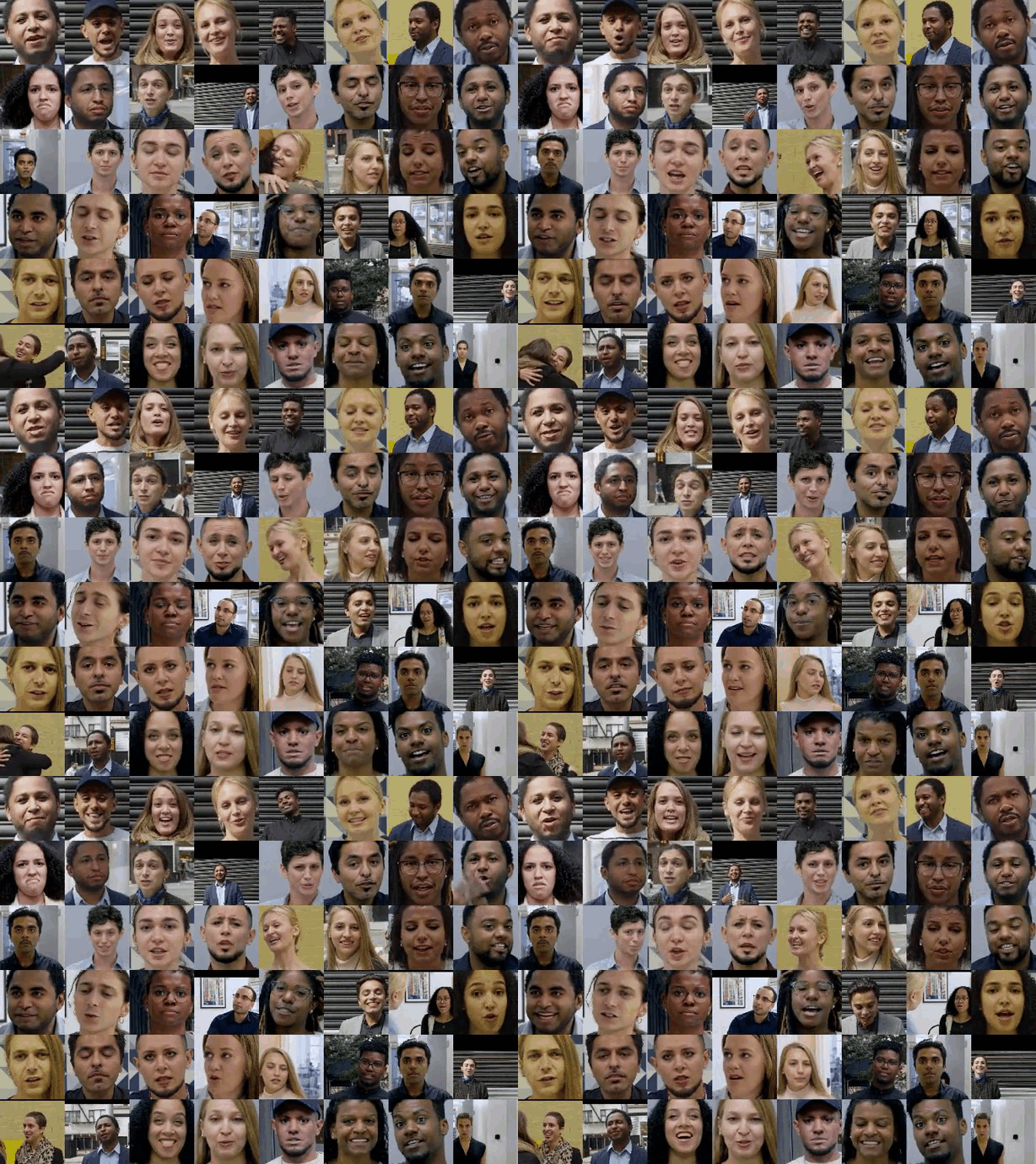
A sample of videos from Google’s contribution to the FaceForensics benchmark. To generate these, pairs of actors were selected randomly and deep neural networks swapped the face of one actor onto the head of another.

To make this dataset, over the past year we worked with paid and consenting actors to record hundreds of videos. Using publicly available deepfake generation methods, we then created thousands of deepfakes from these videos. The resulting videos, real and fake, comprise our contribution, which we created to directly support deepfake detection efforts. As part of the FaceForensics benchmark, this dataset is now available, free to the research community, for use in developing synthetic video detection methods.

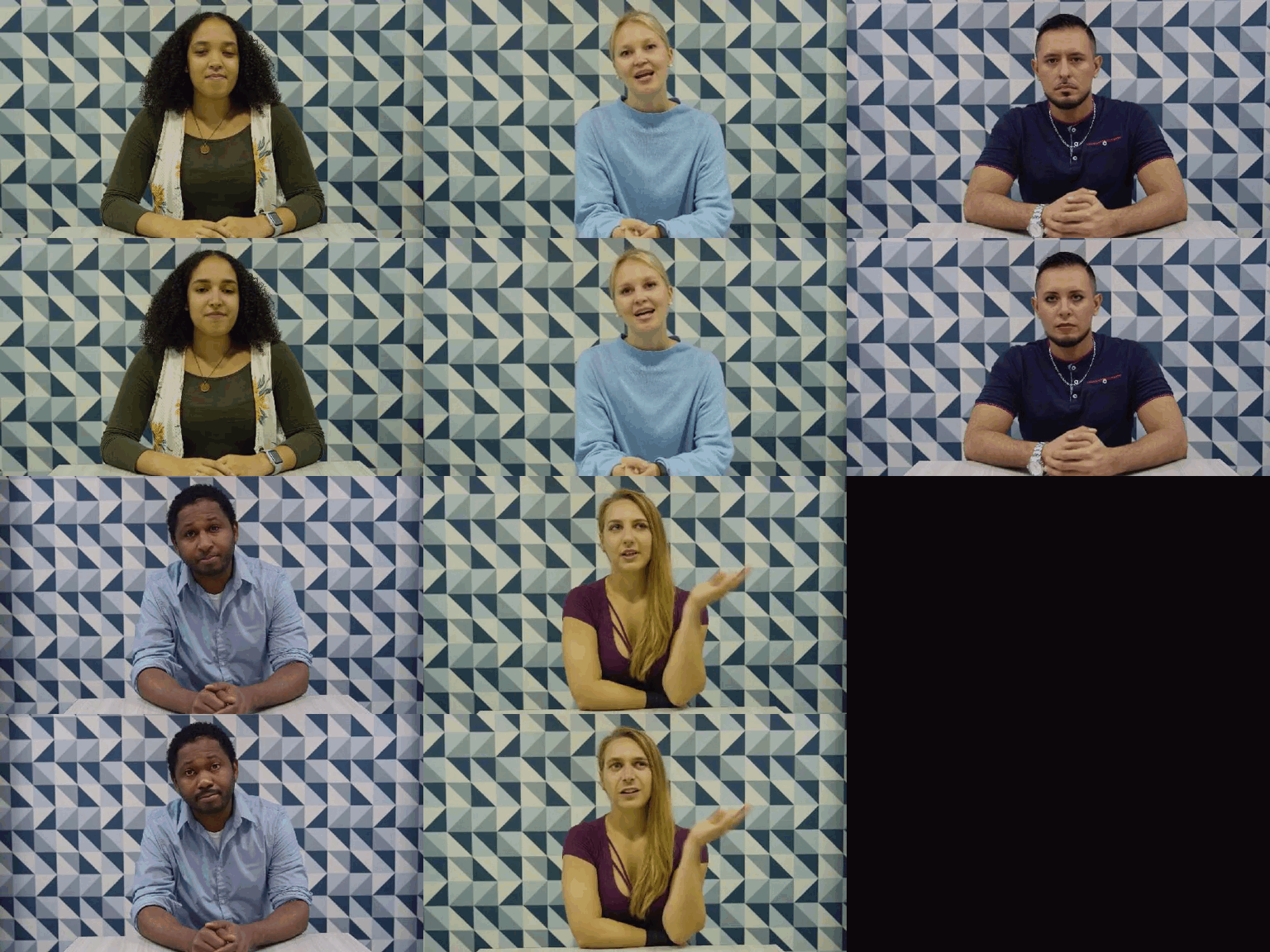
Actors were filmed in a variety of scenes. Some of these actors are pictured here (top) with an example deepfake (bottom), which can be a subtle or drastic change, depending on the other actor used to create them.

Since the field is moving quickly, we’ll add to this dataset as deepfake technology evolves over time, and we’ll continue to work with partners in this space. We firmly believe in supporting a thriving research community around mitigating potential harms from misuses of synthetic media, and today’s release of our deepfake dataset in the FaceForensics benchmark is an important step in that direction.

Acknowledgements
Special thanks to all our team members and collaborators who work on this project with us: Daisy Stanton, Per Karlsson, Alexey Victor Vorobyov, Thomas Leung, Jeremiah “Spudde” Childs, Christoph Bregler, Andreas Roessler, Davide Cozzolino, Justus Thies, Luisa Verdoliva, Matthias Niessner, and the hard-working actors and film crew who helped make this dataset possible.

AI with Appeal: Banana Farmers Spot Crop Disease, Pests with Deep Learning

Bananas are the world’s favorite fruit. If you don’t count tomatoes as fruit. (And really, who does?)

But banana crops around the globe are afflicted by diseases and pests that threaten the livelihoods of small-scale farmers, most of whom rely on just one or two cash crops and lack the resources commercial farms use to monitor the health of their plants.

A new AI app aims to help resource-poor farmers more accurately identify and treat banana diseases, improving their crop yields. Called Tumaini, meaning “hope” in Swahili, the app could also give nonprofits and governments more information and tools to control disease outbreaks in bananas and other crops.

Trained using NVIDIA GPU technology, the convolutional neural networks behind Tumaini achieve around 90 percent accuracy in detecting five common banana diseases and one pest.

The free app has been tested in six countries, including the top three banana-producing nations, and is available in the Google Play Store.

Say Yellow to AI: Splitting Up Banana Diseases

It’s easy for farmers diagnosing problems in their banana crop to confuse the symptoms of fungal, bacterial and viral diseases. Many cause similar patterns of yellow leaf spots and decay. Misinterpreting the signs can waste precious time and resources.

“Especially in developing countries, smallholder farmers have minimal resources to spend on fertilizer and treatments,” said Michael Selvaraj, who led the project at the International Center for Tropical Agriculture. “If you’re spraying fungicide over plants with a bacterial disease, you’re wasting your money.”

Based in Cali, Colombia, the nonprofit organization is a research center of the international agricultural innovation network CGIAR.

Scientists from the nonprofit Biodiversity International helped the team hand-label a dataset of 20,000 banana plant images collected from banana farms in southern India, Uganda, Burundi, Benin and the Democratic Republic of Congo. The team used field images for training to improve the AI’s ability to read low-quality images with background elements such as neighboring plants or leaves.

Bananas are a challenging crop to analyze for disease, because symptoms can appear in several different parts of the plant — from the fruit down to the trunk, known as the pseudostem.

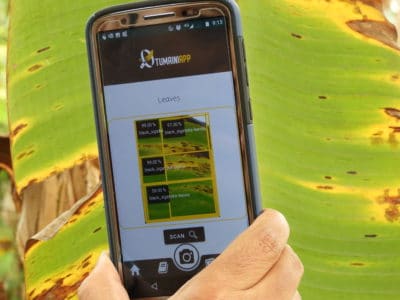
AI Goes Bananas: The Tumaini app analyzes different areas of the banana plant to diagnose crop disease. Image courtesy of the International Center for Tropical Agriculture.

“It may be that the leaf looks very healthy,”  Selvaraj said, “but when you cut open the pseudostem you can find the disease.”

The dataset was used to train six different neural networks, each analyzing images from a different part of the banana plant. This way, farmers using the Tumaini app can take pictures of multiple parts of a diseased crop, like the leaf and the fruit, to double-check the results of the AI model.

After identifying the banana disease, Tumaini provides users with treatment guidance. To better serve farmers worldwide, the interface comes in five languages: English, French, Spanish, Swahili and Tamil — with translations in the works for two additional Indian languages, Hindi and Malayalam.

Spotting Banana Disease Early

Left unchecked, crop diseases can spread rapidly through infected tools, soil, water and insects. Some, like the major fungal disease Fusarium wilt, can survive for decades in soil.

Fusarium wilt has been affecting banana crops in Colombia for the last couple years — but at the start, local farmers were misidentifying the disease as viral. The misdiagnosis meant pathologists and government agencies were delayed in spotting the problem, which has since spread widely in the region.

“Monitoring and early detection is very important,” Selvaraj said. The app encourages farmers to geotag their pictures, so that researchers can flag when a disease shows up for the first time in a new area of the world. “If we had the app then, we would have gone earlier and taken some samples to confirm and avoid the outbreak.”

Pictures uploaded to Tumaini are sent to the researchers’ GPU system for inference, which takes just a few seconds depending on the user’s wireless connection. They’re also added to a database so the researchers can track global trends of banana disease.

Selvaraj and his team also plan to collect and analyze aerial images of banana crops captured by drones and the European Space Agency’s SENTINEL satellite program. By combining this remote data with GPS-tagged ground images from farmers using the app, the researchers can develop crop surveillance tools that monitor the global health of banana plants and alert local farming communities about outbreaks.

Deploying the AI tool in a smartphone app allows farmers to diagnose crop diseases in real-time in the field. Image courtesy of the International Center for Tropical Agriculture.

To broaden the scope of Tumaini, the scientists hope to add detection for additional banana diseases as well as other staple crops, like kidney beans. They’re also interested in adding resources and help lines to the app, so farmers can alert local governments about new crop diseases, contact pesticide and fungicide vendors, and learn about sustainable alternatives like biological pest control.

The team is additionally working to make the app available offline, so farmers can analyze crop images in the field, even without an internet connection.

Selvaraj says offline access and a multilingual, user-friendly interface are essential to make the app a viable solution for smallholder banana farmers. He expects demand for the app will grow further as smartphone adoption increases in Africa and India, two of the largest regions for banana production.

“AI in agriculture is still in an infant state,” he said. “We’re working today for an impact over the next 30 years.”

Main image by Wilfredo Rodríguez, licensed from Wikimedia Commons under CC BY-SA 3.0

The post AI with Appeal: Banana Farmers Spot Crop Disease, Pests with Deep Learning appeared first on The Official NVIDIA Blog.

AI Builds AI: Startup’s AI Generates Compact Neural Networks

University of Waterloo researcher Alexander Wong didn’t have enough processing power for his computer vision startup, so he developed a workaround. That workaround is now the company’s product.

Ontario-based DarwinAI, founded by a team from the Ontario-based university, provides a platform for developers to generate slimmed-down models from neural networks. This offers a quicker way for developers to spin out multiple networks with smaller data footprints.

The company’s lean models are aimed at businesses developing AI-based edge computing networks to process mountains of sensor data from embedded systems and mobile devices.

Industries of all stripes — autonomous vehicles, manufacturing, aerospace, retail, healthcare and consumer electronics — are developing next-generation businesses with AI computing at the edge of their GPU-powered networks.

It’s estimated that by 2025 some 150 billion machine sensors and IoT devices will stream continuous data for processing.

Yet many find that talent and computing resources run high to build these various models.

DarwinAI’s position is that companies can reduce development time and costs — like DarwinAI did for themselves — by using its platform to spin out compact models from full-sized ones.

“We can enable AI at the edge for mobile devices and clients who need to put powerful neural networks into cars, watches, airplanes and other areas,” said Sheldon Fernandez, CEO and co-founder at DarwinAI.

Generative Synthesis: Hello, World 

DarwinAI’s platform, dubbed GenSynth, is the result of pioneering research on what’s called generative synthesis. There’s an easy way to think of generative synthesis: It’s AI to create AI.

The startup’s founders late last year released a research paper on generative synthesis and then fused that with its proprietary research to launch the company’s offering.

DarwinAI’s platform relies on machine learning to probe and understand the architecture of neural networks for customers. Then its AI generates a new family of neural networks that are functionally equivalent to the original but smaller and faster, according to the company.

The company is a member of the NVIDIA Inception program that helps startups move to market faster.

Audi Rides DarwinAI Networks 

The startup’s research has attracted interest from consumer electronics companies, aerospace and automakers, including Audi.

Audi’s case study with DarwinAI used the GenSynth platform to accelerate design of custom, optimized deep neural networks for object detection in autonomous driving.

The GenSynth platform helped Audi developers train models 4x faster and slash GPU processing time by three-fourths.

“They worked with two terrabytes of data, and we really reduced the testing time,” said Fernandez. “There’s real savings for their GPU training time and real benefits for the developers.”

GPUs for GenSynth

DarwinAI developed GenSynth to reduce its own development time, tapping into NVIDIA GPUs on AWS and Microsoft Azure and local instances on premises to boost its coding cycles.

Many of DarwinAI’s early customers are now using the platform to speed their development. It also helps reduce the data processed on customers’ systems running NVIDIA Jetson modules on site and NVIDIA V100 Tensor Core GPUs in the cloud for training and inference.

“Deep learning is so complex that you need to collaborate with AI enabled by GPUs to do it properly — it will free up your time to do the creative work,” said Fernandez.


Image credit: Taken at the University of Waterloo by Victor Vucicevich; licensed under Creative Commons Attribution-Share Alike 3.0 Unported.

The post AI Builds AI: Startup’s AI Generates Compact Neural Networks appeared first on The Official NVIDIA Blog.

Why AI Could Be the End of the Aisle for Shoplifters

Security guards. Closed circuit TV. Anti-theft tags and alarms.

Retailers are constantly battling shoplifters to protect store profits — up to 50 percent of which are lost to theft.

Now, they have a new weapon in their armory.

ThirdEye Labs, a London-based company and member of Inception, NVIDIA’s startup incubator, is combining off-the-shelf CCTV cameras with state-of-the-art AI algorithms to detect fraudulent activities in stores.

Caught AI Handed

Every year, U.S. retailers lose up to $32.25 billion due to theft.

In addition to those pocketing items straight from the shelves, it’s estimated that one percent of all customers who visit self-service checkouts steal. Sometimes it’s accidental — an item doesn’t scan through properly or the wrong type of pastry is selected from the bakery menu.

But some supermarket stealers are more slick — following schemes such as “the banana trick” (steaks scanned as potatoes) or “the switcheroo” (scanning the barcodes of cheaper items, instead of a pricier purchase).

To date, retailers’ attempts to deter thieves have had little effect. Hiring more security personnel is expensive and creates unpleasant shopping experiences. While security alarms are evaded and self-service counters continue to be deceived.

ThirdEye Labs’ AI algorithms help security staff work more effectively and efficiently. Trained on NVIDIA GPUs, the company’s deep learning networks can detect specific indicators of fraudulent behavior from CCTV footage and then alert staff, who can take appropriate action on the spot.

“We chose to train our algorithms on NVIDIA GPUs as they are fast, reliable and effective,” said Raz Ghafoor, CEO and co-founder at ThirdEye Labs. “Without the power of these GPUs, our development time would have doubled.”

ThirdEye Labs’ AI software can be used with existing security infrastructure — no additional hardware or software is needed. None of the video footage used is recorded or stored anywhere and the system doesn’t perform any facial recognition, meaning the system is GDPR compliant.

At stores where ThirdEye Labs’ system has been introduced at self-service checkouts, the AI technology analyzes every scan to detect non-scans, non-payments, substitute scanning and fraudulent refunds. Over the course of a month, two stores caught 27 thieves in action, up from basically zero, by implementing ThirdEye Labs’ point-of-sale system.

In the aisles, too, fraudulent behavior hasn’t gone unnoticed. ThirdEye Labs’ “In-Aisle Theft Detector” sends security guards push notifications every time someone picks up high-risk items, like champagne bottles or fresh meat. They can then decide whether or not to take action, helping them work more efficiently and effectively.

The service has saved stores tens of thousands of dollars in losses by helping security guards have their eyes on the right person, at the right time.

The Future of Convenient Shopping

ThirdEye Labs plans to expand its technology further to improve customer shopping experiences.

Its “Queue Detector” will predict when lots of customers are about to get in checkout lines. By alerting staff, tills can be manned before the rush.

Its “Stock-out Detector” will help stores monitor their shelves and identify when stock is low. Empty shelves cost retailers an estimated three percent of their total revenue each year, so optimizing stock replenishment has big benefits for sellers as well as those looking to purchase.

Image credit: kc0uvb

The post Why AI Could Be the End of the Aisle for Shoplifters appeared first on The Official NVIDIA Blog.

UK Startup Uses AI to Help Retailers Reduce Shrinkage at Point of Sale

Retailers are constantly battling to protect their profits — up to 50 percent of which are lost to theft.

Now, they have a new weapon in their armory.

ThirdEye Labs, a London-based company and member of Inception, NVIDIA’s startup incubator, is combining off-the-shelf CCTV cameras with state-of-the-art AI algorithms to detect anomalous activities in stores.

Caught AI Handed

Every year, U.S. retailers lose up to $32.25 billion due to theft. 

In addition to those pocketing items straight from the shelves, it’s estimated that one percent of all customers who visit self-service checkouts steal. Sometimes it’s accidental — an item doesn’t scan through properly or the wrong type of pastry is selected from the bakery menu. 

But some people follow schemes such as “the banana trick” (steaks scanned as potatoes) or “the switcheroo” (scanning the barcodes of cheaper items, instead of a pricier purchase).

To date, retailers’ attempts at deterrence have had little effect. Hiring more security personnel is expensive and creates unpleasant shopping experiences. While security alarms are evaded and self-service counters continue to be deceived.

ThirdEye Labs’ AI algorithms help security staff work more effectively and efficiently. Trained on NVIDIA GPUs, the company’s deep learning networks can detect specific indicators of fraudulent behavior from CCTV footage and then alert staff, who can take appropriate action on the spot.

“We chose to train our algorithms on NVIDIA GPUs as they are fast, reliable and effective,” said Raz Ghafoor, CEO and co-founder at ThirdEye Labs. “Without the power of these GPUs, our development time would have doubled.”

ThirdEye Labs’ AI software can be used with existing security infrastructure — no additional hardware or software is needed. None of the video footage used is recorded or stored anywhere and the system doesn’t perform any facial recognition, meaning the system is GDPR compliant.

At stores where ThirdEye Labs’ system has been introduced at self-service checkouts, the AI technology analyzes every scan to detect non-scans, non-payments, substitute scanning and fraudulent refunds. Over the course of a month, two stores flagged a few dozen suspect transactions, up from basically zero, by implementing ThirdEye Labs’ point-of-sale system. 

In the aisles, too, fraudulent behavior hasn’t gone unnoticed. ThirdEye Labs’ “In-Aisle Theft Detector” sends security guards push notifications every time someone picks up high-risk items, like champagne bottles or fresh meat. They can then decide whether or not to take action, helping them work more efficiently and effectively. 

The service has saved stores tens of thousands of dollars in losses by helping security guards have their eyes on the right behavior, at the right time.  

The Future of Convenient Shopping

ThirdEye Labs plans to expand its technology to improve customer shopping experiences. 

Its “Queue Detector” will predict when lots of customers are about to get in checkout lines. By alerting staff, tills can be manned before the rush.

Its “Stock-out Detector” will help stores monitor their shelves and identify when stock is low. Empty shelves cost retailers an estimated three percent of their total revenue each year, so optimizing stock replenishment has big benefits for sellers as well as those looking to purchase.

The post UK Startup Uses AI to Help Retailers Reduce Shrinkage at Point of Sale appeared first on The Official NVIDIA Blog.