Amazon SageMaker recently introduced the ability to enable and disable root access for notebook users. Before I give you a preview of how you can implement this new feature using the AWS Management Console and Amazon SageMaker API actions, I’ll explain why controlling root access for users is helpful.
Amazon SageMaker provides fully managed notebook instances that run industry-standard open-source interactive computing software, Jupyter Notebooks. You can use Jupyter Notebooks to clean and transform data, visualize data, run numerical simulations, build statistical and machine learning (ML) models, and much more.
Data science is an iterative process, which might require data scientists and developers to test and use different software and packages. During the planning and experimentation stages of projects having root access gives you the flexibility to modify Jupyter Notebook environments as needed.
However, for our customers who need to comply with specific security policies, it’s important to ensure a segregation between the notebook user and the root of the hosting computer. Since root access means having administrator privileges, users with root access can access and edit all files on the compute instance, including system-critical files. Removing root access prevents notebook users from deleting system-level software, installing new software, and modifying essential environment components.
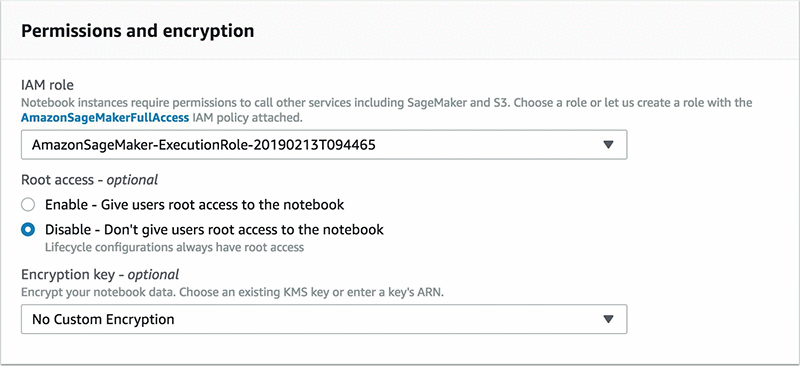
With the new option, Amazon SageMaker customers can now use the AWS Management Console and Amazon SageMaker API actions to enable or disable root access for their notebook instances.
Note: Lifecycle configurations, which are shell scripts you can use to set up and customize notebook instances, give administrators the ability to employ custom configurations even when the notebook instance is set up to have no root access for the user. That’s why lifecycle configurations always run as the root user for the associated notebook instances regardless of however root access permission is defined.
Control root access using the AWS Management Console
When creating new notebook instances or updating existing ones with the AWS Management Console, you can choose to enable or disable root access on the Permissions and encryption menu. For detailed instructions on how to create notebook instances with Amazon SageMaker, follow the steps provided in the Amazon SageMaker Developer Guide.
Control root access with Amazon SageMaker API actions
When you’re calling the CreateNotebookInstance and UpdateNotebookInstance API actions, you can use Enabled or Disabled as parameters to define the string value for ”RootAccess”. Here is an example JSON template to be passed with API actions:
The ability to control root access for notebook instances adds flexibility and security to the administration of Jupyter Notebook environments. To learn more about Amazon SageMaker and start with Jupyter Notebooks, visit the Amazon SageMaker webpage. For more information about managing root access for notebook instances, see the Amazon SageMaker Developer Guide.
About the Author
Erkan Tas is a Sr. Product Manager for Amazon SageMaker. He is on a mission to make Artificial Intelligence easy, accessible, and scalable through cloud platforms. He is also a sailor, science and nature admirer, Go and Stratocaster player.
Posted by Andy Zeng, Student Researcher, Robotics at Google
Though considerable progress has been made in enabling robots to grasp objects efficiently, visually self adapt or even learn from real-world experiences, robotic operations still require careful consideration in how they pick up, handle, and place various objects — especially in unstructured settings. Consider for example, this picking robot which took 1st place in the stowing task of the Amazon Robotics Challenge:
It’s an impressive system, built with many design features that kinematically prevent it from dropping objects due to unforeseen dynamics: from its steady and deliberate movements, to its gripper fingers that mechanically constrain the momentum of the object so that it doesn’t slip.
This robot, like many others, is designed to tolerate the dynamics of the unstructured world. But instead of just tolerating dynamics, can robots learn to use them advantageously, developing an “intuition” of physics that would allow them to complete tasks more efficiently? Perhaps in doing so, robots can improve their capabilities and acquire complex athletic skills like tossing, sliding, spinning, swinging, or catching, potentially leading to many useful applications, such as more efficient debris clearing robots in disaster response scenarios — where time is of the essence.
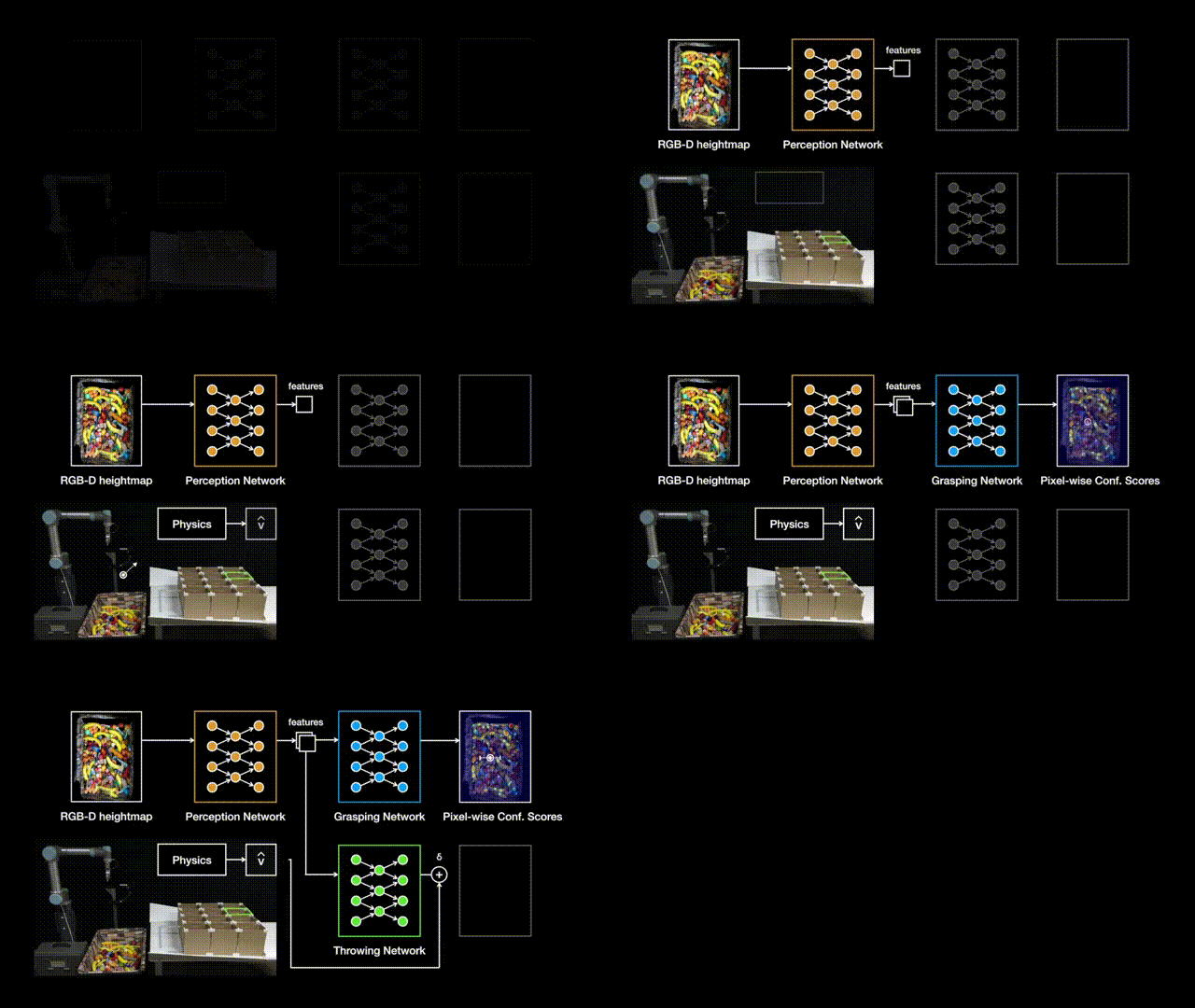
To explore this concept, we worked with researchers at Princeton, Columbia, and MIT to develop TossingBot: a picking robot for our real, random world that learns to grasp and throw objects into selected boxes outside its natural range. We find that by learning to throw, TossingBot is capable of achieving picking speeds that are twice as fast as previous systems, with twice the effective placing range. TossingBot jointly learns grasping and throwing policies using an end-to-end neural network that maps from visual observations (RGB-D images) to control parameters for motion primitives. Using overhead cameras to track where objects land, TossingBot improves itself over time through self-supervision. More technical details are available in an early preprint on arXiv.
The Challenges Throwing is a particularly difficult task as it depends on many factors: from how the object is picked up (i.e., “pre-throw conditions”), to the object’s physical properties like mass, friction, aerodynamics, etc. For example, if you grasp a screwdriver by the handle near the center of mass and throw it, it would land much closer than if you had grasped it from the metal tip, which would swing forward and land much farther away. Regardless of how you grasped it though, tossing a screwdriver is incredibly different from tossing a ping pong ball, which would land closer due to air resistance. Manually designing a solution that explicitly handles these factors for every random object is nearly impossible.
Throwing depends on many factors: from how you picked it up, to object properties and dynamics.
Through deep learning, however, our robots can learn from experience rather than rely on manual case-by-case engineering. Previously we’ve shown that our robots can learn to push and grasp a large variety of objects, but accurately throwing objects requires a larger understanding of projectile physics. Acquiring this knowledge from scratch with only trial-and-error is not only time consuming and expensive, but also generally doesn’t work outside of very specific, and carefully set up training scenarios.
Unifying Physics and Deep Learning A fundamental component of TossingBot is that it learns to throw by integrating simple physics and deep learning, which enables it to train quickly and generalize to new scenarios. Physics provides prior models of how the world works, and we can leverage these models to develop initial controllers for our robots. In the case of throwing, for example, we can use projectile ballistics to provide an estimate for the throwing velocity that is needed to get an object to land at a target location. We can then use neural networks to predict adjustments on top of that estimate from physics, in order to compensate for unknown dynamics as well as the noise and variability of the real world. We call this hybrid formulation Residual Physics, and it enables TossingBot to achieve throwing accuracies of 85%.
At the start of training with randomly initialized weights, TossingBot repeatedly attempts bad grasps. Over time, however, TossingBot learns better ways to grasp objects and simultaneously improves its ability to throw. Occasionally the robot randomly explores what happens if it throws an object at a velocity that it hasn’t tried before. When the bin is emptied, TossingBot lifts the boxes to allow objects to slide back into the bin. This way, human intervention is kept at a minimum during training. By 10,000 grasp and throw attempts (or 14 hours of training time), it is capable of achieving throwing accuracies of 85%, with a grasping reliability of 87% in clutter.
TossingBot starts out performing poorly (left), but progressively learns to grasp and toss overnight (right).
Generalizing to New Scenarios By integrating physics and deep learning, TossingBot is capable of rapidly adapting to never-before-seen throwing locations and objects. For example, after training on objects with simple shapes like wooden blocks, balls, and markers, it can perform reasonably well on new objects such as fake fruit, decorative items, and office objects. On new objects, TossingBot starts out with lower performance, but quickly adapts within a few hundred training steps (i.e., an hour or two) to achieve similar performance as with training objects. We’ve found that combining physics and deep learning with Residual Physics yields better performance than baseline alternatives (e.g. deep learning without physics). We even tried this task ourselves, and we were pleasantly surprised to learn that TossingBot is more accurate than any of us engineers! Though take that with a grain of salt, as we’ve yet to test TossingBot against anyone with any actual athletic talent.
TossingBot can generalize to new objects, and is more accurate at throwing than the average Googler.
We also test our policies on their ability to generalize to new target locations previously unseen in training. To this end, we train on a set of boxes, then later test on a different set of boxes with entirely different landing areas. In this setting, we find that Residual Physics for throwing helps significantly, since the initial estimates of throwing velocities from projectile ballistics easily generalize to new target locations, while the residuals help make adjustments on top of those estimates to compensate for varying object properties in the real world. This is in contrast to the baseline alternative of using deep learning without physics, which can only handle target locations seen during training.
TossingBot uses Residual Physics to throw objects to unforeseen locations.
Emerging Semantics from Interaction To explore what TossingBot learns, we place several objects in the bin, capture images, and feed them into TossingBot’s trained neural network to extract intermediate pixel-wise deep features. By clustering these features based on similarity and visualizing nearest neighbors as a heatmap (hotter regions indicate more similarity in feature space), we can localize all ping pong balls in the scene. Even though the orange block shares a similar color with the ping pong balls, its features are different enough for TossingBot to make a distinction. Likewise, we can also use the extracted features to localize all marker pens, which share similar shape and mass, but do not share color. These observations suggest that TossingBot likely learns to rely more on geometric cues (e.g. shape) to learn grasping and throwing. It is also possible that the learned features reflect second-order attributes such as physical properties, which can influence how the objects should be thrown.
TossingBot learns deep features that distinguish object categories without explicit supervision.
These emerging features were learned implicitly from scratch without any explicit supervision beyond task-level grasping and throwing. Yet, they seem to be sufficient for enabling the system to distinguish between object categories (i.e., ping pong balls and marker pens). As such, this experiment speaks out to a broader concept related to machine vision: how should robots learn the semantics of the visual world? From the perspective of classic computer vision, semantics are often pre-defined using human-fabricated image datasets and manually constructed class categories. However, our experiment suggests that it is possible to implicitly learn such object-level semantics from physical interactions alone, as long as they matter for the task at hand. The more complex these interactions, the higher the resolution of the semantics. Towards more generally intelligent robots — perhaps it is sufficient for them to develop their own notion of semantics through interaction, without requiring any human intervention.
Limitations and Future Work Although TossingBot’s results are promising, it does have its limitations. For example, it assumes that objects are robust enough to withstand landing collisions after being thrown — further work is required to learn throws that account for fragile objects, or possibly train other robots to catch objects in ways that cushion the landing. Furthermore, TossingBot infers control parameters only from visual data — exploring additional senses (e.g. force-torque or tactile) may enable the system to better react to new objects.
The combination of physics and deep learning that made TossingBot possible naturally leads to an interesting question: what else could benefit from Residual Physics? Investigating how the idea generalizes to other types of tasks and interactions is a promising direction for future research.
You can learn more about this work in the summary video below.
Acknowledgements This research was done by Andy Zeng, Shuran Song (faculty at Columbia University), Johnny Lee, Alberto Rodriguez (faculty at MIT), and Thomas Funkhouser (faculty at Princeton University), with special thanks to Ryan Hickman for valuable managerial support, Ivan Krasin and Stefan Welker for fruitful technical discussions, Brandon Hurd and Julian Salazar and Sean Snyder for hardware support, Chad Richards and Jason Freidenfelds for helpful feedback on writing, Erwin Coumans for advice on PyBullet, Laura Graesser for video narration, and Regina Hickman for photography. An early preprint is available on arXiv.
It can be hard to stay healthy in a convention center filled with thousands of people — unless, of course, you’re at the GPU Technology Conference, where healthcare players big and small are showcasing the latest innovations in AI and medicine.
GTC 2019, held last week in Silicon Valley, featured more than 40 healthcare sessions, four panels, several booth exhibits and a handful of meetups. More than a dozen healthcare startups from the NVIDIA Inception program were part of the packed lineup, with five delivering a series of lightning talks.
Share the Health: Inception Pavilion Features Demos, Booths, Meetups
One area of the GTC show floor was reserved for Inception startups, with nearly 50 setting up booths to show off their latest demos. An Inception Theater featured lightning talks, where crowds gathered to hear the companies give five-minute talks about their work.
In its booth, digital health startup DDH showed off its AI models for dental applications, full-body MRI screens, and disease diagnosis for Alzheimer’s and lung cancer. The company, a second-time GTC attendee, also had a poster accepted to this year’s poster session.
South Korean startup Lunit is using AI to provide better quantitative assessments of diseases from medical images, including mammograms and chest x-rays. The company’s goal is to reduce false positives, false negatives and unnecessary tests — particularly invasive ones like biopsies. In its GTC booth, Lunit demonstrated its latest chest x-ray AI.
InformAI CEO Jim Havelka speaks with a GTC attendee at the startup’s booth.
InformAI, a company developing AI-enabled 3D medical image classifiers and patient outcome predictors, showcased its sinus image classifier in the booth. Trained on NVIDIA V100 GPUs through the Microsoft Azure cloud platform and with an onsite NVIDIA DGX Station, the deep learning model can detect 23 medical conditions from 3D CT head scans.
Another Inception startup, doc.ai demonstrated its medical research platform that can run medical studies from a mobile phone. The company’s co-founder and CEO, Walter De Brouwer, spoke on a healthcare panel focused on “Healthcare in the AI Era: Innovating with Data and Its Implications.”
At the panel, De Brouwer discussed the trend of growing datasets in healthcare and addressed data privacy as one of the implications. Certain deep learning healthcare applications transfer data to the cloud, which increases concerns of privacy. Instead, he suggested, patients can be entrusted with their own data.
“You can store all your information on your smartphone, and you can do some local predictions. You don’t need Wi-Fi or the cloud, and it’s extremely fast,” he said.
The Inception Showcase featured presentations by eight top startups, including Vyasa Analytics (third from left).
“It’s our first GTC, but we’re looking forward to being here again many times over,” said Akshay Sharma, doc.ai’s chief technology officer. “As an Inception program member, this is an opportunity to showcase the AI we are building for medical research and learn from what others are doing in the space.”
And at an Inception Showcase held at the Fairmont Hotel in San Jose, eight of the hottest startups in the program presented in front of an audience that included investors, media and industry executives. Vyasa Analytics, which builds deep learning software for life sciences and healthcare companies, was one of the participants — all of which received an NVIDIA TITAN RTX GPU at the event.
GTC’s in Session: Startups Educate Attendees on Latest Innovations
For a deeper dive into their products and projects, a half-dozen Inception healthcare startups led sessions during the week. Subtle Medical CEO Enhao Gong spoke about data augmentation and GANs as tools to overcome the barrier of inadequate training data for medical imaging. Daniel Golden, director of machine learning at Arterys, led a session on neural networks used for volumetric assessment of liver lesions.
Another Inception startup, Innoplexus, gave two talks: one on GPU-powered applications for faster drug development, and another on parsing information from large, textual datasets in life sciences.
NE Scientific presented a session on how deep learning can be used for computerized surgical guidance in liver tumor ablation.
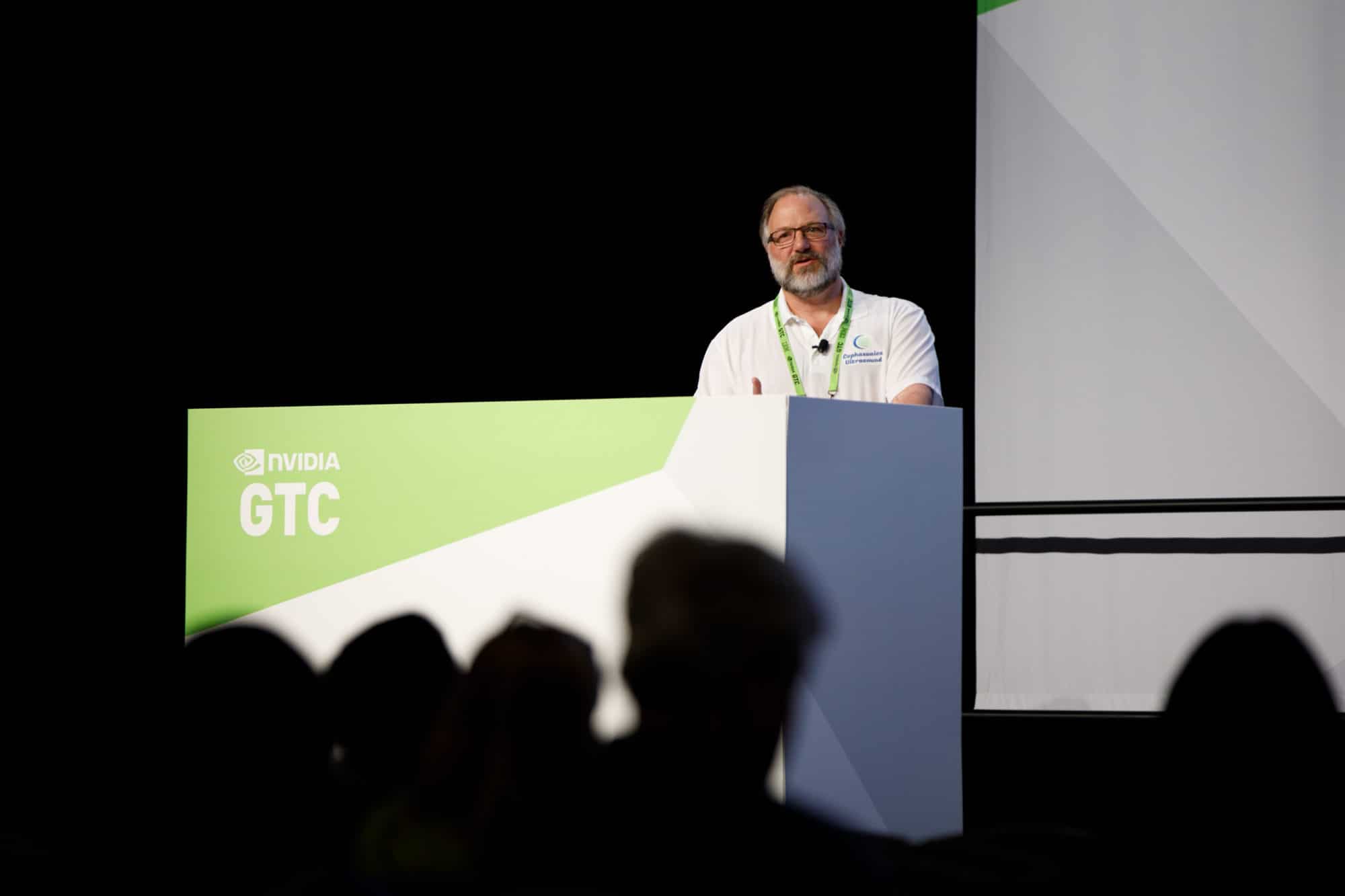
Richard Tobias, CEO of Santa Clara-based Cephasonics Ultrasound Solutions, spoke about the startup’s use of NVIDIA GPUs and the Jetson Xavier developer kit for powerful, AI-ready ultrasound hardware.
The vast majority of data collected during an ultrasound is thrown away before it can be stored and analyzed. But GPU-powered AI models can crunch that data and extract information that can help clinicians, he said. “We’ve got to move the math closer to the source.”
In a GTC session, Cephasonics CEO Richard Tobias spoke about the company’s use of NVIDIA GPUs to develop AI-enabled ultrasound solutions.
Unlike other medical imaging techniques, ultrasound is safe to be used in situations like surgery, where an AI model could help a surgeon gain visibility into an area of the body in real time before making an incision.
Cephasonics’ platform is used by Inception startup ImFusion, another GTC session presenter. Raphael Prevost, senior scientist at ImFusion, spoke about how deep learning algorithms can be used for ultrasound image enhancement, anatomy classification and 3D reconstruction of 2D video clips.
Medical Imaging Startups Accelerate Inference with T4 GPUs
NVIDIA T4 GPUs enable accelerated AI training and inference while using just 70 watts of power. These powerful GPUs are already being adopted into mainstream enterprise servers — and demonstrating their potential for medical imaging startups.
12 Sigma Technologies
San Diego-based startup 12 Sigma Technologies is using deep learning to examine lung CT scans, helping radiologists detect small, hard-to-spot lung nodules. Finding smaller malignant nodules can improve early detection of lung cancer, a condition that accounts for a quarter of all cancer deaths in the U.S. Using an NVIDIA T4 cluster, the company can run its lung cancer screening product 18x faster compared to using a CPU for inference.
InferVISION
InferVISION, one of China’s top medical imaging startups, is also focusing on lung nodule analysis and prediction from CT scans. When using T4 GPUs for inference, its team achieved speedups of around 4x over CPU. The startup’s product, InferRead CT Lung, automatically identifies and labels different types of lung nodules in under 30 seconds, which can help reduce radiologists’ workloads.
Subtle Medical
Silicon Valley-based Subtle Medical is developing a suite of medical imaging software applications powered by deep learning. Its first FDA-cleared product, Subtle PET, enhances scan images so clinicians can run up to 4x faster PET scans — improving patient comfort while speeding up the radiology workflow. Deployed on NVIDIA T4, SubtlePET inferencing is accelerated 3.5x over CPUs.
Even at a conference packed with sophisticated autonomous machines that walk, drive, fly and even slither, on their own, the $250 JetBot was a standout.
Based on the Jetson Nano, the small but mighty $99 AI computer introduced by NVIDIA CEO Jensen Huang at GTC last week, the JetBot drew a crowd of hundreds to a session where its creators explained how to build one of your own.
The bill of materials? Just $250, including the Jetson Nano. That includes a camera, motor and motor driver, and even a tiny PiOLED display.
Yet the dinky robot is capable. The Jetson Nano powering it supports high-resolution sensors, can process many sensors in parallel, and can even run modern neural networks on each sensor stream — giving the JetBot some amazing capabilities.
“With JetBot, you learn not only the training and deployment of deep learning models, but also how to collect a dataset,” said Chitoko Yato, the JetBot’s co-creator. “We run through the full workflow for teaching the robot to avoid collisions by labeling images captured using the onboard camera.”
Bot to You by Jetson Nano
The Jetson Nano that the JetBot is built around comes with out-of-the box support for full desktop Linux and is compatible with many popular peripherals and accessories. Its ready-to-use projects and tutorials help makers get started with AI fast. The small but powerful CUDA-X AI computer delivers 472 GFLOPS of compute performance. Yet it’s power efficient, consuming as little as 5 watts.
All the instructions to build the robot with Jetson Nano are shared on GitHub, so it’s easy to get started. Once you do, you’ll be able to enjoy education tutorials from basic motion to AI-based collision avoidance. And you can interactively control it all from your web browser.
At GTC, John Welsh, a JetBot co-creator, showed it off to hundreds of gawkers as it wound its way through a miniature Lego city.
“It’s all open source, the hardware, the software,” Welsh said. “Then you can take what you learned, take the components and you could build something new.”
Solid understanding of deep learning concepts:. Degree in Computer Science, Machine Learning and/or Artificial Intelligence…. $46.15 – $48.15 an hour From Indeed – Tue, 26 Mar 2019 04:45:34 GMT – View all Toronto, ON jobs
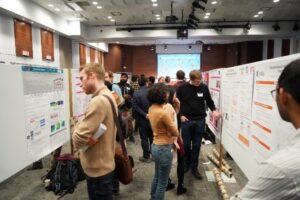
On Friday, February 22, 2019, the Vector Institute held its first-ever Research Symposium and Job Fair – one of the largest gatherings of machine learning talent across Canada. The one-day event showcased top research produced by Vector researchers over the last year. The event was an opportunity for local master’s students, PhD students and post-docs in the fields of machine learning and AI more broadly to connect with Vector’s industry and health partners and to discover a wide range of internship and career opportunities. The event, tailored for Vector’s indsutry sponsors and research community, had representatives from 20 Vector industry sponsors and health partners and over 300 attendees.
The symposium featured a presentation by Vector Faculty Member, David Duvenaud, on Neural Ordinary Differential Equations, work that was recognized with a Best Paper Award at NeurIPS 2018, which is one of the world’s largest flagship machine learning conferences. Hassan Ashtiani, previously a Postgraduate Affiliate at Vector, gave a presentation on Settling the sample complexity of GMMs via Compression Schemes.
Vector Research Symposium & Job Fair by the numbers
300+ attendees including master’s, PhDs, post-docs, faculty, and industry professionals
100 students currently enrolled in Vector- recognized programs and 31 Vector Scholarship in AI recipients
56 research posters
20 Vector Industry Sponsors and health partners with booths seeking to hire local AI talent
For job-seekers and researchers with expertise in machine learning and AI from across Canada, Vector’s Research Symposium & Job Fair was the place to be to expand their networks and meet potential collaborators or employers. Attendees included students and faculty from institutions across Canada and abroad, including:
Carleton University
Krembil Research Institute
Harvard University
Institute of Health Policy, Management and Evaluation
McGill University
McMaster University
Mila
Munzur University
Ontario Institute for Cancer Research
Queen’s University and Smith School of Business
Ryerson University
Sick Kids
Simon Fraser University
South China University of Technology
St. Michael’s Hospital
Sunnybrook Health Sciences Centre
Toronto Rehabilitation Institute
Université de Montréal
Universidad del Norte
University Health Network
University of British Columbia
University of New Hampshire
University of Ontario Institute of Technology
University of Ottawa
University of São Paolo
University of Toronto
University of Waterloo
UPC Barcelona
Western University (UWO)
York University and Schulich School of Business
In addition to the presentations, 56 research posters were on display, featuring work published by Vector researchers and the surrounding AI community in 2018. Many posters featured research that had been accepted by world-renowned conferences and journals and included topics ranging from classifying cancer types and animal identification to high accuracy trajectory tracking. For industry attendees, the poster sessions were an exclusive opportunity to gain exposure to a large concentration of Vector’s local machine learning faculty, graduate students and affiliates working on the latest machine learning advancements.
Throughout the day, students were also able to network with Canadian-based enterprises and startups seeking to hire machine learning and AI talent locally — an exclusive opportunity for Vector’s industry sponsors. Job openings ranged from opportunities in data science, analytics, and engineering, to project management.
Several of the Vector Institute’s industry sponsors and health partners who are at the forefront of AI adoption in Canada were present the Job Fair, including:
Accenture
Air Canada
Baycrest
Borealis AI
BMO Financial Group
CIBC
Deloitte
EY
Intact Insurance
Layer 6 AI
Loblaw Companies Ltd.
Manulife
NVIDIA
ROSS Intelligence
Scotiabank
Shopify Inc
Stradigi AI
Sun Life Financial
Thales Group
Thomson Reuters
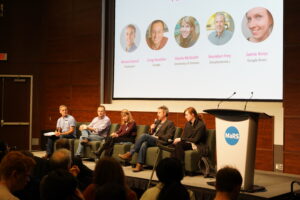
To wrap up the day, there was a lively panel discussion with Craig Boutilier (NeurIPS 2018 Best Paper winner, Google), Sheila McIlraith (University of Toronto and Vector Faculty Affiliate), Brendan Frey (Vector Co-founder, Deep Genomics), and Jamie Kiros (Google Brain), moderated by Vector’s own Research Director, Richard Zemel.
The panel explored big challenges facing machine learning and where the next breakthroughs will come from, diving into topics such as hybrid approaches to deep learning research, interpretability, and ethical AI.
Panel Highlights
The big challenges facing machine learning
The main theme of the panel was how ethics is currently lagging behind recent technological advancements. It was discussed how one of the causes is due to machine learning research being siloed from other fields of study where AI is applied, which presents multiple hurdles when conducting research. According to the panelists, another challenge facing machine learning is the fact that interactions in models are not very intelligent, and understanding how to have natural interactions remains a big challenge in research.
Hybrid approaches to deep learning research (i.e., probabilistic models and logical AI)
Panelists explained that a lot of machine learning techniques take advantage of hybrid approaches that include neural nets as a component. The panel also discussed how, in general, the research community does not talk enough about topics such as algorithms supporting real world decision-making and how machine translation revolutionized the field.
Interpretability
With respect to interpretability, the panel discussed how trust and control are the reasons behind the need for interpretability and how we usually rationalize decisions post-hoc as humans. This led to the question of a researcher’s ability/inability to know exactly what is happening in a model. In addition, one panelist explained that when creating a model, the creator should be able to explain decisions made on behalf of the user. Towards the end of the discussion, it was noted that researchers should have the end user in mind when thinking of what interpretability means because it can change in different contexts.
Ethical AI
The panelists talked about how it is important for researchers to have a solid belief architecture to orient them when designing algorithms.
It was also noted how ethical considerations are not unique to AI. Rather, it is an important issue in other fields, including computer science more broadly. To that end, the panelists expressed that researchers have a responsibility to educate students and build towards a better future for humanity. It was also noted that when faced with hard decisions on what should be researched, and questions about possible negative applications of a model, there is uncertainty about where a line should be drawn to account for a curiosity-danger tradeoff.
Ending on a positive note, the panel expressed that we now have better tools than ever before to take a shot at tackling the big challenges that were discussed. In response to an audience question, it was mentioned that although researchers should participate in an advisory role in public policy discussions, it should not be exclusively the scientific community that gates usage of models in decision-making.
Provide deep understanding of machine learning techniques, and know how to tune them for optimal performance…. From Indeed – Mon, 25 Mar 2019 18:22:59 GMT – View all Toronto, ON jobs
Posted by Łukasz Kaiser and Dumitru Erhan, Research Scientists, Google AI
Deep reinforcement learning (RL) techniques can be used to learn policies for complex tasks from visual inputs, and have been applied with great success to classic Atari 2600 games. Recent work in this field has shown that it is possible to get super-human performance in many of them, even in challenging exploration regimes such as that exhibited by Montezuma’s Revenge. However, one of the limitations of many state-of-the-art approaches is that they require a very large number of interactions with the game environment, often much larger than what people would need to learn to play well. One plausible hypothesis explaining why people learn these tasks so much more efficiently is that they are able to predict the effect of their own actions, and thus implicitly learn a model of which action sequences will lead to desirable outcomes. This general idea—building a so-called model of the game and using it to learn a good policy for selecting actions—is the main premise of model-based reinforcement learning (MBRL).
In “Model-Based Reinforcement Learning for Atari“, we introduce the Simulated Policy Learning (SimPLe) algorithm, an MBRL framework to train agents for Atari gameplay that is significantly more efficient than current state-of-the-art techniques, and shows competitive results using only ~100K interactions with the game environment (equivalent to roughly two hours of real-time play by a person). In addition, we have open sourced our code as part of the tensor2tensor open source library. The release contains a pretrained world model that can be run with a simple command line and that can be played using an Atari-like interface.
Learning a SimPLe World Model At a high-level, the idea behind SimPLe is to alternate between learning a world model of how the game behaves and using that model to optimize a policy (with model-free reinforcement learning) within the simulated game environment. The basic principles behind this algorithm are well established and have been employed in numerous recentmodel-basedreinforcementlearningmethods.
Main loop of SimPLe. 1) The agent starts interacting with the real environment. 2) The collected observations are used to update the current world model. 3) The agent updates the policy by learning inside the world model.
To train an Atari game playing model we first need to generate plausible versions of the future in pixel space. In other words, we seek to predict what the next frame will look like, by taking as input a sequence of already observed frames and the commands given to the game, such as “left”, “right”, etc. One of the important reasons for training a world model in observation space is that it is, in effect, a form of self-supervision, where the observations—pixels, in our case—form a dense and rich supervision signal.
If successful in training such a model (e.g. a video predictor), one essentially has a learned simulator of the game environment that can be used to generate trajectories for training a good policy for a gaming agent, i.e. choosing a sequence of actions such that long-term reward of the agent is maximized. In other words, instead of having the policy be trained on sequences from the real game, which is prohibitively intensive in both time and computation, we train the policy on sequences coming from the world model / learned simulator.
Our world model is a feedforward convolutional network that takes in four frames and predicts the next frame as well as the reward (see figure above). However, in the case of Atari, the future is non-deterministic given only a horizon of the previous four frames. For example, a pause in the game longer than four frames, such as when the ball falls out of the frame in Pong, can lead to a failure of the model to predict subsequent frames successfully. We handle stochasticity problems such as these with a new video model architecture that does much better in this setting, inspired by previouswork.
One example of an issue arising from stochasticity is seen when the SimPLe model is applied to Kung Fu Master. In the animation, the left is the output of the model, the middle is the groundtruth, and the right panel is the pixel-wise difference between the two. Here the model’s predictions deviate from the real game by spawning a different number of opponents.
At each iteration, after the world model is trained, we use this learned simulator to generate rollouts (i.e. sample sequences of actions, observations and outcomes) that are used to improve the game playing policy using the Proximal Policy Optimization (PPO) algorithm. One important detail for making SimPLe work is that the sampling of rollouts starts from the real dataset frames. Because prediction errors typically compound over time and make long-term predictions very difficult, SimPLe only uses medium-length rollouts. Luckily, the PPO algorithm can learn long-term effects between actions and rewards from its internal value function too, so rollouts of limited length are sufficient even for games with sparse rewards like Freeway.
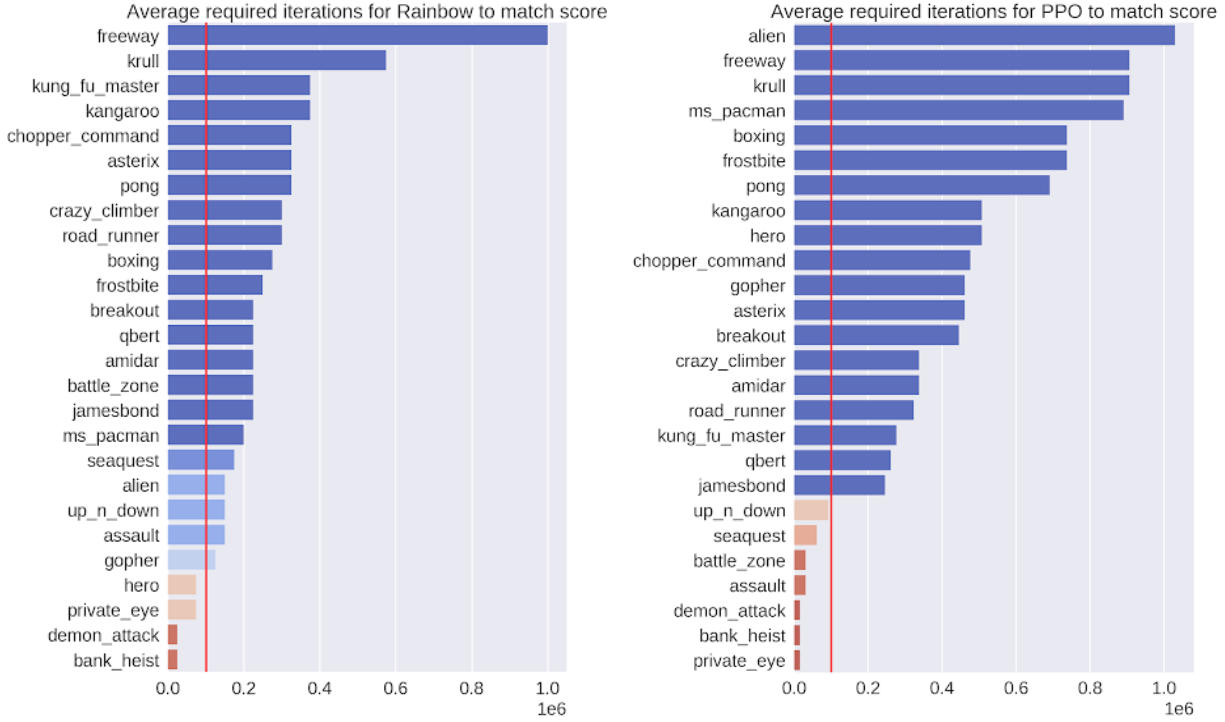
SimPLe Efficiency One measure of success is to demonstrate that the model is highly efficient. For this, we evaluated the output of our policies after 100K interactions with the environment, which corresponds to roughly two hours of real-time game play by a person. We compare our SimPLe method with two state of the art model-free RL methods, Rainbow and PPO, applied to 26 different games. In most cases, the SimPLe approach has a sample efficiency more than 2x better than the other methods.
The number of interactions needed by the respective model-free algorithms (left – Rainbow; right – PPO) to match the score achieved using our SimPLe training method. The red line indicates the number of interactions used by our method.
SimPLe Success An exciting result of the SimPLe approach is that for two of the games, Pong and Freeway, an agent trained in the simulated environment is able to achieve the maximum score. Here is a video of our agent playing the game using the game model that we learned for Pong:
For Freeway, Pong and Breakout, SimPLe can generate nearly pixel-perfect predictions up to 50 steps into the future, as shown below.
Nearly pixel perfect predictions can be made by SimPLe, on Breakout (top) and Freeway (bottom). In each animation, the left is the output of the model, the middle is the groundtruth, and the right pane is the pixel-wise difference between the two.
SimPLe Surprises SimPLe does not always make correct predictions, however. The most common failure is due to the world model not accurately capturing or predicting small but highly relevant objects. Some examples are: (1) in Atlantis and Battlezone bullets are so small that they tend to disappear, and (2) Private Eye, in which the agent traverses different scenes, teleporting from one to the other. We found that our model generally struggled to capture such large global changes.
In Battlezone, we find the model struggles with predicting small, relevant parts, such as the bullet.
Conclusion The main promise of model-based reinforcement learning methods is in environments where interactions are either costly, slow or require human labeling, such as many robotics tasks. In such environments, a learned simulator would enable a better understanding of the agent’s environment and could lead to new, better and faster ways for doing multi-task reinforcement learning. While SimPLe does not yet match the performance of standard model-free RL methods, it is substantially more efficient, and we expect future work to further improve the performance of model-based techniques.
If you’d like to develop your own models and experiments, head to our repository and colab where you’ll find instructions on how to reproduce our work along with pre-trained world models.
Acknowledgements This work was done in collaboration with the University of Illinois at Urbana-Champaign, the University of Warsaw and deepsense.ai. We would like to give special recognition to paper co-authors Mohammad Babaeizadeh, Piotr Miłos, Błażej Osiński, Roy H Campbell, Konrad Czechowski, Chelsea Finn, Piotr Kozakowski, Sergey Levine, Ryan Sepassi, George Tucker and Henryk Michalewski.
The Vector Institute congratulates the newest members of its research community on being accepted into the 2019 Vector Institute Postgraduate Affiliate Program. Established in 2018, the program is intended to promote engagement and collaborations among researchers who are early in their careers, with the broader artificial intelligence (AI) community.
Vector’s new Postgraduate Affiliates (consisting of graduate students or postdoctoral fellows) will join a vibrant community of innovative problem solvers, bringing with them expertise in cancer genomics, computer vision, hardware, medical imaging, nanobiophysics, optimization, radiation, smart home systems, robotics and quantum physics. They hail from a broad cross-section of Ontario universities and institutions including the Ontario Institute for Cancer Research, Princess Margaret Cancer Centre, Ryerson University, Hospital for Sick Children, Toronto Rehabilitation Institute, University of Ontario Institute of Technology (UOIT), University of Toronto, University of Waterloo and Western University.
Vector received an overwhelming response to our call for applications, and competition for the limited number of positions was fierce. Applicants were evaluated and selected according to the strength of their past research contributions and the alignment of their interests with Vector’s vision, mission, and research strengths. The acceptance rate for the 2019 program was 8.6%, demonstrating the high caliber of researchers within the incoming cohort.
The new Postgraduate Affiliates will work alongside continuing members of the 2018 program cohort. The Vector Institute is also excited to celebrate the successes of graduating members of the 2018 Postgraduate Affiliates Program who have gone on to accept positions at leading tech companies in Canada such as RBC Borealis, Thales and Intel, as well as faculty/scientist positions at McMaster University, the Toronto Rehabilitation Institute and the University of Manitoba.
Welcome to the 2019 Vector Institute Postgraduate Affiliates
Anastasia Razdaibiedina, University of Toronto
Anjali Silva, Princess Margaret Cancer Centre – University Health Network
Anna Golubeva, University of Waterloo – Perimeter Institute
Buser Say, University of Toronto
Kyle Mills, University of Ontario Institute of Technology
Lee Clement, University of Toronto
Lydia Y. Liu, Ontario Institute for Cancer Research
Lina Tran, The Hospital for Sick Children
Marie-Julie Favé, Ontario Institute for Cancer Research
Martin Magill, University of Ontario Institute of Technology
Matthew Giamou, University of Toronto
Matthew J. S. Beach, University of Waterloo – Perimeter Institute
Md Amirul Islam, Ryerson University
Michael Ridley, Western University
Muhammad Raisul Alam, University of Toronto
Rafid Mahmood, University of Toronto
Sayeh Sharifymoghaddam, University of Toronto
Xingyu Li, University of Toronto
Zhaleh Safikhani, Princess Margaret Cancer Centre – University Health Network
About Research at Vector Institute:
Since its launch in 2017, the Vector Institute has grown into a community of more than 260 researchers, including faculty, postdocs, students and affiliates. Over the last year, they have published more than 100 papers, many featured in top machine learning conferences and journals. Vector researchers often receive top awards for their scientific contributions and have been named as top innovators on Canada’s Top 40 Under 40 list and by MIT Technology Review. Together, they are working to achieve Vector’s vision to drive excellence and leadership in Canada’s knowledge, creation, and use of AI to foster economic growth and improve the lives of Canadians.
 Erkan Tas is a Sr. Product Manager for Amazon SageMaker. He is on a mission to make Artificial Intelligence easy, accessible, and scalable through cloud platforms. He is also a sailor, science and nature admirer, Go and Stratocaster player.