Blog

Learn About Our Meetup

5000+ Members

MEETUPS

LEARN, CONNECT, SHARE

Join our meetup, learn, connect, share, and get to know your Toronto AI community. 

JOB POSTINGS

INDEED POSTINGS

Browse through the latest deep learning, ai, machine learning postings from Indeed for the GTA.

CONTACT

CONNECT WITH US

Are you looking to sponsor space, be a speaker, or volunteer, feel free to give us a shout.

Author: torontoai

[R] Developing Tech Ethically

Hey all!

I’m running a tech ethics study and I’d love feedback if anyone has a minute to spare!

With companies like Facebook spiraling in the media, I thought it was time to open up the floor for discussion that leads to actual change. The goal of the survey is to write an article to create more discussion around ethics, but the bigger goal is to eventually pitch Apple/Google with solutions. Which is why a diverse set of opinions is so important here.

Short survey: https://docs.google.com/forms/d/18d5twj61AHDt8fmK1xXvIDlw4rOcsupqcpLkBaFZSlQ/edit#responses

(Results will be shared after the article’s completion , or via email if you choose to submit an address.)

submitted by /u/clite31
[link] [comments]

[R] Is Elmo equivalent to Fasttext+Bi-directional GRU?

From what I have read, Elmo uses bi-directional LSTM layers to give contextual embeddings for words in a sentence. So if I use a bi-directional LSTM/GRU layer over Fasttext representations of words, will it be the same? If not why? (I know that Fasttext works at the sub-word level while Elmo works at character level)

Also, does it make sense to use a bi-directional LSTM/GRU layer over the representations produced by Elmo?

The task that I am working on is extreme multi-label classification of documents.

submitted by /u/atif_hassan
[link] [comments]

[R] Seeking model makers for a research interview (comp provided)

Hello all,

We are working with a client who would like to better understand machine learning/deep learning “model consumers.” We define a model consumer as someone who finds, builds on, and tweaks models made by others for his/her own needs.

We are seeking research participants that:

• Are model “consumers” at least half the time (as opposed to only model makers)

• Work directly with machine or deep learning technologies

• Consider themselves end users for apps or tools for building solutions using ML/DL (e.g. TensorFlow, PyTorch, Keras, etc.)

• Typically try to resolve questions on data sets via ML

• Are involved in training models, etc.

• Are applying ML/DL for profit, startup, commercial, or governmental applications (i.e. not university setting)

• Are not employees of Microsoft Azure, Google AI, Amazon Sagemaker, IBM, Data Robot, XILINX

We are conducting 90-minute interviews with a compensation (based on experience) for your/their time. These interviews will be done via Google Hangouts. The first 45 minutes is Q&A. The last 45 minutes is getting feedback on conceptual screens. I know this seems like a long time, but deep learning requires deep discussion.

I would appreciate any leads that fit the above.

Thanks everyone

submitted by /u/BTV-Texas
[link] [comments]

Startup Takes On Cancer Treatment Procedure With Quadro RTX-Powered AI

As more physicians turn to the latest advancements in technology to improve medical practices, one company is bringing the power of AI to the fight against cancer.

Most people know that chemotherapy and surgery are used to treat cancer, but thermal ablation is often under the radar. It’s a minimally invasive process that applies intense heat to tissue to remove early-stage tumors.

Thermal ablation is a safe, effective procedure that’s quickly becoming one of the best alternative treatments for cancer, especially for patients who are unable to undergo surgery.

To date, doctors performing thermal ablation typically haven’t had the tools to visualize or control the damage created during the procedure. This means tumor removal could be incomplete or healthy tissue could be harmed. Plus, physicians needed to wait up to 24 hours to see how effective the procedure was on the targeted tissue.

To address this challenge, Israel-based company TechsoMed has developed BioTrace, the world’s first real-time monitoring and control system for thermal ablation.

With the help of NVIDIA Quadro RTX 8000 GPUs, BioTrace uses AI algorithms applied to image data from ultrasound devices to perform monitoring and analysis during thermal ablation procedures.

The technology tracks the real-time biological response of the tissue so physicians can have better visibility and understand the results of the cancer treatment as it’s performed.

RTX Brings Real-Time Results 

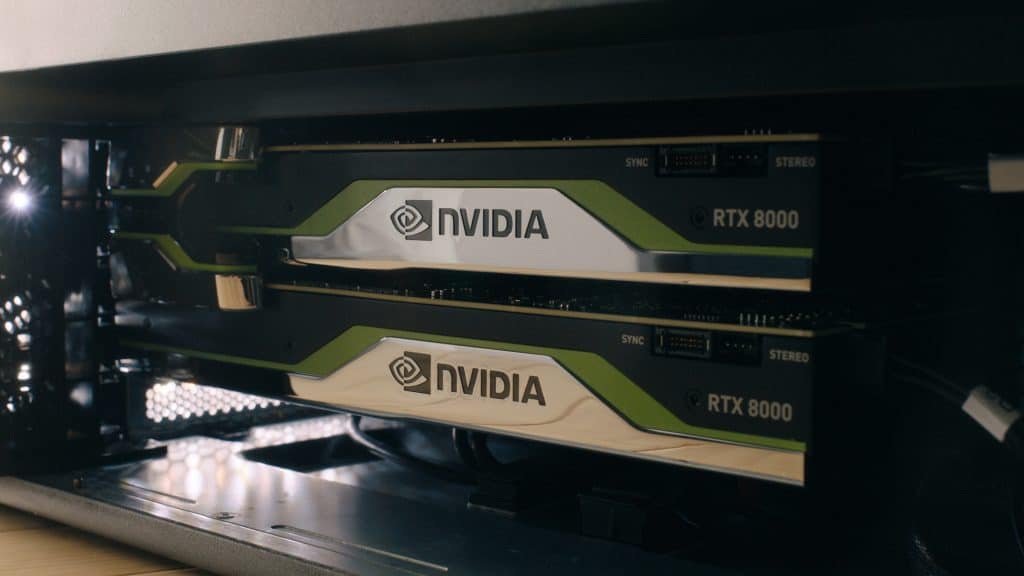
For BioTrace to process data instantly and provide real-time feedback, TechsoMed runs advanced AI algorithms using dual NVIDIA Quadro RTX 8000 graphics packed inside a Lenovo ThinkStation P920 workstation.

Quadro RTX 8000 is the world’s most powerful GPU based on NVIDIA’s latest Turing architecture and features Tensor Cores specifically designed to accelerate AI algorithms.

TechsoMed uses two RTX 8000 GPUs paired with NVIDIA NVLink high-speed interconnect technology to scale up performance and memory capacity to 96GB, which is critical when working with massive image data in real time.

“BioTrace is taking the guesswork out of ablation procedures through AI algorithms and image processing technologies, and the NVIDIA RTX GPUs help make it possible,” said Yossi Abu, founder and CEO of TechsoMed. “By defining the exact algorithm practitioners need to visualize the results, RTX enables our work to bring thermal ablation procedures to a new level.”

The real-time feedback from BioTrace brings benefits such as faster recovery, fewer potential complications and less damage to surrounding healthy tissue. With RTX powering their simulations, doctors can take advantage of higher resolution images and real-time feedback to improve accuracy and minimize damage.

Find more information about TechsoMed’s BioTrace or learn more about NVIDIA RTX.

The post Startup Takes On Cancer Treatment Procedure With Quadro RTX-Powered AI appeared first on The Official NVIDIA Blog.

Innovations in Graph Representation Learning

Relational data representing relationships between entities is ubiquitous on the Web (e.g., online social networks) and in the physical world (e.g., in protein interaction networks). Such data can be represented as a graph with nodes (e.g., users, proteins), and edges connecting them (e.g., friendship relations, protein interactions). Given the widespread prevalence of graphs, graph analysis plays a fundamental role in machine learning, with applications in clustering, link prediction, privacy, and others. To apply machine learning methods to graphs (e.g., predicting new friendships, or discovering unknown protein interactions) one needs to learn a representation of the graph that is amenable to be used in ML algorithms.

However, graphs are inherently combinatorial structures made of discrete parts like nodes and edges, while many common ML methods, like neural networks, favor continuous structures, in particular vector representations. Vector representations are particularly important in neural networks, as they can be directly used as input layers. To get around the difficulties in using discrete graph representations in ML, graph embedding methods learn a continuous vector space for the graph, assigning each node (and/or edge) in the graph to a specific position in a vector space. A popular approach in this area is that of random-walk-based representation learning, as introduced in DeepWalk.
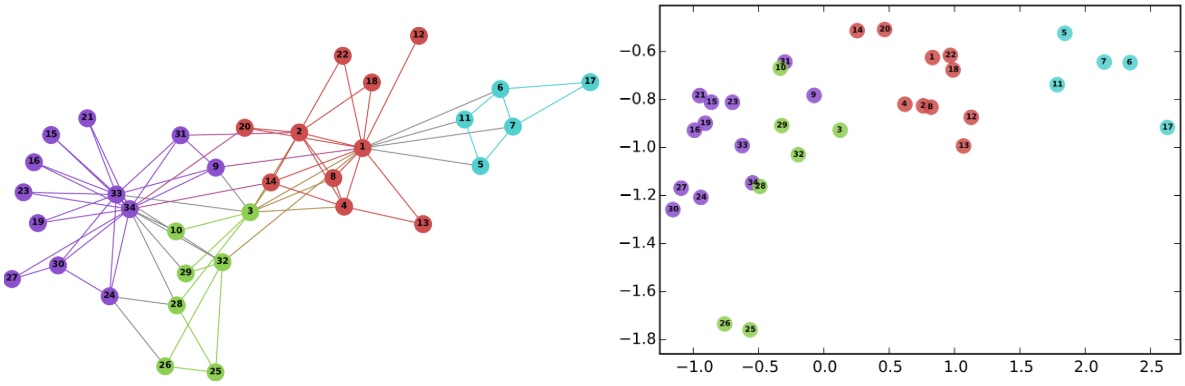
Left: The well-known Karate graph representing a social network. Right: A continuous space embedding of the nodes in the graph using DeepWalk.

Here we present the results of two recent papers on graph embedding: “Is a Single Embedding Enough? Learning Node Representations that Capture Multiple Social Contexts” presented at WWW’19 and “Watch Your Step: Learning Node Embeddings via Graph Attention” at NeurIPS’18. The first paper introduces a novel technique to learn multiple embeddings per node, enabling a better characterization of networks with overlapping communities. The second addresses the fundamental problem of hyperparameter tuning in graph embeddings, allowing one to easily deploy graph embeddings methods with less effort. We are also happy to announce that we have released the code for both papers in the Google Research github repository for graph embeddings.

Learning Node Representations that Capture Multiple Social Contexts
In virtually all cases, the crucial assumption of standard graph embedding methods is that a single embedding has to be learned for each node. Thus, the embedding method can be said to seek to identify the single role or position that characterizes each node in the geometry of the graph. Recent work observed, however, that nodes in real networks belong to multiple overlapping communities and play multiple roles—think about your social network where you participate in both your family and in your work community. This observation motivates the following research question: is it possible to develop methods where nodes are embedded in multiple vectors, representing their participation in overlapping communities?

In our WWW’19 paper, we developed Splitter, an unsupervised embedding method that allows the nodes in a graph to have multiple embeddings to better encode their participation in multiple communities. Our method is based on recent innovations in overlapping clustering based on ego-network analysis, using the persona graph concept, in particular. This method takes a graph G, and creates a new graph P (called the persona graph), where each node in G is represented by a series of replicas called the persona nodes. Each persona of a node represents an instantiation of the node in a local community to which it belongs. For each node U in the graph, we analyze the ego-network of the node (i.e., the graph connecting the node to its neighbors, in this example A, B, C, D) to discover local communities to which the node belongs. For instance, in the figure below, node U belongs to two communities: Cluster 1 (with the friends A and B, say U’s family members) and Cluster 2 (with C and D, say U’s colleagues).
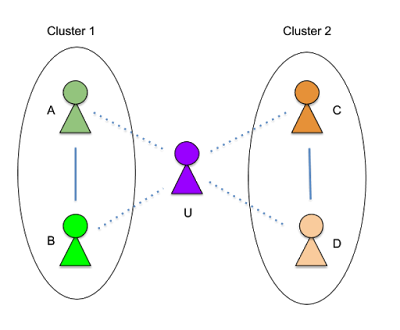
Ego-net of node U

Then, we use this information to “split” node U into its two personas U1 (the family persona) and U2 (the work persona). This disentangles the two communities, so that they no longer overlap.
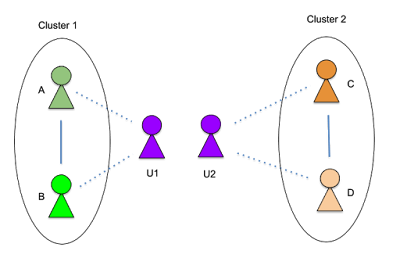
The ego-splitting method separating the U nodes in 2 personas.

This technique has been used to improve the state-of-the-art results in graph embedding methods, showing up to 90% reduction in link prediction (i.e., predicting which link will form in the future) error on a variety of graphs. The key reason for this improvement is the ability of the method to disambiguate highly overlapping communities found in social networks and other real-world graphs. We further validate this result with an in-depth analysis of co-authorship graphs where authors belong to overlapping research communities (e.g., machine learning and data mining).

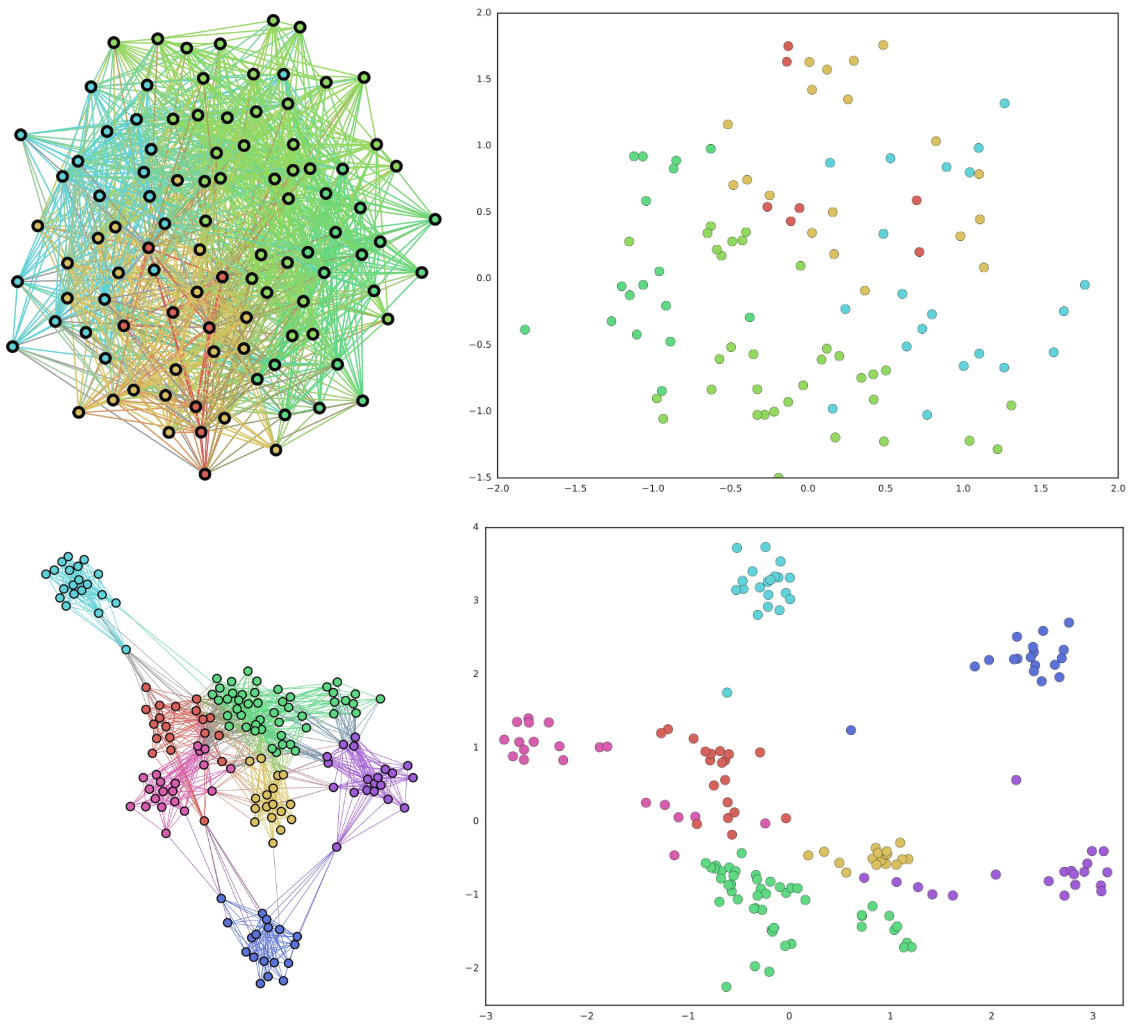
Top Left: A typical graphs with highly overlapping communities. Top Right: A traditional embedding of the graph on the left using node2vec. Bottom Left: A persona graph of the graph above. Bottom Right: The Splitter embedding of the persona graph. Notice how the persona graph clearly disentangles the overlapping communities of the original graph and Splitter outputs well-separated embeddings.

Automatic hyper-parameter tuning via graph attention.
Graph embedding methods have shown outstanding performance on various ML-based applications, such as link prediction and node classification, but they have a number of hyper-parameters that must be manually set. For example, are nearby nodes more important to capture when learning embeddings than nodes that are further away? Even though experts may be able to fine tune these hyper-parameters, one must do so independently for each graph. To obviate such manual work, in our second paper, we proposed a method to learn the optimal hyper-parameters automatically.

Specifically, many graph embedding methods, like DeepWalk, employ random walks to explore the context around a given node (i.e. the direct neighbors, the neighbors of the neighbors, etc). Such random walks can have many hyper-parameters that allow tuning of the local exploration of the graph, thus regulating the attention given by the embeddings to nearby nodes. Different graphs may present different optimal attention patterns and hence different optimal hyperparameters (see the picture below, where we show two different attention distributions). Watch Your Step formulates a model for the performance of the embedding methods based on the above mentioned hyper-parameters. Then we optimize the hyper-parameters to maximize the performance predicted by the model, using standard backpropagation. We found that the values learned by backpropagation agree with the optimal hyper-parameters obtained by grid search.
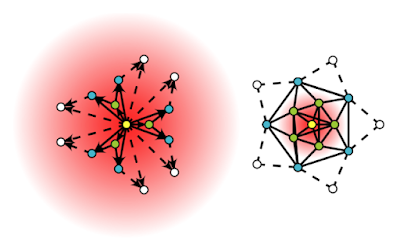
Our new method for automatic hyper-parameter tuning, Watch Your Step, uses an attention model to learn different graph context distributions. Shown above are two example local neighborhoods about a center node (in yellow) and the context distributions (red gradient) that was learned by the model. The left-side graph shows a more diffused attention model, while the distribution on the right shows one concentrated on direct neighbors.

This work falls under the growing family of AutoML, where we want to alleviate the burden of optimizing the hyperparameters—a common problem in practical machine learning. Many AutoML methods use neural architecture search. This paper instead shows a variant, where we use the mathematical connection between the hyperparameters in the embeddings and graph-theoretic matrix formulations. The “Auto” portion corresponds to learning the graph hyperparameters by backpropagation.

We believe that our contributions will further advance the state of the research in graph embedding in various directions. Our method for learning multiple node embeddings draws a connection between the rich and well-studied field of overlapping community detection, and the more recent one of graph embedding which we believe may result in fruitful future research. An open problem in this area is the use of multiple-embedding methods for classification. Furthermore, our contribution on learning hyperparameters will foster graph embedding adoption by reducing the need for expensive manual tuning. We hope the release of these papers and code will help the research community pursue these directions.

Acknowledgements
We thank Sami Abu-el-Haija who contributed to this work and is now a Ph.D. student at USC.

How Siemens Healthineers Is Streamlining Cancer Therapy with AI

Cancer incidence rates are on the rise — expected to increase by 63 percent over the next two decades. To meet the growing demand for care, medical technology leaders are turning to AI tools that can help radiation oncologists provide high-quality, individualized treatment faster.

One of the world’s leading healthcare companies, Siemens Healthineers, is using an NVIDIA GPU-based supercomputing infrastructure to develop AI software for generating organ segmentations that enable precision radiation therapy.

Siemens Healthineers’ Sherlock AI supercomputer is powered by NVIDIA HGX 1 and HGX 2 servers loaded with NVIDIA V100 Tensor Core GPUs. The system provides 20 petaflops of performance and is used to run over 500 AI experiments daily.

Both Siemens Healthineers and NVIDIA this week are sharing their latest work in AI for medical imaging at the Society for Imaging Informatics in Medicine annual conference, held outside Denver, Colorado. The event brings together the medical informatics community to share, debate, and address the challenges and opportunities facing medical imaging.

Augmenting Radiation Therapy Workflows

Radiation therapy for cancer patients is a complex workflow that includes modeling the patient, contouring the target and organs at risk, simulating the treatment, planning and delivering the treatment.

One of the most time-consuming tasks in this process is protecting the healthy organs at risk that surround a patient’s tumor and need to be spared from excessive radiation dose. Traditionally, radiation oncologists contour the tumor target volume and organs at risk, deciding how much radiation should be used to treat tumors without damaging neighboring normal tissue.

To help oncologists develop radiation treatment plans faster, Siemens Healthineers uses syngo.via RT Image Suite, a software tool that automatically outlines organs using AI-assisted AutoContouring. Trained on over 4.5 million images using the Sherlock supercomputer, the AI model saves radiation-oncologist time and eases organs-at-risk contouring tasks. In their current research, Siemens Healthineers automatically outlines 28 organs using AI technology.

“AI-assisted AutoContouring helps save time and improve standardization in organ at risk contouring,” said Dr. Fernando Vega, Head of Software and Concept Definition for Radiation Oncology at Siemens Healthineers. “This allows radiation-oncologists to better focus on other crucial aspects of patient care.”

Tapping into Software To Write Software 

Behind this explosion of AI in medical imaging is a new dynamic within the software development paradigm: the advent of software that writes other software.

Traditionally, engineers have written applications from start to finish, a time-consuming process that requires niche computing expertise. Now, with access to powerful compute resources, AI algorithms can leverage training data to learn processes like medical image analysis without every element being explicitly coded by a developer.

Siemens Healthineers, which has been involved in machine learning since the 1990s, is harnessing this AI capability with the Sherlock system. The supercomputer learns from the company’s massive data lake of over 750 million curated images as well as radiology reports and clinical and genomic data. So far, it has led to the development of more than 40 AI-powered applications approved for clinical use.

“We believe that AI is starting a new era in software development, where advanced neural network architectures, large collections of curated data, and massive computational power come together to deliver tremendous performance and high clinical value,” said Dr. Dorin Comaniciu, Senior Vice President of artificial intelligence and digital innovation at Siemens Healthineers.

Simple and Scalable Infrastructure

Siemens Healthineers’ 20 petaflop Sherlock supercomputer addresses a key computing need in the healthcare industry for an optimized and scalable infrastructure that can be used to develop deep learning tools for imaging and other clinical applications.

The NVIDIA DGX POD reference architecture provides a tested infrastructure for setting up a scalable AI computing system. Through the DGX-Ready Data Center program, NVIDIA and its colocation service providers offer simplified, rapid deployment for customers building and deploying world-class AI data centers for the healthcare industry.

For more on how NVIDIA’s AI  platform is enabling advances in medicine and research, see the NVIDIA Healthcare page.

The post How Siemens Healthineers Is Streamlining Cancer Therapy with AI appeared first on The Official NVIDIA Blog.

[D] Help with the structure of LSTM networks

I’ve gotten fairly interested in neural networks and machine learning, and wanted to learn more about them. So, what better way to do that than to make some yourself? I didn’t want to use already existing libraries, like TensorFlow, to do it. I wanted to learn how to make one, from the ground up. So, I set out to make a library of my own in C#. Things have gone well. I’ve tried various types of networks, and I’ve gotten them to work. But, recently, I decided that I wanted to try out RNN/LSTM. This is where I’ve gotten a bit stuck.

I understand the concept of it, the math of it is clear to me. However, I am having some difficulties in getting the architecture of it all laid out. Most of the models I’ve seen of a RNN/LSTM use only one input. Or, at least, that’s how I’ve interpreted it, and I may be wrong.

Additionally, how do you size the layers? From what I’ve gathered, each LSTM “gate” is its own layer. If you want to use more than 1 point of data, do you line up several of those gates and connect the output from gate 1 to gate 2, and add the 2nd point of input to gate 2?

Most of the research that I’ve found on neural networks have been pretty straightforward, and I’ve been able to apply it fairly easily. But, when it comes to RNN/LSTM, I haven’t been able to find much. Most of the help out there is related to TensorFlow, and doesn’t tell me the fundamental structure of the network. And the ones that I’ve found on the fundamental structure of the network all seem to contradict each other, so I’m left scratching my head.

I figured if anyone could help me out with this, it would be the good people of this subreddit. Any help would be appreciated!

submitted by /u/SocioButt
[link] [comments]

[Discussion] Scaling a massive Deep Learning model. Opinions on the method described?

Hi, r/MachineLearning,

A week ago, at Hugging Face, we released an app which works with GPT-2 to provide a helper when writing texts. It required using GPT-2 as a backend, which is a very heavy model (the medium-sized one weighs 1.7GB).

I wrote a Medium article detailing the approach we took to scale it and to stay online for the ~10,000 users we had in the first few days. I would really like to know your opinion on the matter and if you have used other methods to take full advantage of the machines you were running your model on.

Here is the Medium post.

What do you think?

submitted by /u/jikkii
[link] [comments]