
Blog

Learn About Our Meetup

5000+ Members

MEETUPS

LEARN, CONNECT, SHARE

Join our meetup, learn, connect, share, and get to know your Toronto AI community. 

JOB POSTINGS

INDEED POSTINGS

Browse through the latest deep learning, ai, machine learning postings from Indeed for the GTA.

CONTACT

CONNECT WITH US

Are you looking to sponsor space, be a speaker, or volunteer, feel free to give us a shout.

Author: torontoai

Voicing play with Volley, where words are the gameboard and Amazon Polly brings the fun

Voice-powered experiences are gaining traction and customer love. Volley is at the cutting edge of voice-controlled entertainment with its series of popular smart-speaker games, and many aspects of Volley rely on Amazon Polly.

Every day, more and more people switch on lights, check the weather, and play music not by pushing buttons but with verbal commands to smart speakers. Volley is a San Francisco–based startup co-founded in 2016 by former Harvard roommates Max Child (CEO) and James Wilsterman (CTO). They’re on a mission to use smart speakers as the basis for building fun experiences.

Volley creates games of all sorts, from song quizzes to political satire to role-playing games. Many of the latter, such as “Yes Sire,” feature choose-your-own-adventure style games, in which infinite dialogue permutations can flow from each player’s choices. Volley relies heavily on Amazon Polly to enable these growing dialogue permutations amid multiple characters’ interactions.

“We associate each character with a particular Amazon Polly voice,” said Wilsterman. “Our on-the-fly TTS generation only works because Amazon Polly’s text-to-speech API latency is low enough to be essentially imperceptible to the user.”

From a cost perspective, the comparison is a no-brainer: hiring voice actors to voice the games would be a thousand times more expensive (literally–Volley ran the numbers). Amazon Polly has reaction speed nailed, with faster reactions than a human option. It also provides more diverse characters and reactions than recorded, scripted voice actors.

“We want our games to showcase diverse, memorable characters,” said Wilsterman. “We appreciate that Amazon Polly supports many different languages, accents, and age ranges to help us in that effort.” For example, Amazon Polly’s built-in German language support proved essential to Volley’s recent launch of a localized version of “Yes Sire” for Germany (called “Ja Exzellenz”).

Along with Amazon Polly, many other AWS services support Volley’s fun and games. This platform choice dates to Volley’s beginnings, when the co-founders were looking for the best services to host backend game logic and store persistent customer data.

“We realized quickly that AWS Lambda and Amazon DynamoDB would be ideal options,” said Wilsterman. He soon discovered that AWS also offered appealing scalability and affordability. The Volley team now uses Lambda not only to host the backend logic for their games but also to host a variety of internal tools and microservices deployed through Lambda functions.

DynamoDB supports Volley’s games by storing persistent data like users’ scores and levels, so they can return to the games and pick up right where they left off. And many of the in-game assets are stored in Amazon S3, which makes them instantly accessible to the backend Lambda functions. All those pieces are visualized together in the following workflow diagram.
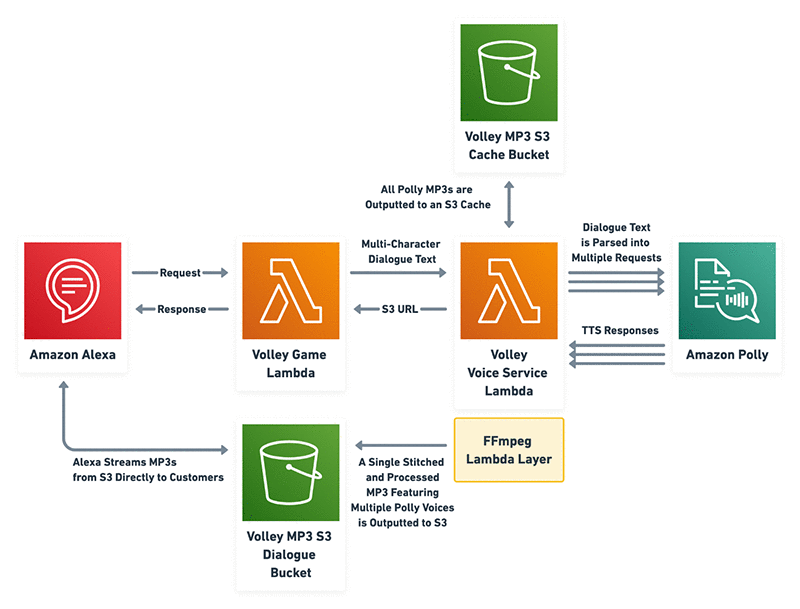
Volley recently added a layer of sophistication to its machine learning work with Amazon SageMaker. They’re using Amazon SageMaker to strengthen their business by understanding user behavior and promoting their games accordingly. Specifically, the Volley team faces a bit of challenge because users don’t carry persistent tags. So, if someone finishes playing “World Detective” and immediately starts to play “Castle Master,” there is no way to identify that they’re the same user.

As a result, the Volley team must find creative ways to measure the impact of their cross-promotional efforts. With Amazon SageMaker, they can predictively generate the outcomes of their marketing based on the active users of each of the games and the timestamps. That helps them make sure that future marketing is better-targeted—and that future games meet the audience trends that Volley is seeing.

As Volley continues to expand its repertoire, the team is also considering new directions beyond sheer entertainment. “Self-improvement is an interesting space, like meditation, fitness, and other coaches,” said Wilsterman. “Also, learning and teaching. We are constantly asking, ‘What new experiences can be possible with voice as an input?’”

No matter what Volley chooses to pursue next, one thing is for sure: their cloud platform of choice. “The entire architecture runs on AWS; we use it for everything from storage to machine learning,” said Wilsterman.


About the Author

Marisa Messina is on the AWS ML marketing team, where her job includes identifying the most innovative AWS-using customers and showcasing their inspiring stories. Prior to AWS, she worked on consumer-facing hardware and then university-facing cloud offerings at Microsoft. Outside of work, she enjoys exploring the Pacific Northwest hiking trails, cooking without recipes, and dancing in the rain.


[D] How to manage scheduling of multiple interviews in order to be able to negotiate simultaneously?

I’ve seen some posts on this sub about people interviewing simultaneously at multiple companies, and then getting to simultaneously negotiate with all of them.

However, they never tell you how they got multiple companies with diversely different interview processes and timelines to schedule the interviews such that they all fall within the same timeframe, and as a result it enabled them to be able to get multiple offers at the same time, and negotiate their way up to the best salary.

I never seem to be able to optimize the interview process timeline. I end up with exploding offers from a couple of companies, while I’m still waiting on another company to arrange their 2nd interview with me. I have multiple questions:

  1. How do you people do this?
  2. When do you make your applications? How do you time it?
  3. Do you deliberately not respond to a(n exploding) offer until you hear back from the other companies you’re also interviewing with?
  4. Do you have such a high risk tolerance that you’d jeopardize an offer being withdrawn while you’re waiting around for the other companies to throw an offer at you?
  5. How do you manage to do all this without coming across as rude, inconsiderate, unreliable, or uninterested?

submitted by /u/LaMasterShredder
[link] [comments]

[D] The 5th Place Approach to the 2019 ACM Recsys Challenge by Team RosettaAI

Just finished the writeup for our 5th place solution in the 2019 ACM RecSys Challenge! This blog post will talk about the datasets, the loss function, the Neural Networks architecture, and feature engineering. Hope you enjoy it 🙂

https://blog.rosetta.ai/the-5th-place-approach-to-the-2019-acm-recsys-challenge-by-team-rosettaai-eb3c4e6178c4

submitted by /u/steeveHuang
[link] [comments]

NVIDIA DGX-Ready Program Goes Global, Doubles Colocation Partners

To help businesses deploy AI infrastructure to power their most important opportunities, our DGX-Ready Data Center program is going global. We’ve also added new services that will help organizations accelerate their progress.

We’ve added to the program three new partners in Europe, five in Asia and two in North America. With these additions, customers now have access to a global network of 19 validated partners around the world.

DGX-Ready Data Center partners help companies access modern data center facilities for their AI infrastructure. They offer world-class facilities to host DGX AI compute infrastructure, giving more organizations access to AI-ready data center facilities while saving on capital expenditures and keeping operational costs low.

The program is now offered in 24 markets, including Australia, Austria, Brazil, Canada, China, Colombia, Denmark, France, Germany, Hong Kong, Iceland, Ireland, Italy, Japan, the Netherlands, Peru, Singapore, South Korea, Spain, Sweden, Switzerland, Turkey, the United Kingdom and the United States — with more coming soon.

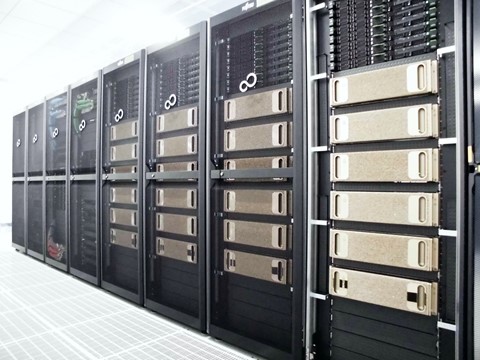
Among the new locations is the Fujitsu Yokohama Data Center in Japan, which hosts dozens of NVIDIA AI systems.

“The Fujitsu Yokohama Data Center hosts more than 60 NVIDIA DGX-1 and DGX-2 systems,” said Hisaya Nakagawa, director at Fujitsu. “As a DGX-Ready Data Center program partner, we’re able to offer customers our world-class, state-of-the-art facility to run their most important AI workloads. With this program, customers can operationalize AI infrastructure swiftly and enjoy a jumpstart on their business transformation.”

DGX-Ready Program
Among the new DGX-Ready colocation partners is Fujitsu, equipped with more than 60 NVIDIA DGX-1 and DGX-2 systems in the Fujitsu Yokohama Data Center in Japan. Image courtesy of Fujitsu Ltd.

Enhanced Services That Accelerate Time to Insight

In addition to access to a world-class data center, the DGX-Ready Data Center program offers services that can reduce the risks of new infrastructure investment.

Select DGX-Ready colocation partners are adding “try-and-buy” options that let enterprises “test drive” their DGX infrastructure. Customers can gain valuable operational experience before they decide to deploy these systems in their own data center. Core Scientific and Flexential are among the first partners to offer this capability.

Additionally, select partners offer GPU-as-a-service options that let businesses access DGX-powered compute in an affordable model, without committing to a full system.

Mobile game developer Jam City is taking advantage of this capability to accelerate game development using Core Scientific’s AI-Optimized Cloud, powered by NVIDIA DGX.

“We’re relying on machine learning and artificial intelligence to guide game design and transform our business,” said Rami Safadi, chief data officer at Jam City. “Core Scientific’s cloud has enhanced how we utilize data and allowed us to analyze billions of rows of data per day. We’ve seen an 8x increase in speed, enabling us to train an entirely new set of winning AI business models.”

Meet the Perfect DGX-Ready Partner Fast

With the many options for AI infrastructure hosting, it’s important to choose a colocation partner that suits your needs.

To make it simpler, we’ve introduced the DGX-Ready Data Center portal, which lets customers search our global network of providers, filtered by region, supported systems and enhanced services. The portal make it faster and easier to find the perfect match.

The post NVIDIA DGX-Ready Program Goes Global, Doubles Colocation Partners appeared first on The Official NVIDIA Blog.

Get Your Fashion Fix: Stitch Fix Adds AI Flair to Your Closet

Some say style never fades, and now with the help of AI, finding one’s fashion sense is about to get a whole lot easier.

Fashion ecommerce startup Stitch Fix is piecing together a seamless balance between AI-powered decision making and human judgement.

“We really want to be a partner and personal stylist for people over a long period of time,” said Stitch Fix’s Chief Algorithms Officer Brad Klingenberg in a conversation with AI Podcast host Noah Kravitz.

“A lot of our clients find it really rewarding to be able to have their stylists get to know them … and this is all augmented and complemented with what we can learn algorithmically,” he added. ‘But I think there’s a really rich human component there that is not something easily replaced by an algorithm.”

Since launching in 2011, Stitch Fix has attracted over 3 million clients. Users complete a style profile and are assigned a personal stylist. Stylists will send a box — also referred to as a “fix” — with a curated selection of clothes, accessories, and shoes that fit within one’s taste and budget. Using clients’ feedback per fix, both the stylist and Stitch Fix’s algorithms gain a better sense of their styles.

As a service, Stitch Fix benefits from a “human-in-the-loop” method to help users experiment with their own aesthetic. The stylist acts as a check to the algorithm by evaluating if a selected piece either deviates too much from or helps diversify a client’s existing wardrobe.

“[This] really allows data scientists and folks on my team to really focus on things that dramatically improve the client experience and worry less about rare edge cases,” said Klingenberg. “The stylist will be able to help us make the right decision.”

Personalized curation, Klingenberg explains, is an increasing trend in not just retail, but also in other consumer services such as television and music.

“There’s certainly a central aspect to the Stitch Fix value proposition where… the goal isn’t to present clients with an unlimited selection of everything they could ever want… but to actually just share what they want,” said Klingenberg. “And so I think this counter trend to just limitless availability will show up in a few places.”

If you are interested in learning more about Klingenberg’s work at Stitch Fix, you can check out their technical blog, Multithreaded, and venture into the science behind the fashion with their Algorithms Tour.

Help Make the AI Podcast Better

Have a few minutes to spare? It’d help us if you fill out this short listener survey.

Your answers will help us learn more about our audience, which will help us deliver podcasts that meet your needs, what we can do better, and what we’re doing right.

How to Tune into the AI Podcast

Our AI Podcast is available through iTunesCastbox, DoggCatcher, Google Play MusicOvercastPlayerFMPodbayPodBean, Pocket Casts, PodCruncher, PodKicker, Stitcher, Soundcloud and TuneIn.

If your favorite isn’t listed here, email us at aipodcast [at] nvidia [dot] com.

The post Get Your Fashion Fix: Stitch Fix Adds AI Flair to Your Closet appeared first on The Official NVIDIA Blog.

[D] Efficient GPU implementation of Empirical Fisher information matrix?

I have seen many implementations. It seems to be a limitation of autograd itself that we can compute the gradient of loglikelihood only one sample at a time.

The batch version has been used but in a WRONG way.

I have seen computing the gradient of a batch of a loglikelihood (essentially a mean of gradients), it doesn’t seem to be truthful to the real Empirical Fisher calculation at all (only a kind of approximation).

Is there a correct GPU efficient impementation of Empricial Fisher out there?

submitted by /u/phizaz
[link] [comments]

[D] Using DVC for data projects – efficient versioning for inputs, intermediate files and algorithm models with no longer need to think about how to store data for collaboration

In the following aritcle Qonto data team explains how DVC helped them dealing with production data files such as trained machine learning algorithms and provided a reliable way of versioning those files along the project development: Using DVC to create an efficient version control system for data projects

DVC brought versioning for inputs, intermediate files and algorithm models and this drastically increased productivity by providing a clean framework to manage data in an effortless way to split a project into atomic steps.

To make it more concrete, Quonto illustrated this article with a real project on VAT auto-detection from receipts – it consists in automatically retrieving the value-added tax amount from a receipt document in order to simplify accounting work.

submitted by /u/thumbsdrivesmecrazy
[link] [comments]