
Blog

Learn About Our Meetup

5000+ Members

MEETUPS

LEARN, CONNECT, SHARE

Join our meetup, learn, connect, share, and get to know your Toronto AI community. 

JOB POSTINGS

INDEED POSTINGS

Browse through the latest deep learning, ai, machine learning postings from Indeed for the GTA.

CONTACT

CONNECT WITH US

Are you looking to sponsor space, be a speaker, or volunteer, feel free to give us a shout.

Author: torontoai

[D] PhD in theoretical ML or Deep Learning?

Hi. I am a soon-to-be ML PhD student. I have the option to choose between joining a theoretical ML group or a Deep Learning group (with application to CV/NLP). The work being done by the theoretical ML group is quite rigorous and basically about proving theorems all day with not much coding (example topics can be inference in graphical model, sample complexity, PAC learning, …). On the other hand, Deep Learning is so hot nowadays with so many cool applications (that also means more job/internship opportunities). Could anyone give me some advice on which group I should join? I am leaning toward the theoretical ML group because I feel like I can still make a switch to Deep Learning later on if I want to.

submitted by /u/keitaro245
[link] [comments]

[D] Dislike/Disinterest of Machine Learning: rant

This is just my personal opinion/rant of what I inherently dislike about ML and neural networks after working on a research project involving a CNN for little under a year and feeling very frustrated with where it is going. Not claiming to be an expert or professional in the field.

#1: Machine learning is frustrating to code/improve on:

I find the coding of machine learning for a neural network (at least at my level when you are only really applying already existing layers/activation functions) to be very unsatisfying to progress through due to the nature of it. When you are solving a normal coding problem I feel like you can get creative with dealing with problems/issues that occur with your algorithm, as you progress through solving the problem (In my case getting high classification accuracy), but the solution offered by machine learning tends to be a sort of black box where it simply works at a certain percent for whatever rhyme or reason. I feel like the time I put into improving my classification accuracy is not proportional to the rate at which it improves and is more factored by chance than anything. For example I spent weeks changing the shape and setup of the input data, the number of nodes in each layer, etc with little to no improvement, but one day I switched the activation functions on my dense layers from relu to selu, and by literally changing 4 letters, my accuracy jumped past everything else that I had tried the last few weeks. This could just be due to my lack of experience in the field, i.e. a talented ML engineer could just tell based the loss function values that selu activation function will lead to improvement. I dislike how when I make a change to the net I don’t really know how exactly that will translate to the result that I get. I could predict an improvement will happen, but I can’t say for certain or really know to what degree an improvement will occur. This gets more frustrating when you have something that needs a lot of epochs to progress through that takes a long time, preventing you from just trying your more long shot ideas that might work but if they don’t will just waste a lot of time with nothing gained.

#2: Reliance on data set:

This could just be a complaint about data science in general, I don’t really know enough about the field to know where the distinction between the two is. I dislike how the prerequisite to solving problems using machine learning is to have a solid dataset that may be inherently biased in a way you can’t predict. An analogy that comes to mind when I think about this is studying for a test. The non ML way to do it would be to build up an understanding of the material from the ground up that is solid enough to solve any problem thrown at you. The ML way to do it would be to gather up old tests that the professor gave in previous years and use those to study for the test. Sure you might do better on the test in this way, but if a curve ball question ends up on the test it is more likely for the non ML way to be able to solve the question. Even if they don’t solve the question they can see where their logic in solving it was flawed, whereas in the ML case, the flawed logic was that the previous tests didn’t have a question similar to this one. Going off of this if your dataset has an inherent bias or is too small then your solution will share that bias and won’t be trustworthy in a scenario that hasn’t been seen before but still needs to be dealt with. Now I know that there are methods to help with having a smaller dataset and preventing overfitting such as dropout layers and transfer learning, but I still have an underlying issue with needing to rely on this large dataset for solving your problem, especially in industries where the dataset isn’t typically knowledge given to the public.

#3 Disconnect between People suggesting ML learning solutions to problems and actual ML engineers who have to implement solutions:

#4 Constant research needed in newest techniques:

Now some people might like this aspect of ML, but I dislike how you constantly need to be learning about the newest trends in ML in order to stay relevant. It seems like the things that I learn this year will become almost completely irrelevant next year i.e. RNNs were thought to be very good for word processing until they found that CNNs were better suited for it. Now this occurs in all industries obliviously but I feel like it is especially true in ML, where you aren’t just designing a system that will solve a problem, you are also designing a system to find the correct weights for said system, so I feel like there is a higher chance for something that you learned about and specialize in to one day become completely irrelevant and you need to now learn this unrelated new idea that will only last for so long.

#5 Paywall in ML:

To even consider an ML solution to a problem you need two things: a good dataset and a lot of computing power. Just having more computing power allows you to train and test your implementations at a much faster rate than someone without those resources. It ultimately comes down to the solution is inherently tied to having a large amount of money to put down before hand to solve the problem before seeing any real proof of concept (this could be wrong I am not very familiar with if there is a proof of concept somewhere in the ML life cycle). While I recognize that in all industries money always allows for better/quicker development, my problem arises when you consider someone learning ML from the ground up. If you have more money to spend on getting a better rig to learn ML, your shitty mnist dataset classifier will train significantly faster and allow you to learn significantly faster than someone with less money, which I think is an inherent problem of the method. Talking about datasets, paying for datasets, and how companies take your data to be used in datasets for ML is a completely different rant so I’m just going to end it here.

Let me know if you disagree/agree with my points and if the dislike that I feel about working with ML will go away with more of an understanding of the data science behind it.

submitted by /u/random__0
[link] [comments]

[D] Are there any legal issues with training machine learning models on copyrighted content?

Say that I purchased some books/movies/research papers/whatever, and used that data to train machine learning models, and then made some money off those models. Are there any legal issues to this?

What if the model generated content that was very similar to the copyrighted content? Any legal issues there?

submitted by /u/PlusImagination
[link] [comments]

[P] I built a video-based vehicle counting system — here’s how

I shared a project of mine, a video-based vehicle counting system, on Twitter a while ago where it got a bit of attention/interest. I decided to write about how I built it on my blog: https://alphacoder.xyz/vehicle-counting/.

The source code is available on GitHub (https://github.com/nicholaskajoh/Vehicle-Counting). Feedback and contributions are welcome! 🙂

submitted by /u/nicholaskajoh
[link] [comments]

[D] should i over-sample rare episodes with successful exploration ?

I am using DRL (mostly policy gradients) in a simulated discrete sokoban-style environment.

Alex-the-agent is rewarded for the shortest possible solution, as well as training on progressively harder/intricate maps. After a while, exploration is very difficult, and it takes millions of attempts to complete an episode with a slightly-better score. To be clear, this is not a plateauing of performance, it just takes excessively longer exploration.

Should i be “over-sampling” these increasing-rare successful score improvements ?

I use PG since it works, but I am open to trying value techniques.

submitted by /u/so_tiredso_tired
[link] [comments]

Helping students learn with Course Hero, powered by Amazon SageMaker

Course Hero is an online learning platform that provides students access to over 25 million course-specific study materials, including study guides, class notes, and practice problems for numerous subjects. The platform, which runs on AWS, is designed to enable every student to take on their courses feeling confident and prepared. To make that possible, Course Hero is equipped to do some learning of its own, using Amazon Machine Learning (Amazon ML), which powers Course Hero and serves as its primary artificial intelligence and ML platform.

The artificial intelligence group at Course Hero is tasked with building the company’s semantic knowledge graph. This constantly expanding graph enables students to access personalized learning experiences and gives educators tools to create unique course content.

Most aspects of Course Hero’s offerings rely on AWS in some form or another (either compute or ML). For example, Amazon Elasticsearch Service (Amazon ES) powers the search function that students and educators use to search for materials. The Amazon ES platform allows the Course Hero team to write custom implementations through its API extension plugin. The plugin gives them the flexibility to create relevant user experiences, even for more esoteric searches that require locally dense semantic search capability.

Students and educators search within Course Hero’s document library (which is freely accessible) in exchange for uploading one’s own content. Course Hero does not accept all documents as publishable library material; documents gain acceptance to the library after going through a cloud-driven vetting process. When new documents are uploaded, an artificial intelligence platform running on Amazon EMR and Amazon SageMaker Inference Pipelines checks and validates the documents for fraud, honor code violations, copyright infringements, and spam.

The documents that pass quality review then move to further processing and tagging using ML models that are built on the label data that Amazon SageMaker Ground Truth has collected. This document labeling enables Course Hero to learn what kind of materials are used by a given student, then predict what else might be useful for them.

By personalizing the experience in this way, Course Hero provides each user with relevant content for their studying needs. With the right content in hand, students gain a deeper understanding and meet their learning objectives more efficiently.

AWS is a comprehensive platform for Course Hero. In addition to the student-facing use cases described above, Course Hero uses AWS services for ad hoc analyses, data exploration, trend discovery, real-time analytics, fraud detection, and more. Course Hero constructs its data platform using key AWS services, including the following:

Course Hero’s planning, tracking, and monitoring platforms also use Kibana, Logstash, and Amazon CloudWatch to keep all monitoring and service centers running smoothly.

The following diagram shows how all of these components work together.
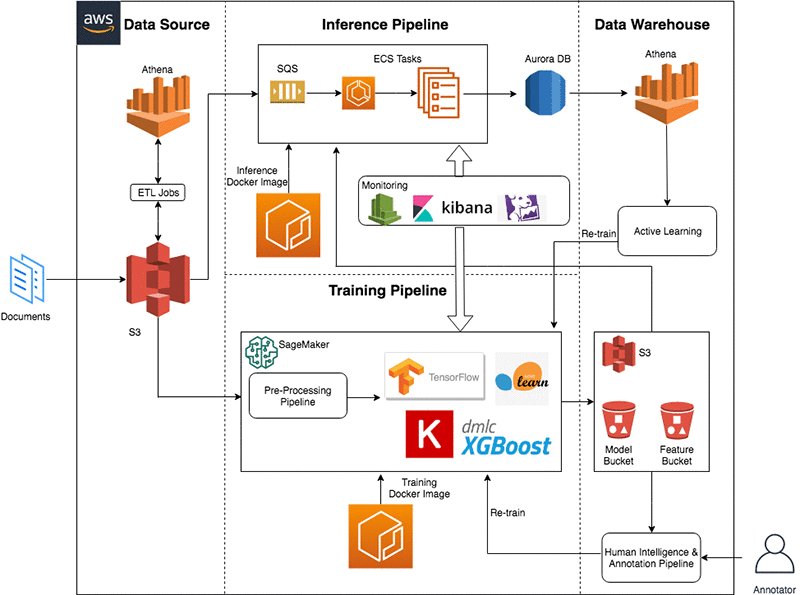
To further augment the existing AWS technology that powers Course Hero, the team is exploring additional Amazon services, including Amazon Forecast, for time series and financial forecasting. It is also looking at possibilities using Amazon Echo that will allow users to ask questions via Alexa,

Course Hero’s Saurabh Khanwalkar, the Director of Machine Learning & Search Sciences, says, “The entire machine learning, engineering, and artificial intelligence stack runs on AWS. From our CI/CD pipelines to our code workbench to our end-to-end model development to our staging and production inferences, we’re on AWS.”


About the Author

Marisa Messina is on the AWS ML marketing team, where her job includes identifying the most innovative AWS-using customers and showcasing their inspiring stories. Prior to AWS, she worked on consumer-facing hardware and then university-facing cloud offerings at Microsoft. Outside of work, she enjoys exploring the Pacific Northwest hiking trails, cooking without recipes, and dancing in the rain.


[R] Facebook, Carnegie Mellon build first AI that beats pros in 6-player poker

Pluribus is the first AI bot capable of beating human experts in six-player no-limit Hold’em, the most widely-played poker format in the world. This is the first time an AI bot has beaten top human players in a complex game with more than two players or two teams.

Link: https://ai.facebook.com/blog/pluribus-first-ai-to-beat-pros-in-6-player-poker/

submitted by /u/downtownslim
[link] [comments]