
Blog

Learn About Our Meetup

5000+ Members

MEETUPS

LEARN, CONNECT, SHARE

Join our meetup, learn, connect, share, and get to know your Toronto AI community. 

JOB POSTINGS

INDEED POSTINGS

Browse through the latest deep learning, ai, machine learning postings from Indeed for the GTA.

CONTACT

CONNECT WITH US

Are you looking to sponsor space, be a speaker, or volunteer, feel free to give us a shout.

Author: torontoai

[D] Transforming the target variable, a bad idea ?

Hi Reddit,

I am currently working on a project and I would like to hear your ideas about it. Basically, the problem consists in predicting the length of an event (target variable is T = d2 – d1). The vast majority of lengths are short (less than 10 days), but some are really big.

It is more of a problem if we make a mistake for short events than for long ones (ex: predicting 10 days instead of 8 is more problematic than predicting 30 instead of 45). I wanted to transform the target variable, using for instance a logarithmic function.

The problem with predicting log(T) is that an estimate will be E[log(T) | X]. When taking the exp function, my estimate for T will be exp(E[log(T) | X]). As exp is convex, by the Jensen inequality, I will in fact underestimate T, which is in my case something I want to avoid.

I see many people transforming their target variable but I don’t really know if most of them care about the problems that may occur with it. Are there any common techniques that you are aware of to handle this issue ? Or could you suggest any other approach that would fit my needs ?

Thank you very much and have a nice day !

(PS: At least, the good thing is that I don’t have any censored data)
submitted by /u/lazywiing
[link] [comments]

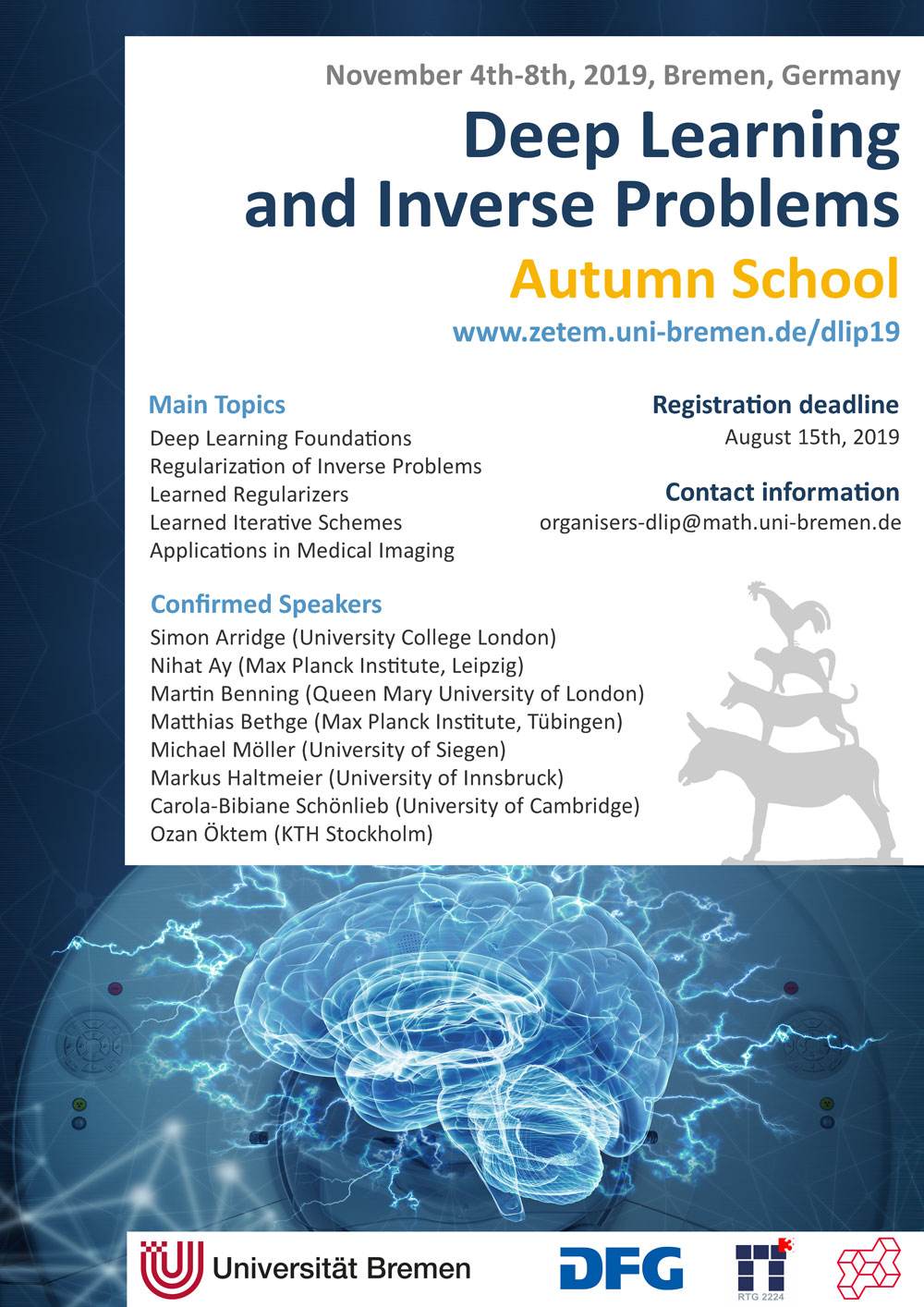
[N] ‘Deep Learning and Inverse Problems’ Autumn School in Bremen (Germany)

Flyer: http://www.math.uni-bremen.de/zetem/alt/optimmedia/cms/dlip19/dlip_flyer.jpg

Recent advances in deep learning have had an increasing impact on the field of inverse problems. In order to pass this knowledge on, the Center for Industrial Mathematics at the University of Bremen hosts an ‘autumn school’ between the 4th and 8th of November 2019. In this autumn school, world-renowned experts of the field will be teaching the mathematical foundations of machine learning and deep learning and how these can be applied to a wide range of inverse problems. The autumn school targets young researchers and advanced students in the field of inverse problems.

The registration is now open at www.zetem.uni-bremen.de/dlip19 until August 15th, 2019.

Lecturers:

Asja Fischer (Ruhr University Bochum)
Carola-Bibiane Schönlieb (University of Cambridge)
Markus Haltmeier (University of Innsbruck)
Martin Benning (Queen Mary University of London)
Matthias Bethge (Max Planck Institute, Tübingen)
Nihat Ay (Max Planck Institute, Leipzig)
Ozan Öktem (KTH Stockholm)
Simon Arridge (University College London)

A tentative list of topics includes:

Mathematical Foundations of Machine Learning / Deep Learning
Current Computational and Theoretical Questions in Deep Learning
Overview of Inverse Problems
Solving Inverse Problems via Learned Iteration Schemes
Learning Regularizers via Deep Networks
Deep Learning for Inverse Problems arising in Medical Imaging

submitted by /u/cetmann
[link] [comments]

[D] Is it possible to do supervised learning when the labels are relative?

I’m doing job matching and I have a dataset consisting of info like “for job A, candidate #1 is better than candidate #2”, and of course some features for the job and for the candidates.

I would like to train a model to output a score of how fit is a candidate for a job. So far I haven’t been able to come up with a loss function, but my intuition says that there should be enough information to build one, provided any two candidates from the dataset are linked though job applications and other candidates (which they are).

Am I wrong? Any ideas?

submitted by /u/TrickyKnight77
[link] [comments]

[D] what techniques/methods can be used to assign probabilities to sequences of measurements where each measurements comes with a confidence/probability?

Consider I have a lot of measurements, some of them are real, some of them are noise. I can build a hypothesis by combining measuremens to a sequence. There are a lot of possible hypotheses considering that two sequences can combine a different subset of all measurements (which means two sequences of measurements can have different amount of measurements). Each measurement also comes with a probability.

My question is: what would be a good/proper way of finding the best/most likely hypothesis here?

Example: imagine the sequence of measurements with probabilities [0.8, 0.8, 0.8] and [0.9, 0.95]. Which of these 2 hypotheses would you pick over the other?

submitted by /u/DeepDeeperRIPgradien
[link] [comments]

[R] Using DVC to create an efficient version control system for data projects

The following article shows how DVC (Data Version Control) tool helped a fintech data team in dealing with production data files such as trained machine learning algorithms and provided a reliable way of versioning those files along the project development: Using DVC to create an efficient version control system for data projects

The tool brought versioning for inputs, intermediate files and algorithm models and this drastically increased productivity by providing a clean framework to manage data in an effortless way to split a project into atomic steps.

To make it more concrete, the article illustrated with a real project on VAT auto-detection from receipts – it consists in automatically retrieving the value-added tax amount from a receipt document in order to simplify accounting work.

submitted by /u/thumbsdrivesmecrazy
[link] [comments]

[R] Any relevant papers about Meta-Learning or Active Learning in ICML or CVPR 2019?

Hi r/MachineLearning,

I have a clear background on Meta-Learning relevant works (families of Meta-Learning approaches) and on Active Learning methods (depending on its heuristic, scenario…). However, there are many papers on those topics from CVPR and ICML and I don’t know how to filter them.

As far as I have researched, I have read the papers Learning loss for Active Learning from Donggeun Yoo and Online Meta-Learning from Chelsea Finn (the author of MAML and many other important works in Meta-Learning).

Does anybody have any clue on where to begin?

Thank you in advanced!

submitted by /u/MrLeylo
[link] [comments]