
Blog

Learn About Our Meetup

5000+ Members

MEETUPS

LEARN, CONNECT, SHARE

Join our meetup, learn, connect, share, and get to know your Toronto AI community. 

JOB POSTINGS

INDEED POSTINGS

Browse through the latest deep learning, ai, machine learning postings from Indeed for the GTA.

CONTACT

CONNECT WITH US

Are you looking to sponsor space, be a speaker, or volunteer, feel free to give us a shout.

Author: torontoai

[Discussion] eGPU option?

So currently I have a 2013 15-inch MacBook Pro with intel Core i7 and 16GB of RAM. This upcoming semester I will be taking a deep learning course focused in computer vision. I was in a deep learning course last semester and because of that I am scared I will roast my computer further into oblivion than it already has been if I try to train my models on it next semester.

So with that said I am thinking of purchasing an external GPU. Does anyone have any experience with this or do I just have to suck it up and use google collab, or use campus computers, or just buy a new machine? (I don’t want to do any of those because I hate notebooks, I would rather be able to code in the comfort of my home and I don’t want to pay that much money when my laptop works just fine for everything else).

The one thing I am worried about is getting bottlenecked by transfer speeds between my mac and the eGPU. I have thunderbolt 2 ports and I am not that knowledgable of hardware so I have no idea if the transfer speeds are so slow that having an eGPU will just be useless because of this.

But if anyone has experience with this or suggestions I would love to hear them!

submitted by /u/biologicalterminator
[link] [comments]

[R] TL;DR for all few-shot learning papers from CVPR

I wrote TL;DR for all few-shot learning papers from CVPR. There are about 20 of them (compared to only 4 last year). Hope you find it useful and will be glad to hear if I missed something or got anything wrong.

https://medium.com/p/few-shot-learning-in-cvpr19-6c6892fc8c5?source=email-23022de21ddd–writer.postDistributed&sk=63c74613f22e056844d3d6b785f116a0

submitted by /u/FSMer
[link] [comments]

[P] I’m stuck designing a neural net architecture for my project

Hi!

A few weeks ago I had the idea to write an app that counts of players in finished game of go. Instead of using pure computer vision I wanted to use deep learning.

The idea was to translate a picture of a go game into a 19x19x3 px image representing the board position and then count the points. I created all the data for the training. This is how an image looks and its corresponding label. So I am training on like 7000 images/labels like this.

I tried out some architectures like multiple conv/pool layers without any FC layers. I am using mostly categorical cross entropy. Sizes of the kernel are 3×3. I played around with different number of filters. Often the training gets like to 60% accuracy and then stops to learn, so no accuracy progress is visible. I am thinking that the architecure is not suitable for my task. Seems like my data is fine although its weird that I always have to cast the data to tf.float32 before training, because tf doesnt let me to use tf.uint8.

Any tips how I could better my architecture for this specific task or maybe even a different approach?

submitted by /u/jthat92
[link] [comments]

Multilingual Universal Sentence Encoder for Semantic Retrieval

Since it was introduced last year, “Universal Sentence Encoder (USE) for English’’ has become one of the most downloaded pre-trained text modules in Tensorflow Hub, providing versatile sentence embedding models that convert sentences into vector representations. These vectors capture rich semantic information that can be used to train classifiers for a broad range of downstream tasks. For example, a strong sentiment classifier can be trained from as few as one hundred labeled examples, and still be used to measure semantic similarity and for meaning-based clustering.

Today, we are pleased to announce the release of three new USE multilingual modules with additional features and potential applications. The first two modules provide multilingual models for retrieving semantically similar text, one optimized for retrieval performance and the other for speed and less memory usage. The third model is specialized for question-answer retrieval in sixteen languages (USE-QA), and represents an entirely new application of USE. All three multilingual modules are trained using a multi-task dual-encoder framework, similar to the original USE model for English, while using techniques we developed for improving the dual-encoder with additive margin softmax approach. They are designed not only to maintain good transfer learning performance, but to perform well on semantic retrieval tasks.

Multi-task training structure of the Universal Sentence Encoder. A variety of tasks and task structures are joined by shared encoder layers/parameters (pink boxes).

Semantic Retrieval Applications
The three new modules are all built on semantic retrieval architectures, which typically split the encoding of questions and answers into separate neural networks, which makes it possible to search among billions of potential answers within milliseconds. The key to using dual encoders for efficient semantic retrieval is to pre-encode all candidate answers to expected input queries and store them in a vector database that is optimized for solving the nearest neighbor problem, which allows a large number of candidates to be searched quickly with good precision and recall. For all three modules, the input query is then encoded into a vector on which we can perform an approximate nearest neighbor search. Together, this enables good results to be found quickly without needing to do a direct query/candidate comparison for every candidate. The prototypical pipeline is illustrated below:
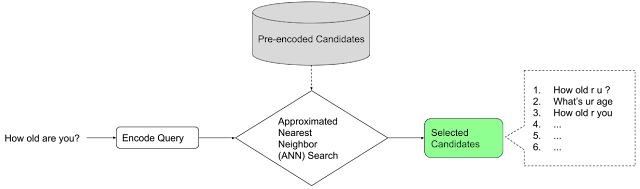
A prototypical semantic retrieval pipeline, used for textual similarity.

Semantic Similarity Modules
For semantic similarity tasks, the query and candidates are encoded using the same neural network. Two common semantic retrieval tasks made possible by the new modules include Multilingual Semantic Textual Similarity Retrieval and Multilingual Translation Pair Retrieval.

  • Multilingual Semantic Textual Similarity Retrieval
    Most existing approaches for finding semantically similar text require being given a pair of texts to compare. However, using the Universal Sentence Encoder, semantically similar text can be extracted directly from a very large database. For example, in an application like FAQ search, a system can first index all possible questions with associated answers. Then, given a user’s question, the system can search for known questions that are semantically similar enough to provide an answer. A similar approach was used to find comparable sentences from 50 million sentences in wikipedia. With the new multilingual USE models, this can be done in any of supported non-English languages.
  • Multilingual Translation Pair Retrieval
    The newly released modules can also be used to mine translation pairs to train neural machine translation systems. Given a source sentence in one language (“How do I get to the restroom?”), they can find the potential translation target in any other supported language (“¿Cómo llego al baño?”).

Both new semantic similarity modules are cross-lingual. Given an input in Chinese, for example, the modules can find the best candidates, regardless of which language it is expressed in. This versatility can be particularly useful for languages that are underrepresented on the internet. For example, an early version of these modules has been used by Chidambaram et al. (2018) to provide classifications in circumstances where the training data is only available in a single language, e.g. English, but the end system must function in a range of other languages.

USE for Question-Answer Retrieval
The USE-QA module extends the USE architecture to question-answer retrieval applications, which generally take an input query and find relevant answers from a large set of documents that may be indexed at the document, paragraph, or even sentence level. The input query is encoded with the question encoding network, while the candidates are encoded with the answer encoding network.
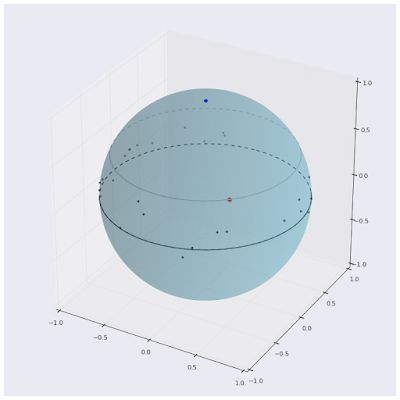
Visualizing the action of a neural answer retrieval system. The blue point at the north pole represents the question vector. The other points represent the embeddings of various answers. The correct answer, highlighted here in red, is “closest” to the question, in that it minimizes the angular distance. The points in this diagram are produced by an actual USE-QA model, however, they have been projected downwards from ℝ500 to ℝ3 to assist the reader’s visualization.

Question-answer retrieval systems also rely on the ability to understand semantics. For example, consider a possible query to one such system, Google Talk to Books, which was launched in early 2018 and backed by a sentence-level index of over 100,000 books. A query, “What fragrance brings back memories?”, yields the result, “And for me, the smell of jasmine along with the pan bagnat, it brings back my entire carefree childhood.” Without specifying any explicit rules or substitutions, the vector encoding captures the semantic similarity between the terms fragrance and smell. The advantage provided by the USE-QA module is that it can extend question-answer retrieval tasks such as this to multilingual applications.

For Researchers and Developers
We’re pleased to share the latest additions to the Universal Sentence Encoder family with the research community, and are excited to see what other applications will be found. These modules can be used as-is, or fine tuned using domain-specific data. Lastly, we will also host the semantic similarity for natural language page on Cloud AI Workshop to further encourage research in this area.

Acknowledgements
Mandy Guo, Daniel Cer, Noah Constant, Jax Law, Muthuraman Chidambaram for core modeling, Gustavo Hernandez Abrego, Chen Chen, Mario Guajardo-Cespedes for infrastructure and colabs, Steve Yuan, Chris Tar, Yunhsuan Sung, Brian Strope, Ray Kurzweil for discussion of the model architecture.

[R] AI-Based Photo Restoration

This article deals with how to restore old photos using neural networks. Applied approaches: In-Place BatchNorm, Partial Convolution, Self-Attention GAN. The whole process of restoration is described in detail:

  1. Find all the image defects: fractures, scuffs, holes.
  2. Inpaint the discovered defects, based on the pixel values around them.
  3. Colorize the image.

Also, the website was created where any photo could be uploaded for restoration online.

https://habr.com/en/company/mailru/blog/459696/

submitted by /u/pvl18
[link] [comments]

[R] “We also 3D-print our adversarial objects and perform physical experiments to illustrate that such vulnerability exists in the real world” – Adversarial Objects Against LiDAR

Abstract:

Deep neural networks (DNNs) are found to be vulnerable against adversarial examples, which are carefully crafted inputs with a small magnitude of perturbation aiming to induce arbitrarily incorrect predictions. Recent studies show that adversarial examples can pose a threat to real-world security-critical applications: a “physical adversarial Stop Sign” can be synthesized such that the autonomous driving cars will misrecognize it as others (e.g., a speed limit sign). However, these image-space adversarial examples cannot easily alter 3D scans of widely equipped LiDAR or radar on autonomous vehicles. In this paper, we reveal the potential vulnerabilities of LiDAR-based autonomous driving detection systems, by proposing an optimization based approach LiDAR-Adv to generate adversarial objects that can evade the LiDAR-based detection system under various conditions. We first show the vulnerabilities using a blackbox evolution-based algorithm, and then explore how much a strong adversary can do, using our gradient-based approach LiDAR-Adv. We test the generated adversarial objects on the Baidu Apollo autonomous driving platform and show that such physical systems are indeed vulnerable to the proposed attacks. We also 3D-print our adversarial objects and perform physical experiments to illustrate that such vulnerability exists in the real world.

Website: https://sites.google.com/view/lidar-adv

Paper: https://arxiv.org/abs/1907.05418

submitted by /u/downtownslim
[link] [comments]

[P] Looking to Hire Someone to Assist in Recreating this Research Paper

I hope this an OK place to post this and please let me know if its not.

If it is, I’m looking to hire someone who is able to recreate a research paper I’m reading in Python. I’m not really interested in the actual set up of the ANN model as I am in the wavelet transform and PCA portion that they did in the per-processing step. It would be good if whoever was hired had a deep understanding of that space and was able to implement tweaks and changes if necessary.

The paper is here but the crux of it is they took open, high, low, and close data on 6 Asian stock indices, applied wavelet transform to all 4 features (separately and individually), added technical indicators and used PCA to select features before feeding the inputs to a ANN.

https://journals.plos.org/plosone/article?id=10.1371/journal.pone.0156338#pone.0156338.s012

I should note that I know this is a financial paper but please don’t mistake this as someone who sees big returns and is just trying to hire someone to rebuild their project to capitalize on it. I don’t think the returns cited in this paper are realistic and I have no intentions of trying to trade it or use it to make money. It’s more about my own edification. I dont have a high level math background and Ive spent hours reading about wavelet transforms and it still seems a bit daunting.

If you’re interested in talking further, please shoot me a message and we can go from there.

submitted by /u/randomwalk84
[link] [comments]