Blog

Learn About Our Meetup

5000+ Members

MEETUPS

LEARN, CONNECT, SHARE

Join our meetup, learn, connect, share, and get to know your Toronto AI community. 

JOB POSTINGS

INDEED POSTINGS

Browse through the latest deep learning, ai, machine learning postings from Indeed for the GTA.

CONTACT

CONNECT WITH US

Are you looking to sponsor space, be a speaker, or volunteer, feel free to give us a shout.

Category: Global

Accenture drives machine learning growth in one of the world’s largest private AWS DeepRacer Leagues

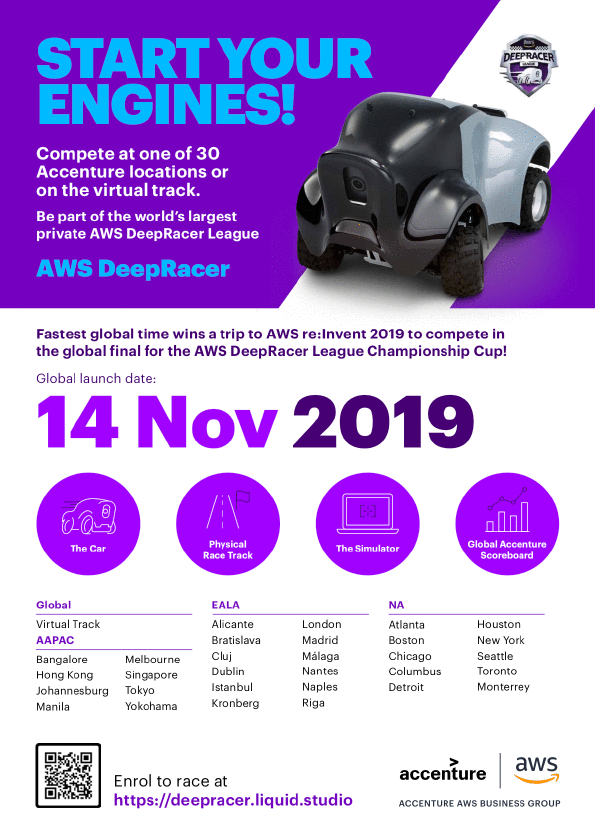
Accenture has a rich history of helping customers all over the world build artificial intelligence (AI) and machine learning (ML) powered solutions with AWS services. In doing so, they always look for new and engaging ways to develop their teams with the appropriate level of enablement and hands-on training. Accenture’s next ML initiative is rolling out their version of an AWS DeepRacer League, which is the world’s first global autonomous racing league launched by AWS at re:Invent in 2018. Accenture’s league spans 30 global locations and 17 countries, with each location featuring both a physical and virtual track to compete on for the title of Accenture AWS DeepRacer Champion.
Why an AWS DeepRacer League and why now?

Machine learning is one of the fastest growing areas in the market. IDC predicted that by 2021, global spending on AI and cognitive technologies will exceed $50M; companies are exploring how they can best take advantage of the technology, no matter the industry. However, the opportunities heavily outweigh the skills present in the workforce to make an AI strategy a reality, and although the breadth of ML-skilled data scientists is growing, companies cannot afford to hire at the scale needed to succeed, leading them to explore ways to upskill their existing talent. AWS DeepRacer and the implementation of the league is a mechanism for Accenture to help their customers take advantage of new ML technologies at scale by democratizing the development of these ML skills throughout their global organization. This unique program provides employees and customers with creative ways to explore machine learning. Participants have the opportunity to learn through hands-on labs followed instantly with practical application—deploying their models to an AWS DeepRacer car and watching it perform. Coupled with the element of competition, it gives teams something to rally around, while helping their organizations learn and grow.

Accenture’s AWS DeepRacer journey

As an emerald sponsor at re:Invent 2018, Accenture was present for the AWS DeepRacer announcement. They attended the workshops, learned about ML basics, built and trained a reinforcement learning model via the AWS DeepRacer 3D cloud-based simulator, and raced that model on one of the physical tracks in the MGM Grand Garden Arena. They even took home their own DeepRacer car! It was during this experience that Accenture realized how easy it was to learn such a complex ML technique and apply these new skills in a fun and engaging way.

Multiple individuals and groups within Accenture signed up to become private preview customers with access to the AWS DeepRacer console in preparation for the launch of their global competition. They have also begun building their own leaderboard that is integrated into the Accenture single sign on, to use for every site’s competition. Accenture participants in each city can create competitions, track their leaderboard, join competitions in other cities, and upload video recordings from their blazing fast laps to claim victory.
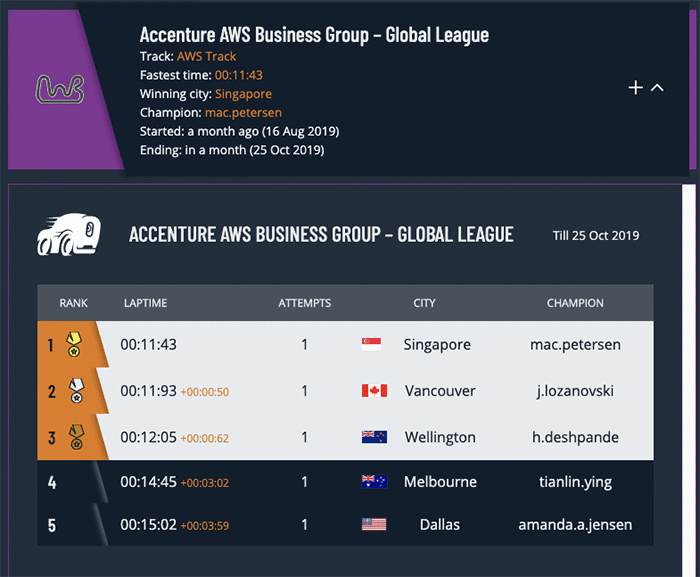
The Accenture AWS Business Group has been the driving force behind the Accenture DeepRacer League competition, assembling teams across the world, and equipping each location with everything they need, including tracks, barriers, and leaderboards. Any Accenture employee can join a competition and start their engines November 14, when the Accenture league will launch with a 24-hour follow-the-sun competition across the globe, bringing the excitement of AWS DeepRacer and machine learning to life.

Showcasing AWS DeepRacer at Accenture’s innovation centers

Accenture’s innovation centers, innovation hubs, and liquid studios are the primary locations hosting the AWS DeepRacer physical tracks. The intention is to showcase Accenture’s ML expertise and accelerate AWS ML around the world, extending the opportunity to upskill clients and the AWS communities in each global city. We encourage you to see how straightforward it is to get hands-on with ML, learn essential ML concepts, and experiment through autonomous driving using AWS DeepRacer. Connect with the teams of technologists from the Accenture AWS Business Group (AABG) to get started on your AWS machine learning journey today!


About the Author

Alexandra Bush is a Senior Product Marketing Manager for AWS AI. She is passionate about how technology impacts the world around us and enjoys being able to help make it accessible to all. Out of the office she loves to run, travel and stay active in the outdoors with family and friends.



U.S. Government CTO, CIO Among Leaders Flocking to GTC DC

The U.S. government’s CTO and CIO on Tuesday joined other key tech decision makers, lawmakers, and industry leaders at the start of the two-day GPU Technology Conference in Washington D.C.

Federal CIO Suzette Kent led a panel of civilian agency leaders explaining how they’re using AI.  Moments later, U.S. CTO Michael Kratsios led a discussion of how the federal government is supporting U.S. AI leadership.

And Moira Bergin, the House Committee on Homeland Security’s subcommittee director for cybersecurity and infrastructure protection, joined a discussion of how Congress and the administration are addressing new AI cybersecurity capabilities.

The talks were among the more than 160 sessions — led by a cross-section of Washington  leaders from government and industry — that have drawn more than 3,500 to downtown D.C. this week.

GTC DC — hosted by NVIDIA and its partners, including Booz Allen Hamilton, Dell, IBM, Lockheed Martin and others — has quickly become the capital’s largest AI event. And it’s research, not rhetoric, attendees will tell you, that makes DC an AI accelerator like no other.

The conference is packed with representatives from more than a score of federal agencies — among them the U.S. Department of Energy, NASA, and the National Institutes of Health — together able to marshal scientific efforts on a scale far beyond that of anywhere else in the world.

Putting AI to Work

The conference opened with a keynote from Ian Buck, NVIDIA’s vice president for accelerated computing.

Buck — known for creating the CUDA computing platform that puts GPUs to work powering everything from supercomputing to next-generation AI — detailed the broad range of AI tools NVIDIA makes available to help organizations advance their work.

“The challenge is how do we take AI from innovation to actually applying AI,” Buck said during his keynote address Wednesday morning. “Our challenge, NVIDIA’s challenge, and my challenge is ‘How can I bring AI to industries and activate it?’”

Buck’s message was buttressed by Kent, who led a panel of civilian agency leaders discussing how they’re using AI to improve government services.

“We’re using these AI capabilities to act faster,” Kent said. “In the areas where we’re keeping citizens safe, whether it’s reacting to weather or a problem caused by humans — the speed at which we help is increasing.”

Meanwhile, Kratsios led a discussion about how the U.S government — which has a decades long history of supporting key technology advances — is working to extend U.S. technology leadership in the AI age.

“We fundamentally believe that AI is something that’s going to touch every industry in the United States,” Kratsios said. “We view artificial intelligence as a tool that can empower workers to do their jobs better, safer, faster, and more effectively.”

Wrapping up the day, the House’s Bergin joined Coleman Mehta, senior director of U.S. policy at Palo Alto Networks; Daniel Kroese, associate director of the national risk management center at the Cybersecurity and Infrastructure Security Agency; and Joshua Patterson, GM of data science at NVIDIA.

In a panel moderated by NVIDIA’s  Iain Cunningham, VP of intellectual property and cybersecurity, the four spoke about the new AI capabilities, potential countermeasures, and preparations being made by the administration and Congress.

Bergin said she’s “excited” about the prospects for AI after what she described as a decade of underinvestment in R&D.

“There’s a lot of demystification that needs to happen about what AI actually is, what it’s capabilities are now, and what its capabilities will be later,” Bergin said.

Scores more discussions are slated through Wednesday afternoon.

Underscoring the role AI can play for good, speakers from the Johns Hopkins University Applied Physics Laboratory and the Joint AI Center will discuss how they’re harnessing AI to provide humanitarian assistance and disaster relief.

Expect their discussion — of how they harnessed airborne and satellite imagery data after Hurricane Florence hit North and South Carolina in 2018 — to point the way to more groundbreaking AI feats to come.

The post U.S. Government CTO, CIO Among Leaders Flocking to GTC DC appeared first on The Official NVIDIA Blog.

US Government CTO, CIO Among Leaders Flocking to GTC DC

The U.S. government’s CTO and CIO on Tuesday joined other key tech decision makers, lawmakers and industry leaders at the start of the two-day GPU Technology Conference in Washington, D.C.

U.S. CTO Michael Kratsios gave the conference’s policy day keynote on how the federal government is supporting U.S. AI leadership. And Federal CIO Suzette Kent led a panel of civilian agency leaders explaining how they’re using AI.

Another highlight: a panel on national AI strategy featuring Lynne Parker assistant director for AI with the White House Office of Science and Technology and National Security AI Commissioner Jason Matheny.

The talks were among the more than 160 sessions — led by a cross-section of Washington  leaders from government and industry — that have drawn more than 3,500 to downtown DC this week.

GTC DC — hosted by NVIDIA and its partners, including Booz Allen Hamilton, Dell, IBM, Lockheed Martin and others — has quickly become the capital’s largest AI event. And it’s research, not rhetoric, attendees will tell you, that makes DC an AI accelerator like no other.

The conference is packed with representatives from more than a score of federal agencies — among them the U.S. Department of Energy, NASA and the National Institutes of Health — together able to marshal scientific efforts on a scale far beyond that of anywhere else in the world.

Putting AI to Work

The conference opened with a keynote from Ian Buck, NVIDIA’s vice president for accelerated computing.

Buck — known for creating the CUDA computing platform that puts GPUs to work powering everything from supercomputing to next-generation AI — detailed the broad range of AI tools NVIDIA makes available to help organizations advance their work.

“The challenge is how do we take AI from innovation to actually applying AI,” Buck said during his keynote address Tuesday morning. “Our challenge, NVIDIA’s challenge and my challenge is ‘How can I bring AI to industries and activate it?’”

Buck then joined Kratsios for a discussion about how the U.S. government — which has a decades-long history of supporting key technology advances — is working to extend U.S. technology leadership in the AI age.

“We fundamentally believe that AI is something that’s going to touch every industry in the United States,” Kratsios said. “We view artificial intelligence as a tool that can empower workers to do their jobs better, safer, faster and more effectively.”

Kratsios’s points were buttressed by the speakers on the national AI strategy panel — which included Parker and Matheny — discussing the progress of the U.S. government’s national AI strategy.

They touched on the federal government’s ongoing investment in R&D, obtaining and training the highest quality talent, and implementation of AI across the federal government.

As part of that, Parker, invited listeners to participate in the 30-day public comment period in following the draft release of draft guidance on facilitating industry AI adoption from the U.S. Office of Management and Budget’s Office of Information and Regulatory Affairs.

Kent who is leading federal AI adoption efforts, participated in a discussion about advancing AI adoption across the federal government, as part of a panel of civilian agency leaders.

“We’re using these AI capabilities to act faster,” Kent said. “In the areas where we’re keeping citizens safe, whether it’s reacting to weather or a problem caused by humans — the speed at which we help is increasing.”

Wrapping up the day, Moira Bergin, the House Committee on Homeland Security’s subcommittee director for cybersecurity and infrastructure protection, joined a discussion of how Congress and the administration are addressing new AI cybersecurity capabilities.

Bergin joined Coleman Mehta, senior director of U.S. policy at Palo Alto Networks; Daniel Kroese, associate director of the national risk management center at the Cybersecurity and Infrastructure Security Agency; and Joshua Patterson, general manager of data science at NVIDIA.

Bergin said she’s “excited” about the prospects for AI after what she described as a decade of underinvestment in R&D.

“There’s a lot of demystification that needs to happen about what AI actually is, what it’s capabilities are now and what its capabilities will be later,” Bergin said.

Scores more discussions took place throughout the conference, including packed discussions discussions policies to speed adoption of AI in healthcare and building an inclusive AI workforce across the country.

Underscoring the role AI can play for good, speakers from the Johns Hopkins University Applied Physics Laboratory and the U.S. Department of Defense’s Joint Artificial Intelligence Center will discuss how they’re harnessing AI to provide humanitarian assistance and disaster relief.

Expect their discussion — of how they harnessed airborne and satellite imagery data after Hurricane Florence hit North and South Carolina in 2018 — to point the way to more groundbreaking AI feats to come.

The post US Government CTO, CIO Among Leaders Flocking to GTC DC appeared first on The Official NVIDIA Blog.

AI4Good: Canadian Lab Empowers Women in Computer Science

Doina Precup is applying Romanian wisdom to the gender gap in the fields of AI and computer science.

The associate professor at McGill University and research team lead at AI startup DeepMind spoke with AI Podcast host Noah Kravitz about her personal experiences, along with the AI4Good Lab she co-founded to give women more access to machine learning training.

Growing up in Romania, Precup attended a high school that specialized in computer science and a technical university. She didn’t experience gender disparity in these learning environments.

“If anything, programming was considered a very good job for women, because you did not need to be working in the fields,” she explained.

It made the gap in Canadian universities and companies even more noticeable. At McGill, Precup saw that female students were hesitant to speak up or pursue graduate studies.

Together with Angelique Mannella, CEO of AM Consulting and an Amazon employee, Precup was inspired to start the AI4Good Lab in 2017.

Key Points From This Episode:

  • Aimed at improving women’s access to advanced AI and machine learning, the AI4Good Lab brings together 30 women from across Canada every spring for a seven-week workshop
  • Workshop participants take classes, hear from speakers, visit companies and work in small groups to create projects.
  • This year’s projects ranged from identifying fake news to using a caf ’s food supplies efficiently to helping people manage chronic pain.
  • To hear Precup’s best sci-fi book recommendations, listen to the podcast for her guide to the genre.
  • Visit the AI4Good Lab website or Twitter to learn more about participants’ projects and to apply to next year’s workshop. And visit Precup’s Google Scholar page to see her most recent publications.

Tweetables:

“Emphasizing the creativity and the fun in computer science and algorithms is really important, for everybody” — Doina Precup [04:30]

“I also noticed that people were sometimes afraid to speak up in classes, even if they were really good at based on their exams and their assignments and their projects” — Doina Precup [05:43]

You Might Also Like

UC Berkeley’s Pieter Abbeel on How Deep Learning Will Help Robots Learn

Robots can do amazing things. Compare even the most advanced robots to a three-year-old, however, and they can come up short. UC Berkeley Professor Pieter Abbeel has pioneered the idea that deep learning could be the key to bridging that gap: creating robots that can learn how to move through the world more fluidly and naturally.


Teaching Families to Embrace AI

Tara Chklovski is CEO and founder of Iridescent, a nonprofit that provides access to hands-on learning opportunities to prepare underrepresented children and adults for the future of work. We spoke with her about the UN’s AI for Good Global Summit last May in Geneva and the AI World Championship, part of the AI Family Challenge, also in May in Silicon Valley.

Good News About Fake News: AI Can Now Help Detect False Information

With “fake news” embedding itself into, well, our news, it’s become more important than ever to distinguish between content that is fake or authentic. That’s why Vagelis Papalexakis, a professor of computer science at the University of California, Riverside, developed an algorithm that detects fake news with 75 percent accuracy.

Make Our Podcast Better

Have a few minutes to spare? Fill out this short listener survey. Your answers will help us make a better podcast.


The post AI4Good: Canadian Lab Empowers Women in Computer Science appeared first on The Official NVIDIA Blog.

Special Delivery: With U.S. Post Office on Board, NVIDIA to Enable AI Deployment, NVIDIA’s Ian Buck Says

The AI revolution is here — as near as the closest mailbox — and the time’s right to put AI to work solving your organization’s biggest challenges, NVIDIA’s Ian Buck said Tuesday.

Kicking off the Washington edition of our GPU Technology Conference, Buck, NVIDIA’s VP for accelerated computing, detailed a new generation of technologies that will help companies put modern AI to work.

Buck also announced that the United States Postal Service — the world’s largest delivery service, with 146 billion pieces of mail processed and delivered annually — is adopting end-to-end AI technology from NVIDIA.

“The challenge is how do we take AI from innovation to actually applying AI,” Buck told an audience of more than 3,500 developers, CIOs and federal employees at the three-day GTC DC. “Our challenge, NVIDIA’s challenge, and my challenge is ‘How can I bring AI to industries and activate it.’”

Over the course of his hour-long talk, Buck explained how modern AI is trained and deployed, and described how NVIDIA is adapting AI for the automotive, healthcare, robotics, and 5G industries, among others.

The U.S. Postal Service offers a glimpse at what’s possible.

Buck said the U.S. Postal Service will roll out a deep learning solution based on NVIDIA EGX to 200 processing facilities that should be operational in 2020.

Using EGX, Buck said, the USPS will be able to process packages 10 times faster with higher accuracy and enhance its ability to detect hazardous parcels.

“We’re very excited to see a U.S. agency really leaning into AI, they have a cool problem, processing your mail as quickly as possible, and by working with NVIDIA they’re accelerating that work,” Buck said.

A Day in the Life of AI

Buck, known for creating the CUDA computing platform while still a Stanford student, detailed how NVIDIA’s technologies accelerate every step in the process of putting AI to work from data ingestion, to AI training, and, ultimately, deployment. The next step will be the creation of vertical AI platforms that experts in a wide variety of industries will be able to put to work fast, Buck said.

In healthcare, workers are being inundated with data. A typical radiology department views 8,000 images a day. Three papers per minute are published on the PubMed medical research hub, Buck said.

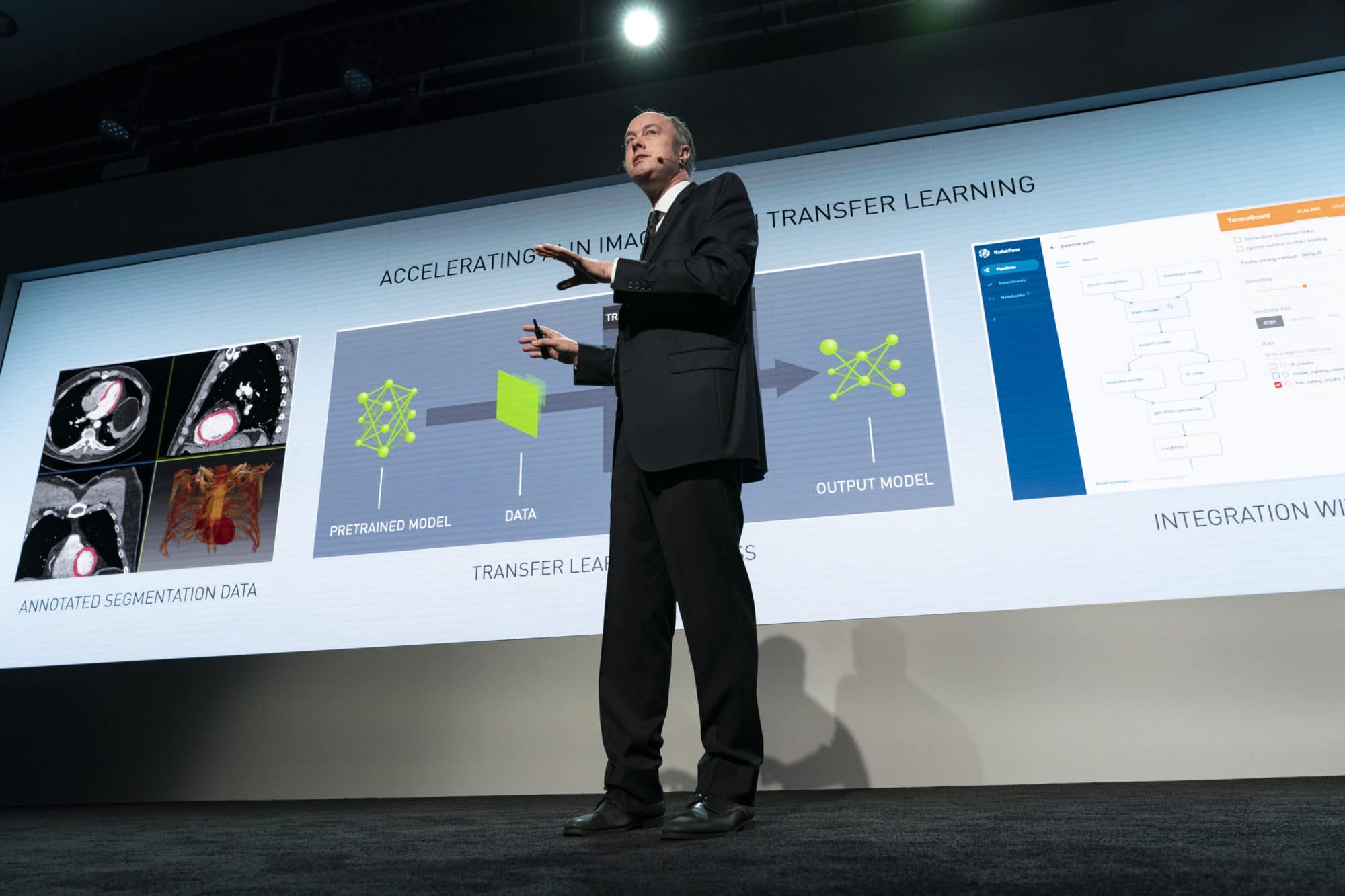
Buck detailed how the NVIDIA Clara software development kit is able to use a new generation of transfer learning models to help healthcare workers quickly adapt by augmenting an existing pre-trained model to tackle new tasks, such as looking for a particular kind of cancer, in minutes or hours, while using less training data.

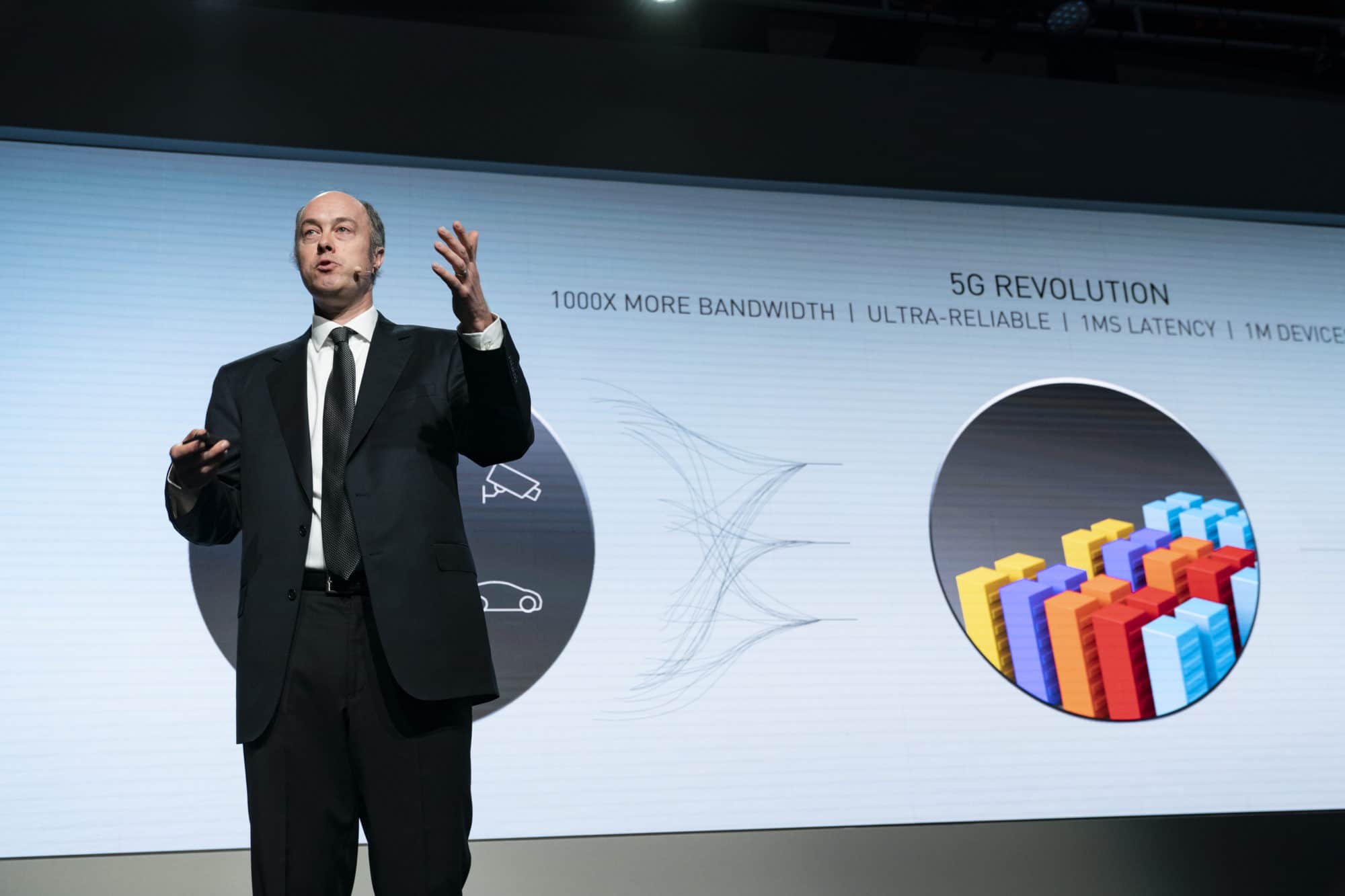
Telecommunications is another industry that can benefit from AI as it races to adopt 5G wireless technology. Compared to today’s 4G networks, 5G allows you to download an entire season of “Stranger Things” in just three minutes on a mobile device, compared to three hours. 5G is more responsive, with 1 millisecond of latency, versus 10 milliseconds for 4G. It’s ultra-reliable.

“It is a revolution, and I don’t use that word lightly,” Buck said. “It gives us the opportunity to send enormous streams of data and respond in real time,” Buck said.

To help telcos and their customers make the most of 5Gs, NVIDIA last month launched the NVIDIA EGX edge supercomputing platform. Scalable and secure, these servers pack as much as many as four NVIDIA CUDA Tensor Core GPUs.

Smart cities can benefit from EGX, too.

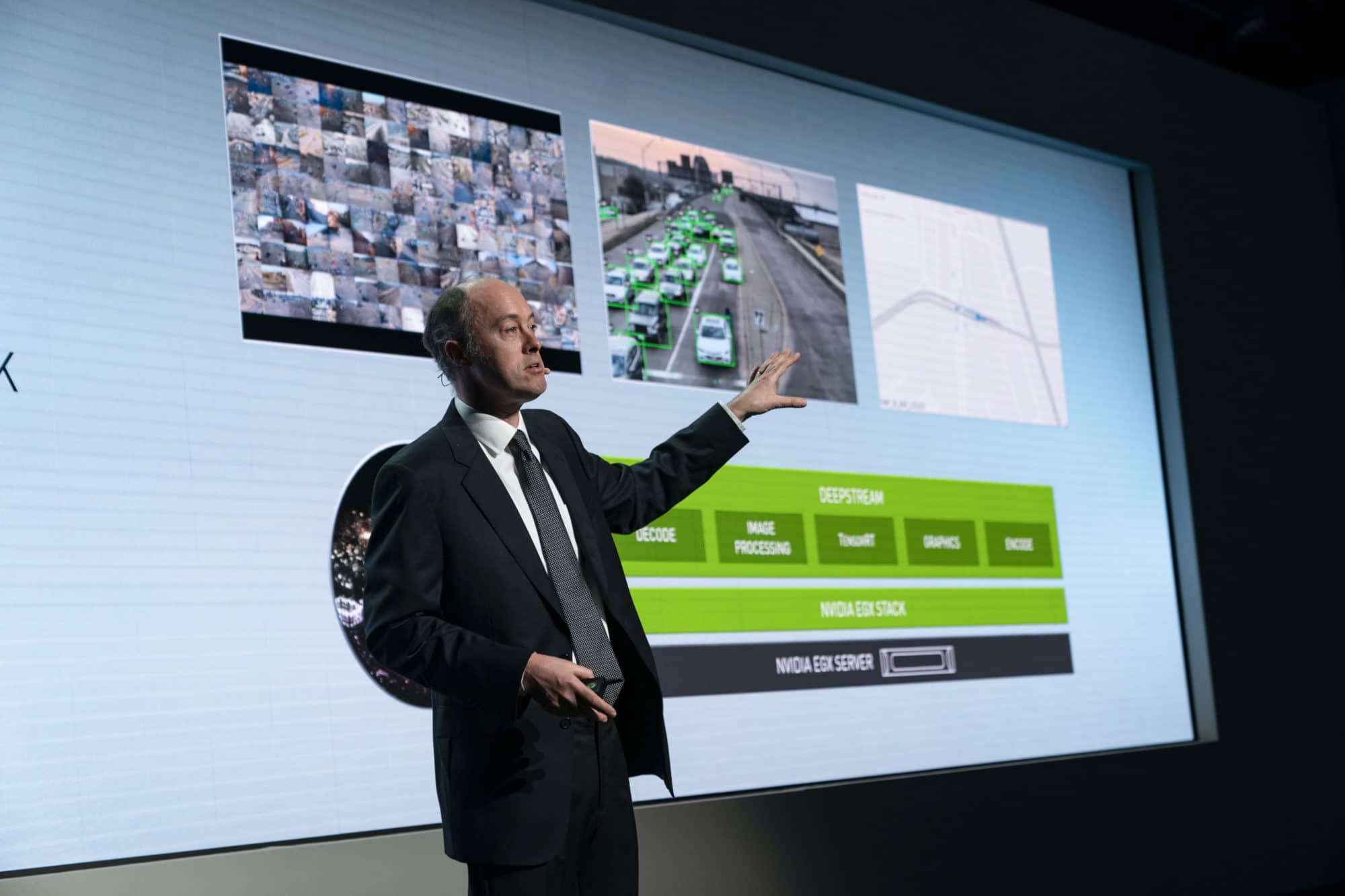
Running NVIDIA’s Metropolis Internet of Things application framework as part of a pilot program, public safety officials in Dubuque, Iowa, Metropolis picked out a vehicle driving the wrong way onto a freeway.

Of course, NVIDIA is working to help make cars smarter — safer — too. NVIDIA’s autonomous vehicle platform spans everything from cars to trucks to robo taxis to industrial vehicles.

To enable safe development and deployment NVIDIA’s built an end-to-end workflow to develop autonomous vehicles, including systems for collecting data, curating it, labeling it, training AI, replaying it, and using it to simulate the performance of new systems in all kinds of scenarios.

“This is a much more deeper, richer stack than just traditional inference and training,” Buck said.

Lastly, robots are another area where NVIDIA’s building tools that are unleashing a new wave of innovation. In the past, robots were very good at repetitive tasks. The future of robots, however, “is all about interaction,” Buck said.

These new generation of robots are being put to work in retail, agriculture, and the food delivery business — slated to grow to $100 billion by 2025.

To enable all this, NVIDIA built Jetson, an end-to-end robotics platform that lets companies deploy new kinds of robots more quickly. It includes a complete software stack built on to a range of powerful SoCs, starting with the $99 Jetson Nano.

“This is going to be an exciting time for robotics,” Buck said.

It’s yet another example of how NVIDIA is bringing AI to vertical industries, with NVIDIA Clara for healthcare, NVIDIA Metropolis for smart cities and retail, NVIDIA DRIVE for autonomous vehicles, NVIDIA Omniverse for design and media, and NVIDIA Aerial for telcos.

“What’s going to take it to the next level is vertical platforms that allow the healthcare data scientist or smart city engineer to get access to this technology” Buck said.

It’s an effort that extends to help with workforce training through NVIDIA’s Deep Learning Institute. NVIDIA’s Deep Learning Institute has just added 12 new courses, it’s already trained more than 180,000 AI workers. And it’s available to individuals, teams, and universities.

“My goal and my mission is to help put AI to work not just to do amazing demos but to help industries move to adopt AI,” Buck said.

The post Special Delivery: With U.S. Post Office on Board, NVIDIA to Enable AI Deployment, NVIDIA’s Ian Buck Says appeared first on The Official NVIDIA Blog.

Special Delivery: With U.S. Postal Service on Board, NVIDIA to Enable AI Deployment, NVIDIA’s Ian Buck Says

The AI revolution is here — as near as the closest mailbox — and the time’s right to put AI to work solving your organization’s biggest challenges, NVIDIA’s Ian Buck said Tuesday.

Kicking off the Washington edition of our GPU Technology Conference, Buck, NVIDIA’s vice president for accelerated computing, detailed a new generation of technologies that will help companies put modern AI to work.

Buck also announced that the United States Postal Service — the world’s largest delivery service, with 146 billion pieces of mail processed and delivered annually — is adopting end-to-end AI technology from NVIDIA.

“The challenge is how do we take AI from innovation to actually applying AI,” Buck told an audience of more than 3,500 developers, CIOs and federal employees at the three-day GTC DC. “Our challenge, NVIDIA’s challenge, and my challenge is ‘How can I bring AI to industries and activate it?’”

Over the course of his hour-long talk, Buck explained how modern AI is trained and deployed, and described how NVIDIA is adapting AI for the automotive, healthcare, robotics and 5G industries, among others.

The U.S. Postal Service offers a glimpse at what’s possible.

Buck said the USPS will roll out a deep learning solution based on NVIDIA EGX to 200 processing facilities that should be operational in 2020.

Using EGX, Buck said, the USPS will be able to process packages 10x faster with higher accuracy.

“We’re very excited to see a U.S. agency really leaning into AI. They have a cool problem, processing your mail as quickly as possible, and by working with NVIDIA they’re accelerating that work,” Buck said.

A Day in the Life of AI

Buck, known for creating the CUDA computing platform while still a Stanford student, detailed how NVIDIA’s technologies accelerate every step in the process of putting AI to work from data ingestion, to AI training, and, ultimately, deployment. The next step will be the creation of vertical AI platforms that experts in a wide variety of industries will be able to put to work fast, Buck said.

In healthcare, workers are being inundated with data. A typical radiology department views 8,000 images a day. Three papers per minute are published on the PubMed medical research hub, Buck said.

Buck detailed how the NVIDIA Clara software development kit uses a new generation of transfer learning models to help healthcare workers quickly adapt. It augments a pretrained model to tackle new tasks, such as looking for a particular kind of cancer, in minutes or hours, while using less training data.

Telecommunications is another industry that can benefit from AI as it races to adopt 5G wireless technology. Compared to today’s 4G networks, 5G allows you to download an entire season of “Stranger Things” in just three minutes on a mobile device, compared to three hours. 5G is more responsive, with 1 millisecond of latency, versus 10 milliseconds for 4G. It’s ultra-reliable.

“It is a revolution, and I don’t use that word lightly,” Buck said. “It gives us the opportunity to send enormous streams of data and respond in real time,” Buck said.

To help telcos and their customers make the most of 5Gs, NVIDIA last month launched the NVIDIA EGX Edge Supercomputing platform. Scalable and secure, these servers pack as many as four NVIDIA CUDA Tensor Core GPUs.

Smart cities can benefit from EGX, too.

Running NVIDIA’s Metropolis Internet of Things application framework as part of a pilot program, public safety officials in Dubuque, Iowa, picked out a vehicle driving the wrong way onto a freeway.

Of course, NVIDIA is working to help make cars smarter — safer — too. NVIDIA’s DRIVE autonomous vehicle platform spans everything from cars to trucks to robotaxis to industrial vehicles.

To enable safe development and deployment, NVIDIA built an end-to-end workflow to develop autonomous vehicles, including systems for collecting data, curating it, labeling it, training AI, replaying it and using it to simulate the performance of new systems in all kinds of scenarios.

“This is a much more deeper, richer stack than just traditional inference and training,” Buck said.

Lastly, robots are another area where NVIDIA is building tools that are unleashing a new wave of innovation. In the past, robots were very good at repetitive tasks. The future of robots, however, “is all about interaction,” Buck said.

These new generation of robots are being put to work in retail, agriculture and the food delivery business — slated to grow to $100 billion by 2025.

To enable all this, NVIDIA built Jetson, an end-to-end robotics platform that lets companies deploy new kinds of robots more quickly. It includes a complete software stack built onto a range of powerful SoCs, starting with the $99 Jetson Nano.

“This is going to be an exciting time for robotics,” Buck said.

It’s yet another example of how NVIDIA is bringing AI to vertical industries, with NVIDIA Clara for healthcare, NVIDIA Metropolis for smart cities and retail, NVIDIA DRIVE for autonomous vehicles, NVIDIA Omniverse for design and media, and NVIDIA Aerial for telcos.

“What’s going to take it to the next level is vertical platforms that allow the healthcare data scientist or smart city engineer to get access to this technology” Buck said.

It’s an effort that extends to help with workforce training through NVIDIA’s Deep Learning Institute. The DLI has just added 12 new courses, it’s already trained more than 180,000 AI workers. And it’s available to individuals, teams and universities.

“My goal and my mission is to help put AI to work not just to do amazing demos, but to help industries move to adopt AI,” Buck said.

The post Special Delivery: With U.S. Postal Service on Board, NVIDIA to Enable AI Deployment, NVIDIA’s Ian Buck Says appeared first on The Official NVIDIA Blog.

Closing the AI Skills Gap: Deep Learning Institute Adds A Dozen New Courses

From finding the best sushi near you to improving the manufacturing process of industrial components to making the car you drive safer, AI is advancing convenience, productivity and reliability across industries.

But taking advantage of the power of AI is not feasible without a skilled workforce. In fact, industry research indicates that lack of AI skills is the primary reason companies are unable to achieve business value with AI.

This is why companies and government agencies around the world are swarming the job market to hire developers, data scientists, engineers and researchers with AI expertise. But there just aren’t enough AI-trained developers to meet the demand.

To help bridge that gap, NVIDIA created the Deep Learning Institute in 2016 to train developers with hands-on courses in both fundamental and advanced AI topics. In that time, more than 183,000 students have taken advantage of this program to advance their skills.

Today, DLI is expanding its portfolio with a dozen new courses. Among the instructor-led workshops:

Onsite workshops are one of the most effective ways to train teams of developers and data scientists. DLI has delivered instructor-led workshops on-site at organizations as diverse as Adobe, Baker Hughes, Booz Allen Hamilton, Cisco, Groupe PSA, and the U.S. Food and Drug Administration. Plus, DLI is working with companies like Lockheed Martin to provide this training at multiple sites across their enterprise.

“Lockheed Martin Corporation is committed to providing our employees with access to advanced training and tools,” said Matt Tarascio, chief data and analytics officer at Lockheed Martin. “The outstanding instructors and material of NVIDIA’s DLI program have been instrumental in helping to accelerate the adoption of modern data-driven AI across the corporation in applications such as deep learning, computer vision, natural language processing, intelligent video analytics and more.”

In addition to in-person training, DLI launched new online, self-paced courses on:

Many of the courses offer a certificate of competency to support professional growth. Plus, DLI offers resources to universities including free DLI Teaching Kits to bring AI skills to their classrooms and the DLI Ambassador Program to teach DLI courses to students for free.

Enroll in online, self-paced courses or request an instructor-led workshop for your team.

The post Closing the AI Skills Gap: Deep Learning Institute Adds A Dozen New Courses appeared first on The Official NVIDIA Blog.