
Blog

Learn About Our Meetup

5000+ Members

MEETUPS

LEARN, CONNECT, SHARE

Join our meetup, learn, connect, share, and get to know your Toronto AI community. 

JOB POSTINGS

INDEED POSTINGS

Browse through the latest deep learning, ai, machine learning postings from Indeed for the GTA.

CONTACT

CONNECT WITH US

Are you looking to sponsor space, be a speaker, or volunteer, feel free to give us a shout.

Author: torontoai

UK Government Aims to Tackle Insurance Fraud with AI

A bodybuilder, a cyclist and a student.

They didn’t walk into a bar. But they did raise some hair-raising fraudulent insurance claims.

In 2017, a cyclist claimed £135,000 compensation after he falsely stated that he fell off his bike following a collision with a pothole. A bodybuilder claimed £150,000 for a back injury that wasn’t hindering him from the press-up challenge he went on to film. And a student thought his luck was in when he tried to claim £14,000 for the “loss” of some of his more expensive personal items while on a jolly holiday in Venice.

Insurance fraud cases cost the U.K. billions of pounds every year. On average, it boils down to over £10,000 per fraudulent claim — and results in consumers having to spend an extra £50 per policy.

To drive these numbers down, Intelligent Voice, Strenuus and the University of East London are creating an AI and voice recognition technology that will help identify fraudulent claims.

Tackling the Big Issues

Insurance companies currently face two major challenges.

The first is the large number of calls they receive for fraudulent claims. The second is adapting to the recent GDPR law, which prohibits so-called black box policies. Instead, insurance companies have to be able to explain to their customers, as well as regulators, how decisions have been made.

In response, London-based Intelligent Voice has set out to develop a set of machine learning algorithms that can identify fraudulent behavior in real time. The goal is to make processes more efficient and effective, as well as reduce the fatigue experienced by call agents.
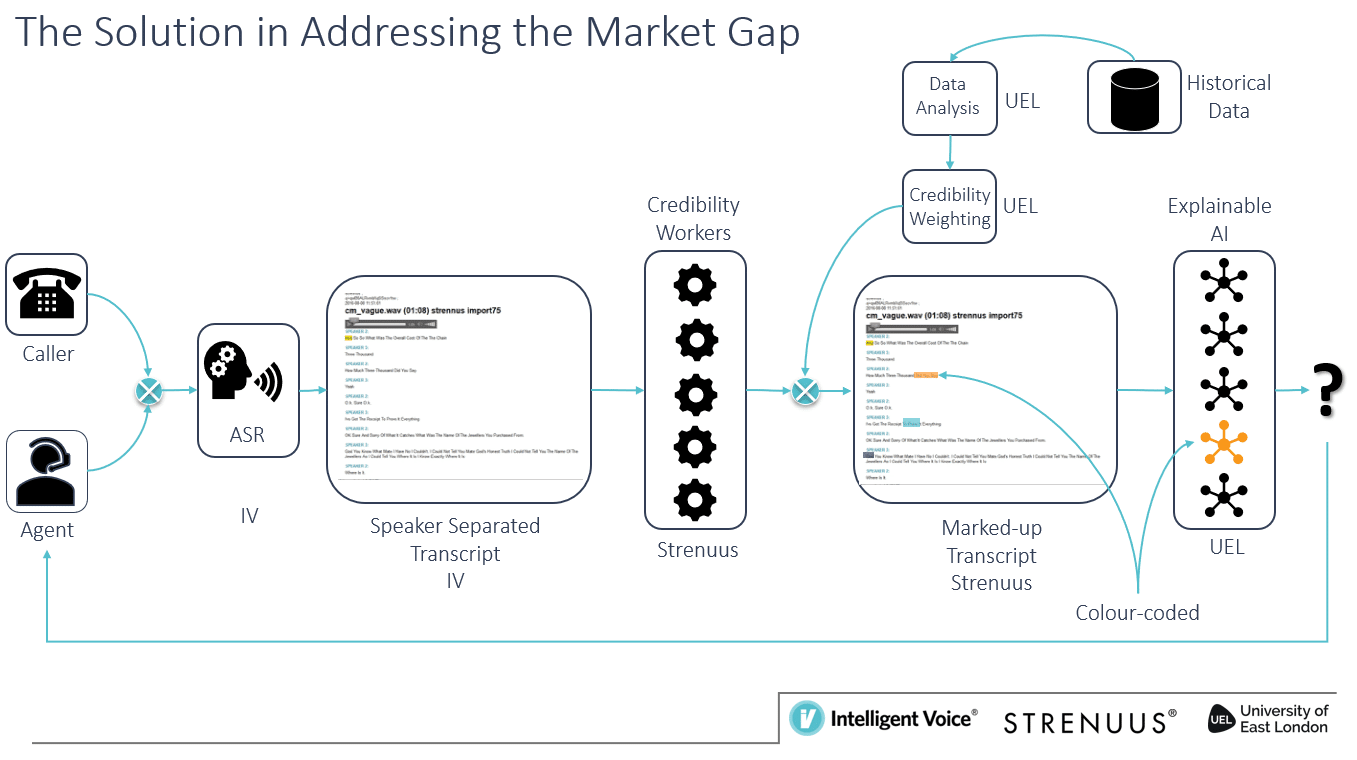
Intelligent Voice, Strenuus and the University of East London are using AI to tackle insurance fraud.

Intelligent Voice combines its machine learning and speech recognition skills with behavioral analytics knowledge from Strenuus, also based in London. The University of East London is working on adding an explainability layer to the technology that will determine how and when decisions were made in a particular case.

The team has shown that they can match human-level efforts in identifying potential fraud.

Their efforts are part of the U.K. government’s Next Generation Services Industrial Strategy Challenge Fund. The project will run for about two-and-a-half years.

Detecting Fraud Before the Payout

During calls to insurers, the system picks up signals of potential deception. These can take the form of specific words or phrases as well as tone of voice. A long short-term memory (LSTM) network has been trained to recognize the signals in real time, so call agents can respond to alerts immediately and change their responses accordingly.

Employee productivity gets a boost because calls flagged by the technology can be provided as a list noting potentially fraudulent markers. Call agents can jump directly to flagged sections for review.

Intelligent Voice’s machine learning algorithms are trained using hundreds of thousands of insurance calls, which have already been manually screened. To power this training, they use an assortment of NVIDIA GPUs and, in production, their software runs on NVIDIA Tensor Core V100 GPUs.

“From a technology perspective, we’ve not found anything which gives us the flexibility and performance that NVIDIA GPUs do,” said Nigel Cannings, CTO of Intelligent Voice. “The flexibility that CUDA offers, in particular, both on the programming side as well as supporting deep learning simultaneously, means that NVIDIA is the obvious choice for us.”

The post UK Government Aims to Tackle Insurance Fraud with AI appeared first on The Official NVIDIA Blog.


[D] Machine Learning – WAYR (What Are You Reading) – Week 59

This is a place to share machine learning research papers, journals, and articles that you’re reading this week. If it relates to what you’re researching, by all means elaborate and give us your insight, otherwise it could just be an interesting paper you’ve read.

Please try to provide some insight from your understanding and please don’t post things which are present in wiki.

Preferably you should link the arxiv page (not the PDF, you can easily access the PDF from the summary page but not the other way around) or any other pertinent links.

Previous weeks :

1-10 11-20 21-30 31-40 41-50 51-60
Week 1 Week 11 Week 21 Week 31 Week 41 Week 51
Week 2 Week 12 Week 22 Week 32 Week 42 Week 52
Week 3 Week 13 Week 23 Week 33 Week 43 Week 53
Week 4 Week 14 Week 24 Week 34 Week 44 Week 54
Week 5 Week 15 Week 25 Week 35 Week 45 Week 55
Week 6 Week 16 Week 26 Week 36 Week 46 Week 56
Week 7 Week 17 Week 27 Week 37 Week 47 Week 57
Week 8 Week 18 Week 28 Week 38 Week 48 Week 58
Week 9 Week 19 Week 29 Week 39 Week 49
Week 10 Week 20 Week 30 Week 40 Week 50

Most upvoted papers two weeks ago:

/u/wassname: CipherGan

/u/data_everyware: http://www.dbs.ifi.lmu.de/Publikationen/Papers/LOF.pdf

Besides that, there are no rules, have fun.

submitted by /u/ML_WAYR_bot
[link] [comments]

Announcing the BAIR Open Research Commons

The University of California Berkeley Artificial Intelligence Research (BAIR)
Lab is pleased to announce the BAIR Open Research Commons, a new industrial
affiliate program launched to accelerate cutting-edge AI research. AI research
is advancing rapidly in both university and corporate research settings, with
existing collaborations already underway driven by individual
researcher-to-researcher collaborations. The BAIR Commons is designed to enhance
and streamline such collaborative cutting-edge research by students, faculty,
and corporate research scholars.

The Commons agreement has been framed with the goal of promoting open research
in AI: all on-campus effort, data, and results in the Commons program will be
non-exclusive with open publication and open-source code release expected.
Fostering an environment for excellence for graduate student research is the
primary motivation of the new program: Berkeley students will lead the design of
projects in the Commons, and the program of research must be approved by their
home departments before a project commences. Students are expected to benefit
from collaboration with leading researchers in industrial research labs, as well
as the availability of partner resources useful to investigate certain open
questions in state-of-the-art AI research. The University will benefit from
membership fees paid by partners to participate in the program. The Commons
agreement provides for collaborative joint projects between the partners and
Berkeley, with intellectual property shared jointly and equally by the parties.

The agreement also provides for joint research “lablets”, which will be embedded
collaborative open research spaces inside BAIR’s 27,000 sq. ft. research
facility opening this summer in the Berkeley Way West facility on the Berkeley
campus. More than a dozen faculty and 120 students will be assigned space in
the new lab, with an equal number of visiting positions allocated for
researchers from other BAIR labs and for visiting industrial partners.

Initial alliance participants include Amazon, Facebook, Google, Samsung, and
Wave Computing. Funding for over twenty joint projects has been committed in the
initial launch of the program, which will support both BAIR facilities and
research efforts. Over 30 faculty and 200 graduate students and postdocs at
Berkeley are affiliated with BAIR. For more information about BAIR or the
Commons program please contact bair-admin@berkeley.edu.


BAIR will occupy the top floor of Berkeley Way West.

Betting on Monte Carlo: GPUs a ‘Game Changer’ for Nuking Noise in Nuclear Imaging

Andras Wirth is like many early AI researchers: His deep learning ambitions only turned into reality because of a sea change in technology.

A physicist, Wirth wanted to run Monte Carlo algorithms to make leaping advances in nuclear imaging, which was previously computationally impossible without massive supercomputers.

A decade ago, his breakthrough came when his lab began using GPUs and the first CUDA release on the computationally demanding algorithms.

On Thursday at the GPU Technology Conference in Silicon Valley, Wirth, who leads nuclear imaging at Mediso Medical, spoke about his company’s groundbreaking work.

Wirth’s team of CUDA programmers runs Monte Carlo method transport calculations on GPUs to enhance image quality. This helps to eliminate the usual degenerating effects that come from inaccuracies in physical modeling.

Monte Carlo transport methods rely on modeling the physical processes that contribute to acquiring the image of a patient. For maximum precision, the modeling consists of simulating billions of photon tracks. These photon tracks are random by nature, thus the simulation itself has to be random —  just like the games in the city of Monte Carlo.

Besides improving the image quality of scans, the main issue for nuclear medicine is the need to lower the dose of injected radioactive isotopes without impairing the diagnostic value of the acquired images. Neural networks help cope with the increasing noise level while also maintaining the useful information with a performance that is unrivaled by  conventional methods.

The lowered dosages are a boon to patients and the facilities that administer the radioactive substances, and the GPU-accelerated technique behind it holds great promise across the field.

“This is a complete game changer — it can have an effect on every type of nuclear medical procedure,” Wirth said.

Los Alamos to Budapest

The Monte Carlo method dates back to research at the Manhattan Project in the 1940s. But it wasn’t until recently that researchers and engineers applied GPUs to the computationally demanding algorithms.

Wirth’s work with GPUs on Monte Carlo methods have added to the capabilities of Budapest-based Mediso’s software used in its cameras for SPECT scans. SPECT (single-photon emission computerized tomography) scans rely on radioisotopes that are injected into the bloodstream of patients. Clinicians then use specialized cameras to capture 3D images of organs.

Mediso trained its U-Net convolutional neural network architecture on 1,000 images of bone scans. U-nets are used in medical imaging to bolster image segmentation so that different areas of details can be outlined.

It took a lot of computing power to do these types of calculations, Wirth said. “Traditionally, only supercomputers were able to do these type of calculations,” he said. “Until, GPUs appeared for general computing, it didn’t even make sense to try out Monte Carlo particle transport calculations in medical imaging.”

GPUs Lower Dose

Radioisotopes administered in medical imaging are low-level carcinogens for patients, expensive for imaging facilities to obtain and require special handling.

“Nobody likes to have nuclear isotopes in their body. That’s why we want to minimize the dose injected to the body — there are risks,” said Wirth.

However, when you lower a radioisotope dose, those lines are more difficult to decipher and blurring occurs that makes it difficult to spot lesions in bones.

Mediso used its neural network solutions running on GPUs to help to minimize that imaging “noise” while reducing the radioisotope dose administered to patients by one-eighth.

“It’s hard to imagine developing neural network-based products without the help of GPUs nowadays. It doesn’t stop there, however: since processing time is crucial in medical imaging, GPU technology has become a vital element of imaging products,” Wirth said.

The post Betting on Monte Carlo: GPUs a ‘Game Changer’ for Nuking Noise in Nuclear Imaging appeared first on The Official NVIDIA Blog.

Snack Shacks: Startup Shows Off Self-Service Stores

A credit card swipe gets you into the checkout-free miniature convenience store. After that, just grab Oreos, Pringles or other munchies, check your receipt and go.

Startup AiFi presented its automated retail store, dubbed the NanoStore, at the GPU Technology Conference this week.

The Silicon Valley-based company uses image recognition powered by a single NVIDIA T4 GPU to automatically capture customers’ shopping items and charge them.

AiFi — an NVIDIA Inception winner last year — is now in pilot tests with its NanoStores and offers its store technology to retailers of all sizes.

The NVIDIA Inception program is a virtual accelerator that helps startups get to market faster.

AiFi’s NanoStores are built into a shipping container that can hold more than 500 different products. The NanoStore concept fills a niche in the market between a vending machine and a convenience store, said co-founder and CEO Steve Gu.

“There’s a gap between vending machines and convenience stores. We believe this will be the next big thing,” said Gu.

Snack Tracking

NanoStores pack cameras inside to capture a customer’s merchandise choices, which are identified by AiFi’s image recognition algorithms and then put on the tab.

It’s not easy to recognize the merchandise and connect it with the customer, and the startup continues to work on this, Gu said.

Detecting more than 500 different products was made easier by using 3D simulations. That made it possible to create about thousands of images from different angles for each product to refine their training set.

Training time was accelerated by using workstations sporting NVIDIA TITAN series GPUs, Gu said.

NanoStore Pilots

AiFi’s NanoStore offers retailers an easy way to try out a fully automated store that is always open, extending hours and sales, Gu told attendees of his GTC talk.

“It creates a new line of business for convenience stores.”

The company is working with Valora, based in Switzerland, on a pilot of its NanoStores located at European railway stations. The startup is also working on a pilot with Carrefour, a French retail giant with more than 12,000 stores, for its technology.

Closer to home, AiFi is in discussions with some universities to place pilots of its NanoStores, which could operate 24/7 on their campuses.

“Students never sleep and neither does the NanoStore,” Gu said.

The post Snack Shacks: Startup Shows Off Self-Service Stores appeared first on The Official NVIDIA Blog.

AWS Deep Learning AMIs now come with TensorFlow 1.13, MXNet 1.4, and support Amazon Linux 2

The AWS Deep Learning AMIs now come with MXNet 1.4.0, Chainer 5.3.0, and TensorFlow 1.13.1, which is custom-built directly from source and tuned for high-performance training across Amazon EC2 instances.

AWS Deep Learning AMIs are now available on Amazon Linux 2

Developers can now use the AWS Deep Learning AMIs and Deep Learning Base AMI on Amazon Linux 2, the next generation of Amazon Linux. This version brings long term support (LTS) until June 30, 2023 and access to the latest innovations from the Linux ecosystem. The Deep Learning AMIs on Amazon Linux 2 have prebuilt and optimized virtual environments for TensorFlow (with Keras), MXNet, PyTorch, and Chainer on Python 3.6 and Python 2.7. Developers can continue using the AWS Deep Learning AMI and Deep Learning Base AMI on Ubuntu and Amazon Linux.

Amazon Linux 2 offers extended availability for software updates. The core operating system has 5 years of long-term support and provides access to the latest software packages through the Amazon Linux Extras repository. Amazon Linux 2 provides a modern execution environment with LTS Kernel (4.14) tuned for optimal performance on AWS, systemd support, and newer tooling (gcc 7.3.1, glibc 2.26, Binutils 2.29.1). Customers can also use Amazon Linux 2 virtual machine images for on-premises development and testing.

Faster training with TensorFlow 1.13

The Deep Learning AMI on Ubuntu, Amazon Linux, and Amazon Linux 2 now come with an optimized build of TensorFlow 1.13.1 and CUDA 10. On CPU instances, TensorFlow 1.13 is custom-built directly from source to accelerate performance on Intel Xeon Platinum processors that power EC2 C5 instances. Training a ResNet-50 model with synthetic ImageNet data using the Deep Learning AMI results in 9.4X faster throughput than stock TensorFlow 1.13 binaries. GPU instances come with an optimized build of TensorFlow 1.13 that is configured with NVIDIA CUDA 10 and cuDNN 7.4 to take advantage of mixed precision training on Volta V100 GPUs powering EC2 P3 instances. The Deep Learning AMI automatically deploys the most performant build of TensorFlow optimized for the EC2 instance of your choice when you activate the TensorFlow virtual environment for the first time.

For developers looking to scale their TensorFlow training to multiple GPUs, the Deep Learning AMIs come with the Horovod distributed training framework. The framework is fully optimized to efficiently use distributed training cluster topologies composed of Amazon EC2 P3 instances. Horovod is an open source distributed training framework based on the Message Passing Interface (MPI) model. This is a popular standard for passing messages and managing communication between nodes in a high-performance distributed computing environment. Training a ResNet-50 model using TensorFlow 1.13 and Horovod in the Deep Learning AMI results in 27% faster throughput than stock TensorFlow 1.13 on 8 nodes.

Better performance and ease-of-use with MXNet 1.4

AWS Deep Learning AMIs now come with the latest release of Apache MXNet 1.4 that bring improvements to performance and ease-of-use. MXNet 1.4 adds Java bindings for inference, Julia bindings, experimental control flow operators, JVM memory management, and many more under-the-hood enhancements. This release also improves MXNet support for Intel MKL-DNN with improved graph optimization and quantization. This feature reduces memory usage and improves inference time without a significant loss in accuracy.

Chainer 5.3

AWS Deep Learning AMIs now support Chainer 5.3.0. The Chainer define-by-run approach allows developers to modify computational graphs on the fly during training. This provides greater flexibility in implementing dynamic neural networks like recurrent neural networks (RNNs) used for natural language processing (NLP) tasks such as sequence-to-sequence translation and question answering systems. Chainer comes fully-configured to take advantage of CuPy with NVIDIA CUDA 9 and cuDNN 7 drivers for accelerating computations on NVIDIA Volta GPUs powering Amazon EC2 P3 instances. You can quickly get started with Chainer using our step-by-step tutorial.

Getting started with AWS Deep Learning AMIs

You can quickly get started with the AWS Deep Learning AMIs by using our getting started tutorial. For more tutorials, go to our developer guide for more resources and release notes. The latest AMIs are now available on the AWS Marketplace. You can also subscribe to our discussion forum to get new launch announcements and post your questions.


About the Authors

Aditya Bindal is a Senior Product Manager for AWS Deep Learning. He works on products that make it easier for customers to use deep learning engines. In his spare time, he enjoys playing tennis, reading historical fiction, and traveling.


Bhavin Thaker is a Software Development Manager in the AWS Deep Learning group, working on products that helps customers use deep learning tools efficiently, with a specific focus on the AWS Deep Learning AMI. He enjoys working with people and computers to make this happen. In his spare time, he enjoys reading and spending time with his family and friends.


Kalyanee Chendke is a Software Engineer for AWS Deep Learning. She works on products that make it easier for customers to get started with deep learning. Outside of work, she enjoys playing badminton, painting and spending time with friends and family.


Error Parer: How AI Could Help Cardiologists Detect Heart Defects Without Skipping a Beat

Nearly a third of physicians will be sued at least once in their careers — most commonly for an error in diagnosis. Medical errors are also the third-leading cause of death in the United States, according to a study by Johns Hopkins Medicine.

Deep learning has the potential to help doctors cut down on diagnostic errors, said cardiologist Rima Arnaout in a talk at the GPU Technology Conference.

An assistant professor of medicine at the University of California, San Francisco, Arnaout is focusing on the potential of AI to analyze cardiac ultrasounds and detect congenital heart disease from fetal ultrasounds.

“In medicine, a picture is worth more than a thousand words,” she said. “It really can be worth a patient’s life, in some cases.”

What Can AI Do to Help?

Arnaout outlined a few key challenges for humans analyzing medical images. For one, people sometimes make mistakes. There’s also a physical limit to how much data cardiac imaging specialists like cardiologists and radiologists can analyze.

“We cannot allow those kinds of shortcomings,” she said. “We need accuracy, precision, and we need it delivered at scale.”

While AI models are not without their limitations, Arnaout said, they can help clinicians use medical imaging techniques like ultrasound to their full potential.

She turned to echocardiogram data because “it’s balanced in terms of information richness and clinical volume compared to other cardiovascular imaging tools.” Since echocardiograms can be used for the diagnosis and management of almost every cardiovascular disease, she said, there’s very little selection bias in the datasets.

Echocardiograms are a challenging training dataset, however, because one ultrasound study consists of still images and videos captured from over a dozen angles. A study Arnaout’s team published in npj Digital Medicine used deep learning to classify 15 of these standard views, achieving 91.7 percent accuracy on low-resolution images.

Detecting Congenital Heart Disease in Utero

Recent work by Arnaout focused on the detection of congenital heart disease from fetal ultrasounds. While in theory more than 90 percent of complex congenital heart disease cases can be diagnosed through traditional fetal screening ultrasounds, the actual detection rate is under 50 percent.

This gap occurs in part because fetal hearts are small and fast beating. Since the fetus itself is often moving, diagnostic-quality images can be difficult to obtain. And although it’s the most common birth defect, congenital heart disease affects just one percent of live births. Since it’s so rare, the condition can easily go overlooked by human readers.

That’s where an algorithm can help: once trained, it could reliably catch congenital heart disease in perpetuity.

Using hundreds of fetal echocardiograms from 18 to 24 weeks of gestational age, the UCSF researchers developed convolutional neural networks to distinguish two varieties of congenital heart disease. The deep learning model, trained on NVIDIA GPUs hosted on Amazon Web Services, was able to classify the two kinds of defects at well above the average diagnostic rate.

Catching heart defects early can lead to better outcomes for patients after birth. And if certain types of lesions are spotted in a fetal ultrasound, doctors can recommend in-utero therapies that significantly improve the heart’s condition by birth.

Arnaout said, “This has the potential to really affect the natural history of an entire life.”


Main image is of an echocardiogram showing a ventricular septal defect, or hole in the heart — a common congenital heart defect. Photo by Kjetil Lenes/Ekko, licensed under public domain on Wikimedia Commons.

The post Error Parer: How AI Could Help Cardiologists Detect Heart Defects Without Skipping a Beat appeared first on The Official NVIDIA Blog.