
Blog

Learn About Our Meetup

5000+ Members

MEETUPS

LEARN, CONNECT, SHARE

Join our meetup, learn, connect, share, and get to know your Toronto AI community. 

JOB POSTINGS

INDEED POSTINGS

Browse through the latest deep learning, ai, machine learning postings from Indeed for the GTA.

CONTACT

CONNECT WITH US

Are you looking to sponsor space, be a speaker, or volunteer, feel free to give us a shout.

Author: torontoai

Get started with the AWS Live Streaming with Automated Multi-Language Subtitling solution

Live Streaming with Automated Multi-Language Subtitling is a solution that automatically generates multi-language subtitles for live streaming video content in real time. You can use this solution as-is, customize the solution to meet your specific use case, or work with AWS Partner Network (APN) partners to implement an end-to-end subtitling workflow.

Based on the Live Streaming on AWS solution, the implementation adds machine learning services Amazon Transcribe and Amazon Translate into the mix. The solution enables the last-mile addition of automatically generated subtitles to live over the top (OTT) channels without having to hire a dedicated transcriptionist, which could be too costly to make subtitles available in general. The solution is available as open source for anyone who wants to expand the basic architecture, adding custom features to fit the solution into their workflow. The GitHub repository can be found here.

Additional AWS Solutions offerings are available on the AWS Solutions webpage, where customers can browse solutions by product category or industry to find AWS-vetted, automated, and turnkey reference implementations that address specific business needs.

Note: The solution described in this blog post uses Amazon Transcribe Streaming, AWS MediaLive, and AWS MediaPackage, which are currently available only in specific AWS Regions. Therefore, you must launch this solution in an AWS Region where all of these services are available. For the most current AWS service availability by Region, see AWS service offerings by region.

Step 1: Deploy the Live Streaming with Automated Multi-Language Subtitling solution

Sign into the AWS Management Console and then head over to the Live Streaming with Automated Multi-Language Subtitling Solution page. Choose Launch solution in the AWS Console.
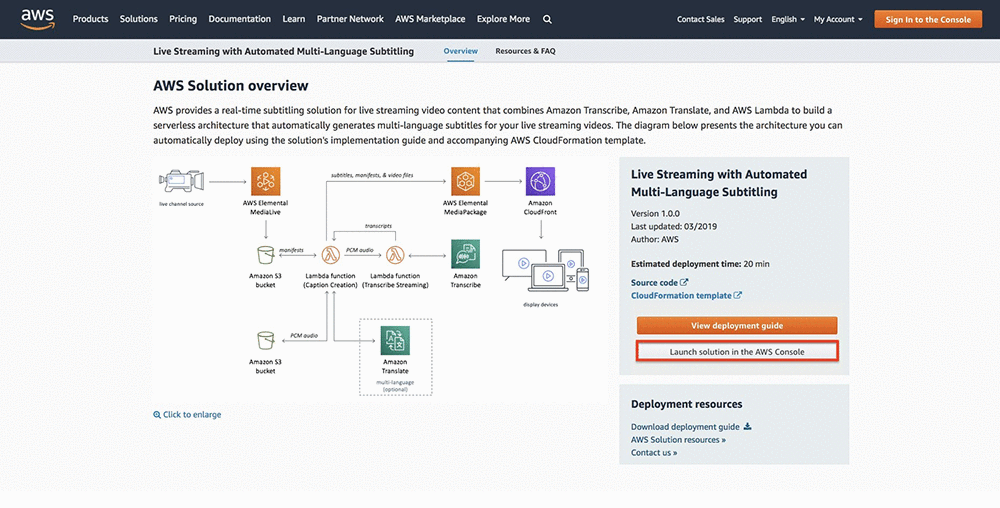
Step 2: Launch the AWS CloudFormation template

The stack can also be launched with the Launch Solution in the documentation guide.

Step 3: On the Select Template page, choose Next

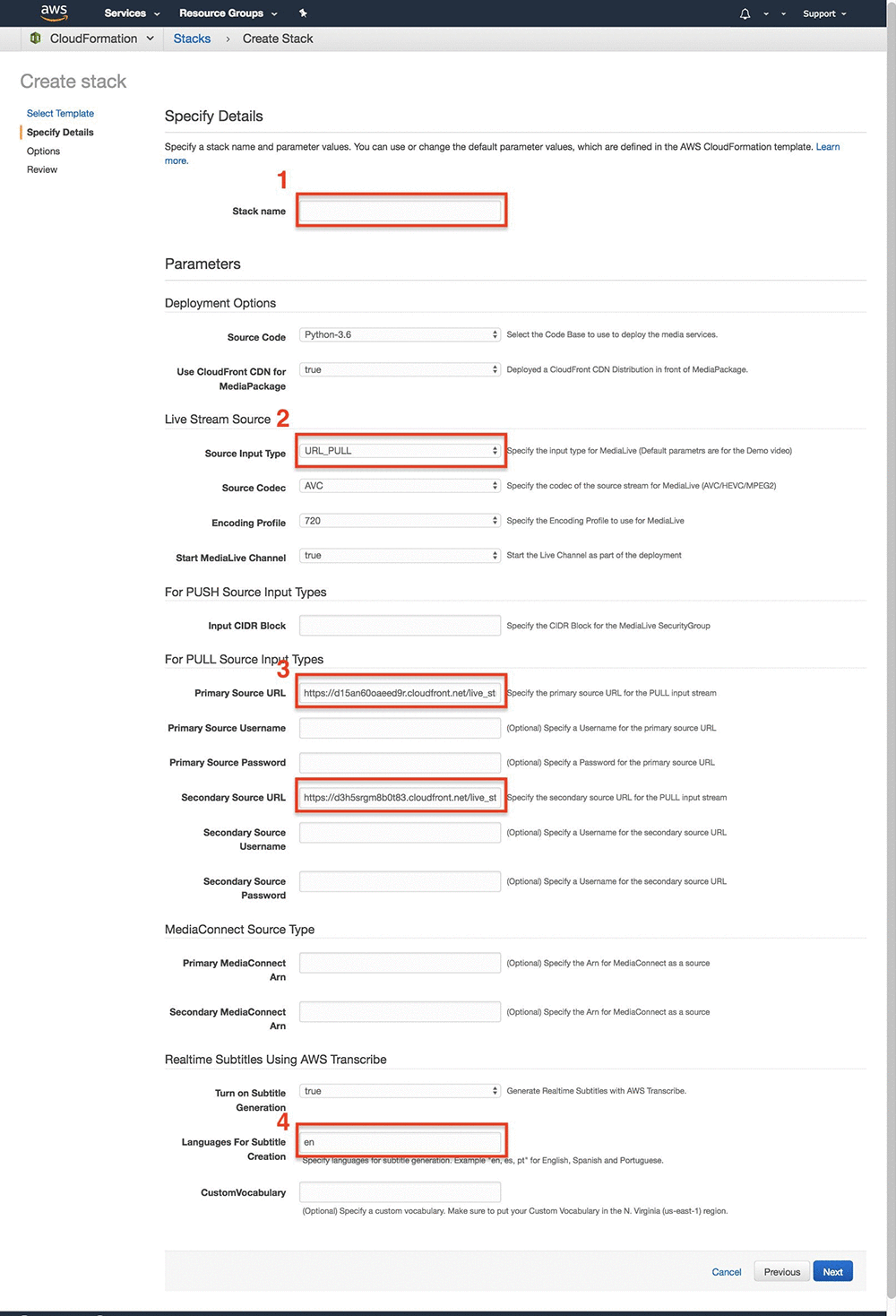
Step 4: Input information on the Specify Details page

  1. Choose a name for your stack.
  2. Choose what input format you want to use.
  3. If you are using HLS pull put in your input URLs. Example: https://s3.amazonaws.com/yourbucketname/index.m3u8
  4. Choose the languages you want as subtitles. For example if you want English, Spanish, and German you would enter: en, es, de.

The supported output subtitle languages are listed here. For information on the inputs see the documentation guide.
Step 5: On the Options page, choose Next

Choose the Next button on the options page.
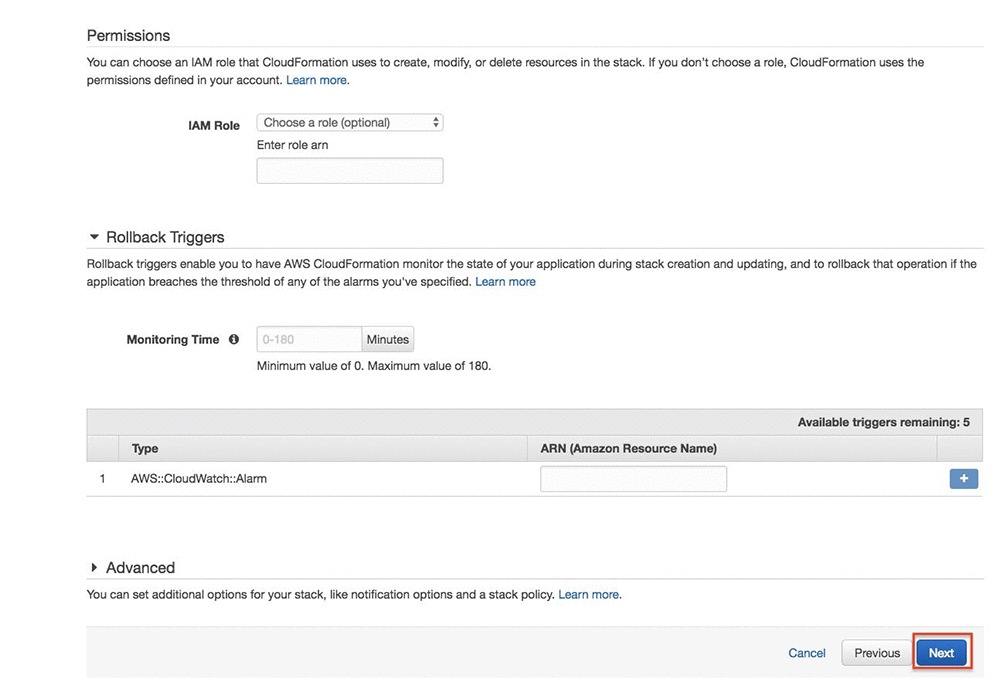
Then, check that you accept that AWS CloudFormation will create IAM resources and choose Create. 

Note that this CloudFormation takes about 20 minutes to deploy.

Step 6: Solution should show deployed now

You should see CREATE_COMPLETE in the status area.
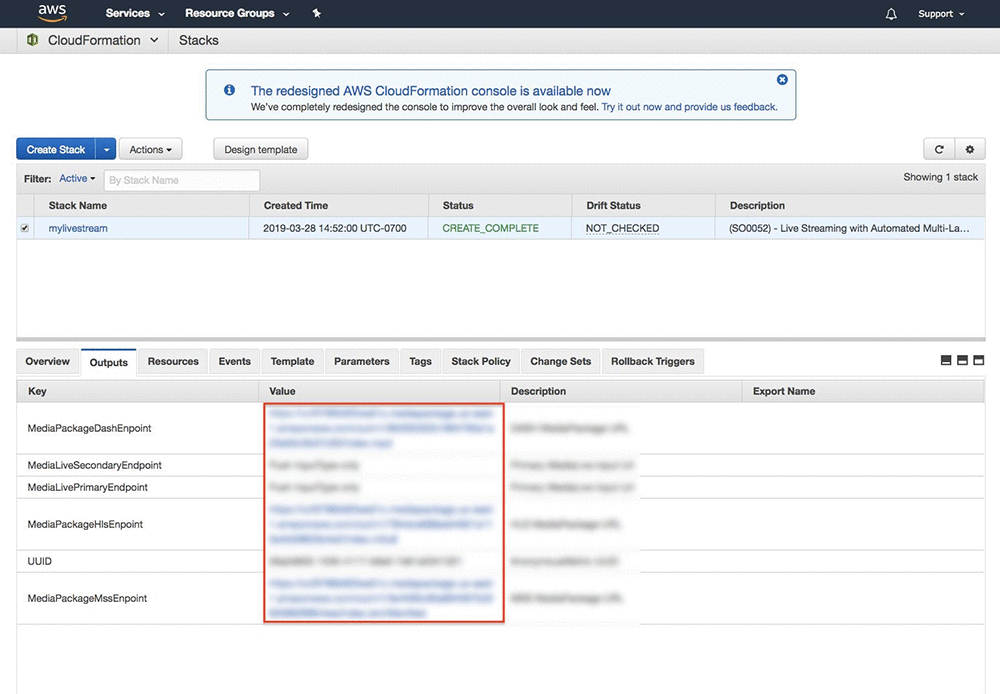
The screenshot of the solution deployed page should say CREATE_COMPLETE under the status area for the solution.
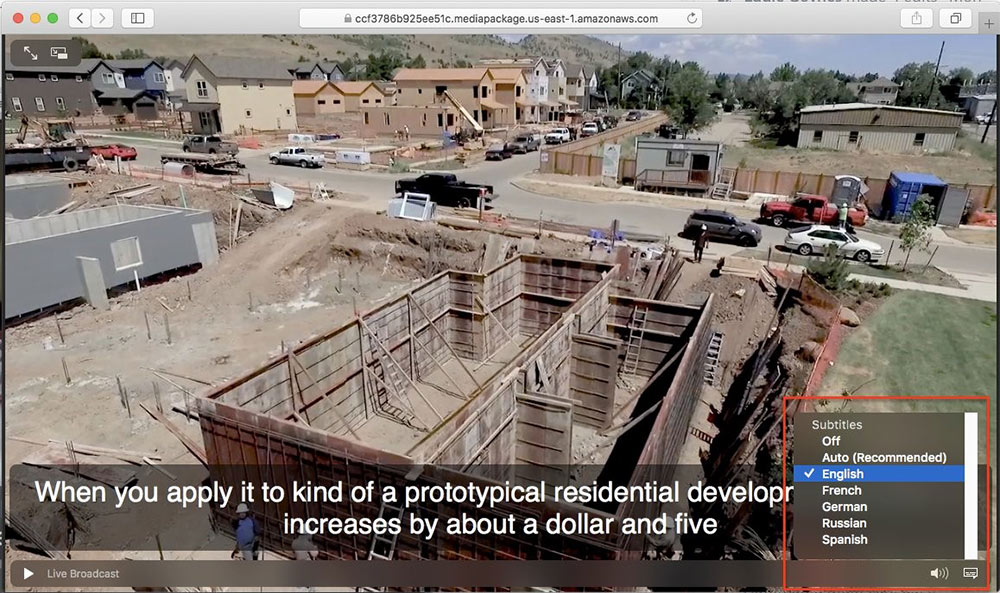
After waiting a minute for the AWS MediaLive channel to start you can copy and paste the HLSEndpoint URL ending in m3u8 into Safari or an online test player, such as Video.JS.

I took the HLS stream output ending in m3u8 and pasted it into my Safari browser search bar. The subtitle selector on the bottom right allows a user to select different languages for the subtitles.

Conclusion

We have shown you how easy it is to set up your Live Stream with automatically generated subtitles from Amazon Transcribe. For more information about AWS Media Services or this solution follow these links:


About the Author

Eddie Goynes is a Technical Marketing Engineer for AWS Elemental. He is an AWS Cloud and Live Video Streaming technical expert.


[P] YouTube Advertisement Scraper

I am working on a project to predict advertisement effectiveness based on ad video content. I realized there wasn’t any dataset for this task, so I wrote my own python code to collect ads on youtube. The code downloads advertisement videos and the website the ad links to. I wanted to share the code in case this data would be useful for anyone. Link to Github: https://github.com/sdilbaz/Youtube-Advertisement-Collector

PS: If you have any comments, or if there is any functionality you want me to add please tell me. Thanks

submitted by /u/raijinraijuu
[link] [comments]

[D] How do you keep the fundamentals fresh as a PhD student?

I feel like the knowledge that I can easily recall has become more and more narrow as the years (and my PhD) goes by, and while (I think) I have a very strong understanding of my sub-subfield, I still have to spend a decent amount of time refreshing on the fundamentals before internship interviews.

I’ve taken many (and TA’d several) courses in probability theory, statistical ML, algorithms, etc. but since none of the models in my field are really probabilistic and we don’t use most fundamental algorithms or data structures I’m finding it more difficult to recall those topics during interviews. Given enough time I can find a DP recurrence relation but not as fast as I would like since I haven’t had to do this in years. Ditto for questions like implementing EM from scratch.

How do you keep these topics fresh? Do you occasionally look over old notes, grind leetcode once or twice a week, etc?

submitted by /u/harmonium1
[link] [comments]

Medical Imaging Startup Uses AI to Classify Conditions from Sinus and Brain Scans

Radiologists are tasked with diagnosing some of the most serious medical conditions — but their workloads are becoming increasingly demanding as the volume of imaging studies such as CT and MRI has steadily gone up.

Houston-based InformAI is stepping in to help reduce fatigue and stress for radiologists by building deep learning tools that can help them analyze medical scans faster.

“We wanted to build diagnostic-assist tools for clinicians to speed up information workflow and decision-making at the point of care to benefit patients,” said InformAI CEO Jim Havelka.

InformAI trains its deep learning image classifiers and patient outcome predictors on NVIDIA V100 GPUs through the Microsoft Azure cloud platform and with an onsite NVIDIA DGX Station. The startup worked with data science consulting firm SFL Scientific to develop a convolutional neural network-based deep learning technology stack using top technology resources.

In less than 30 seconds, InformAI’s image classifier scans for 20 sinus conditions and flags which ones might be present in a patient’s 3D CT scan. This AI tool has also formed the basis for other image classification applications that analyze 3D scans of soft tissue — including detecting common brain cancers from MRI scans.

AI Spots Sinus Conditions

Figuring out the structure of an individual’s sinuses is harder than it sounds. Each person’s sinus cavities look different, making it challenging for AI to determine if an infection or abnormal mass is present in the eight major sinus cavities and passageways that connect them.

Doctors perform around 700,000 sinus procedures each year in the United States. Using AI to speed up the diagnostics workflow can save on healthcare costs and shorten the time it takes to begin treatment.

InformAI and its healthcare partners built a training dataset was built consisting of approximately 6 million images from 20,000 patient studies. The scans were labeled by a team of radiologists and medical residents who worked with the company on the project.

Radiologists using the startup’s platform can examine and analyze 3D sinus CT scans while the predictor neural network is running. In under a minute, the AI results pop up for 20 sinus medical conditions, which the doctors can then use to assist in their diagnosis and treatment planning process.

InformAI is deploying the sinus classifier this spring at a hospital and several clinics to test its effectiveness as an assist tool for radiologists and ear, nose and throat physicians. The team is also going through the regulatory process required for the AI to be certified as a direct diagnostic tool.

A Neural Network for Neurological Disorders

In general terms, the sinus classification neural network extracts 3D segments from a CT scan to analyze whether a particular disease or set of diseases is present in those image segments, Havelka said. Since the network was trained on such a large medical dataset, it can be repurposed using transfer learning to solve image classification problems for a broad range of soft tissue medical applications.

The startup is doing just that. Using transfer learning, the team trained a neural network to detect disease from another kind of soft tissue: the brain.

When a tumor or lesion is identified in the brain, “it can be life-and-death for patients,” said Havelka. “Early detection and classification are critical in providing the best treatment options and outcome for patients.”

But different brain tumors and lesions can look alike, and can also resemble other neurological disorders with different treatments. As a result of this classification complexity, a patient’s treatment plan can evolve over time.

When radiologists are unable to make a conclusive diagnosis from a brain MRI scan, physicians turn to invasive brain biopsies to obtain additional information. An AI tool that can assist radiologists in making an earlier and more certain diagnosis could reduce the number of required biopsies.

Using a 3D CNN, InformAI is developing a tool that analyzes brain MRI scans to detect whether a tumor or lesion is present, and can classify an abnormal scan as one of four conditions: glioblastoma, metastatic brain tumor, multiple sclerosis or lymphoma.

The deep learning model for brain cancer detection, which is still under development, was initially trained on around 100,000 image scans from 1,000 patient studies.

Founded in 2017, InformAI is a member of the NVIDIA Inception virtual accelerator program. To learn more about the company’s work, read this recent white paper.

The post Medical Imaging Startup Uses AI to Classify Conditions from Sinus and Brain Scans appeared first on The Official NVIDIA Blog.

[D] Intuition behind embedding dimension and LSTM output space dimension?

So I have followed an example of building an LSTM network for sentiment analysis. I have used my own dataset and the performance of the network is pretty good. I do want to understand the logic behind choosing the right embedding dimension space and the LSTM output dimension space. How would one go on to choose an optimal space for both? What effect would reducing the dimension space?

I am quite new to this, and any help would be great! I am using Keras in Python.

submitted by /u/Fender6969
[link] [comments]

[P] CppRl: A C++ reinforcement learning library using the new PyTorch C++ frontend

[P] CppRl: A C++ reinforcement learning library using the new PyTorch C++ frontend

I’m really excited to show you guys what I’ve been working on lately: https://github.com/Omegastick/pytorch-cpp-rl

It is very heavily based on Ikostrikov’s wonderful pytorch-a2c-ppo-acktr-gail. You could even consider this a port. The API and underlying algorithms are almost identical (with the necessary changes involved in the move to C++).

It also contains a reimplementation simple OpenAI Gym server that communicates via ZeroMQ to test the framework on Gym environments.

CppRl aims to be an extensible, reasonably optimized, production-ready framework for using reinforcement learning in projects where Python isn’t viable. It should be ready to use in desktop applications on user’s computers with minimal setup required on the user’s side.

Motivation

At the time of writing, there are no general-use reinforcement learning frameworks for C++. I needed one for a personal project, and the PyTorch C++ frontend had recently been released, so I figured I should make one.

Features

  • Implemented algorithms:
    • A2C
    • PPO
  • Recurrent policies (GRU based)
  • Cross-platform compatibility (tested on Windows 10, Ubuntu 16.04, and Ubuntu 18.04)
  • Solid test coverage
  • Decently optimized (always open to pull requests improving optimization though)

Sample

Processing gif r1w6ksghemr21…

If you want to help with the project, please submit a PR!

submitted by /u/Flag_Red
[link] [comments]

[D] Examples of machine learning applied to “solved” problems

I have been recently reading the article The Case for Learned Index Structures which is about applying ML methods to a deeply investigated problem of search indexes. From the article: “Our initial results show, that by using neural nets we are able to outperform cache-optimized B-Trees by up to 70% in speed while saving an order-of-magnitude in memory over several real-world data sets”.

This was an eye-opener to me as I always thought about B-Trees indexes as a very well investigated area which is essentially “solved” and we already know a lot about theoretical bounds, etc. You see, it is one thing to use ML to solve a previously unsolved or poorly done problem (e.g. object detection in CV), it is an entirely different thing to revisit a problem that we already claim we know the best general solution to.

So I was wondering if there are other examples that you know of that would describe an ML based method which beats well investigated and established methods in real-world situations?

submitted by /u/shapul
[link] [comments]