Robots that Learn to Use Improvised Tools
In many animals, tool-use skills emerge from a combination of observational
learning and experimentation. For example, by watching one another, chimpanzees
can learn how to use twigs to “fish” for insects. Similarly, capuchin
monkeys demonstrate the ability to wield sticks as sweeping tools to pull
food closer to themselves. While one might wonder whether these are just
illustrations of “monkey see, monkey do,” we believe these tool-use abilities
indicate a greater level of intelligence.
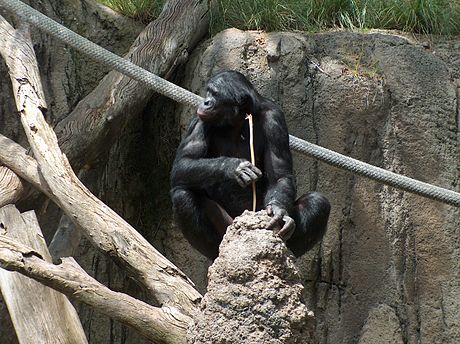
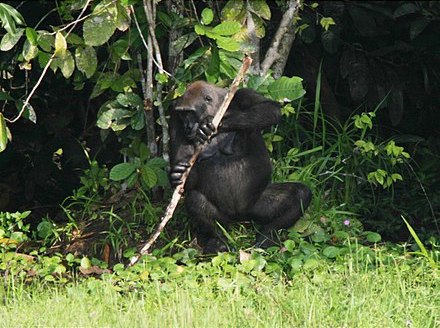
Left: A chimpanzee fishing for termites. Right: A gorilla using a stick to
gather herbs. (source)
The question our new work explores is: can we enable robots to use tools in the
same way — through observation and experimentation?
A requisite for performing complex multi-object manipulation tasks, such as
those involved in tool use, is an understanding of physical cause-and-effect
relationships. Therefore, the ability to predict how one object might
interact with another is crucial. Our prior work has investigated how
visual predictive models of cause-and-effect can be learned from unsupervised
robot interaction with the world. After learning such a model, the robot can
plan to accomplish a diverse set of simple tasks, including cloth folding and
object arrangement. However, if we consider the more complex interactions that
occur in tool-use tasks, such as how a broom can sweep dirt into a dustpan,
undirected experimentation isn’t enough.
Hence, taking inspiration from how animals learn, we designed an algorithm that
allows robots to learn tool-use skills through a similar paradigm of imitation
and interaction. In particular, we show that, with a mix of demonstration data
and unsupervised experience, a robot can use novel objects as tools and even
improvise tools in the absence of traditional ones. Further, depending on the
demands of the task, our method demonstrates the ability to decide whether to
use the provided tools. In this post, we will describe how this works.

