Blog

Learn About Our Meetup

5000+ Members

MEETUPS

LEARN, CONNECT, SHARE

Join our meetup, learn, connect, share, and get to know your Toronto AI community. 

JOB POSTINGS

INDEED POSTINGS

Browse through the latest deep learning, ai, machine learning postings from Indeed for the GTA.

CONTACT

CONNECT WITH US

Are you looking to sponsor space, be a speaker, or volunteer, feel free to give us a shout.

Author: torontoai

[P] Intro to word2vec recommenders and how Airbnb and Alibaba use them [video]

Hello r/machinelearning,

This talk is my best attempt to strip down the core concepts of word2vec, and explain how the algorithm is being to power recommendation engines. The power of recent NLP models is a testament to how far we’ve come in extracting patterns from sequential data. This application of the algorithm treats other sequences of data (e.g. website click sessions, songs in user-created playlists) as sentences leading us to create embeddings (for items in an ecommerce store, or songs/artists in a music service) that we can use for similarity and recommendation. My Illustrated Word2vec post built on the materials I created for this talk. I hope you find it useful:

https://www.infoq.com/presentations/nlp-word-embedding

submitted by /u/nortab
[link] [comments]
[R] [OC] Intrinsic Multi-scale Evaluation of Generative Models

Generative models are often used to sample high-dimensional data points from a manifold with small intrinsic dimension. Existing techniques for comparing generative models focus on global data properties such as mean and covariance; in that sense, they are extrinsic and uni-scale. We develop the first, to our knowledge, intrinsic and multi-scale method for characterizing and comparing underlying data manifolds, based on comparing all data moments by lower-bounding the spectral notion of the Gromov-Wasserstein distance between manifolds. In a thorough experimental study, we demonstrate that our method effectively evaluates the quality of generative models; further, we showcase its efficacy in discerning the disentanglement process in neural networks.

TL;DR: We introduce a metric based on heat kernels that is able to compare data manifolds in unaligned spaces. We test it on GAN evaluation (it works), and on tracking the disentanglement and training progress of NNs (also works!).

ArXiv page: https://arxiv.org/abs/1905.11141 Code is available here: https://github.com/xgfs/msid I am here to answer your questions about the paper! 🙂

Extra shoutout to /u/augustushimself who wrote a brilliant GAN post, and the discussion that followed on this sub. It gave a lot of inspiration for writing this.

submitted by /u/olBaa
[link] [comments]

[D]HELP in machine learning

I am so much confused and tired for looking online courses…Idk where to start and what to do..i tried udacity intro to machine learning but they use python 2 and it gets very hectic to change to python 3 all time … Neither the teachers teach well …😞😭Pls guide me ….im a beginner

submitted by /u/Vaibhav_37
[link] [comments]

End-to-End Deep Reinforcement Learning without Reward Engineering

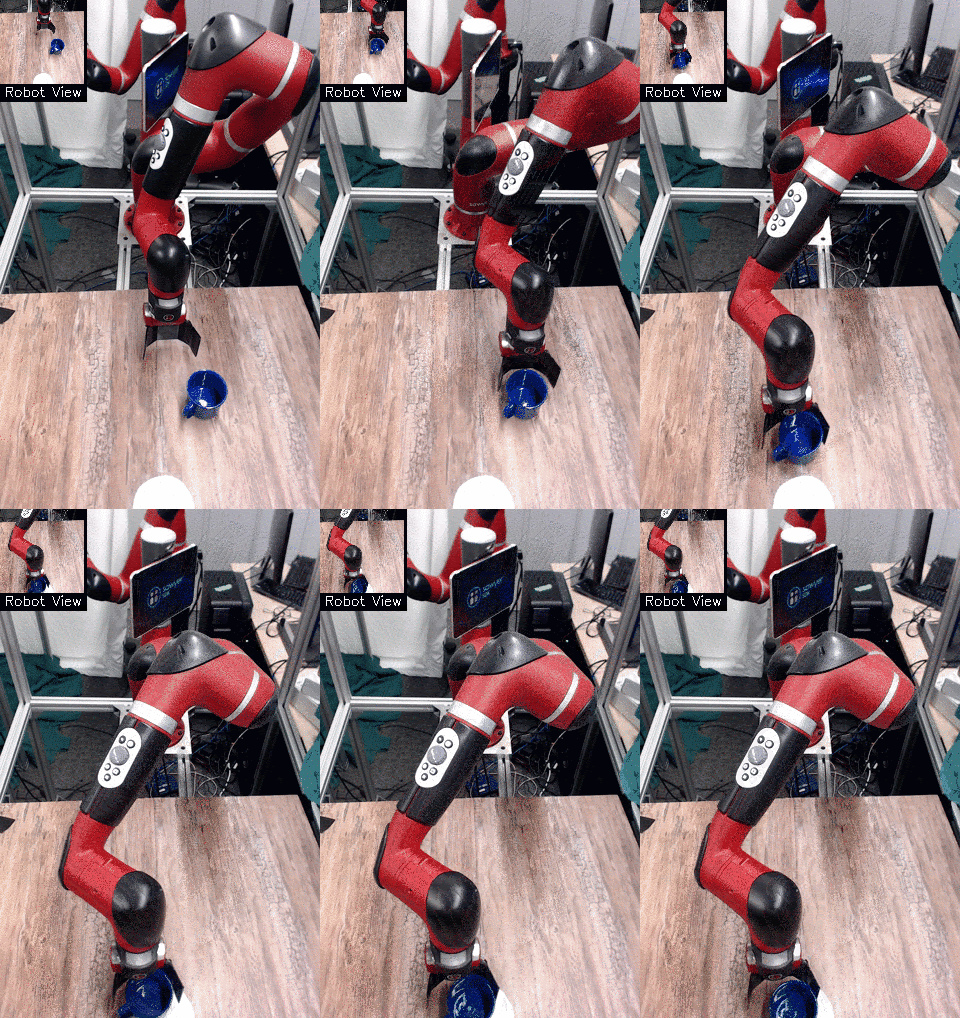
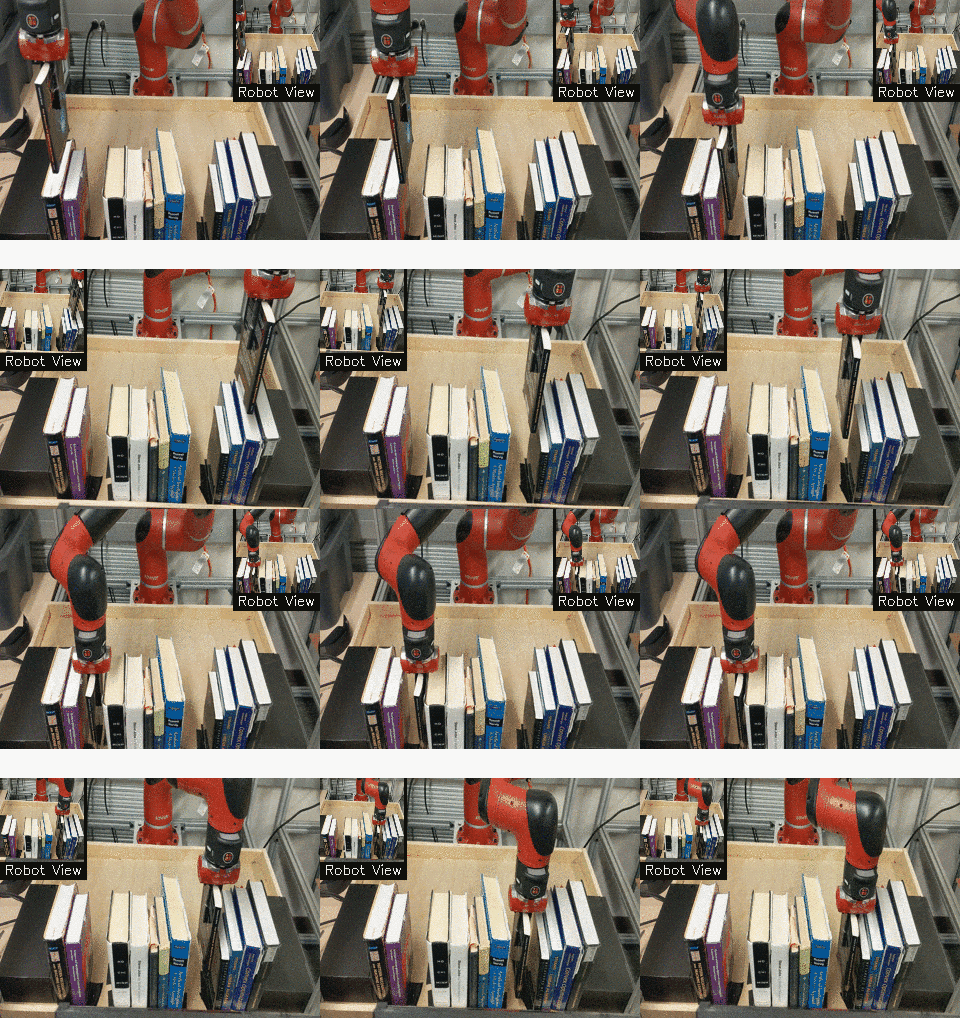
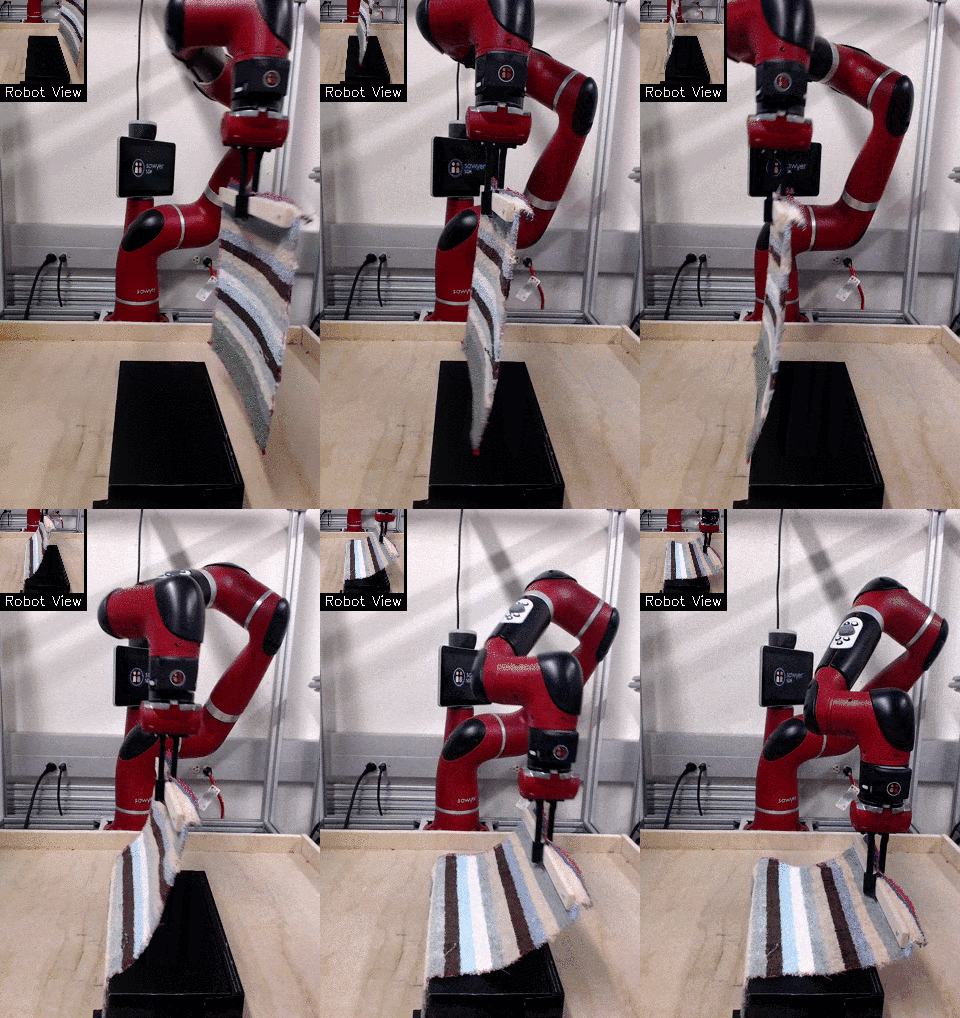
Communicating the goal of a task to another person is easy: we can use language, show them an image of the desired outcome, point them to a how-to video, or use some combination of all of these. On the other hand, specifying a task to a robot for reinforcement learning requires substantial effort. Most prior work that has applied deep reinforcement learning to real robots makes uses of specialized sensors to obtain rewards or studies tasks where the robot’s internal sensors can be used to measure reward. For example, using thermal cameras for tracking fluids, or purpose-built computer vision systems for tracking objects. Since such instrumentation needs to be done for any new task that we may wish to learn, it poses a significant bottleneck to widespread adoption of reinforcement learning for robotics, and precludes the use of these methods directly in open-world environments that lack this instrumentation.

We have developed an end-to-end method that allows robots to learn from a modest number of images that depict successful completion of a task, without any manual reward engineering. The robot initiates learning from this information alone (around 80 images), and occasionally queries a user for additional labels. In these queries, the robot shows the user an image and asks for a label to determine whether that image represents successful completion of the task or not. We require a small number of such queries (around 25-75), and using these queries, the robot is able to learn directly in the real world in 1-4 hours of interaction time, resulting in one of the most efficient real-world image-based robotic RL methods. We have open-sourced our implementation.


Our method allows us to solve a host of real world robotics problems from pixels in an end-to-end fashion without any hand-engineered reward functions.

Continue reading

[D] Does anyone created a formal database for word meaning?

I’m looking for a database that has sufficient information to mathematically prove things like: “[young man] == [a boy] == [male child]”.

This database should have basic information such as “[a king] is [male], [person], [sovereign], [ruler], etc..” but also strict definitions like “[quick] == [moving fast] or [in short time]”.

Any thoughts?

submitted by /u/moshestv
[link] [comments]

[P] Demo of “Arbitrary Style Transfer with Style-Attentional Network”

[P] Demo of "Arbitrary Style Transfer with Style-Attentional Network"

Hi MachineLearning

I’ll introduce awesome style transfer demo site.

This site is demo of “Arbitrary Style Transfer with Style-Attentional Network” (CVPR 2019).

– project page: https://dypark86.github.io/SANET/

– Improved Version Demo Site: http://style.airi.kr/demo/

– CVPR 2019 Version Demo Site: http://style.airi.kr/ori_demo/

– Paper Arxiv: https://arxiv.org/pdf/1812.02342.pdf

If you were interested, please share this post.

Thanks!

https://i.redd.it/jwp5r6a8ww031.jpg

submitted by /u/likebullet86
[link] [comments]

[R] Triplet loss for image retrieval

[R] Triplet loss for image retrieval

Hi, there!

This is an example of image retrieval based on MNIST and fashion-MNIST!

After learning by using typical triplet loss (a type of metric loss), we checked the retrieval results for the query image.

Despite simple learning, the results show fairly accurate retrieval results.

We have also shown the embedding space for the learned network in various ways.

If you are interested in doing research or metric learning, you might want to refer to it.

https://github.com/kdhht2334/Triplet_loss_for_image_retrieval

Image retrieval result 1

Image retrieval result 2

Visualization of embedding space

submitted by /u/kdhht2334
[link] [comments]

[P] GAN Music Generator

Hi MachineLearning,

I have also created a GAN music generator (seen a few on here in the past few months)

Link: https://hookgen.com

It is basically a GAN in TensorFlow r1.13, however, I have two separate discriminative networks, i.e. one network feeds the piano score, while the other the duration the song was played on the website in milliseconds

Please let me know if you have any questions

I will deploy the code tomorrow on GitHub if you have any interest

submitted by /u/scriptcoder43
[link] [comments]