Develop, implement, and deploy machine learning and especially deep learning methods. Exposure to deep learning algorithms such as Caffe, Theano, TensorFlow and… From Arterys – Sat, 24 Aug 2019 15:22:54 GMT – View all Toronto, ON jobs
tl;dr: Instance Segmentation slow, YOLACT make fast (29.8 COCO mAP, 33.5 Titan Xp fps).
Hi all, my paper was recently accepted ICCV 2019 Oral so I thought I’d post it here. (Note: fps numbers were rebenchmarked for ICCV and I haven’t updated it elsewhere).
Today, object detection has several methods that do well (e.g., Faster R-CNN+++, RetinaNet), and several that do well enough but are also fast (e.g., YOLOv2-3, SSD). On the other hand, the same isn’t true for instance segmentation. We have good methods (e.g., Mask R-CNN and its derivatives, Retina-Mask), but no fast methods that do well enough on a complex dataset like COCO.
YOLACT changes this. We obtain 29.8 mAP (30.1 after a stupid bug fix, but the paper’s out now >.>) on COCO at 33.5 fps on a single Titan Xp, making YOLACT the best fast instance segmention method out at the moment. And it’s simple: predict a set of k basis masks (prototypes) over the whole image and in parallel predict a set of k linear combination coefficients (mask coefficients) for each detection. Then to generate masks for a detection, just multiply the mask coefficients into the prototypes and add (which can be implemented as one matrix multiplication per image). This whole process takes ~5-6 ms to add a masks to any existing object detector.
I also came up with “Fast NMS”, a close approximation to traditional per-class NMS that’s 12ms faster.
I’m working on a data labeling project to assist with the labeling and sharing of datasets. The goal is to minimize your time scraping the web for images and labeling data manually. Why let your side projects go to waste when you can share your datasets with others? I have included an AI powered annotation tool as well.
You have experience and interested in AI, Machine learning and the Blockchain. Support the product strategy by developing a deep understanding of market trends,… From Freckle IoT – Sat, 24 Aug 2019 12:06:45 GMT – View all Toronto, ON jobs
Join Mathew Salvaris and Ilia Karmanov an on a lively discussion about all things deep learning. I was blown away by these two incredibly talented data scientists. Nothing inspires me more than having a conversation with people who are literally 10 times smarter than me. We discuss Mat’s work on building out patterns for distributed deep learning on Azure. Ilia discusses the latest and greatest on video action detection. We talk about computer vision, interpretability, robustness, ML engineering and the democratisation of deep learning. Finishing off we discuss where the deep learning space is going in the next 5 years!
Traditional open surgeries require large incisions that provide doctors a broad view of the area they’re operating on. But surgeons are increasingly opting for minimally invasive techniques that rely instead on live video feeds from tiny cameras, which provide a more limited view past much smaller incisions.
The benefits for patients are clear: less blood loss, less pain and faster recovery times.
However, minimally invasive procedures are more technically demanding for surgeons since they must operate with a narrow field of view and use small instruments that require fine manipulation skills.
To give surgeons an assist, Kaliber Labs, a San Francisco-based startup, is developing AI models to interpret these video feeds in real time.
The company’s deep learning models recognize and measure aspects of a patient’s anatomy and pathology, as well as display key information and treatment recommendations on operating room video monitors.
“A surgery consists of a series of steps,” said Ray Rahman, founder and CEO of Kaliber Labs, a member of the NVIDIA Inception virtual accelerator program. “We’re going through the entire process to provide surgeons AI guidance that decreases their cognitive load, improves accuracy and reduces uncertainty.”
The startup is also developing a deep learning model that annotates surgical video after procedures to provide better communication and transparency with patients.
To develop tools that process real-time video input in the operating room, Kaliber Labs uses the JetPack SDK and NVIDIA Jetson TX2 AI computing device for inference at the edge. The team plans for its deployed product to run on the NVIDIA Jetson AGX Xavier, enabling the low latency required for real-time processing.
Keeping an AI on Operating Rooms
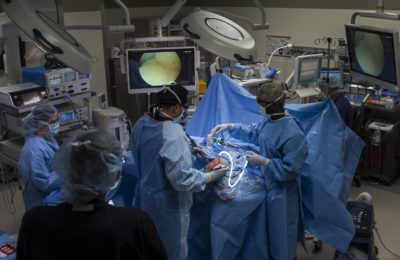
During a minimally invasive orthopedic procedure, surgeons rely on video monitors to view the area they’re operating on. (U.S. Air Force photo/Airman 1st Class Kevin Tanenbaum)
Kaliber Labs’ current suite of AI tools are focused on orthopedic surgery — covering shoulder, knee, hip and wrist procedures. Arthroscopy, or minimally invasive joint surgery, is the most common orthopedic operation, used to treat many disorders and sports injuries.
At the start of a procedure, the Kaliber Labs’ deep learning tools use the video feed to identify what kind of surgery is taking place and which camera view is being used. Then, AI models specific to the relevant procedure type come into play for real-time guidance.
Surgeons begin with an initial assessment of the patient’s anatomy and pathology before picking a course of action for the operation. The startup’s models aid in this process, combining with computer vision algorithms to recognize and measure, for example, a 20 percent bone defect of the shoulder socket, or glenoid cavity, during the procedure.
Such real-time quantitative analyses provide orthopedic surgeons with greater objectivity and an extra layer of insight as they make intraoperative decisions.
So far, Kaliber Labs has finished developing its shoulder surgery algorithms and is working on its models for knee and hip procedures. Its deep learning tools are trained on thousands of hours of actual surgery videos, which are first processed by an AI algorithm that scrubs the footage to delete any personally identifiable information about patients and surgeons.
The startup recently signed an agreement with a major medical device company to build a Jetson Xavier-powered AI edge machine that integrates with operating room equipment to provide intraoperative guidance. To work in real time during a surgical procedure, Rahman says a GPU at the edge is essential.
“We run a cascade of models for detecting anatomy and pathology, and various measurement algorithms,” he said. “Since we’re doing real-time video inference, our inference has to occur in less than 30 milliseconds in order to avoid perceived lag by the surgeons.”
The NVIDIA Jetson platform enables edge computing with a combination of high GPU compute performance and low power usage. Kaliber Labs chose the Jetson Xavier embedded module due to its small footprint and wide range of options for systems integration, Rahman said.
Running on Jetson Xavier, the startup’s CNN binary classification model — optimized for inference using NVIDIA TensorRT software — has a latency rate of just 1.5 milliseconds.
For the Record: Analyzing Surgical Video Post-Op
After an operation, patients typically receive a short debrief from their surgeon, who shares key snapshots from the surgery. These photos or video segments have limited value to patients because, to the untrained eye, it’s hard to get a sense of what’s taking place in the procedure without context and labels of the anatomy.
“Patients and their families want to know what the surgeons did, what they saw during the procedure,” Rahman said, “but nobody has time to manually annotate a whole video. That would take hours and days, and it’d be prohibitively expensive.”
Kaliber Labs is developing a set of AI models that analyzes and labels the surgical video with descriptions of each step in the procedure. Providing patients with annotated footage of a surgery could be useful to those curious about their operation, and improve transparency about what took place during the surgery.
This kind of operative record could also facilitate accurate medical coding and efficient billing.
Main image shows an orthopedic surgeon performing ACL surgery. (U.S. Air Force photo/Airman 1st Class Kevin Tanenbaum)
I am from Germany and I looked for jobs both here in Germany and USA for Deep Reinforcement Learning positions. Every single position I’ve found required a Ph.D. I understand why, the field is new and mostly academic / research work. Still I wonder if anyone has any information about getting a job maybe not as a researcher scientist (where Ph.D. would be required) but maybe as a research engineer when having a M.Sc degree? As a research engineer you implement papers to solve current problems. The question is, is there any hope for the field of Deep Reinforcement Learning currently? I know for “classic” Deep Learning (supervised etc) such positions exist, but I am very interested in deep RL.
I am nearning the end of my M.Sc. in robotics with the master thesis being on Deep Learning. I am teaching myself deep RL on my free time and would like to pursue a career in that field. I find RL and agents interacting with the environment fascinating.