Blog

Learn About Our Meetup

5000+ Members

MEETUPS

LEARN, CONNECT, SHARE

Join our meetup, learn, connect, share, and get to know your Toronto AI community. 

JOB POSTINGS

INDEED POSTINGS

Browse through the latest deep learning, ai, machine learning postings from Indeed for the GTA.

CONTACT

CONNECT WITH US

Are you looking to sponsor space, be a speaker, or volunteer, feel free to give us a shout.

Author: torontoai

Closing the AI Skills Gap: Deep Learning Institute Adds A Dozen New Courses

From finding the best sushi near you to improving the manufacturing process of industrial components to making the car you drive safer, AI is advancing convenience, productivity and reliability across industries.

But taking advantage of the power of AI is not feasible without a skilled workforce. In fact, industry research indicates that lack of AI skills is the primary reason companies are unable to achieve business value with AI.

This is why companies and government agencies around the world are swarming the job market to hire developers, data scientists, engineers and researchers with AI expertise. But there just aren’t enough AI-trained developers to meet the demand.

To help bridge that gap, NVIDIA created the Deep Learning Institute in 2016 to train developers with hands-on courses in both fundamental and advanced AI topics. In that time, more than 183,000 students have taken advantage of this program to advance their skills.

Today, DLI is expanding its portfolio with a dozen new courses. Among the instructor-led workshops:

Onsite workshops are one of the most effective ways to train teams of developers and data scientists. DLI has delivered instructor-led workshops on-site at organizations as diverse as Adobe, Baker Hughes, Booz Allen Hamilton, Cisco, Groupe PSA, and the U.S. Food and Drug Administration. Plus, DLI is working with companies like Lockheed Martin to provide this training at multiple sites across their enterprise.

“Lockheed Martin Corporation is committed to providing our employees with access to advanced training and tools,” said Matt Tarascio, chief data and analytics officer at Lockheed Martin. “The outstanding instructors and material of NVIDIA’s DLI program have been instrumental in helping to accelerate the adoption of modern data-driven AI across the corporation in applications such as deep learning, computer vision, natural language processing, intelligent video analytics and more.”

In addition to in-person training, DLI launched new online, self-paced courses on:

Many of the courses offer a certificate of competency to support professional growth. Plus, DLI offers resources to universities including free DLI Teaching Kits to bring AI skills to their classrooms and the DLI Ambassador Program to teach DLI courses to students for free.

Enroll in online, self-paced courses or request an instructor-led workshop for your team.

The post Closing the AI Skills Gap: Deep Learning Institute Adds A Dozen New Courses appeared first on The Official NVIDIA Blog.

[R] You can find a lot of interesting things in the loss landscape of your neural network

[R] You can find a lot of interesting things in the loss landscape of your neural network

Just sharing with you a small (and somewhat fun) project I was recently working on, which is about finding different patterns in the loss surface of neural networks. Usually, a landscape around a minimum looks like a pit with random hills and mountains surrounding it, but there exist more meaningful ones, like in the picture below (check the paper for more results). We have discovered that you can find a minimum with (almost) any landscape you like. An interesting thing is that the found landscape pattern remains valid even for a test set, i.e. it is a property that (most likely) remains valid for the whole data distribution.

https://preview.redd.it/t885u6vosow31.png?width=1810&format=png&auto=webp&s=793644af78a5430368e7a1c05d7b38c6b02ec637

Paper: https://arxiv.org/abs/1910.03867
Code: https://github.com/universome/loss-patterns

submitted by /u/universome
[link] [comments]

[D] Thoughts on Quantum Artificial Intelligence / Q Supremacy

[D] Thoughts on Quantum Artificial Intelligence / Q Supremacy

“Quantum Computing: The Why and How ǀ Jonathan Baker, UChicago” https://www.youtube.com/watch?v=5kTiB_KDUj0

Hey 🙂 So just wanted to start a discussion on what people think about whether Quantum Algorithms will “revolutinize” machine learning algorithms. I’m not a quantum expert, so take my stance with a grain of salt.

I was watching many videos (“Quantum algorithm for solving linear equations” https://www.youtube.com/watch?v=KtIPAPyaPOg, “Seth Lloyd: Quantum Machine Learning” https://www.youtube.com/watch?v=wkBPp9UovVU etc etc) + reading Wikipedia blah. Then I came across the diagram above.

According to Jonathan Baker, there are 3 main future trends for QPCs. I just extrapolated his graphs. The green line is most optimistic, utilising “co-design”??? which I don’t know what that means. The red is less steep, and the blue is just a straight line continuation of the current # of qubit trend. (Notice the log10 scale)

QAOA or Quantum Approximation Optimization Algorithms include Quantum Linear Regression, and possibly??? (I don’t know) optimisation methods for backprop. The green line shows by 2025 QPCs can be used for Linear Reg. Red which is like average case is 2035? and worst case is 2045.

To crack cryptography (ie Shor’s Algorithm), over 10,000 # of qubits are needed. By green best case, that will be at 2032. Average is 2045 and worst is 2067.

I was also reading Wikipedia “Quantum algorithm for linear systems of equations” https://en.wikipedia.org/wiki/Quantum_algorithm_for_linear_systems_of_equations, and it highlights how solving X * beta = y or A * x = b takes O( log(P) * K^2 ), where K is the condition number and P is the # of coefficients in beta. The best conjugate gradeint method takes O( P * K ).

More concretely, the “exponential speedup” (I think???) applies to sparse matrices. If you include error bounds, then you get O( log(P) * K^2 / err ). For dense matrices you get O( sqrt(P) log(P) K^2 ).

The issue I see is since methods all include error bounds, it isn’t necessarily a good way to compare direct methods with quantum algos. A better way is to compare randomized methods, where an “exponential speedup” is also possible by sketching only log(N) rows. It’s possible to also say apply the randomized methods with Q Algos, hence in total you might get a staggering “exponential-exponential” speedup, but because Q Algos inherently have error, this will exaggerate the error a lot.

So what do people think about the potential of Q Algos for ML ?

PS: The graph above is suprisingly a log10 plot (ie x10). This is clearly different from Moore’s Law graph (x2 for # of transistors), but anyways I’m guessing Qubits don’t follow Moores Law

submitted by /u/danielhanchen
[link] [comments]

[R] Announcing Confident Learning: Finding and Learning with Label Errors in Datasets

Hi, Reddit. I’m excited to share confident learning for characterizing, finding, and learning with label errors in datasets. To promote and standardize future research in learning with noisy labels and weak supervision, I’ve also open-sourced the cleanlab Python package: https://pypi.org/project/cleanlab/

Post: https://l7.curtisnorthcutt.com/confident-learning

Title: Confident Learning: Uncertainty Estimation for Dataset Labels

Abstract: Learning exists in the context of data, yet notions of confidence typically focus on model predictions, not label quality. Confident learning (CL) has emerged as an approach for characterizing, identifying, and learning with noisy labels in datasets, based on the principles of pruning noisy data, counting to estimate noise, and ranking examples to train with confidence. Here, we generalize CL, building on the assumption of a classification noise process, to directly estimate the joint distribution between noisy (given) labels and uncorrupted (unknown) labels. This generalized CL, open-sourced as cleanlab, is provably consistent under reasonable conditions, and experimentally performant on ImageNet and CIFAR, outperforming recent approaches, e.g. MentorNet, by 30% or more, when label noise is non-uniform. cleanlab also quantifies ontological class overlap, and can increase model accuracy (e.g. ResNet) by providing clean data for training.

Paper: https://arxiv.org/abs/1911.00068
Code: https://github.com/cgnorthcutt/cleanlab/

submitted by /u/cgnorthcutt
[link] [comments]

[P] Machine Learning for Excel. Anyone interested?

Hello everyone! I’m looking into building a machine learning Excel Add-In. Here is how it works (roughly):

  1. Prepare a sheet of training data, one of the columns contain the target or label, other columns are features.
  2. Open the add-in. Select relevant columns for training. For each column, choose whether it is categorical or numerical.
  3. The data is submitted to a cluster of servers and the servers automatically try different types of models and hyperparameters to produce the most accurate results.
  4. Then the user can use the add-in to make predictions on new data in another Excel sheet.

Would this be useful for people who don’t know how to train machine learning models?

submitted by /u/DomLiu
[link] [comments]

Can We Learn the Language of Proteins?

The incredible success of BERT in Natural Language Processing (NLP) showed that large models trained on unlabeled data are able to learn powerful representations of language. These representations have been shown to encode information about syntax and semantics. In this blog post we ask the question: Can similar methods be applied to biological sequences, specifically proteins? If so, to what degree do they improve performance on protein prediction problems that are relevant to biologists?

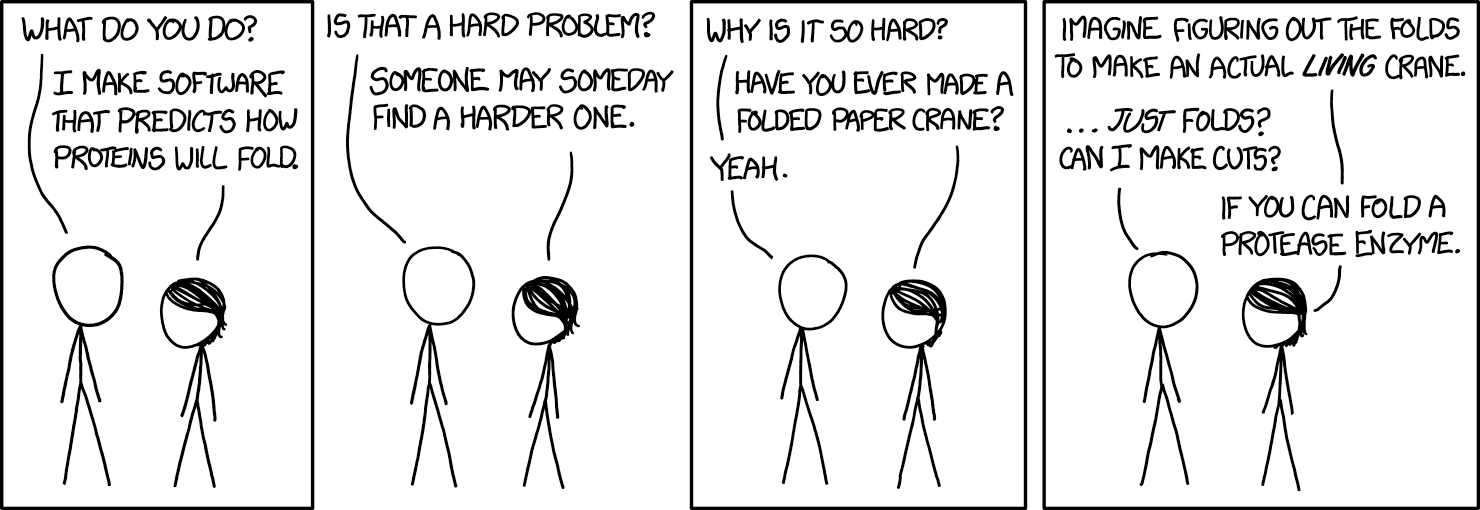
We discuss our recent work on TAPE: Tasks Assessing Protein Embeddings (preprint) (github), a benchmarking suite for protein representations learned by various neural architectures and self-supervised losses. We also discuss the challenges that proteins present to the ML community, previously described by xkcd:

Continue reading

[D] relation between the learned parameters of two trained neural networks on the same dataset

I was wondering if there is any work that studies the relation of learned weights between two neural nets.

For example, suppose we have a simple regression task, and we trained an MLP with one hidden layer with 20 neurons. If we train another MLP with 15 neurons in the hidden layer, what would the relation of the weight matrices be between these two networks?

I found some related works on neural network compression literature that start with the bigger model and use matrix pruning with factorization and/or decomposition to reach a smaller model. But, I’m not sure if the obtained parameters will be close to the weights a neural network(with the same parameters as the smaller model) will learn if trained from scratch. I mean, the fact that we can use pruning methods and get good accuracy doesn’t necessarily mean that that is the true relation between the bigger model and the smaller one. What do you think?

submitted by /u/nodet07
[link] [comments]