
Blog

Learn About Our Meetup

5000+ Members

MEETUPS

LEARN, CONNECT, SHARE

Join our meetup, learn, connect, share, and get to know your Toronto AI community. 

JOB POSTINGS

INDEED POSTINGS

Browse through the latest deep learning, ai, machine learning postings from Indeed for the GTA.

CONTACT

CONNECT WITH US

Are you looking to sponsor space, be a speaker, or volunteer, feel free to give us a shout.

Author: torontoai

[R] [P] UNC BIAG Releases Mermaid, Pytorch based image registration toolkit

We are thrilled to release our image registration toolkit after a long time! 🔥🔥

You can quickly prototype and test your image registration pipelines with Mermaid, based on PyTorch. 🌟

By using Mermaid, it is convenient to utilize GPU acceleration for registration models. PRs, questions are welcome! 🙌

We also have another package called easyreg, it wraps Mermaid and uses deep networks.

Github repository: https://github.com/uncbiag/mermaid

Documentation: https://mermaid.readthedocs.io/en/latest/index.html

Related papers:

Region-specific Diffeomorphic Metric Mapping https://arxiv.org/pdf/1906.00139.pdf https://github.com/uncbiag/easyreg

Zhengyang Shen, François-Xavier Vialard, Marc Niethammer. NeurIPS 2019.

Networks for Joint Affine and Non-parametric Image Registration https://arxiv.org/pdf/1903.08811.pdf https://github.com/uncbiag/easyreg

Zhengyang Shen, Xu Han, Zhenlin Xu, Marc Niethammer. CVPR 2019.

Metric Learning for Image Registration https://arxiv.org/pdf/1904.09524.pdf

Marc Niethammer, Roland Kwitt, Francois-Xavier Vialard. CVPR 2019.

Quicksilver: Fast predictive image registration–a deep learning approach https://arxiv.org/pdf/1703.10908.pdf https://github.com/rkwitt/quicksilver

Xiao Yang, Roland Kwitt, Martin Styner, Marc Niethammer, NeuroImage 2017.

Fast Predictive Image Registration https://github.com/rkwitt/FastPredictiveImageRegistration

Xiao Yang, Roland Kwitt, Marc Niethammer. DLMIA 2016.

submitted by /u/SahinOlut
[link] [comments]

[D] Given the recent news about plagiarism, will this be even more of a problem in the future?

A couple examples:

https://www.reddit.com/r/MachineLearning/comments/dq82x7/discussion_a_questionable_sigir_2019_paper/

https://www.reddit.com/r/MachineLearning/comments/dh2xfs/d_siraj_has_a_new_paper_the_neural_qubit_its/

Both papers were easy to catch because they directly copied word for word large sections of text. But with more aggressive word substitution and NLP applications getting better, this would get much harder to detect in the future.

Are we going to see plagiarism on the rise in the near future?

submitted by /u/FirstTimeResearcher
[link] [comments]

[D] Random Forests and Decision Trees

I am doing a binary classification problem where I currently run a decision tree across the data with 100 different random seeds, and then take the total number of outputs and figure out the final predicted classification. So if it comes out 1 75 times and 0 25 times, then the final prediction is a 1. I am using a pure majority problem (in the event of a tie, I go with 0). Would there be any benefit to running the exact same thing, but with 100 different random forests? In other words, will a decision tree and random forest predict the same wrong ones, but predict different correct ones? I am trying to find a way to push the accuracy a little higher. It works well, coming in with about 65% accuracy.

P.S. I do all the normal stuff like train-test split, limit the number of branches to the decision tree, etc.

P.P.S. I should note that the random seed changes for the train-test split and the decision tree when running the next tree.

submitted by /u/spot4992
[link] [comments]

[D] Parallelization for neuroevolution AutoML models

I want to run multiple smaller models in parallel on the same GPU for the purposes of implementing something like CoDeepNEAT. However when, in testing, creating 100 small Torch CUDA models and getting the output of a 1000×8 tensor passed to each model with layer sizes 8-64-8, parallelizing with a pool of 8 workers takes ~15 seconds and uses ~6 GB of vRAM, and serially processing them takes ~0.03 seconds and uses ~100 MB of vRAM.

Is there some particular scheme that I should be using for this? Should I switch from Torch to Tensorflow? From Python to C++? Anyone have any ideas?

submitted by /u/MrAcurite
[link] [comments]

U.S. Government CTO, CIO Among Leaders Flocking to GTC DC

The U.S. government’s CTO and CIO on Tuesday joined other key tech decision makers, lawmakers, and industry leaders at the start of the two-day GPU Technology Conference in Washington D.C.

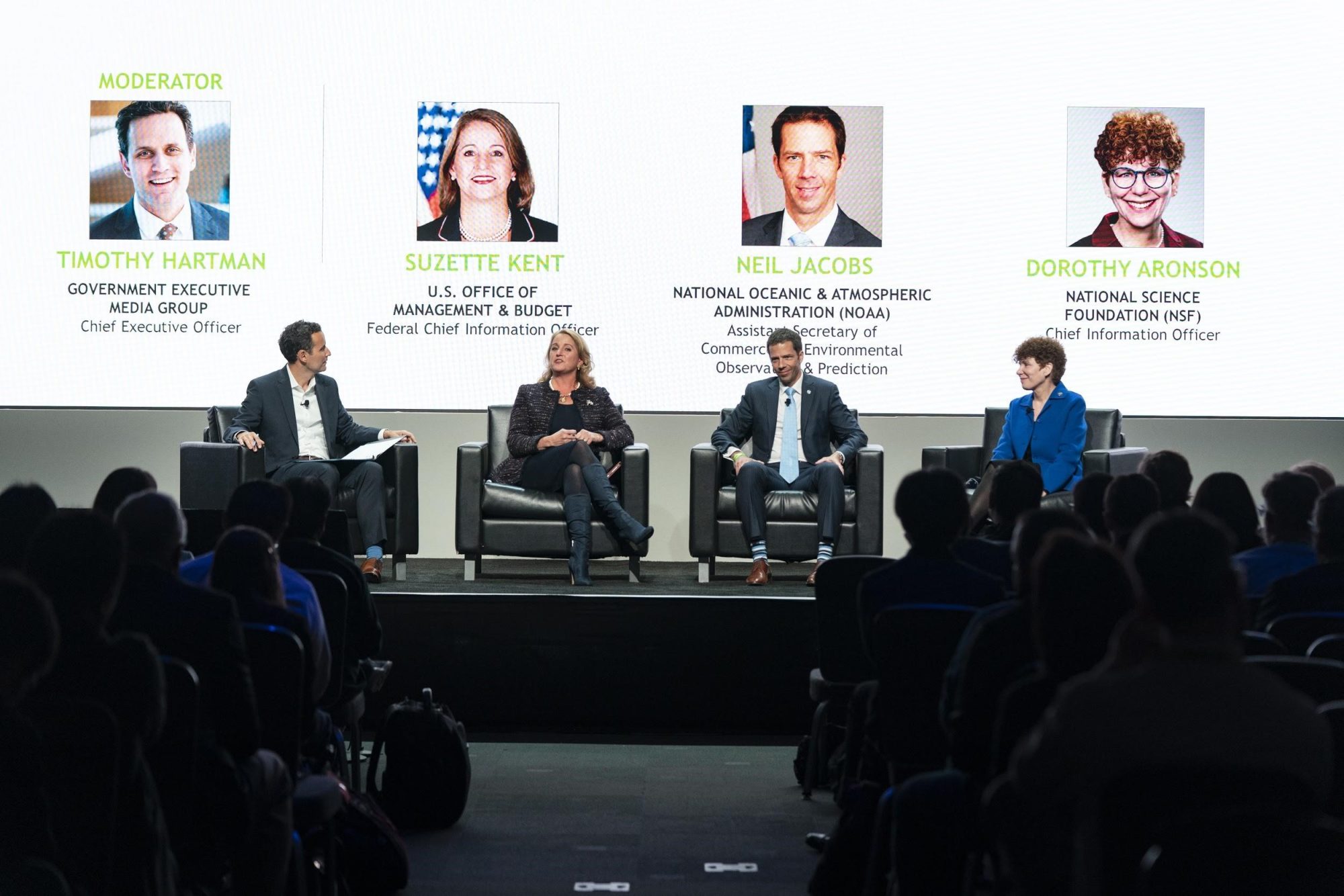
Federal CIO Suzette Kent led a panel of civilian agency leaders explaining how they’re using AI.  Moments later, U.S. CTO Michael Kratsios led a discussion of how the federal government is supporting U.S. AI leadership.

And Moira Bergin, the House Committee on Homeland Security’s subcommittee director for cybersecurity and infrastructure protection, joined a discussion of how Congress and the administration are addressing new AI cybersecurity capabilities.

The talks were among the more than 160 sessions — led by a cross-section of Washington  leaders from government and industry — that have drawn more than 3,500 to downtown D.C. this week.

GTC DC — hosted by NVIDIA and its partners, including Booz Allen Hamilton, Dell, IBM, Lockheed Martin and others — has quickly become the capital’s largest AI event. And it’s research, not rhetoric, attendees will tell you, that makes DC an AI accelerator like no other.

The conference is packed with representatives from more than a score of federal agencies — among them the U.S. Department of Energy, NASA, and the National Institutes of Health — together able to marshal scientific efforts on a scale far beyond that of anywhere else in the world.

Putting AI to Work

The conference opened with a keynote from Ian Buck, NVIDIA’s vice president for accelerated computing.

Buck — known for creating the CUDA computing platform that puts GPUs to work powering everything from supercomputing to next-generation AI — detailed the broad range of AI tools NVIDIA makes available to help organizations advance their work.

“The challenge is how do we take AI from innovation to actually applying AI,” Buck said during his keynote address Wednesday morning. “Our challenge, NVIDIA’s challenge, and my challenge is ‘How can I bring AI to industries and activate it?’”

Buck’s message was buttressed by Kent, who led a panel of civilian agency leaders discussing how they’re using AI to improve government services.

“We’re using these AI capabilities to act faster,” Kent said. “In the areas where we’re keeping citizens safe, whether it’s reacting to weather or a problem caused by humans — the speed at which we help is increasing.”

Meanwhile, Kratsios led a discussion about how the U.S government — which has a decades long history of supporting key technology advances — is working to extend U.S. technology leadership in the AI age.

“We fundamentally believe that AI is something that’s going to touch every industry in the United States,” Kratsios said. “We view artificial intelligence as a tool that can empower workers to do their jobs better, safer, faster, and more effectively.”

Wrapping up the day, the House’s Bergin joined Coleman Mehta, senior director of U.S. policy at Palo Alto Networks; Daniel Kroese, associate director of the national risk management center at the Cybersecurity and Infrastructure Security Agency; and Joshua Patterson, GM of data science at NVIDIA.

In a panel moderated by NVIDIA’s  Iain Cunningham, VP of intellectual property and cybersecurity, the four spoke about the new AI capabilities, potential countermeasures, and preparations being made by the administration and Congress.

Bergin said she’s “excited” about the prospects for AI after what she described as a decade of underinvestment in R&D.

“There’s a lot of demystification that needs to happen about what AI actually is, what it’s capabilities are now, and what its capabilities will be later,” Bergin said.

Scores more discussions are slated through Wednesday afternoon.

Underscoring the role AI can play for good, speakers from the Johns Hopkins University Applied Physics Laboratory and the Joint AI Center will discuss how they’re harnessing AI to provide humanitarian assistance and disaster relief.

Expect their discussion — of how they harnessed airborne and satellite imagery data after Hurricane Florence hit North and South Carolina in 2018 — to point the way to more groundbreaking AI feats to come.

The post U.S. Government CTO, CIO Among Leaders Flocking to GTC DC appeared first on The Official NVIDIA Blog.

US Government CTO, CIO Among Leaders Flocking to GTC DC

The U.S. government’s CTO and CIO on Tuesday joined other key tech decision makers, lawmakers and industry leaders at the start of the two-day GPU Technology Conference in Washington, D.C.

U.S. CTO Michael Kratsios gave the conference’s policy day keynote on how the federal government is supporting U.S. AI leadership. And Federal CIO Suzette Kent led a panel of civilian agency leaders explaining how they’re using AI.

Another highlight: a panel on national AI strategy featuring Lynne Parker assistant director for AI with the White House Office of Science and Technology and National Security AI Commissioner Jason Matheny.

The talks were among the more than 160 sessions — led by a cross-section of Washington  leaders from government and industry — that have drawn more than 3,500 to downtown DC this week.

GTC DC — hosted by NVIDIA and its partners, including Booz Allen Hamilton, Dell, IBM, Lockheed Martin and others — has quickly become the capital’s largest AI event. And it’s research, not rhetoric, attendees will tell you, that makes DC an AI accelerator like no other.

The conference is packed with representatives from more than a score of federal agencies — among them the U.S. Department of Energy, NASA and the National Institutes of Health — together able to marshal scientific efforts on a scale far beyond that of anywhere else in the world.

Putting AI to Work

The conference opened with a keynote from Ian Buck, NVIDIA’s vice president for accelerated computing.

Buck — known for creating the CUDA computing platform that puts GPUs to work powering everything from supercomputing to next-generation AI — detailed the broad range of AI tools NVIDIA makes available to help organizations advance their work.

“The challenge is how do we take AI from innovation to actually applying AI,” Buck said during his keynote address Tuesday morning. “Our challenge, NVIDIA’s challenge and my challenge is ‘How can I bring AI to industries and activate it?’”

Buck then joined Kratsios for a discussion about how the U.S. government — which has a decades-long history of supporting key technology advances — is working to extend U.S. technology leadership in the AI age.

“We fundamentally believe that AI is something that’s going to touch every industry in the United States,” Kratsios said. “We view artificial intelligence as a tool that can empower workers to do their jobs better, safer, faster and more effectively.”

Kratsios’s points were buttressed by the speakers on the national AI strategy panel — which included Parker and Matheny — discussing the progress of the U.S. government’s national AI strategy.

They touched on the federal government’s ongoing investment in R&D, obtaining and training the highest quality talent, and implementation of AI across the federal government.

As part of that, Parker, invited listeners to participate in the 30-day public comment period in following the draft release of draft guidance on facilitating industry AI adoption from the U.S. Office of Management and Budget’s Office of Information and Regulatory Affairs.

Kent who is leading federal AI adoption efforts, participated in a discussion about advancing AI adoption across the federal government, as part of a panel of civilian agency leaders.

“We’re using these AI capabilities to act faster,” Kent said. “In the areas where we’re keeping citizens safe, whether it’s reacting to weather or a problem caused by humans — the speed at which we help is increasing.”

Wrapping up the day, Moira Bergin, the House Committee on Homeland Security’s subcommittee director for cybersecurity and infrastructure protection, joined a discussion of how Congress and the administration are addressing new AI cybersecurity capabilities.

Bergin joined Coleman Mehta, senior director of U.S. policy at Palo Alto Networks; Daniel Kroese, associate director of the national risk management center at the Cybersecurity and Infrastructure Security Agency; and Joshua Patterson, general manager of data science at NVIDIA.

Bergin said she’s “excited” about the prospects for AI after what she described as a decade of underinvestment in R&D.

“There’s a lot of demystification that needs to happen about what AI actually is, what it’s capabilities are now and what its capabilities will be later,” Bergin said.

Scores more discussions took place throughout the conference, including packed discussions discussions policies to speed adoption of AI in healthcare and building an inclusive AI workforce across the country.

Underscoring the role AI can play for good, speakers from the Johns Hopkins University Applied Physics Laboratory and the U.S. Department of Defense’s Joint Artificial Intelligence Center will discuss how they’re harnessing AI to provide humanitarian assistance and disaster relief.

Expect their discussion — of how they harnessed airborne and satellite imagery data after Hurricane Florence hit North and South Carolina in 2018 — to point the way to more groundbreaking AI feats to come.

The post US Government CTO, CIO Among Leaders Flocking to GTC DC appeared first on The Official NVIDIA Blog.
AI4Good: Canadian Lab Empowers Women in Computer Science

Doina Precup is applying Romanian wisdom to the gender gap in the fields of AI and computer science.

The associate professor at McGill University and research team lead at AI startup DeepMind spoke with AI Podcast host Noah Kravitz about her personal experiences, along with the AI4Good Lab she co-founded to give women more access to machine learning training.

Growing up in Romania, Precup attended a high school that specialized in computer science and a technical university. She didn’t experience gender disparity in these learning environments.

“If anything, programming was considered a very good job for women, because you did not need to be working in the fields,” she explained.

It made the gap in Canadian universities and companies even more noticeable. At McGill, Precup saw that female students were hesitant to speak up or pursue graduate studies.

Together with Angelique Mannella, CEO of AM Consulting and an Amazon employee, Precup was inspired to start the AI4Good Lab in 2017.

Key Points From This Episode:

  • Aimed at improving women’s access to advanced AI and machine learning, the AI4Good Lab brings together 30 women from across Canada every spring for a seven-week workshop
  • Workshop participants take classes, hear from speakers, visit companies and work in small groups to create projects.
  • This year’s projects ranged from identifying fake news to using a caf ’s food supplies efficiently to helping people manage chronic pain.
  • To hear Precup’s best sci-fi book recommendations, listen to the podcast for her guide to the genre.
  • Visit the AI4Good Lab website or Twitter to learn more about participants’ projects and to apply to next year’s workshop. And visit Precup’s Google Scholar page to see her most recent publications.

Tweetables:

“Emphasizing the creativity and the fun in computer science and algorithms is really important, for everybody” — Doina Precup [04:30]

“I also noticed that people were sometimes afraid to speak up in classes, even if they were really good at based on their exams and their assignments and their projects” — Doina Precup [05:43]

You Might Also Like

UC Berkeley’s Pieter Abbeel on How Deep Learning Will Help Robots Learn

Robots can do amazing things. Compare even the most advanced robots to a three-year-old, however, and they can come up short. UC Berkeley Professor Pieter Abbeel has pioneered the idea that deep learning could be the key to bridging that gap: creating robots that can learn how to move through the world more fluidly and naturally.


Teaching Families to Embrace AI

Tara Chklovski is CEO and founder of Iridescent, a nonprofit that provides access to hands-on learning opportunities to prepare underrepresented children and adults for the future of work. We spoke with her about the UN’s AI for Good Global Summit last May in Geneva and the AI World Championship, part of the AI Family Challenge, also in May in Silicon Valley.

Good News About Fake News: AI Can Now Help Detect False Information

With “fake news” embedding itself into, well, our news, it’s become more important than ever to distinguish between content that is fake or authentic. That’s why Vagelis Papalexakis, a professor of computer science at the University of California, Riverside, developed an algorithm that detects fake news with 75 percent accuracy.

Make Our Podcast Better

Have a few minutes to spare? Fill out this short listener survey. Your answers will help us make a better podcast.


The post AI4Good: Canadian Lab Empowers Women in Computer Science appeared first on The Official NVIDIA Blog.

[N] Spleeter released by Deezer for Source Separation

Spleeter is an open-source project from Deezer for source separation on music tracks. Built with keras and tensorflow.

So basically this allows you to separate the vocal, drum, bass tracks and more from an mp3 file. They have provided a Google colab link so you can test their work without the need for installing anything.

Blog post: https://deezer.io/releasing-spleeter-deezer-r-d-source-separation-engine-2b88985e797e

Github: https://github.com/deezer/spleeter

Colab: https://colab.research.google.com/github/deezer/spleeter/blob/master/spleeter.ipynb

submitted by /u/Claree007
[link] [comments]