Blog

Learn About Our Meetup

5000+ Members

MEETUPS

LEARN, CONNECT, SHARE

Join our meetup, learn, connect, share, and get to know your Toronto AI community. 

JOB POSTINGS

INDEED POSTINGS

Browse through the latest deep learning, ai, machine learning postings from Indeed for the GTA.

CONTACT

CONNECT WITH US

Are you looking to sponsor space, be a speaker, or volunteer, feel free to give us a shout.

Category: NVIDIA

How AI Can Protect the World’s Woods from Deforestation

For weeks, the Amazon rainforest has been burning at a startling rate. Tens of thousands of fires have been recorded this year — largely started by humans clearing land for logging, ranching or mining.

Weak regulations and the insufficient levels of forest monitoring personnel around the globe are no match for an illegal timber market worth up to $152 billion. Around a fifth of global carbon dioxide emissions come from deforestation.

But AI can give officials ears all over the forest, listening for chainsaws and unauthorized vehicles — warning signs of illegal logging in progress. Outland Analytics, a member of the NVIDIA Inception virtual accelerator, has developed a tree-mounted device that uses audio recognition algorithms to detect these signals and alert forest rangers.

“We have a dire law enforcement shortage,” said Elliot Richards, 20-year-old CEO of the Philadelphia-based startup, which began as a high school engineering project and is now a six-person company. “It’s a lot of not being in the right place at the right time.”

For every 300,000 acres of land managed by the U.S. Forest Service — an area equivalent to nearly 500 square miles — there’s just one law enforcement officer patrolling for illicit activity. A network of warning systems could help understaffed forest monitoring agencies worldwide better track and prevent illicit logging before it’s too late.

The AI algorithms behind Outland Analytics’ system are trained using NVIDIA GPUs, including a V100 Tensor Core GPU in the IBM Cloud. The company is working with the New York State Department of Environmental Conservation for field testing and plans to launch a paid pilot program in the fall.

If a Tree Falls in the Forest, AI Will Hear It

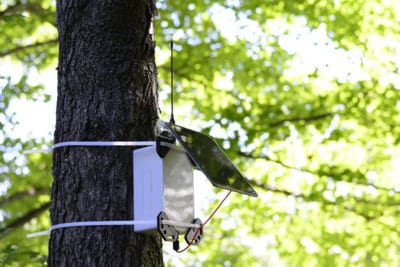
outland analytics device mounted on a tree
AI Speaks for the Trees: Outland Analytics edge devices can be mounted to a tree to listen for chainsaws and unauthorized vehicles.

Not every high school project turns into a full-fledged startup. But that’s how Outland Analytics got going, inspired by Richards and co-founder Edward Buckler’s love of nature and interest in land management.

Now undergrads at Drexel University and Stony Brook University, respectively, the founders started working on the company three years ago with the goal of improving forest protection.

While some organizations use satellite imagery or trail cameras that might provide notifications to forest rangers, those methods typically don’t provide immediate results — and it’s near impossible to identify individuals from the footage. Low-latency AI models that analyze audio could shorten response times, giving rangers minute-to-minute visibility into large areas of forest.

Using the TensorFlow deep learning framework, the team trained their AI algorithms with around 100 hours of audio from field recordings and publicly available data.

“GPUs in the cloud are nice because they’re preconfigured for you,” said Buckler. “We were blown away by how easy it was to tell a V100 on IBM Cloud to train our model, come back a few hours later and it’s all good to go.”

Buckler and Richards built a cellular-connected edge device about the size of a small backpack, topped with a solar panel and antenna. Strapped to a tree, a single device can monitor up to 150 acres of forest, collecting sound signals and sending them to the cloud for analysis.

If the neural network detects a chainsaw or unauthorized vehicle, it’ll contact officials through an email to a dispatch center or a text message to an individual ranger. Authorities can then head to the scene to catch potential environmental crimes in progress.

The low-maintenance device can be mounted at any height on a tree and is charged by solar power — though it can last a few days without sun. It’s so far been tested in the Adirondack and Catskill mountain ranges.

“The forests have the odds against them for protection,” said Richards. “We want to bolster the presence of specialized police forces by enabling them to respond to in-progress crimes.”

The post How AI Can Protect the World’s Woods from Deforestation appeared first on The Official NVIDIA Blog.

Frontera’s New Frontier: Fastest Academic Supercomputer Wields NVIDIA GPUs for Science Research

Everything’s bigger in Texas — supercomputers included.

The Texas Advanced Computing Center today launched Frontera, the most powerful academic supercomputer in the world, now featuring two subsystems powered by some 800 NVIDIA GPUs.

Frontera will leverage the AI, high performance computing and data analytics capabilities of NVIDIA Tensor Core GPUs to enable powerful scientific simulation and accelerate research areas including drug discovery, astrophysics and natural hazards modeling.

Housed at The University of Texas at Austin, Frontera ranked fifth on the most recent TOP500 list of fastest supercomputers, achieving 23.5 petaflops on the High-Performance Linpack benchmark and 38.75 petaflops of peak double-precision performance. The new GPU subsystems add a further 11 petaflops of peak single-precision performance for researchers.

NVIDIA GPUs power more than 100 systems on the TOP500 list, including half the top 10 incuding Summit, the world’s fastest supercomputer.

“With Frontera, the key is time to solution. That’s what we’re here for — to solve the biggest problems in science and engineering,” said Niall Gaffney, the center’s director of data-intensive computing.

One of the new subsystems features a cluster of 360 NVIDIA Tensor Core GPUs, liquid-cooled in racks developed by GRC, which specializes in immersion cooling for data centers. Another, built by IBM and named Longhorn, consists of 448 NVIDIA Tensor Core GPUs. Purpose-built with mixed-precision capabilities, these powerful GPUs provide scientists the flexibility to accelerate a variety of AI, simulation and data analysis workloads.

More than three dozen research teams have been using Frontera since the system began supporting science applications in June. The supercomputer was funded by a $60 million award from the National Science Foundation.

Over its lifetime, Frontera and its GPU subsystems will be used for hundreds of applications by thousands of researchers from academic institutions around the world.

From Molecular to Supermassive, Accelerating Science Research

High performance computing systems help researchers rapidly analyze data and run experiments and simulations. GPU acceleration enables faster iteration, cutting down the time it takes for scientists to achieve breakthroughs that can improve human health, broaden our understanding of the universe, and inform how we use materials and energy resources.

“Techniques like machine learning and AI are becoming more and more important for researchers doing large-scale compute,” Gaffney said. “GPU environments allow scientists to take advantage of acceleration for a wide array of applications.”

Initial projects benefiting from the powerful NVIDIA GPU-accelerated Frontera subsystems include:

  • Astronomy insights: In the field of astrophysics, researchers often work with datasets 100 terabytes in size or more. GPU acceleration and AI enables them to separate signal from noise in these massive datasets, run large-scale simulations of the universe and better understand phenomena like neutron star collision.
  • Medical breakthroughs: Deep learning tools are used in the field of medical imaging to help doctors more quickly identify diseases and abnormalities, like spotting glioblastoma tumors from brain scans. With supercomputing resources, developers can create more complex models to improve the accuracy of cancer diagnosis.
  • Drug discovery: Identifying promising molecular compounds for drug candidates is computationally demanding, time-consuming and expensive. Researchers can leverage GPU-accelerated systems for faster simulations of protein folding, helping narrow down candidates to test in a wet laboratory.
  • Smart city planning: Cities collect vast quantities of data that can be analyzed for smarter urban planning. With an AI model that can analyze visual data from traffic pole cameras, cities can identify congested areas and better address safety concerns like dangerous intersections.
  • Understanding Earth: In weather modeling and in energy research, scientists depend on high-fidelity simulations to analyze the interaction of complex natural systems. Researchers can use AI to better predict weather events and earthquakes, inform precision agriculture projects and explore potential energy sources such as nuclear fusion.

Learn more about how NVIDIA GPUs power the world’s top supercomputers.

The post Frontera’s New Frontier: Fastest Academic Supercomputer Wields NVIDIA GPUs for Science Research appeared first on The Official NVIDIA Blog.

Kitchen Confidential: Robotics Startup Dishes Out Automation to Clean Up Food Service Operations

Clean dishes make the world go ‘round — for food service operations, at least.

Dishwashers are a key component to a commercial kitchen’s smooth operation, but they have one of the highest labor shortage and turnover rates in any industry. With the average dishwasher staying only 42 days, the commercial food industry continuously faces the expensive challenge of hiring and training.

Dishcraft Robotics, a startup based in Silicon Valley, aims to wash away this and other problems the commercial food service industry faces with the implementation of its dish-washing automation technology.

Washing dishes isn’t just difficult, it can be dangerous as well. A slip ‘n slide is ideal on a hot summer day, but not in the kitchen — the primary cause of injuries in the commercial food industry is caused by the wet floor surrounding sinks. Beyond slips and falls, dish washing is an exhausting job due to the repetition, muscle strain and frequent burns from hot water.

In response, many operations have transitioned to using disposable or compostable dishes and bowls. But that is turning out to be an even bigger headache to operations and the environment as regulations increasingly crack down on the growing volume of waste being generated each day.

According to a 2017 study by Rethink Disposable, the vast majority of compostable foodware ends up in landfill.

Dishcraft is solving these labor, safety and environmental issues with a dish delivery service that uses proprietary robotic and AI technology to provide food service operations with clean, reusable dishes every day at an affordable price. Called Dishcraft Daily, the delivery service increases efficiency and productivity of operations while reducing waste.

Dishcraft founders, CEO Linda Pouliot and CTO Paul Birkmeyer, both robotics industry veterans, spent time washing dishes in commercial dish rooms to identify challenges of the job and how robotics could resolve them. It’s that hands-on experience, combined with their vision for automation and innovative spirit, that led to the creation of Dishcraft.

Taking its inspiration from the linen service model, Dishcraft exchanges dirty dishes from the client’s location for commercially cleaned dishes from one of its dish-washing hubs each day.

The company uses its own line of dishware that includes a magnet that enables its robotic dish machine to easily pick up the dishes to scrub, wash and rack them. Dishcraft’s robot then use cameras to inspect the dishes and analyze that data through deep neural networks to clean them efficiently. Birkmeyer says that, after the dishes are washed, the robotics system uses vision-based networks to perform a quality inspection step prior to allowing the dishes to leave the system.

Each system generates a lot of data and requires real-time inference powered by internal GPUs. The startup is currently experimenting with GeForce RTX 2080 Ti cards in its robot.

The system’s deep learning training uses local NVIDIA GPUs and occasionally AWS with NVIDIA V100 Tensor Core GPUs.

Constructing a robot that can handle commercial dish washing — akin to the mania of the family kitchen after Thanksgiving dinner but with more dishes — is no easy feat. The commercial kitchen is a fast-paced, unpredictable environment, said Birkmeyer, and building a robot that can anticipate complicated scenarios is a challenge.

“Without deep neural networks, trained and deployed on NVIDIA hardware, we wouldn’t be able to provide the consistent and reliable operations that our customers demand,” he says.

Since its founding in 2015, Dishcraft’s team of just under 50 staff members has raised over $25 million in venture funding. It’s providing its Dishcraft Daily service to mostly companies ranging from 300 to 2,500 employees.

Dishcraft’s clients are primarily dining service operations in the San Francisco Bay Area that provide food on site or through catering and delivery. The company is also planning on servicing universities and hospitals in the future.

The post Kitchen Confidential: Robotics Startup Dishes Out Automation to Clean Up Food Service Operations appeared first on The Official NVIDIA Blog.

How AI Is Helping Care for an Aging Population

Forty percent of nursing home residents fall at least once a year, with one in five of these spills resulting in fractures or hospital stays.

Falling isn’t the only risk for eldercare residents. Those who are non- or partially mobile often suffer pressure ulcers, commonly known as bed sores, from not moving enough in their beds.

The risk of falls and ulcers dramatically increases in nursing homes that are short staffed. With staff stretched thin, their attention is divided across many rooms, many beds and many residents.

TeiaCare, based in Milan, Italy, wants to give caregivers a helping hand and ensure that nursing home residents get the attention they need, when they need it. The company offers the first digital assistant for long-term care that uses intelligent video analytics to make sure carers are alerted when their help is needed the most.

An aging population brings increasing demand for resources such as access to nursing homes. And the population of our planet is aging dramatically. In 2017, the UN estimates there were nearly a billion people aged 60 or over — about 13 percent of the global population, a proportion that is expected to soar.

However, the number of needed caregivers isn’t keeping up. By 2020, when nearly 20 percent of Europe’s population will be over 65, an estimated 800,000 more caregivers will be needed.

Putting Patient Care First

To reduce the risk of falls and bed sores, TeiaCare’s digital assistant, which consists of an optical sensor connected to a processor, is mounted onto ceilings. The processor uses a series of computer vision and deep learning algorithms, accelerated by NVIDIA GPUs, to analyze the visual data captured.

None of the video data is saved or stored. Instead, the system identifies specific movements and resting positions in real time.

The system then sends alerts directly to carers when attention needs to be given to a patient — perhaps they have fallen out of bed or have spent too long on one side and are at risk of developing an ulcer.

Each bed is tagged according to the patient’s individual requirements.

As well as real-time alerts, the system generates customized reports, giving staff an insight into patient movements, how long they’re spending in and out of bed, and allowing them to identify any areas for improving patient care.

Caregivers also see improvements to their working conditions — they know that they’ll be alerted if something happens to a resident and can take appropriate action. This means less stress for them and improved working efficiency.

For the facility owners, introducing the digital assistant means fewer liabilities, better quality of service and improved efficiency metrics.

And families enjoy better peace of mind by knowing that any falls will be immediately identified and their relatives will get the help they need.

Improving Patient Care Further

TeiaCare is now expanding its assistant to monitor other behavioral and physiological traits.

Activity tracking will help improve the care of residents with dementia or Alzheimer’s disease as they tend to suffer from wandering. By monitoring patient movements, staff can ensure that their safety is not put at risk.

The company is also developing algorithms to monitor patients’ heart and breathing rates, using the same optical sensor-based system. This non-invasive way of monitoring resident vital signs could help ensure their comfort, prevent health deterioration and give families peace of mind.

TeiaCare is a member of the NVIDIA Inception virtual accelerator, which provides marketing and technology support to AI startups.

Image credit: sabinevanerp 

The post How AI Is Helping Care for an Aging Population appeared first on The Official NVIDIA Blog.

Keeping an AI on Damage: Startup Automates Vehicle Condition Inspections

Anyone familiar with a fender bender knows that the rigmarole of getting a damage estimate is ready for the wrecking yard.

A startup wants to change that.

Ravin is using AI to help automate the process of vehicle inspections and reduce headaches for car rental agencies, car dealers, insurers and all of these companies’ customers.

Based in Haifa, Israel, and London, Ravin applies computer vision and AI to vehicle damage detection and assessment. It has obvious applications such as rental car pickups and returns.

With its app, people can circle a vehicle to take a video and be done. AI does the rest: It calculates the cost of repairs based on the vehicle and damages it identifies.

Ravin co-founders Eliron Ekstein and Roman Sandler formed the company to harness AI to alleviate the problems of tracking damages for car rental businesses and dealerships.

The startup came about as a digital business unit spinout of oil giant Shell. Earlier this year, the founders secured $4 million in seed funding led by Pico Venture Partners and with participation from the Dutch energy giant.

Automated Inspections

Today’s advanced vehicle damage assessment can require a person to take photos up close from multiple angles and another person at an office to assess the damage from the pictures.

There’s an easier way, says Ekstein, the company’s CEO. “We ask the user to walk around the car with a mobile phone (running a video app), or drive through a set of CCTV cameras. We pick up the damages ourselves automatically, and we classify and estimate it for the insurer or fleet owner to make a decision,” he said.

Ravin’s app enables a quick video to be converted into dozens of images around a car and then run through its algorithms in AWS powered by NVIDIA GPUs for damage detection, he said.

The startup’s neural networks were trained on NVIDIA GPUs running in workstations. “We used hundreds of thousands of images to train the models,” said Sandler, the company’s CTO.

Rental Applications

For fleet operators, Ravin can set up fixed camera systems to capture photos of inbound vehicles, automating the process of damage assessments.

Rental company Avis has been using Ravin’s system at Heathrow Airport in London.

“They use it to inspect cars for damage when customers come back, which helps them charge only the right people for the right damage,” said Ekstein.

Ravin’s system can help fleet operators manage their risk on damaged vehicles as well as more quickly move cars to repairs for a faster turnaround to get them back in use, he said.

“We can shorten the lead time to repair and help understand the true cost to repair it,” said Ekstein.

The post Keeping an AI on Damage: Startup Automates Vehicle Condition Inspections appeared first on The Official NVIDIA Blog.

AI, Shoulders, Knees and Toes: Startup Builds Deep Learning Tools for Orthopedic Surgeons

Traditional open surgeries require large incisions that provide doctors a broad view of the area they’re operating on. But surgeons are increasingly opting for minimally invasive techniques that rely instead on live video feeds from tiny cameras, which provide a more limited view past much smaller incisions.

The benefits for patients are clear: less blood loss, less pain and faster recovery times.

However, minimally invasive procedures are more technically demanding for surgeons since they must operate with a narrow field of view and use small instruments that require fine manipulation skills.

To give surgeons an assist, Kaliber Labs, a San Francisco-based startup, is developing AI models to interpret these video feeds in real time.

The company’s deep learning models recognize and measure aspects of a patient’s anatomy and pathology, as well as display key information and treatment recommendations on operating room video monitors.

“A surgery consists of a series of steps,” said Ray Rahman, founder and CEO of Kaliber Labs, a member of the NVIDIA Inception virtual accelerator program. “We’re going through the entire process to provide surgeons AI guidance that decreases their cognitive load, improves accuracy and reduces uncertainty.”

The startup is also developing a deep learning model that annotates surgical video after procedures to provide better communication and transparency with patients.

Its AI models — developed using the Keras, PyTorch and TensorFlow deep learning frameworks — are trained and tested on NVIDIA RTX GPUs featuring Tensor Cores, shrinking training times by more than 5x.

To develop tools that process real-time video input in the operating room, Kaliber Labs uses the JetPack SDK and NVIDIA Jetson TX2 AI computing device for inference at the edge. The team plans for its deployed product to run on the NVIDIA Jetson AGX Xavier, enabling the low latency required for real-time processing.

Keeping an AI on Operating Rooms

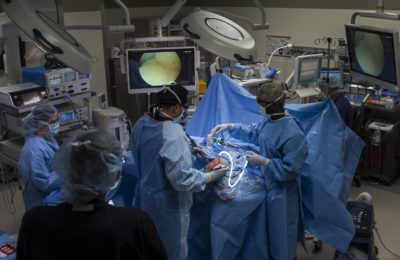
orthopedic surgery in progress
During a minimally invasive orthopedic procedure, surgeons rely on video monitors to view the area they’re operating on. (U.S. Air Force photo/Airman 1st Class Kevin Tanenbaum)

Kaliber Labs’ current suite of AI tools are focused on orthopedic surgery — covering shoulder, knee, hip and wrist procedures. Arthroscopy, or minimally invasive joint surgery, is the most common orthopedic operation, used to treat many disorders and sports injuries.

At the start of a procedure, the Kaliber Labs’ deep learning tools use the video feed to identify what kind of surgery is taking place and which camera view is being used. Then, AI models specific to the relevant procedure type come into play for real-time guidance.

Surgeons begin with an initial assessment of the patient’s anatomy and pathology before picking a course of action for the operation. The startup’s models aid in this process, combining with computer vision algorithms to recognize and measure, for example, a 20 percent bone defect of the shoulder socket, or glenoid cavity, during the procedure.

Such real-time quantitative analyses provide orthopedic surgeons with greater objectivity and an extra layer of insight as they make intraoperative decisions.

So far, Kaliber Labs has finished developing its shoulder surgery algorithms and is working on its models for knee and hip procedures. Its deep learning tools are trained on thousands of hours of actual surgery videos, which are first processed by an AI algorithm that scrubs the footage to delete any personally identifiable information about patients and surgeons.

The startup recently signed an agreement with a major medical device company to build a Jetson Xavier-powered AI edge machine that integrates with operating room equipment to provide intraoperative guidance. To work in real time during a surgical procedure, Rahman says a GPU at the edge is essential.

“We run a cascade of models for detecting anatomy and pathology, and various measurement algorithms,” he said. “Since we’re doing real-time video inference, our inference has to occur in less than 30 milliseconds in order to avoid perceived lag by the surgeons.”

The NVIDIA Jetson platform enables edge computing with a combination of high GPU compute performance and low power usage. Kaliber Labs chose the Jetson Xavier embedded module due to its small footprint and wide range of options for systems integration, Rahman said.

Running on Jetson Xavier, the startup’s CNN binary classification model — optimized for inference using NVIDIA TensorRT software — has a latency rate of just 1.5 milliseconds.

For the Record: Analyzing Surgical Video Post-Op 

After an operation, patients typically receive a short debrief from their surgeon, who shares key snapshots from the surgery. These photos or video segments have limited value to patients because, to the untrained eye, it’s hard to get a sense of what’s taking place in the procedure without context and labels of the anatomy.

“Patients and their families want to know what the surgeons did, what they saw during the procedure,” Rahman said, “but nobody has time to manually annotate a whole video. That would take hours and days, and it’d be prohibitively expensive.”

Kaliber Labs is developing a set of AI models that analyzes and labels the surgical video with descriptions of each step in the procedure. Providing patients with annotated footage of a surgery could be useful to those curious about their operation, and improve transparency about what took place during the surgery.

This kind of operative record could also facilitate accurate medical coding and efficient billing.

Main image shows an orthopedic surgeon performing ACL surgery. (U.S. Air Force photo/Airman 1st Class Kevin Tanenbaum)

The post AI, Shoulders, Knees and Toes: Startup Builds Deep Learning Tools for Orthopedic Surgeons appeared first on The Official NVIDIA Blog.

How AI Is Helping Protect Taiwan’s Endangered Leopard Cats

There’s no mistaking why the leopard cat of Taiwan got its name. While only about the size of domestic felines, it sports a beautiful, flower-spotted pattern on its fur.

There’s also no debate about why the leopard cat, the only remaining native wild cat species in Taiwan, is on the edge of extinction.

Fewer than 500 of the leopard cats live in a natural habitat that overlaps with many development projects in the central regions of the island. In an otherwise rural area, the cats are often victims of roadkill due to increased traffic.

To preserve leopard cat populations, the Taiwanese government, animal protection organizations, researchers and AI experts have been working together to save the species.

DT42, a Taiwan-based deep learning startup, and a research team led by Ya-Yu Chiang, assistant professor of mechanical engineering at National Chung Hsing University (NCHU), are collaborating on an AI project initiated by Taiwan’s Directorate General of Highways to detect leopard cats when they near roads and keep them out of harm’s way, reducing roadkills.

Spotting Roadside Leopard Cats

One of the primary challenges of conserving the leopard cat in Taiwan stems from a lack of resources and network infrastructure in the field. Building the network required for cloud-based AI detection isn’t feasible in the animal’s rural habitat.

Traffic signs meant to warn drivers to be cautious of wildlife are in place, but haven’t reduced the number of wildlife collisions. Edge AI systems could provide a more effective way to warn drivers of nearby leopard cats.

DT42, a member of the NVIDIA Inception program, developed a user-friendly, GPU-powered cloud platform through Amazon Web Services to help NCHU researchers train an AI model that identifies leopard cats. Deployed on NVIDIA Jetson TX2 edge devices, the image recognition model can detect leopard cats at wildlife hotspots.

When one of the devices spots a feline getting too close to the road, it sets off a mechanical warning. The alert system plays sounds designed to keep the animals away from passing cars. Additionally, flashing lights on the road also attract the attention of the animals to prevent them from getting on the road.

“After considering all the factors — size, heat dissipation, price, device stability and flexibility — the Jetson TX2 was the best hardware choice on which to deploy our AI model,” said Tammy Yang, DT42’s founder and CEO. “For training, the GPU resources in the AWS cloud platform are easy to use, allowing anyone to upload leopard cat images to help train and refine the neural networks and improve recognition accuracy.”

The company optimized its algorithms for inference at the edge using the NVIDIA Jetson TX2, shrinking the time to detect fast-moving leopard cats to less than half a second. A short response time is critical to spot the animals and sound the alarm before one runs into the road.

Continuing the Conservation Conversation

The average leopard cat roadkill rate from 2015 to 2018 was about one feline killed a month. In the three months since the AI system was deployed in a test area in central Taiwan, there’s been just one leopard cat-related collision — and the animal survived. Earlier this month, the system marked its first recorded instance of deterring a crossing.

Based on these initial results, NCHU researchers and the Taiwanese government hope to roll out additional AI-powered developments.

“Following the success of the leopard cat project, we are going to broaden the monitoring field, and are in discussions with the government to initiate new projects to continuously support leopard cat preservation,” said Chiang.

The researchers also plan to expand the project to other wildlife, including the endangered Chinese ferret-badger and masked palm civet.

“We are devoted to using deep learning to make contributions to the world,” Yang said. “We’re looking forward to seeing more people and organizations joining meaningful conservation projects like this.”

The leopard cat protection project was recently featured in a broadcast by the Taiwan Public Television Service, attracting the government’s attention and sparking discussions about the need for leopard cat conservation laws.

The post How AI Is Helping Protect Taiwan’s Endangered Leopard Cats appeared first on The Official NVIDIA Blog.

What’s Up, Doc?: AI Startup Gives Patients the Power

AI, when applied to healthcare, holds the promise of better medical predictions and faster medicinal improvements. To do so, it needs data on which to train. But healthcare data is sensitive and private, creating a dead end.

Or not. Walter De Brouwer, CEO of Silicon Valley startup doc.ai, joined AI Podcast host Noah Kravitz to discuss how his medical research-based platform makes the application of deep learning to healthcare possible.

Many consumers worry about the outcome of putting their data in the cloud, where it risks being pirated. And larger institutions like hospitals that have an abundance of healthcare data are reticent to share it because it could reveal other sensitive business information.

Doc.ai first collects everything it needs from the device and user input. It takes into account data from Apple Health, blood tests, urine analysis, and any other medical information uploaded by the client.

The platform has eight prediction models, which exist locally on the client’s device. Each module has a specific focus, from the general medical record, to urine sampling, to phenomics.

These models transform the data into tensors — what De Brouwer calls “a big pile of numbers.” They’re then uploaded to the cloud with no risk of being pirated, because without the model that produced them, they’re like “GPS coordinates on planet Jupiter – you can’t do anything with it.”

From there, doc.ai can use these tensors to improve its deep learning algorithms and improve medical predictions.

Doc.ai also provides a platform to run medical trials. Clients and doctors can create their own, or take part in the three that De Brouwer has already organized. The first is organized in collaboration with advisors from Harvard Medical School, and focuses on allergy triggers. Another, studying the various combinations of the 26 medicines designed to treat epilepsy, was designed alongside Stanford specialists.

De Brouwer is no stranger to entrepreneurship. He’s the cofounder of several AI-based companies, including Inui Health, which performs urine analysis using machine learning and mobile phones, and XY.ai, a spinoff of Harvard Medical School that uses AI for large-scale digital twin technology.

De Brouwer is certain that doc.ai has found the ideal approach for improving healthcare knowledge. “This is Darwinism,” he says. “First you collect, then you predict, and then you change the bad things and amplify the good things. These three steps are basically the evolution algorithm of the planet.”

To learn more about doc.ai, visit their website here. Or visit their blog for weekly stories, as well as Github commands and Jupyter notebooks.

Help Make the AI Podcast Better

Have a few minutes to spare? Fill out this short listener survey. Your answers will help us make a better podcast.

How to Tune in to the AI Podcast

Get the AI Podcast through iTunesCastbox, DoggCatcher, OvercastPlayerFMPodbayPodBean, Pocket Casts, PodCruncher, PodKicker, Stitcher, Soundcloud and TuneIn. Your favorite not listed here? Email us at aipodcast [at] nvidia [dot] com.


The post What’s Up, Doc?: AI Startup Gives Patients the Power appeared first on The Official NVIDIA Blog.

AI Frame of Mind: Neural Networks Bring Speed, Consistency to Brain Scan Analysis

In the field of neuroimaging, two heads are better than one. So radiologists around the globe are exploring the use of AI tools to share their heavy workloads — and improve the consistency, speed and accuracy of brain scan analysis.

“We often refer to manual annotation as the gold standard for neuroimaging, when it’s actually probably not,” said Tim Wang, director of operations at the Sydney Neuroimaging Analysis Centre, or SNAC. “In many cases, AI provides a more consistent, less biased evaluation than manual classification or segmentation.”

An Australian company co-located with the University of Sydney’s Brain and Mind Centre, SNAC conducts neuroimaging research as well as commercial image analysis for clinical research trials. The center is building AI tools to automate laborious analysis tasks in their research workflow, like isolating brain images from head scans and segmenting brain lesions.

Additional algorithms are in development and being validated for clinical use. One compares how a patient’s brain volume and lesions change over time. Another flags critical brain scans, so radiologists can more quickly attend to urgent cases.

SNAC uses the NVIDIA DGX-1 and DGX Station, powered by NVIDIA V100 Tensor Core GPUs,  as well as PC workstations with NVIDIA GeForce RTX 2080 Ti graphics cards. The researchers develop their algorithms using the NVIDIA Clara suite of medical imaging tools, as well as cuDNN libraries and TensorRT inference software.

Brainstorming AI Solutions

When developing medicines, pharmaceutical companies conduct clinical trials to test how effective a new drug treatment is — often using brain imaging metrics such as brain atrophy rates and lesion changes as key indicators.

To ensure accurate and consistent measurements, pharma companies rely on centralized reading centers that evaluate trial participants’ brain scans in a blind analysis.

That’s where SNAC comes in. It analyzes patient MRI and CT scans acquired at clinical sites around the world. Its expertise in multicenter studies makes it well-positioned to develop AI tools that address challenges faced by radiologists and clinicians.

With a training dataset of more than 15,000 three-dimensional CT and MRI images, SNAC is building its deep learning algorithms using the PyTorch and TensorFlow frameworks.

One of the center’s AI models automates the time-consuming task of cleaning up MRI images to isolate the brain from other parts of the head, such as the venous sinuses and fluid-filled compartments around the brain. Using the NVIDIA DGX-1 system for inference, SNAC can speed up this process by at least 10x.

“That’s no small difference,” Wang said. “Previously, this would take our analysts 20 to 30 minutes with semi-automatic methods. Now, that’s down to 2 or 3 minutes of pure machine time, while performing better and more consistently than a human.”

Another tool tackles brain lesion analysis for multiple sclerosis cases. In research and clinical trials, image analysts typically segment brain lesions and determine their volume by manually examining scans — a process that takes up to 15 minutes.

AI can shrink the time needed to determine lesion volume to just 3 seconds. That makes it possible for these metrics to be used in clinical practice as well, where due to time constraints, radiologists often simply eyeball scans to estimate lesion volumes.

“By providing quantitative, individualized neuroimaging measurements, we can help streamline and add value to clinical radiology,” said Wang.

The center collaborates with I-MED, one of the largest imaging providers in the world, as well as the computational neuroscience team at the University of Sydney’s Brain and Mind Centre. The group also works closely with radiologists at major Australian hospitals to validate its algorithms.

SNAC plans to integrate its analysis tools with systems already used by clinicians, so that once a scan is taken, it’s automatically routed to a server and processed. The AI-evaluated scan is then passed on to radiologists’ viewers — giving them the analysis results without altering their workflow.

“Someone can develop a fantastic tool, but it’s hard to ask radiologists to use it by opening yet another application, or another browser on their workstations,” Wang said. “They don’t want to do that simply because they’re time poor, often punching through a very large volume of clinical scans a day.”

Main image shows a side-by-side comparison of multiple sclerosis lesion segmentation. Left image shows manual lesion segmentation, while right shows fully automated lesion segmentation. Image courtesy of Sydney Neuroimaging Analysis Center. 

The post AI Frame of Mind: Neural Networks Bring Speed, Consistency to Brain Scan Analysis appeared first on The Official NVIDIA Blog.

What Is Conversational AI?

For a quality conversation between a human and a machine, responses have to be quick, intelligent and natural-sounding.

But up to now, developers of language-processing neural networks that power real-time speech applications have faced an unfortunate trade-off: Be quick and you sacrifice the quality of the response; craft an intelligent response and you’re too slow.

That’s because human conversation is incredibly complex. Every statement builds on shared context and previous interactions. From inside jokes to cultural references and wordplay, humans speak in highly nuanced ways without skipping a beat. Each response follows the last, almost instantly. Friends anticipate what the other will say before words even get uttered.

What Is Conversational AI? 

True conversational AI is a voice assistant that can engage in human-like dialogue, capturing context and providing intelligent responses. Such AI models must be massive and highly complex.

But the larger a model is, the longer the lag between a user’s question and the AI’s response. Gaps longer than just two-tenths of a second can sound unnatural.

With NVIDIA GPUs and CUDA-X AI libraries, massive, state-of-the-art language models can be rapidly trained and optimized to run inference in just a couple of milliseconds, thousandths of a second — a major stride towards ending the tradeoff between an AI model that’s fast versus one that’s large and complex.

These breakthroughs help developers build and deploy the most advanced neural networks yet, and bring us closer to the goal of achieving truly conversational AI.

GPU-optimized language understanding models can be integrated into AI applications for such industries as healthcare, retail and financial services, powering advanced digital voice assistants in smart speakers and customer service lines. These high-quality conversational AI tools can allow businesses across sectors to provide a previously unattainable standard of personalized service when engaging with customers.

How Fast Does Conversational AI Have to Be?

The typical gap between responses in natural conversation is about 200 milliseconds. For an AI to replicate human-like interaction, it might have to run a dozen or more neural networks in sequence as part of a multilayered task — all within that 200 milliseconds or less.

Responding to a question involves several steps: converting a user’s speech to text, understanding the text’s meaning, searching for the best response to provide in context, and providing that response with a text-to-speech tool. Each of these steps requires running multiple AI models — so the time available for each individual network to execute is around 10 milliseconds or less.

If it takes longer for each model to run, the response is too sluggish and the conversation becomes jarring and unnatural.

Working with such a tight latency budget, developers of current language understanding tools have to make tradeoffs. A high-quality, complex model could be used as a chatbot, where latency isn’t as essential as in a voice interface. Or, developers could rely on a less bulky language processing model that more quickly delivers results, but lacks nuanced responses.

What Will Future Conversational AI Sound Like? 

Basic voice interfaces like phone tree algorithms (with prompts like “To book a new flight, say ‘bookings’”) are transactional, requiring a set of steps and responses that move users through a pre-programmed queue. Sometimes it’s only the human agent at the end of the phone tree who can understand a nuanced question and solve the caller’s problem intelligently.

Voice assistants on the market today do much more, but are based on language models that aren’t as complex as they could be, with millions instead of billions of parameters. These AI tools may stall during conversations by providing a response like “let me look that up for you” before answering a posed question. Or they’ll display a list of results from a web search rather than responding to a query with conversational language.

A truly conversational AI would go a leap further. The ideal model is one complex enough to accurately understand a person’s queries about their bank statement or medical report results, and fast enough to respond near instantaneously in seamless natural language.

Applications for this technology could include a voice assistant in a doctor’s office that helps a patient schedule an appointment and follow-up blood tests, or a voice AI for retail that explains to a frustrated caller why a package shipment is delayed and offers a store credit.

Demand for such advanced conversational AI tools is on the rise: an estimated 50 percent of searches will be conducted with voice by 2020, and, by 2023, there will be 8 billion digital voice assistants in use.

What Is BERT? 

BERT (Bidirectional Encoder Representations from Transformers) is a large, computationally intensive model that set the state of the art for natural language understanding when it was released last year. With fine-tuning, it can be applied to a broad range of language tasks such as reading comprehension, sentiment analysis or question and answer. 

Trained on a massive corpus of 3.3 billion words of English text, BERT performs exceptionally well — better than an average human in some cases — to understand language. Its strength is its capability to train on unlabeled datasets and, with minimal modification, generalize to a wide range of applications. 

The same BERT can be used to understand several languages and be fine-tuned to perform specific tasks like translation, autocomplete or ranking search results. This versatility makes it a popular choice for developing complex natural language understanding. 

At BERT’s foundation is the Transformer layer, an alternative to recurrent neural networks that applies an attention technique — parsing a sentence by focusing attention on the most relevant words that come before and after it. 

The statement “There’s a crane outside the window,” for example, could describe either a bird or a construction site, depending on whether the sentence ends with “of the lakeside cabin” or “of my office.” Using a method known as bidirectional or nondirectional encoding, language models like BERT can use context cues to better understand which meaning applies in each case.

Leading language processing models across domains today are based on BERT, including BioBERT (for biomedical data), SciBERT (for scientific publications) and ERNIE (which incorporates knowledge graphs for better language understanding).

How Does NVIDIA Technology Optimize Transformer-Based Models? 

The parallel processing capabilities and Tensor Core architecture of NVIDIA GPUs allow for higher throughput and scalability when working with complex language models — enabling record-setting performance for both the training and inference of BERT.

Using the powerful NVIDIA DGX SuperPOD system, the 340 million-parameter BERT-Large model can be trained in under an hour, compared to a typical training time of several days. But for real-time conversational AI, the essential speedup is for inference.

NVIDIA developers optimized the 110 million-parameter BERT-Base model for inference using TensorRT software. Running on NVIDIA T4 GPUs, the model was able to compute responses in just 2.2 milliseconds when tested on the Stanford Question Answering Dataset. Known as SQuAD, the dataset is a popular benchmark to evaluate a model’s ability to understand context.

The latency threshold for many real-time applications is 10 milliseconds. Even highly optimized CPU code results in a processing time of more than 40 milliseconds.

By shrinking inference time down to a couple milliseconds, it’s practical for the first time to deploy BERT in production. And it doesn’t stop with BERT — the same methods can be used to accelerate other large, Transformer-based natural language models like GPT-2, XLNet and RoBERTa.

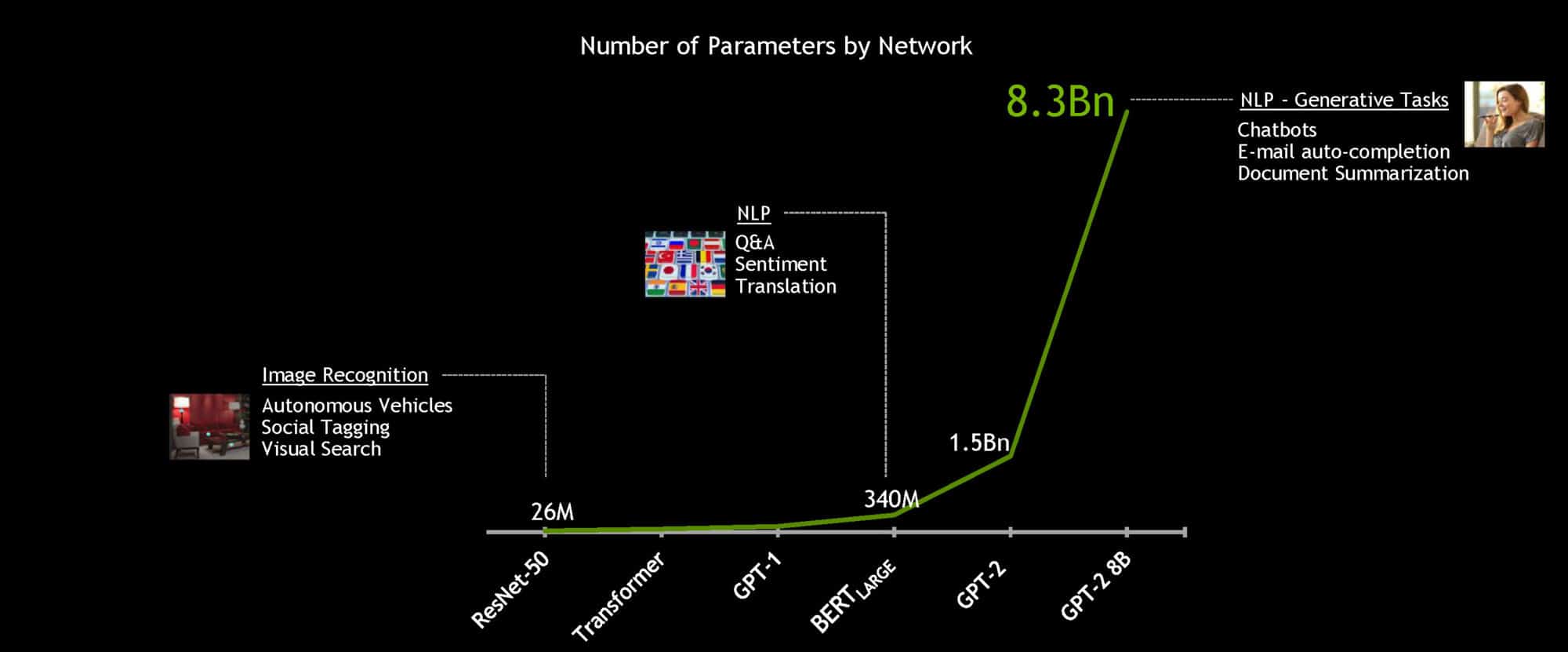
To work toward the goal of truly conversational AI, language models are getting larger over time. Future models will be many times bigger than those used today, so NVIDIA built and open-sourced the largest Transformer-based AI yet: GPT-2 8B, an 8.3 billion-parameter language processing model that’s 24x bigger than BERT-Large.
Chart showing the growing number of parameters in deep learning language models

For more information on training BERT on GPUs, optimizing BERT for inference, and other projects in natural language processing, check out NVIDIA’s developer blog.

The post What Is Conversational AI? appeared first on The Official NVIDIA Blog.