
Blog

Learn About Our Meetup

5000+ Members

MEETUPS

LEARN, CONNECT, SHARE

Join our meetup, learn, connect, share, and get to know your Toronto AI community. 

JOB POSTINGS

INDEED POSTINGS

Browse through the latest deep learning, ai, machine learning postings from Indeed for the GTA.

CONTACT

CONNECT WITH US

Are you looking to sponsor space, be a speaker, or volunteer, feel free to give us a shout.

Category: NVIDIA

Smoothing Out the Bumps: Researchers Aim to Solve Mystery of Turbulence 

Turns out turbulence isn’t just something to concern anxious fliers clasping onto their seats at 30,000 feet.

Apart from jiggling your plane around, turbulence also affects how cars drive, the stability of tall buildings and the amount of energy that can be produced by wind turbines.

While the experience of turbulence is all around us, the mathematics behind this bumpy phenomenon remains a mystery. So much so it’s one of seven Millennium Prize Problems posed by the Clay Mathematics Institute. These problems challenge the field of mathematics to solve some of the “deepest, most difficult problems” of classical physics.

Understanding turbulence is of crucial importance for engineers around the world. And that’s just what a team from Imperial College London, headed by Peter Vincent, Reader and EPSRC Fellow, has set out to do using highly accurate flow simulations on GPU-accelerated supercomputers.

The Physics Behind Turbulence

Turbulent flows are chaotic, containing millions of small vortices — spinning regions of the flow — that interact in incredibly complicated ways.

When designing stable buildings and optimal vehicles, engineers can often ignore the smallest-scale chaotic motions and instead focus on averages of pressure and velocity.

But it turns out that even these average properties are extremely difficult to predict accurately since their behavior is linked to chaotic small-scale motions. This means engineers generally resort to using approximate models.

To improve the accuracy of turbulent flow calculations, Vincent and his team ran thousands of turbulent flow simulations, each requiring billions of calculations to complete, over a period of 12 months. To power these, the team made use of two of Europe’s fastest supercomputers — Piz Daint at CSCS and Wilkes-2 from the University of Cambridge.

These NVIDIA GPU-accelerated systems enabled the team to identify for the first time so-called “eigenmode” solutions of averaged turbulent flow in a channel. This provides fundamental insights into the flow physics, which can be used to develop improved approximate models for use in industry.

“From these calculations, we’ve been able to shed new light on the physics that governs averaged properties of turbulent flow,” explained Vincent. “In particular, they show that the governing equations cannot possess certain symmetries, which are often assumed by existing models.”

With a deeper understanding of the physics behind turbulence, engineers can design the next generation of airplanes, wind turbines, submarines and many other objects to be more stable and secure.

“With the mainstream emergence of unsteady turbulence modeling for wind energy applications, the need for improved models is vital,” stated David Standingford, co-founder and director of Zenotech and an expert in mathematics and fluid dynamics. “The current work from Imperial College London addresses fundamental questions that will enable better industrial simulations in the future.”


Photo credit: Thomas Angus, Imperial College London

The post Smoothing Out the Bumps: Researchers Aim to Solve Mystery of Turbulence  appeared first on The Official NVIDIA Blog.
Speaking of AI: Startup Empowers Indian Language Speakers with Deep Learning

A flood of new smartphone users will come online in the next couple years — and many don’t speak or read a word of English, the internet’s most common language.

To make web adoption smoother for hundreds of millions of these new users, one Bangalore-based startup is building AI speech tools for 10 different languages spoken in India. India will have more than 600 million smartphone owners by 2020, but the country has just 125 million English speakers — most of whom speak it as a second language.

“While internet adoption is increasing in India, there’s still a gap in the market for users who don’t know how to read and write English,”.said Ananth Nagaraj, co-founder of Gnani.ai, a member of the NVIDIA Inception program. “Even if something is written in their own language, it may not necessarily be easy for every user to read. We can empower those customers to interact with voice in their native language.”

India’s linguistic diversity presents a challenge for government agencies and private companies trying to communicate with the country’s 1.37 billion people. The country has 22 major languages and around 100 other languages that each have 10,000 or more speakers.

AI speech engine tools that process multiple languages can facilitate conversation by serving as a voice assistant, fielding customer service calls or conducting voice-based transactions.

Gnani.ai provides APIs and voice assistant solutions to e-commerce enterprises, insurance companies, banking and finance firms. Developed using cloud-based NVIDIA GPUs, its tools support languages spoken across the entire subcontinent: Indian English, Hindi, Bengali, Gujarati, Kannada, Malayalam, Marathi, Punjabi, Tamil and Telugu.

Now AI’s Speaking My Language 

Although the linguistic makeup of online content has shifted from 80 percent English in the 1990s to just over 25 percent English today, there’s still a dearth of user-friendly interfaces for Indian language speakers.

Even Indians who speak English as a second language often prefer to consume online content in their native language. But keyboards on computers and mobile devices largely default to the QWERTY keyboard layout, making it slower to type in Indian scripts like Devanagari, used for several languages including Hindi — which is spoken by half a billion people.

Local governments in India have to publish every communication in English and the official language of a given state. Gnani.ai’s voice-to-text tools could speed up this process by up to 4x, Nagaraj said.

The startup’s voice assistant software can integrate with a business’ mobile apps and websites, or be used as an interactive voicebot on customer service telephone lines.

Gnani.ai has collected more than 50,000 hours of annotated audio data to build its AI models. The startup develops its algorithms on NVIDIA V100 Tensor Core GPUs on Amazon Web Services, accelerating the training process up to 20x compared to using CPUs.

The company chose cloud-based GPUs because they were easier to spin up multiple clusters at once for large-scale data training, Nagaraj said. Gnani.AI uses CUDA matrix libraries and NVIDIA’s AMP feature for TensorFlow designed to  speed up neural network training up to 3x.

Starting the Conversation 

Nagaraj said the team believes that AI voice assistants can make the customer support experience more efficient and personalized. With multilingual bots, enterprises can provide personalized service experiences for customers with AI — and allow human agents to devote more time to complex queries from callers.

Bank clients incorporating Gnani.ai’s software could allow the automated system to help customers access their account statements or freeze a credit card, while passing more detailed processes on to staffers. The voice assistant could even reach out to insurance customers in their preferred language to coordinate policy payments, help elderly clients book taxis or provide farmers with pricing information for their crops.

As a Bangalore-based company, Nagaraj said, “we have a significantly higher accuracy compared to some of the global providers because we understand the nuances of the languages and dialects of a diverse country. That helps us tune our AI algorithms to perform better for this market.”

Since its founding in 2016, Gnani.ai has piloted or deployed voice assistant solutions with more than 20 large enterprises in India. The company — which recently received funding from Samsung’s investment arm — plans to expand its call center automation AI tools to other countries, including the United States, in 2020.

The post Speaking of AI: Startup Empowers Indian Language Speakers with Deep Learning appeared first on The Official NVIDIA Blog.
Life Imitating Art: AI Startup Resembles Pied Piper in HBO’s Silicon Valley

Like Silicon Valley’s plot on fictional startup Pied Piper, Compression AI is a scrappy team of developers working on media-compression technology in a tech incubator.

Except instead of being characters in a Hollywood-scripted startup, founders Francis Doumet and Migel Tissera met at a Vancouver coworking space, hired two employees and pulled late nighters to release  their first beta software, dubbed PixelDrive.

Founded in 2018, Compression AI aims to enable faster transmission of media files over the web, even on low-quality internet networks.

It reduces image file sizes up to 80 percent using the company’s neural compression technology, the product of the team’s custom work on convolutional neural networks trained on NVIDIA GPUs.

Doumet and Tissera initially launched PixelDrive as a consumer product. But they soon figured out that the underlying technology is much more valuable to developers because image compression enables faster web page load times and increases search engine rankings. They have since made the technology available as an API for developers.

Doumet and Tissera’s ultimate goal is to bring their technology to video compression. That’s because Tissera — a fan of watching UFC mixed martial arts fights but frustrated with choppy broadcasts — sees a need for improvement in video compression, especially where the internet quality is suboptimal.

Compression AI is a member of NVIDIA Inception, a virtual accelerator program that helps startups get to market faster.

Compressed Launch Date

The neural networks that run the developer API and PixelDrive were trained on the entire ImageNet set of images and many more that were collected from the web, totaling more than 10 million images, Doumet said.

The Compression AI team designed the neural networks, which focused on the part of CNNs known as auto-encoders, he said. The development allowed Compression AI to come up with the optimal image compression for each individual image down to the pixel, according to the company.

The deployed service is powered by NVIDIA P4 GPUs performing inference in the cloud. “We’re best in class in terms of image compression,” said Doumet.

Neural network training was also fast on desktop PCs running NVIDIA GPUs.

Online Business Applications

Improved image compression has potentially big implications for businesses. The startup has multiple pilot tests with companies exploring the benefits.

One is with a major online real estate site. Sites like these rank higher in Google searches if they load faster from better compression of images, said Doumet.

Another is video game apps because lighter file sizes from image compression get lower bounce rates at the time of download.

And online retailers are exploring pilots to get better sales results from fast load times of pages, according to Doumet.

Coming Attraction: Video 

Compression AI is focused on launching compression for video next.

Doumet and Tissera say that even with advances in 4G and the promise of 5G, mobile internet remains bandwidth constrained. For instance, a four-minute video shot in 4K on a mobile device takes roughly 13 minutes to transmit over the average U.S. internet connection.

“Advances in AI create an opportunity to develop more intelligent kinds of codecs that can adapt and optimize for any image to offer a reduced footprint in file size,” said Doumet.


Image license and credit: Creative Commons; photo by @noisytoy.net

The post Life Imitating Art: AI Startup Resembles Pied Piper in HBO’s Silicon Valley appeared first on The Official NVIDIA Blog.
Spotting Clouds on the Horizon: AI Resolves Uncertainties in Climate Projections

Climate researchers look into the future to project how much the planet will warm in coming decades — but they often rely on decades-old software to conduct their analyses.

This legacy software architecture is difficult to update with new methodologies that have emerged in recent years. So a consortium of researchers is starting from scratch, writing a new climate model that leverages AI, new software tools and NVIDIA GPUs.

Scientists from Caltech, MIT, the Naval Postgraduate School and NASA’s Jet Propulsion Laboratory are part of the initiative, named the Climate Modeling Alliance — or CliMA.

“Computing has advanced quite a bit since the ‘60s,” said Raffaele Ferrari, oceanography professor at MIT and principal investigator on the project. “We know much more than we did at that time, but a lot was hard-coded into climate models when they were first developed.”

Building a new climate model from the ground up allows climate researchers to better account for small-scale environmental features, including cloud cover, rainfall, sea ice and ocean turbulence.

These variables are too geographically miniscule to be precisely captured in climate models, but can be better approximated using AI. Incorporating the AI’s projections into the new climate model could reduce uncertainties by half compared to existing models.

The team is developing the new model using Julia, an MIT-developed programming language that was designed for parallelism and distributed computation, allowing the scientists to accelerate their climate model calculations using NVIDIA V100 Tensor Core GPUs onsite and on Google Cloud.

As the project progresses, the researchers plan to use supercomputers like the GPU-powered Summit system at Oak Ridge National Labs as well as commercial cloud resources to run the new climate model — which they hope to have running within the next five years.

AI Turns the Tide

Climate scientists use physics and thermodynamics equations to calculate the evolution of environmental variables like air temperature, sea level and rainfall. But it’s incredibly computationally intensive to run these calculations for the entire planet. So in existing models, researchers divide the globe into a grid of 100-square-kilometer sections.

They calculate every 100 km block independently, using mathematical approximations for smaller features like turbulent eddies in the ocean and low-lying clouds in the sky — which can measure less than one kilometer across. As a result, when stringing the grid back together into a global model, there’s a margin of uncertainty introduced in the output.

Small uncertainties can make a significant difference, especially when climate scientists are estimating for policymakers how many years it will take for average global temperature to rise by more than two degrees Celcius. Due to the current levels of uncertainty, researchers project that, with current emission levels, this threshold could be crossed as soon as 2040 — or as late as 2100.

“That’s a huge margin of uncertainty,” said Ferrari. “Anything to reduce that margin can provide a societal benefit estimated in trillions of dollars. If one knows better the likelihood of changes in rainfall patterns, for example, then everyone from civil engineers to farmers can decide what infrastructure and practices they may need to plan for.”

A Deep Dive into Ocean Data

The MIT researchers are focusing on building the ocean elements of CliMA’s new climate model. Covering around 70 percent of the planet’s surface, oceans are a major heat and carbon dioxide reservoir. To make ocean-related climate projections, scientists look at such variables as water temperature, salinity and velocity of ocean currents.

One such dynamic is turbulent streams of water that flow around in the ocean like “a lot of little storms,” Ferrari said. “If you don’t account for all that swirling motion, you strongly underestimate how the ocean is absorbing heat and carbon.”

Using GPUs, researchers can narrow the resolution of their high-resolution simulations from 100 square kilometers down to one square kilometer, dramatically reducing uncertainties. But these simulations are too expensive to directly incorporate into a climate model that looks decades into the future.

That’s where an AI model that learns from fine-resolution ocean and cloud simulations can help.

“Our goal is to run thousands of high-resolution simulations, one for each 100-by-100 kilometer block, that will resolve the small-scale physics presently not captured by climate models,” said Chris Hill, principal research engineer at MIT’s earth, atmospheric and planetary sciences department.

These high-resolution simulations produce abundant synthetic data. That data can be combined with sparser real-world measurements, creating a robust training dataset for an AI model that estimates the impact of small-scale physics like ocean turbulence and cloud patterns on large-scale climate variables.

CliMA researchers can then plug these AI tools into the new climate model software, improving the accuracy of long-term projections.

“We’re betting a lot on GPU technology to provide a boost in compute performance,” Hill said.

MIT hosted in June a weeklong GPU hackathon, where developers — including Hill’s team as well as research groups from other universities — used the CUDA parallel computing platform and the Julia programming language for projects such as ocean modeling, plasma fusion and astrophysics.

For more on how AI and GPUs accelerate scientific research, see the NVIDIA higher education page. Find the latest NVIDIA hardware discounts for academia on our educational pricing page.

Image by Tiago Fioreze, licensed from Wikimedia Commons under Creative Commons 3.0 license.

The post Spotting Clouds on the Horizon: AI Resolves Uncertainties in Climate Projections appeared first on The Official NVIDIA Blog.
Evening the Odds: Cornell’s STORK AI Tool Evaluates Embryo Candidates for Better IVF

There’s less than a 50 percent chance that a round of in vitro fertilization — one of the most common treatments for infertility, running up to $15,000 — will succeed. But those odds could be dramatically improved with an AI tool developed by researchers at Cornell University.

Introduced in 1978, IVF is a process through which eggs are fertilized with sperm in a lab, creating multiple embryos that can be transferred into a patient’s uterus. Clinics monitor embryo development to pick the highest-quality embryos for transfer, improving the odds of pregnancy.

Still, less than half of transferred blastocysts (embryos that have grown for around five days) successfully implant in a patient’s uterus, according to the CDC. That figure drops below 15 percent for patients over the age of 40.

Trained and tested on a dataset of over 10,000 time-lapse images of human embryos, Cornell researchers created an AI model dubbed STORK that uses convolutional neural networks to analyze embryo growth and evaluate which candidates are most likely to lead to successful implantation.

To increase the probability of pregnancy, clinics often transfer multiple embryos at once. And that carries risks.

“This can lead to twins, triplets and other multiples, which adds to the complications,” said Iman Hajirasouliha, assistant professor of computational genomics at Weill Cornell Medicine. “If we can reliably predict the implantation success rate based on an algorithm, then we can limit the number of transfers.”

Betting on the Best Embryo Candidate

Over 2.5 million cycles of IVF are performed each year, resulting in around 500,000 births. For each of these cycles, the task of choosing which embryos are most likely to result in a successful pregnancy lies with a team of embryologists.

These experts manually grade the developing embryos based on time-lapse images — a time-consuming and subjective evaluation. With no universal grading system, there’s little agreement among embryologists on which are the best embryo candidates.

The scientists developing STORK found that a panel of five embryologists unanimously agreed less than 25 percent of the time on whether an embryo was high, fair or low quality.

In contrast, STORK’s predictions agreed with the embryologist panel’s majority vote more than 95 percent of the time — suggesting that the tool may outperform individual embryologists and bring better consistency to the embryo evaluation process.

AI is also much faster at analyzing the image data. A clinic that treats around 4,000 people a year may have three embryologists manually evaluate embryo candidates for each patient. STORK can evaluate embryo candidate quality for 2,000 patients in just four minutes.

The Cornell researchers developed the deep learning model using the TensorFlow framework and four NVIDIA GPUs, accelerating the training process up to 4x over CPUs.

So far, the scientists have tested their tool on embryo images from clinics in New York, Spain and the United Kingdom. They hope any IVF facility that collects time-series images of embryos could use the tool.

However, embryo quality is just one clinical factor behind IVF success rates. Patient age is a key variable affecting the probability of implantation — and the likelihood of a healthy full-term pregnancy.

To better assess the rate of successful pregnancy and live birth, the researchers have developed a decision tree model that incorporates STORK’s embryo quality analyses as well as patient age data.

The post Evening the Odds: Cornell’s STORK AI Tool Evaluates Embryo Candidates for Better IVF appeared first on The Official NVIDIA Blog.

NVIDIA DGX-Ready Program Goes Global, Doubles Colocation Partners

To help businesses deploy AI infrastructure to power their most important opportunities, our DGX-Ready Data Center program is going global. We’ve also added new services that will help organizations accelerate their progress.

We’ve added to the program three new partners in Europe, five in Asia and two in North America. With these additions, customers now have access to a global network of 19 validated partners around the world.

DGX-Ready Data Center partners help companies access modern data center facilities for their AI infrastructure. They offer world-class facilities to host DGX AI compute infrastructure, giving more organizations access to AI-ready data center facilities while saving on capital expenditures and keeping operational costs low.

The program is now offered in 24 markets, including Australia, Austria, Brazil, Canada, China, Colombia, Denmark, France, Germany, Hong Kong, Iceland, Ireland, Italy, Japan, the Netherlands, Peru, Singapore, South Korea, Spain, Sweden, Switzerland, Turkey, the United Kingdom and the United States — with more coming soon.

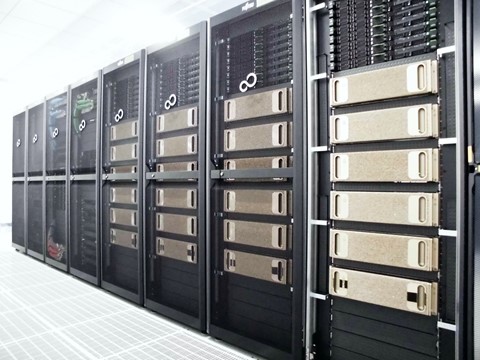
Among the new locations is the Fujitsu Yokohama Data Center in Japan, which hosts dozens of NVIDIA AI systems.

“The Fujitsu Yokohama Data Center hosts more than 60 NVIDIA DGX-1 and DGX-2 systems,” said Hisaya Nakagawa, director at Fujitsu. “As a DGX-Ready Data Center program partner, we’re able to offer customers our world-class, state-of-the-art facility to run their most important AI workloads. With this program, customers can operationalize AI infrastructure swiftly and enjoy a jumpstart on their business transformation.”

DGX-Ready Program
Among the new DGX-Ready colocation partners is Fujitsu, equipped with more than 60 NVIDIA DGX-1 and DGX-2 systems in the Fujitsu Yokohama Data Center in Japan. Image courtesy of Fujitsu Ltd.

Enhanced Services That Accelerate Time to Insight

In addition to access to a world-class data center, the DGX-Ready Data Center program offers services that can reduce the risks of new infrastructure investment.

Select DGX-Ready colocation partners are adding “try-and-buy” options that let enterprises “test drive” their DGX infrastructure. Customers can gain valuable operational experience before they decide to deploy these systems in their own data center. Core Scientific and Flexential are among the first partners to offer this capability.

Additionally, select partners offer GPU-as-a-service options that let businesses access DGX-powered compute in an affordable model, without committing to a full system.

Mobile game developer Jam City is taking advantage of this capability to accelerate game development using Core Scientific’s AI-Optimized Cloud, powered by NVIDIA DGX.

“We’re relying on machine learning and artificial intelligence to guide game design and transform our business,” said Rami Safadi, chief data officer at Jam City. “Core Scientific’s cloud has enhanced how we utilize data and allowed us to analyze billions of rows of data per day. We’ve seen an 8x increase in speed, enabling us to train an entirely new set of winning AI business models.”

Meet the Perfect DGX-Ready Partner Fast

With the many options for AI infrastructure hosting, it’s important to choose a colocation partner that suits your needs.

To make it simpler, we’ve introduced the DGX-Ready Data Center portal, which lets customers search our global network of providers, filtered by region, supported systems and enhanced services. The portal make it faster and easier to find the perfect match.

The post NVIDIA DGX-Ready Program Goes Global, Doubles Colocation Partners appeared first on The Official NVIDIA Blog.

Get Your Fashion Fix: Stitch Fix Adds AI Flair to Your Closet

Some say style never fades, and now with the help of AI, finding one’s fashion sense is about to get a whole lot easier.

Fashion ecommerce startup Stitch Fix is piecing together a seamless balance between AI-powered decision making and human judgement.

“We really want to be a partner and personal stylist for people over a long period of time,” said Stitch Fix’s Chief Algorithms Officer Brad Klingenberg in a conversation with AI Podcast host Noah Kravitz.

“A lot of our clients find it really rewarding to be able to have their stylists get to know them … and this is all augmented and complemented with what we can learn algorithmically,” he added. ‘But I think there’s a really rich human component there that is not something easily replaced by an algorithm.”

Since launching in 2011, Stitch Fix has attracted over 3 million clients. Users complete a style profile and are assigned a personal stylist. Stylists will send a box — also referred to as a “fix” — with a curated selection of clothes, accessories, and shoes that fit within one’s taste and budget. Using clients’ feedback per fix, both the stylist and Stitch Fix’s algorithms gain a better sense of their styles.

As a service, Stitch Fix benefits from a “human-in-the-loop” method to help users experiment with their own aesthetic. The stylist acts as a check to the algorithm by evaluating if a selected piece either deviates too much from or helps diversify a client’s existing wardrobe.

“[This] really allows data scientists and folks on my team to really focus on things that dramatically improve the client experience and worry less about rare edge cases,” said Klingenberg. “The stylist will be able to help us make the right decision.”

Personalized curation, Klingenberg explains, is an increasing trend in not just retail, but also in other consumer services such as television and music.

“There’s certainly a central aspect to the Stitch Fix value proposition where… the goal isn’t to present clients with an unlimited selection of everything they could ever want… but to actually just share what they want,” said Klingenberg. “And so I think this counter trend to just limitless availability will show up in a few places.”

If you are interested in learning more about Klingenberg’s work at Stitch Fix, you can check out their technical blog, Multithreaded, and venture into the science behind the fashion with their Algorithms Tour.

Help Make the AI Podcast Better

Have a few minutes to spare? It’d help us if you fill out this short listener survey.

Your answers will help us learn more about our audience, which will help us deliver podcasts that meet your needs, what we can do better, and what we’re doing right.

How to Tune into the AI Podcast

Our AI Podcast is available through iTunesCastbox, DoggCatcher, Google Play MusicOvercastPlayerFMPodbayPodBean, Pocket Casts, PodCruncher, PodKicker, Stitcher, Soundcloud and TuneIn.

If your favorite isn’t listed here, email us at aipodcast [at] nvidia [dot] com.

The post Get Your Fashion Fix: Stitch Fix Adds AI Flair to Your Closet appeared first on The Official NVIDIA Blog.

NVIDIA Breaks Eight AI Performance Records

You can’t be first if you’re not fast.

Inside the world’s top companies, teams of researchers and data scientists are creating ever more complex AI models, which need to be trained, fast.

That’s why leadership in AI demands leadership in AI infrastructure. And that’s why the AI training results released today by MLPerf matter.

Across all six of six MLPerf categories, NVIDIA demonstrated world-class performance and versatility. Our AI platform set eight records in training performance, including three in overall performance at scale and five on a per-accelerator basis.

Record Type Benchmark Record
Max Scale
(Minutes to Train)
Object Detection (Heavy Weight) – Mask R-CNN 18.47 mins
Translation (Recurrent) – GNMT 1.8 mins
Reinforcement Learning – MiniGo 13.57 mins
Per Accelerator
(Hours to Train)
Object Detection (Heavy Weight) – Mask R-CNN 25.39 hrs
Object Detection (Light Weight) – SSD 3.04 hrs
Translation (Recurrent) – GNMT 2.63 hrs
Translation (Non-recurrent) – Transformer 2.61 hrs
Reinforcement Learning – MiniGo 3.65 hrs

Table 1: NVIDIA MLPerf AI Records

Per accelerator comparison derived from reported performance for MLPerf 0.6 on a single NVIDIA DGX-2H (16 V100 GPUs) compared to other submissions at same scale except for MiniGo, where NVIDIA DGX-1 (8 V100 GPUs) submission was used | MLPerf ID Max Scale: Mask R-CNN: 0.6-23, GNMT: 0.6-26, MiniGo: 0.6-11 | MLPerf ID Per Accelerator: Mask R-CNN, SSD, GNMT, Transformer: all use 0.6-20, MiniGo: 0.6-10 

These numbers — backed by Google, Intel, Baidu, NVIDIA and the dozens of other top technology companies and universities behind the creation of MLPerf’s suite of AI benchmarks — translate into innovation where it counts.

Simply put, our AI platform now slashes through models that once took a whole workday to train in less than two minutes.

Companies know unlocking that kind of productivity is key. Supercomputers are now the essential instruments of AI, and AI leadership requires strong AI computing infrastructure.

Our latest MLPerf results bring all these strands together, demonstrating the benefits of weaving our NVIDIA V100 Tensor Core GPUs into supercomputing-class infrastructure.

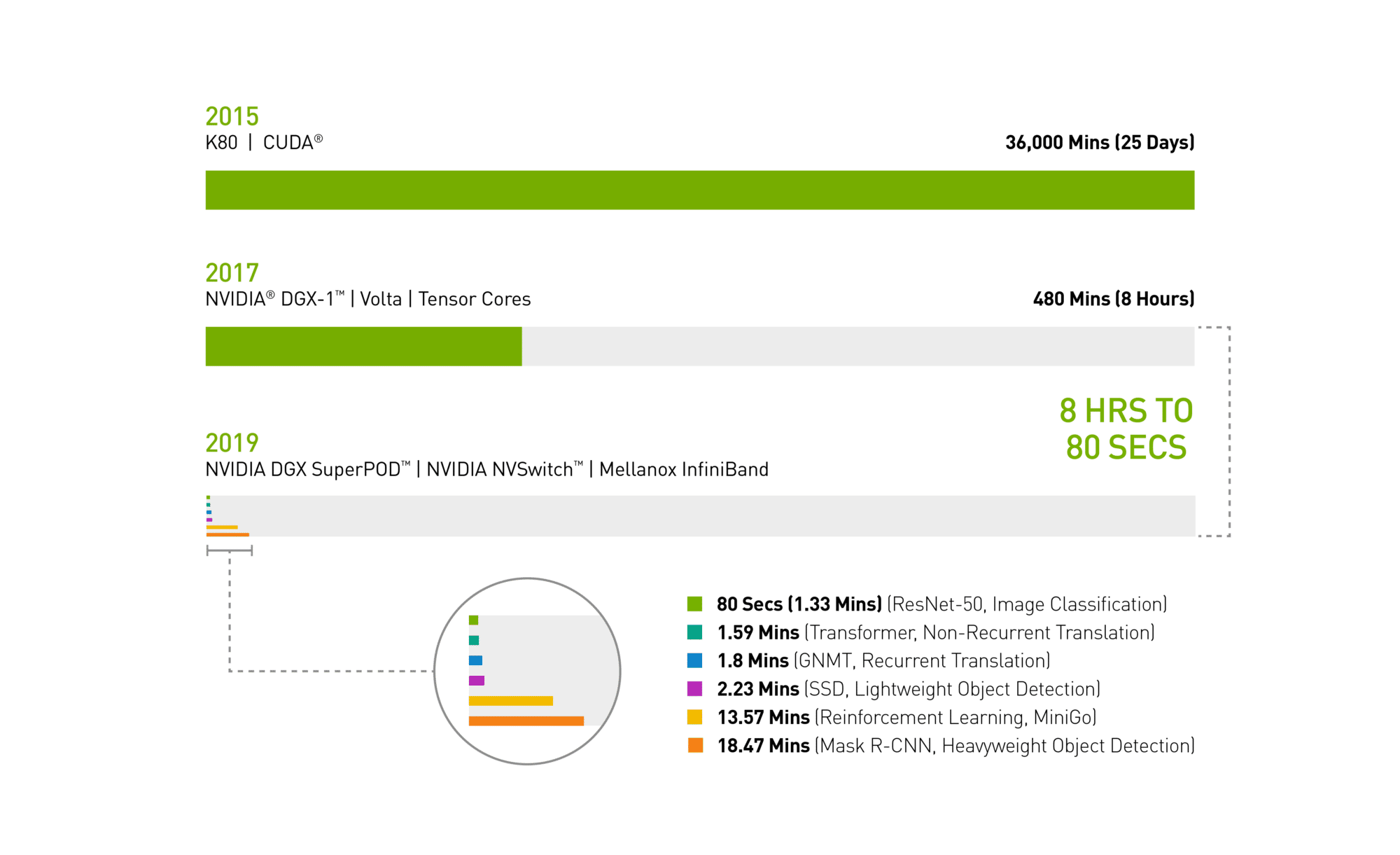
In spring 2017, it took a full workday — eight hours — for an NVIDIA DGX-1 system loaded with V100 GPUs to train the image recognition model ResNet-50.

Today an NVIDIA DGX SuperPOD — using the same V100 GPUs, now interconnected with Mellanox InfiniBand and the latest NVIDIA-optimized AI software for distributed AI training — completed the task in just 80 seconds.

That’s less time than it takes to get a cup of coffee.

MLPerf infographic
Chart 1: Time Machine for AI
2019 MLPerf ID (in order from top to bottom of chart): ResNet-50: 0.6-30 | Transformer: 0.6-28 | GNMT: 0.6-14 | SSD: 0.6-27 | MiniGo: 0.6-11 | Mask R-CNN: 0.6-23

The Essential Instrument of AI: DGX SuperPOD Masters Workloads Faster 

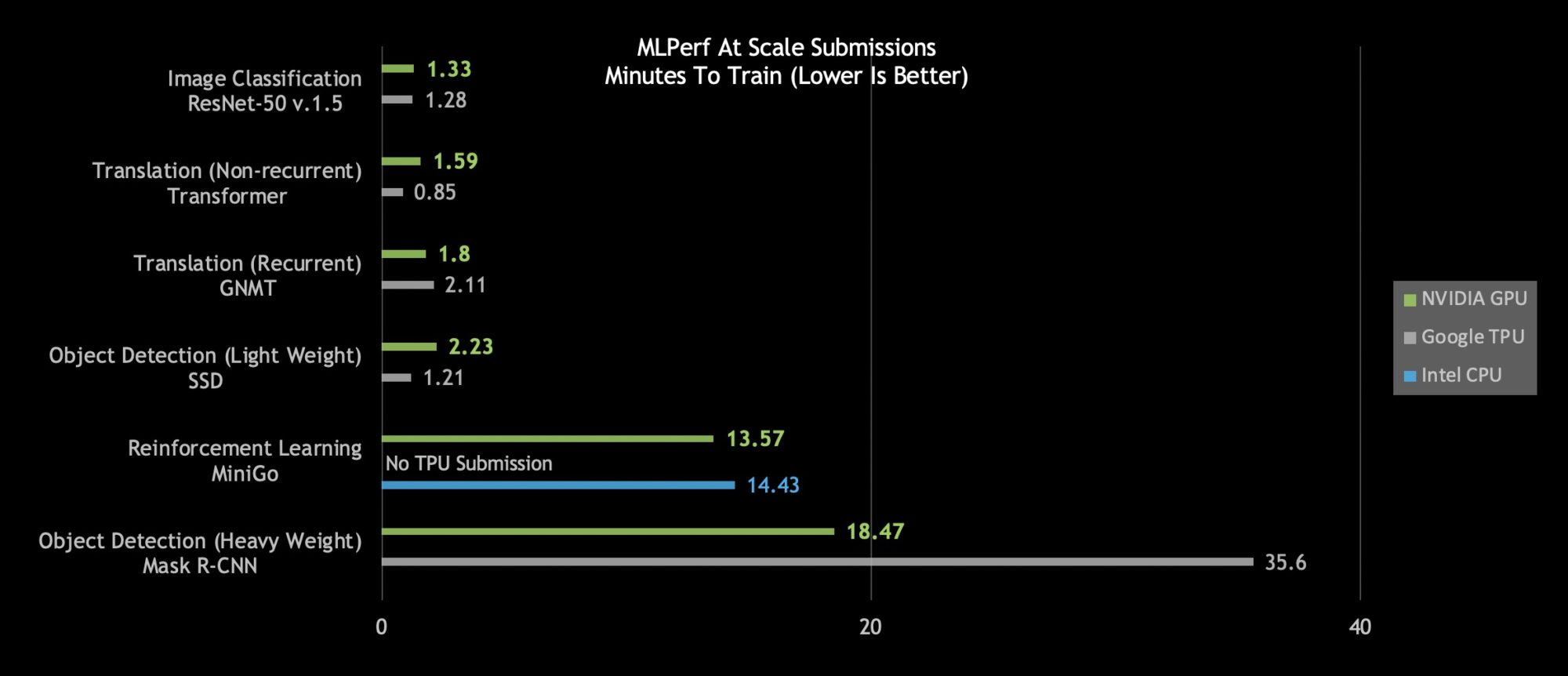
A close look at today’s MLPerf results shows the NVIDIA DGX SuperPOD is the only AI platform able to complete each of the six MLPerf categories in less than 20 minutes:

MLPerf at scale submissions
Chart 2: DGX SuperPOD Breaks At Scale AI Records MLPerf 0.6 Performance at Max Scale | MLPerf ID at Scale: RN50 v1.5: 0.6-30, 0.6-6 | Transformer: 0.6-28, 0.6-6 | GNMT: 0.6-26, 0.6-5 | SSD: 0.6-27, 0.6-6 | MiniGo: 0.6-11, 0.6-7 | Mask R-CNN: 0.6-23, 0.6-3

An even closer look reveals NVIDIA’s AI platform stands out on the hardest AI problems as measured by total time to train: heavyweight object detection and reinforcement learning.

Heavyweight object detection using the Mask R-CNN deep neural network provides users with advanced instance segmentation. Its uses include combining it with multiple data sources — cameras, sensors, lidar, ultrasound and more — to precisely identify and locate specific objects.

This type of AI workload helps train autonomous vehicles, providing precise locations of pedestrians and other objects to self-driving cars. Another real-life application helps doctors find and identify tumors in medical scans. Critical stuff.

NVIDIA’s heavyweight object detection submission, which came in at just under 19 minutes, delivers nearly twice the performance as the next best submission.

Reinforcement learning is another difficult category. This AI method trains robots working on factory floors to streamline production. It’s also used in cities to control traffic lights to reduce congestion. Using an NVIDIA DGX SuperPOD, NVIDIA trained the MiniGo AI reinforcement training model in a record-setting 13.57 minutes.

No More Time for Coffee: Instant AI Infrastructure Delivers World-Leading Performance

Speeding innovation, however, is about more than beating benchmarks. That’s why we made DGX SuperPOD not only powerful, but easy to set up.

Fully configured with optimized CUDA-X AI software freely available from our NGC container registry, DGX SuperPODs deliver world-leading AI performance out of the box.

They plug into an ecosystem of more than 1.3 million CUDA developers we work with to support every AI framework and development environment.

We’ve helped optimize millions of lines of code so our customers can bring their AI projects to life everywhere you can find NVIDIA GPUs: on the cloud, in data centers and at the edge.

AI Infrastructure That’s Fast Now, Faster Tomorrow 

Better still, this is a platform that’s always getting faster. We publish new optimizations and performance improvements to CUDA-X AI software every month, with integrated software stacks freely available for download on our NGC container registry. That includes containerized frameworks, pre-trained models and scripts.

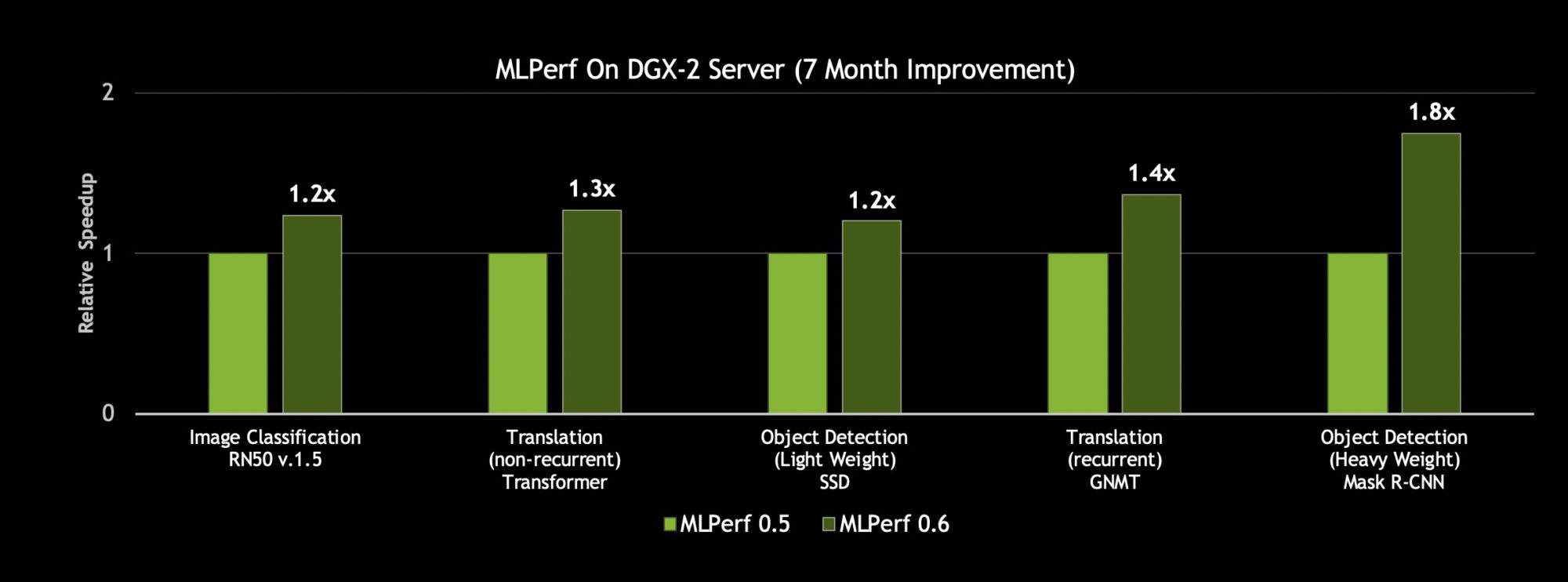
With such innovation to the CUDA-X AI software stack, an NVIDIA DGX-2H server gained up to 80 percent more throughput on our MLPerf 0.6 submissions than what we posted just seven months ago.

MLPerf on DGX-2 server
Chart 3: Up to 80 Percent More Performance on the Same Server Comparing the throughput of a single DGX-2H server on a single epoch (Single pass of the dataset through the neural network) | MLPerf ID 0.5/0.6 comparison: ResNet-50 v1.5: 0.5-20/0.6-30 | Transformer: 0.5-21/0.6-20 | SSD: 0.5-21/0.6-20 | GNMT: 0.5-19/0.6-20 | Mask R-CNN: 0.5-21/0.6-20

Add it up and these efforts represent an investment of tens of billions of dollars. All so you can get your work done fast today. And faster tomorrow.

The post NVIDIA Breaks Eight AI Performance Records appeared first on The Official NVIDIA Blog.

What’s My Line? GPUs Help Researcher Decipher Ancient Sanskrit

With 10 verb tenses, eight noun cases, three grammatical genders and a strong predilection for compound words, Sanskrit is not an easy language to teach a human — let alone an AI model.

But Indologist Oliver Hellwig is undertaking the challenge, training deep learning models that can analyze Sanskrit texts up to 4,000 years old. A digital repository of Sanskrit works parsed word by word would enable researchers to more easily search for information and better identify passages with parallel context.

AI is being used to interpret historical texts in German and Italian, as well as classical Japanese literature. But most existing NLP models are geared towards Western languages that follow similar rules of grammar, punctuation and formatting.

That presents a challenge for researchers developing software to transcribe and analyze scripts that are read right to left, are pictographical instead of phonetic, or — like Sanskrit — often don’t use character breaks between words.

Unlike English, Sanskrit is a highly inflected language, which means words change their form depending on their function in a sentence. Some Sanskrit verbs have more than 200 forms depending on the context. The language also has an extensive vocabulary, with more than 50 words for terms like “sun” or “moon” — making it essential that an AI model be trained on a large, diverse dataset of text.

Hellwig, a postdoctoral researcher at the University of Zurich, Switzerland, knew 15 years ago that computational tools could enable new possibilities for his linguistics research — but found that just a fraction of Sanskrit manuscripts have been digitized into machine-readable text.

For a half hour almost every day since, he’s been changing that bit by bit, painstakingly parsing Sanskrit works and adding them to a database that now consists of 4.5 million manually labeled words.

Hellwig began building Sanskrit-parsing tools from scratch — starting with statistical models before advancing to more complex optical character recognition and NLP models. Using an NVIDIA Quadro GPU, he’s now training deep learning models that can identify characters and find word endings in Sanskrit texts.

AI tools that transcribe Sanskrit could help digitize a vast corpus of historical manuscripts, spanning epic poetry, religious texts and Ayurvedic medicine.

Segmenting Sanskrit 

When training an AI model for texts based on the Latin alphabet, researchers can teach the neural network to detect white spaces to determine where one word ends and another begins.

That’s not the case for Sanskrit manuscripts, where one line of text can be made up of multiple words merged together into just one or two compound strings. The word sandhi, meaning “connection,” is used to describe the phonetic process of joining these words together.

An effective NLP model for Sanskrit texts must be able to split a sandhied line into individual words, posing a significant challenge for researchers.

“Any algorithm has to a certain degree understand the semantics of a line of text to generate a valid split form of it,” said Hellwig. “What’s quite trivial for English is actually the most problematic step in Sanskrit.”

The deep learning tool Hellwig developed to split lines of Sanskrit into individual words is 10 to 15 percent more accurate than previous methods.

“I was surprised that it worked so well,” he said, “because it’s a complicated task, even for human readers using the original forms of these texts.”

Using an NVIDIA GPU helped Hellwig speed up training his AI models by 10x. This speed allows him to evaluate errors faster, and efficiently develop more accurate models. His sandhi-splitting tool is now being used on a large Sanskrit corpus dubbed GRETIL.

Many historians debate the age of key Sanskrit texts — particularly religious works like the Bhagavad Gita. To contribute to this academic conversation, Hellwig wants to use neural networks and NVIDIA GPUs to analyze the grammatical structure and language patterns in ancient Sanskrit texts.

By connecting this linguistic evidence with a model of how Sanskrit changed over time, he hopes to help determine when some of these major texts were composed.

Main image shows a leaf from a manuscript of the Mahabharata, a 100,000-verse Sanskrit epic poem that includes the Bhagavad Gita  a foundational Hindu text. Image from Miami University Libraries Digital Collections, available in the public domain.

The post What’s My Line? GPUs Help Researcher Decipher Ancient Sanskrit appeared first on The Official NVIDIA Blog.

Striking a Chord: Anthem Helps Patients Navigate Healthcare with Ease

AI is bringing convenience to your healthcare experience.

Health insurance company Anthem helps patients personalize and better understand their healthcare information through AI.

Operating in 14 states with more than 40 million members on its health plans, Anthem is developing into “AI and digital-first company” to better assist their customers.

“We have to acknowledge that our legacy has been that we’re an insurance company, and we’re quite good at it,” said Rajeev Ronanki, senior vice president and chief digital officer at Anthem, in a conversation with AI Podcast host Noah Kravitz. “But more and more the world is evolving to where insurance is really about data. And to make data meaningful and useful, we need AI, hence the transformation.”

Ronanki believes that “digital data and AI are the bridge” to solving the issues in the healthcare industry, and that, in the future, the medical field will employ a variety of AI-assisted tools to augment patient care.

“Almost no one gives the US healthcare system high marks,” Ronanki said. “Hard to use, hard to understand, it’s too expensive — the system is just broken.”

“If we can think of healthcare as a supply and demand problem, and systematically digitize all the supply points so your doctors’ offices, hospitals, retail, clinics… and make all of that supply available in a consistent and systematic manner to the demand of the patients, then we can thrive.”

Acknowledging the concerns over data privacy, Ronanki stressed Anthem’s mission for patients to have greater transparency into and full control over their own entire health history.

“That’s the paradigm shift that we want to make,” said Ronanki. “Which is to liberate data from all the places that it exists today, and make it available to consumers and let them make the choice and to who to make that data available to.”

Later this fall, Anthem plans to launch their AI-powered product that gives users the opportunity to diagnose themselves, schedule video consultations, and book doctors’ appointments all with a few clicks of a button.

Help Make the AI Podcast Better

Have a few minutes to spare? It’d help us if you fill out this short listener survey.

Your answers will help us learn more about our audience, which will help us deliver podcasts that meet your needs, what we can do better, and what we’re doing right.

How to Tune into the AI Podcast

Our AI Podcast is available through iTunesCastbox, DoggCatcher, Google Play MusicOvercastPlayerFMPodbayPodBean, Pocket Casts, PodCruncher, PodKicker, Stitcher, Soundcloud and TuneIn.

If your favorite isn’t listed here, email us at aipodcast [at] nvidia [dot] com.

The post Striking a Chord: Anthem Helps Patients Navigate Healthcare with Ease appeared first on The Official NVIDIA Blog.