As more physicians turn to the latest advancements in technology to improve medical practices, one company is bringing the power of AI to the fight against cancer.
Most people know that chemotherapy and surgery are used to treat cancer, but thermal ablation is often under the radar. It’s a minimally invasive process that applies intense heat to tissue to remove early-stage tumors.
Thermal ablation is a safe, effective procedure that’s quickly becoming one of the best alternative treatments for cancer, especially for patients who are unable to undergo surgery.
To date, doctors performing thermal ablation typically haven’t had the tools to visualize or control the damage created during the procedure. This means tumor removal could be incomplete or healthy tissue could be harmed. Plus, physicians needed to wait up to 24 hours to see how effective the procedure was on the targeted tissue.
To address this challenge, Israel-based company TechsoMed has developed BioTrace, the world’s first real-time monitoring and control system for thermal ablation.
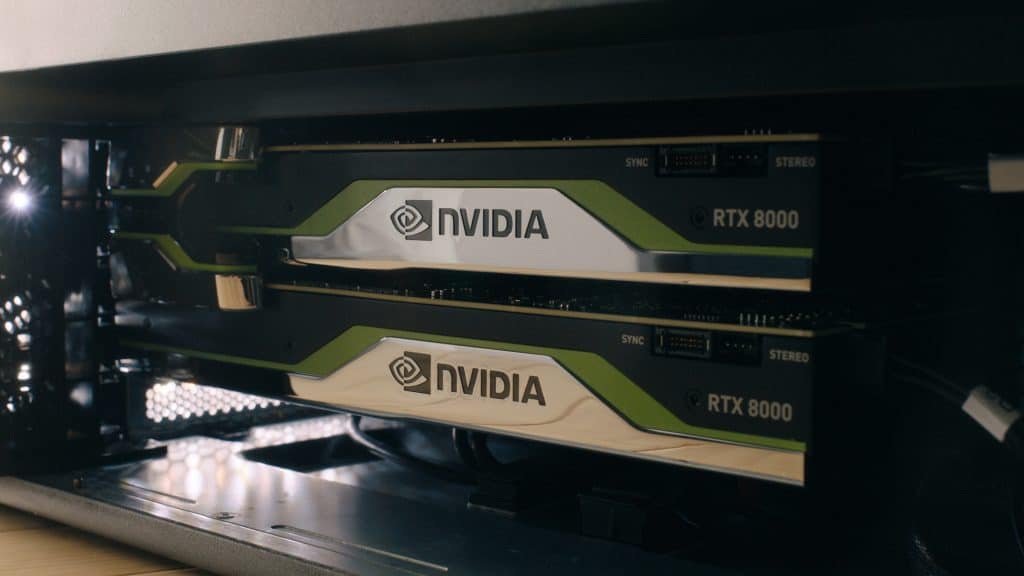
With the help of NVIDIA Quadro RTX 8000 GPUs, BioTrace uses AI algorithms applied to image data from ultrasound devices to perform monitoring and analysis during thermal ablation procedures.
The technology tracks the real-time biological response of the tissue so physicians can have better visibility and understand the results of the cancer treatment as it’s performed.
RTX Brings Real-Time Results
For BioTrace to process data instantly and provide real-time feedback, TechsoMed runs advanced AI algorithms using dual NVIDIA Quadro RTX 8000 graphics packed inside a Lenovo ThinkStation P920 workstation.
Quadro RTX 8000 is the world’s most powerful GPU based on NVIDIA’s latest Turing architecture and features Tensor Cores specifically designed to accelerate AI algorithms.
TechsoMed uses two RTX 8000 GPUs paired with NVIDIA NVLink high-speed interconnect technology to scale up performance and memory capacity to 96GB, which is critical when working with massive image data in real time.
“BioTrace is taking the guesswork out of ablation procedures through AI algorithms and image processing technologies, and the NVIDIA RTX GPUs help make it possible,” said Yossi Abu, founder and CEO of TechsoMed. “By defining the exact algorithm practitioners need to visualize the results, RTX enables our work to bring thermal ablation procedures to a new level.”
The real-time feedback from BioTrace brings benefits such as faster recovery, fewer potential complications and less damage to surrounding healthy tissue. With RTX powering their simulations, doctors can take advantage of higher resolution images and real-time feedback to improve accuracy and minimize damage.
Cancer incidence rates are on the rise — expected to increase by 63 percent over the next two decades. To meet the growing demand for care, medical technology leaders are turning to AI tools that can help radiation oncologists provide high-quality, individualized treatment faster.
One of the world’s leading healthcare companies, Siemens Healthineers, is using an NVIDIA GPU-based supercomputing infrastructure to develop AI software for generating organ segmentations that enable precision radiation therapy.
Siemens Healthineers’ Sherlock AI supercomputer is powered by NVIDIA HGX 1 and HGX 2 servers loaded with NVIDIA V100 Tensor Core GPUs. The system provides 20 petaflops of performance and is used to run over 500 AI experiments daily.
Both Siemens Healthineers and NVIDIA this week are sharing their latest work in AI for medical imaging at the Society for Imaging Informatics in Medicine annual conference, held outside Denver, Colorado. The event brings together the medical informatics community to share, debate, and address the challenges and opportunities facing medical imaging.
Augmenting Radiation Therapy Workflows
Radiation therapy for cancer patients is a complex workflow that includes modeling the patient, contouring the target and organs at risk, simulating the treatment, planning and delivering the treatment.
One of the most time-consuming tasks in this process is protecting the healthy organs at risk that surround a patient’s tumor and need to be spared from excessive radiation dose. Traditionally, radiation oncologists contour the tumor target volume and organs at risk, deciding how much radiation should be used to treat tumors without damaging neighboring normal tissue.
To help oncologists develop radiation treatment plans faster, Siemens Healthineers uses syngo.via RT Image Suite, a software tool that automatically outlines organs using AI-assisted AutoContouring. Trained on over 4.5 million images using the Sherlock supercomputer, the AI model saves radiation-oncologist time and eases organs-at-risk contouring tasks. In their current research, Siemens Healthineers automatically outlines 28 organs using AI technology.
“AI-assisted AutoContouring helps save time and improve standardization in organ at risk contouring,” said Dr. Fernando Vega, Head of Software and Concept Definition for Radiation Oncology at Siemens Healthineers. “This allows radiation-oncologists to better focus on other crucial aspects of patient care.”
Tapping into Software To Write Software
Behind this explosion of AI in medical imaging is a new dynamic within the software development paradigm: the advent of software that writes other software.
Traditionally, engineers have written applications from start to finish, a time-consuming process that requires niche computing expertise. Now, with access to powerful compute resources, AI algorithms can leverage training data to learn processes like medical image analysis without every element being explicitly coded by a developer.
Siemens Healthineers, which has been involved in machine learning since the 1990s, is harnessing this AI capability with the Sherlock system. The supercomputer learns from the company’s massive data lake of over 750 million curated images as well as radiology reports and clinical and genomic data. So far, it has led to the development of more than 40 AI-powered applications approved for clinical use.
“We believe that AI is starting a new era in software development, where advanced neural network architectures, large collections of curated data, and massive computational power come together to deliver tremendous performance and high clinical value,” said Dr. Dorin Comaniciu, Senior Vice President of artificial intelligence and digital innovation at Siemens Healthineers.
Simple and Scalable Infrastructure
Siemens Healthineers’ 20 petaflop Sherlock supercomputer addresses a key computing need in the healthcare industry for an optimized and scalable infrastructure that can be used to develop deep learning tools for imaging and other clinical applications.
The NVIDIA DGX POD reference architecture provides a tested infrastructure for setting up a scalable AI computing system. Through the DGX-Ready Data Center program, NVIDIA and its colocation service providers offer simplified, rapid deployment for customers building and deploying world-class AI data centers for the healthcare industry.
For more on how NVIDIA’s AI platform is enabling advances in medicine and research, see the NVIDIA Healthcare page.
Dementia diagnosis starts with uncertainty — patients or their family members make an appointment after noticing symptoms that suggest something’s wrong.
It may take months or years to reach a final diagnosis, as doctors must observe how a patient’s condition progresses over time.
Radiologists don’t typically have serial quantitative brain data — calculated measurements of a patient’s brain structures taken at different times — on hand during this process. They rely instead on visual assessments of the scans, rating a patient’s brain atrophy levels on a four or five-point scale.
Experts rely on these qualitative scores because even when serial scans are available, it would radiologists inordinately long to quantify the data, as they have to calculate brain structure volumes by hand.
“It’d just be too expensive to let radiologists do that,” said Jorrit Glastra, chief technology officer of Quantib, a Netherlands-based startup using deep learning to tackle this problem.
AI can accelerate the analysis of brain MRI data, taking just a few minutes to generate a report of structure volumes for radiologists and neurologists, who work together to study a patient’s scans and cognitive test results. Looking at the hard numbers can help experts more easily measure the change in a patient’s brain over time, shortening the time to diagnosis.
“The longer disease diagnosis is delayed, the more care a patient will need and the higher the costs,” Glastra said. “It’s very valuable to diagnose cases early.”
A member of the NVIDIA Inception program, Quantib trains its deep learning algorithms on NVIDIA V100 and K80 GPUs. Its deep learning software, Quantib ND, is FDA cleared in the United States and CE marked in Europe.
The company’s technology is installed in around 20 countries across Europe, North America and Asia.
AI’ll Do the Math
Dementia affects 50 million people worldwide — a figure expected to grow in coming years as life expectancy rises. Artificial intelligence tools like Quantib ND can help radiologists monitor disease progress in patients and diagnose new cases earlier.
Quantib ND quantifies brain atrophy by segmenting brain structures and white matter hyperintensities, which signify the level of disease-induced damage in the brain.
Radiologists can also use the tool to compare a patient’s brain tissue volumes to a reference library of MRI scans. This database makes it easier to determine whether a patient’s brain is showing normal aging or not.
Based on a dataset of 5,000 brain scans, Quantib ND’s AI can differentiate between brain atrophy patterns indicative of Alzheimer’s disease and ones associated with other kinds of dementia. The tool can also be used to compare an individual patient’s scans over time to determine how a disease is progressing.
Beyond the Brain
Quantib is also building deep learning solutions for oncologists detecting prostate cancer and breast cancer. Its AI algorithm for prostate cancer, currently in development, can segment, classify and predict the state of suspicious lesions from MRI scans. Doctors can then use these insights to determine which lesions to target with a biopsy.
The company’s breast cancer screening AI analyzes MRI scans for women with high breast density — an independent risk factor for developing breast cancer. Radiologists and oncologists use these scans to determine if a patient will require a biopsy.
Glastra said for both breast and prostate cancer screening, the AI must analyze a set of multiple images from different time points. The complexity of the deep learning task demands powerful computation tools for inference.
“For breast cancer screening, the data volume going into that set of scans is unbelievable. It’s several orders of magnitude higher than the brain,” he said. “Running inference on the types of models that can handle those inputs can only be done with GPU support.”
Quantib benchmarked the performance of its prostate cancer AI using the 70-watt NVIDIA T4 GPUs for inference — and found the algorithms run 24x faster compared to using a CPU cluster with the same power usage.
“For on-premises inference,” Glastra said, “the low-power footprint of the T4 makes it a very attractive option.”
Virtually every federal agency is focused on understanding how AI will affect society, from better protecting data to improving public services, lowering costs and providing better quality of life for consumers.
Leaders in the federal government and private sector pushing these initiatives forward will come together later this year at the GPU Technology Conference in Washington, hosted by NVIDIA and its partners, including Booz Allen Hamilton, Dell, IBM, Lockheed Martin and other important AI technology providers.
More than 3,000 attendees — made up of developers, researchers, policymakers and CIOs — will be there to discuss the latest developments in deep learning, machine learning, cybersecurity, autonomous machines, HPC, intelligent video analytics, healthcare, 5G, VR and more.
Registration is now open for the conference and training sessions, which will run from Nov. 4-6 at the Reagan Center.
Over 700 companies and organizations will participate in the event, from the nation’s top technology firms to government contractors and national labs — such as Alphabet, Amazon Web Services, Booz Allen Hamilton, Carnegie Mellon University, Dell EMC, the Department of Energy, IBM, Lockheed Martin, Microsoft and Oak Ridge National Laboratory.
Non-Stop: Keynotes, Panels, Hands-On Training
GTC DC, now in its fourth year, will feature more than 100 sessions and panels on topics such as AI applications for humanitarian disaster relief, supply chain management, fraud prevention and 5G technology.
Tuesday morning kicks off with a keynote by Ian Buck, NVIDIA’s vice president of accelerated computing. Dozens more experts across a wide range of fields will be presenting, with talks from NetApp, Pure Storage, Carahsoft Technology Corp., Kinetica, Government Acquisitions, Inc. and others. Confirmed speakers include:
Suzette Kent, U.S. chief information officer – U.S. Office of Management and Budget
Rodrigo Aramburu, CEO – BlazingDB
Ciro Donalek, cofounder and chief technology officer – Virtualitics
John Ferguson, CEO – Deepwave Digital
Sertac Karaman, associate professor of aeronautics and astronautics – MIT
Joshua Patterson, director of AI infrastructure – NVIDIA
Kimberly Powell, vice president of healthcare – NVIDIA
A series of policy discussions will take place Nov. 5 with leaders from a variety of agencies and government contractors. The panel discussions will focus on America’s national AI strategy, cybersecurity and workforce training.
Attendees can register for dozens of hands-on training sessions held throughout the conference. Six NVIDIA Deep Learning Institute full-day workshops will be offered on Nov. 4 — from Fundamentals of Accelerated Computing with CUDA Python to industry-specific deep learning trainings for industrial inspection, robotics, intelligent video analytics, and healthcare image analysis. Register early to reserve your seat.
We will also host our third Women in AI breakfast in DC this year. The event, which covers relevant and timely topics in AI, features women speakers across industry and research fields.
More than 50 companies will exhibit their latest technology in the Expo Hall, during show hours on Nov. 5 and 6. Evening receptions will offer networking opportunities for attendees.
Developers and thought leaders are invited to submit talks and research posters for the event. For registration and additional conference details, check out the GTC DC website.
Computer vision technology that can identify items in a shopping bag. Deep learning tools that inspect train tracks for defects. An AI model that automatically labels street-view imagery.
These are just a few of the AI breakthroughs being showcased this week by the dozens of NVIDIA Inception startups at the annual Computer Vision and Pattern Recognition conference, one of the world’s top AI research events.
The NVIDIA Inception virtual accelerator program supports startups harnessing GPUs for AI and data science applications. Since its launch in 2016, the program has expanded over tenfold in size, to over 4,000 companies. More than 50 of them can be found in the CVPR expo hall — exhibiting GPU-powered work spanning retail, robotics, healthcare and beyond.
Malong Technologies: Giving Retailers an Edge with AI
From self-serve weighing stations that automatically identify fresh produce items in a plastic shopping bag, to smart vending machines that can recognize when a shopper takes a beverage out of a cooler — product recognition AI developed by Malong Technologies is enabling frictionless shopping experiences.
Malong’s computer vision solutions are transforming traditional retail equipment into smarter devices, enabling machines to see the products within them to improve operational efficiency, security and the customer experience.
Using the NVIDIA Metropolis platform for smart cities, the company is building product recognition AI models that enable highly accurate, real-time decisions at the edge. Malong develops powerful, scalable intelligent video analytics tools that can accurately recognize hundreds of thousands of retail products in real time. The company researches weakly-supervised learning to significantly reduce the effort to retrain their models as product packaging and store environments change.
Malong was able to speed its inferencing by more than 40x compared to CPU when using DeepStream and TensorRT software libraries on the NVIDIA T4 GPU. The company uses NVIDIA V100 GPUs in the cloud for training, and the Jetson TX2 supercomputer on a module to bring true AI computing at the edge.
At CVPR, the company is at booth 1316 on the show floor and is presenting research that achieves a new gold standard for image retrieval, outperforming prior methods by a significant margin. Malong is also co-hosting the Fine-Grained Visual Categorization Workshop and organized the first ever retail product recognition challenge at CVPR.
ABEJA: Keeping Singapore’s Metros on Track
Manually inspecting railway tracks is a dangerous task, often done by workers at night when trains aren’t running. But with high-speed cameras, transportation companies can instead capture images of the tracks and use AI to automatically detect defects for railway maintenance.
ABEJA, based in Japan, is developing deep learning models that detects anomalies on tracks with more than 90 percent accuracy, a significant improvement over other automated inspection methods. The startup works with SMRT, Singapore’s leading public transport operator, to examine rail defects.
Founded in 2012, ABEJA builds deep learning tools for multiple industries, including retail, manufacturing and infrastructure. Other use cases include an AI to measure efficiency in car factories and a natural language processing model to provide insights for call centers.
The company uses NVIDIA GPUs on premises and in the cloud for training its AI models. For inference, ABEJA has used GPUs for real-time data processing and high-performance image segmentation projects. It has also deployed projects using NVIDIA Jetson TX2 for AI inference at the edge.
The startup is showing a demo of the ABEJA annotation model in its CVPR booth.
Mapillary: AI in the Streets
Sweden-based Mapillary uses computer vision to automate mapping. Its AI models break down and classify street-level images, segmenting and labeling elements like roads, lane markings, street lights and sidewalks. The company has to date processed hundreds of millions of images submitted by individual contributors, nonprofit organizations, companies and governments worldwide.
These labeled datasets can be used for various purposes, including to create useful maps for local governments, train self-driving cars, or build tools for people with disabilities.
Mapillary is presenting four papers at CVPR this year, including one titled Seamless Scene Segmentation. The model described in the research — a new approach that joins two AI models into one, setting a new state-of-the-art for performance — was trained on eight NVIDIA V100 GPUs.
The segmentation models featured in Mapillary’s CVPR booth were also trained using V100 GPUs. By adopting the NVIDIA TensorRTinference software stack in 2017, Mapillary was able to speed up its segmentation algorithms by up to 27x when running on the Amazon Web Services cloud.
Companies interested in the NVIDIA Inception virtual accelerator can visit the program website and apply to join. Inception members are eligible for a 20 percent discount on up to six NVIDIA TITAN RTX GPUs until Oct. 26.
Startups based in the following countries can request a discount code by emailing inceptionprogram@nvidia.com: Australia, Austria, Belgium, Canada, Czech Republic, Denmark, Finland, France, Germany, Ireland, Italy, Luxembourg, the Netherlands, Norway, Poland, Spain, Sweden, United Kingdom, United States.
From discovering drugs, to locating black holes, to finding safer nuclear energy sources, high performance computing systems around the world have enabled breakthroughs across all scientific domains.
Japan’s fastest supercomputer, ABCI, powered by NVIDIA Tensor Core GPUs, enables similar breakthroughs by taking advantage of AI. The system is the world’s first large-scale, open AI infrastructure serving researchers, engineers and industrial users to advance their science.
The software used to drive these advances is as critical as the servers the software runs on. However, installing an application on an HPC cluster is complex and time consuming. Researchers and engineers are unproductive as they wait to access the software, and their requests to have applications installed distract system admins from completing mission-critical tasks.
Containers — packages that contain software and relevant dependencies — allow users to pull and run the software on a system without actually installing the software. They’re a win-win for users and system admins.
NGC: Driving Ease of Use of AI, Machine Learning and HPC Software
NGC offers over 50 GPU-optimized containers for deep learning frameworks, machine learning algorithms and HPC applications that run on both Docker and Singularity.
The HPC applications provide scalable performance on GPUs within and across nodes. NVIDIA continuously optimizes key deep learning frameworks and libraries, with updates released monthly. This provides users access to top performance for training and inference for all their AI projects.
ABCI Runs NGC Containers
Researchers and industrial users are taking advantage of ABCI to run AI-powered scientific workloads across domains, from nuclear physics to manufacturing. Others are taking advantage of the system’s distributed computing to push the limits on speeding AI training.
To achieve this, the right set of software and hardware tools must be in place, which is why ABCI has adopted NGC.
“Installing deep learning frameworks from the source is complicated and upgrading the software to keep up with the frequent releases is a resource drain,” said Hirotaka Ogawa, team leader of the Artificial Intelligence Research Center at AIST. “NGC allows us to support our users with the latest AI frameworks and the users enjoy the best performance they can achieve on NVIDIA GPUs.”
ABCI has turned to containers to address another user need — portability.
“Most of our users are from industrial segments who are looking for portability between their on-prem systems and ABCI,” said Ogawa. “Thanks to NGC and Singularity, the users can develop, test, and deploy at scale across different platforms. Our sampling data showed that NGC containers were used by 80 percent of the over 100,000 jobs that ran on Singularity.”
NGC Container Replicator Simplifies Ease of Use for System Admins and Users
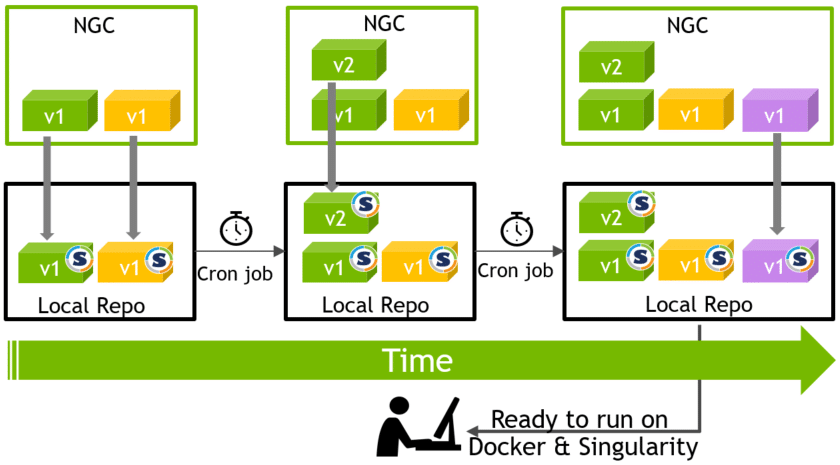
System admins managing HPC systems at supercomputing centers and universities can now download and save NGC containers on their clusters. This gives users faster access to the software, alleviates their network traffic, and saves storage space.
NVIDIA offers NGC Container Replicator, which automatically checks and downloads the latest versions of NGC containers.
Without lifting a finger, system admins can ensure that their users benefit from the superior performance and newest features from the latest software.
More Than Application Containers
In addition to deep learning containers, NGC hosts 60 pre-trained models and 17 model scripts for popular use cases like object detection, natural language processing and text to speech.
It’s much faster to tune a pre-trained model for a use case than to start from scratch. The pre-trained models allow researchers to quickly fine-tune a neural network or build on top of an already optimized network for specific use-case needs.
The model training scripts follow best practices, have state-of-the-art accuracy and deliver superior performance. They’re ideal for researchers and data scientists planning to build a network from scratch and customize it to their liking.
The models and scripts take advantage of mixed precision powered by NVIDIA Tensor Core GPUs to deliver up to 3x deep learning performance speedups over previous generations.
Take NGC for a Spin
NGC containers are built and tested to run on-prem and in the cloud. They also support hybrid as well as multi-cloud deployments. Visit ngc.nvidia.com, pull your application container on any GPU-powered system or major cloud instance, and see how easy it is to get up and running for your next scientific research.
From voice assistants like Alexa and Google Maps navigation to Bing’s conversational search, AI has become a part of daily life for many.
These tasks are performing deep learning inference, which might be thought of as AI put into action.
The deep learning neural networks that power AI are trained on massive amounts of data. Putting this training to work in the digital world — to recognize spoken words, images or street signs, or to suggest the shirt you might want to buy or the next movie to watch — is inferencing.
And the breadth of inference applications on GPUs may surprise you. It’s pervasive in everything from the lumber industry to research that delves into reading ancient Japanese texts.
Below are four diverse ways inference running on GPUs is already making a difference.
Fighting Fraud
PayPal is using deep learning inference on GPUs to pinpoint fraudulent transactions — and help ensure they don’t happen again.
The company processes millions of transactions every day. Advances in AI — specifically logistic regression-powered neural network models — have allowed it to filter out deceptive merchants and crack down on sales of illegal products.
The deep learning models also help PayPal optimize its operations by identifying why some transactions fail and spotting opportunities to work more efficiently.
And since the models are always learning, they can personalize user experiences by serving up relevant advertisements based on people’s interests.
Weather Insight
Boston-based ClimaCell is working to bring unprecedented speed, precision and accuracy to weather forecasting by listening closely to a powerful voice: Mother Nature’s.
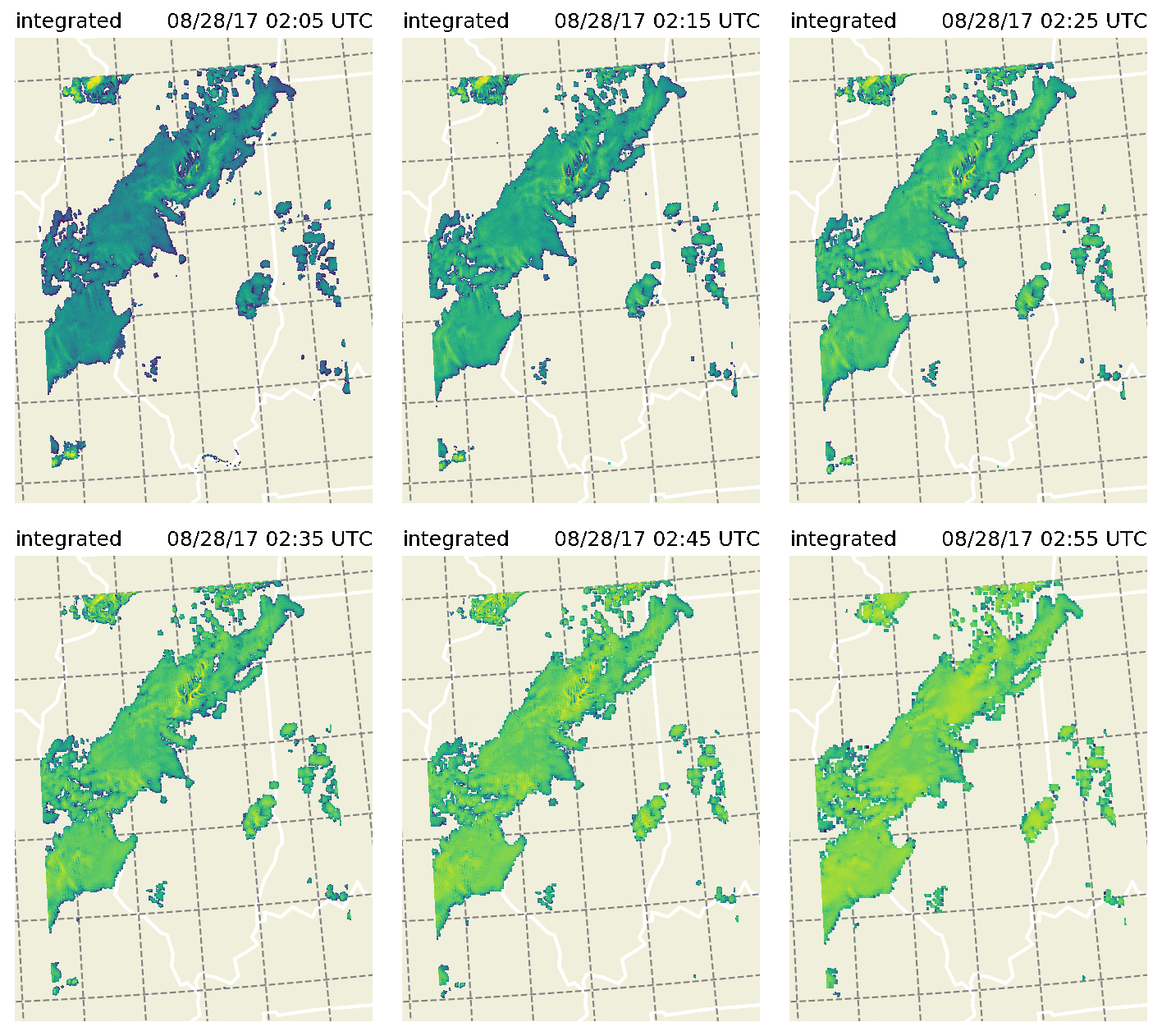
The company uses inference on GPUs to offer so-called “nowcasting” — hyper-local, high-resolution forecasts that can help businesses and people make better decisions about everything from paving projects to wind generation to planning a daily commute to avoid bad weather. The company also offers forecasting and historic data.
ClimaCell’s nowcasting GPU model in action.
To achieve this, the company writes software that turns the signals in existing communication networks into sensors that can analyze the surrounding environment and extract real-time weather data.
ClimaCell’s network quickly analyzes the signals, integrates them with data from the National Oceanic and Atmospheric Administration and then weaves it all together using predictive models run on NVIDIA GPU accelerators.
Detecting Cancer
Mammogram machines are effective at detecting breast cancer, but expensive. In many developing countries, this makes them rare outside of large cities.
Mayo Clinic researcher Viksit Kumar is leading an effort to use GPU-powered inferencing to more accurately classify breast cancer images using ultrasound machines, which are much cheaper and more accessible around the world.
Kumar and his team have been able to detect and segment breast cancer masses with very good accuracy and few false positives, according to their research paper.
The red outline shows the manually segmented boundary of a carcinoma, while the deep learning-predicted boundaries are shown in blue, green and cyan.
The team does its local processing using the TensorFlow deep learning framework container from the NGC registry on NVIDIA GPUs. It also uses NVIDIA V100 Tensor Core GPUs on AWS using the same container.
Eventually, Kumar hopes to use ultrasound images for the early detection of other forms of the disease, such as thyroid and ovarian cancer.
Making Music
MuseNet is a deep learning algorithm demo from AI research organization OpenAI that automatically generates music using 10 kinds of instruments and a host of different styles — everything from pop to classical.
People can create entirely new tracks by applying different instruments and sounds to music the algorithm generates. The demo uses NVIDIA V100 Tensor Core GPUs for this inferencing task.
Using the demo, you can take spin up twists on your favorite songs. Add guitars, leave out the piano, go big on drums. Or change its style to sound like jazz or classic rock.
The algorithm wasn’t programmed to mimic the human understanding of music. Instead, it was trained on hundreds of thousands of songs so it could learn the patterns of harmony, rhythm and style prevalent within music.
Its 72-layer network was trained using NVIDIA V100 Tensor Core GPUs with the cuDNN-accelerated TensorFlow deep learning framework.
The intersection of HPC and AI is extending the reach of science and accelerating the pace of innovation like never before. It’s driving discovery in scientific astrophysics, weather forecasting, energy exploration, molecular dynamics and many other fields.
That’s why over 3,000 people will flock to ISC High Performance 2019, in Frankfurt, Germany, next week. Attendees will descend on the annual supercomputing conference, running from June 16-20, for scores of talks, demos and workshops to explore the latest HPC breakthroughs.
Hear from NVIDIA Experts at ISC
GPUs are at the heart of accelerating HPC. That’s why you’ll find NVIDIA technology featured in a number of talks and workshops across the show.
A number of sessions from NVIDIA experts at our partners’ booths.
Witness Groundbreaking Technology in Action
GPU computing is the most accessible and energy-efficient path forward for HPC and the data center.
At ISC, dozens of NVIDIA partners will demonstrate the importance of GPU acceleration through a range of exhibits and demos.
Look out for “NVIDIA partner” signs at booths including those from Dell EMC, HPE, Mellanox, Boston, One Stop Systems and Supermicro to discover GPU-powered demos. Across the show, you’ll also find:
The AI “Emoji” demo — Pass by one of these demo stations at our partners’ booths and get your emotion read in real time. The Emoji demo performs real-time face detection and can identify a whole range of emotions, including “neutral,” “happiness,” “surprise,” “sadness,” “anger,” “disgust,” “fear” and “contempt.”
The Index Supernova demo — Large, 3D scientific simulations typically take about four months to create and generate over a terabyte of visualization data. With the NVIDIA IndeX SDK running on NGC, researchers can now view and interact with their data, make modifications and focus on the most pertinent parts of the data — all in real time.
Over the course of three days, a total of 14 teams will have the chance to showcase systems of their own design and compete to achieve the highest performance across a series of standard HPC benchmarks and applications.
The winner will be announced on Wednesday, June 19, at 5:15 p.m. in Panorama 2.
Keep up to date on all things HPC and AI by following our social handles @NVIDIAEU and #ISC19.
You don’t need specialized hardware to do ray tracing, but you want it.
Software-based ray tracing, of course, is decades old. And it looks great: movie makers have been using ray tracing for decades now.
But it’s now clear that specialized hardware — like the RT Cores built into NVIDIA’s Turing architecture — makes a huge difference if you’re doing ray tracing in real time. Games require real-time ray tracing.
Once considered the “holy grail” of graphics, real-time ray tracing brings the same techniques long used by movie makers to gamers and creators.
Thanks to a raft of new AAA games developers have introduced this year — and the introduction last year of NVIDIA GeForce RTX GPUs — this once wild idea is mainstream.
Millions are now firing up PCs that benefit from the RT Cores and Tensor Cores built into RTX. And they’re enjoying ray-tracing enhanced experiences many thought would be years, even decades, away.
Real-time ray tracing, however, is possible without dedicated hardware. That’s because — while ray tracing has been around since the 1970s — the real trend is much newer: GPU-accelerated ray tracing with dedicated cores.
The use of GPUs to accelerate ray-tracing algorithms gained fresh momentum last year with the introduction of Microsoft’s DirectX Raytracing (DXR) API. And that’s great news for gamers and creators.
Ray Tracing Isn’t New
So what is ray tracing? Look around you. The objects you’re seeing are illuminated by beams of light. Now follow the path of those beams backwards from your eye to the objects that light interacts with. That’s ray tracing.
It’s a technique first described by IBM’s Arthur Appel, in 1969, in “Some Techniques for Shading Machine Renderings of Solids.” Thanks to pioneers such as Turner Whitted, Lucasfilm’s Robert Cook, Thomas Porter and Loren Carpenter, CalTech’s Jim Kajiya, and a host of others, ray tracing is now the standard in the film and computer graphics industry for creating lifelike lighting and images.
However, until last year, almost all ray tracing was done offline. It’s very compute intensive. Even today, the effects you see at movie theaters require sprawling, CPU-equipped server farms. Gamers want to play interactive, real-time games. They won’t wait minutes or hours per frame.
GPUs, by contrast, can move much faster, thanks to the fact they rely on larger numbers of computing cores to get complex tasks done more quickly. And, traditionally, they’ve used another rendering technique, known as “rasterization,” to display three-dimensional objects on a two-dimensional screen.
With rasterization, objects on the screen are created from a mesh of virtual triangles, or polygons, that create 3D models of objects. In this virtual mesh, the corners of each triangle — known as vertices — intersect with the vertices of other triangles of different sizes and shapes. It’s fast and the results have gotten very good, even if it’s still not always as good as what ray tracing can do.
GPUs Take on Ray Tracing
But what if you used these GPUs — and their parallel processing capabilities — to accelerate ray tracing? This is where GPU-accelerated software ray tracing comes in. NVIDIA OptiX, introduced in 2009, targeted design professionals with GPU-accelerated ray tracing. Over the next decade, OptiX rode the steady advance in speed delivered by successive generations of NVIDIA GPUs.
By 2015, NVIDIA was demonstrating at SIGGRAPH how ray tracing could turn a CAD model into a photorealistic image — indistinguishable from a photograph — in seconds, speeding up the work of architects, product designers and graphic artists.
That approach — GPU-accelerated software ray tracing — was endorsed by Microsoft early last year, with the introduction of DXR, which enables full support of NVIDIA RTX ray-tracing software through Microsoft’s DXR API.
Delivering high-performance, real-time ray tracing required two innovations: dedicated ray-tracing hardware, RT Cores; and Tensor Cores for high-performance AI processing for advanced denoising, anti-aliasing and super resolution.
RT Cores accelerate ray tracing by speeding up the process of finding out where a ray intersects with the 3D geometry of a scene. These specialized cores accelerate a tree-based ray-tracing structure called a bounding volume hierarchy, or BVH, used to calculate where rays and the triangles that comprise a computer-generated image intersect.
Tensor Cores — first unveiled with NVIDIA’s Volta architecture aimed at enterprise and scientific computing in 2018 to accelerate AI algorithms — further accelerate graphically intense workloads. That’s through a special AI technique called NVIDIA DLSS, short for Deep Learning Super Sampling. RTX’s Tensor Cores make this possible.
Turing at Work
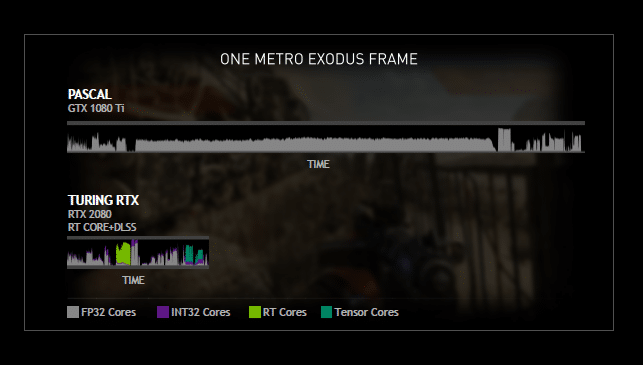
You can see how this works by comparing how quickly Turing and our previous generation Pascal architecture render a single frame of Metro Exodus.
Top: One frame of Metro Exodus rendered on Pascal, with the time in the middle spent on ray tracing.
On Turing, you can see several things happening. One is green, that’s our RT cores kicking in. As you can see, the same ray tracing done on Pascal GPU is done in one-fifth of the time on Turing.
Reinventing graphics, NVIDIA and our partners have been driving Turing to market through a stack of products that now range from the highest performance product, at $999, all the way down to an entry gamer, at $149. The RTX products, with RT Cores and Tensor Cores, start at $349.
Broad Support
There’s no question that real-time ray tracing is the next generation of gaming.
Some of the most important ecosystem partners have announced their support and are now opening the floodgates for real-time ray tracing in games.
Inside of Microsoft’s DirectX 12 multimedia programming interfaces is a ray-tracing component they call DirectX Raytracing (DXR). So every PC, if enabled by the GPU, is capable of accelerated ray tracing.
At the Game Developers Conference in March, we turned on DXR-accelerated ray tracing on our Pascal and Turing GTX GPUs.
To be sure, earlier GPU architectures, such as Pascal, were designed to accelerate DirectX 12. So on this hardware, these calculations are performed on the programmable shader cores, a resource shared with many other graphics functions of the GPU.
So while your mileage will vary — since there are many ways ray tracing can be implemented — Turing will consistently perform better when playing games that make use of ray-tracing effects.
And that performance advantage on the most popular games is only going to grow.
EA’s AAA engine Frostbite, supports ray tracing. Unity and Unreal, which together power 90 percent of the world’s games, now support Microsoft’s DirectX ray tracing in the engine.
Collectively, that opens up an easy path for thousands and thousands of game developers to implement ray tracing in their games.
All told, NVIDIA’s engaged somewhere in excess of 100 developers who are working on ray-traced games.
To date we have millions of gamers who are gaming on RTX hardware, GPU-accelerated hardware with RT Cores.
And — thanks to ray tracing — that number is growing every week.
The grass really is greener on the AI side. Grownetics CEO and co-founder Vince Harkiewicz would know. He helps grow it.
AI isn’t new to agtech, of course. But Grownetics, an intelligent cultivation management system for indoor farms and greenhouses, has a very specific focus: cannabis.
“We’ve specifically targeted the cannabis industry because there’s a lack of tools built for them and indoor agriculture as a whole,” Harkiewicz explained in a conversation with AI Podcast host Noah Kravitz.
Grownetics handles every step of the cultivation process, Harkiewicz says. Using harvest data, an open sensor network and a deep learning recommendation engine, the company provides a “specific recipe leading to an ideal yield for that particular variety” of cannabis, or any crop.
While he’s focused cannabis, for now, Harkiewicz believes Grownetics’ work in the industry will support growth in the broader indoor agriculture market.
“I’d argue that [the cannabis industry is] leading the indoor-ag field,” Harkiewicz said. “The two industries don’t really communicate too much yet, and that’s really what we’re striving to do, is to bridge precision agriculture, indoor agriculture with what’s been going on in the cannabis space.”
Based in Boulder, Colo., Grownetics began running beta tests at the end of last year. Since then, the company has gained eight clients and hopes to commercially launch at the end of this year.
“It’s been intense,” Harkiewicz said. “Not only are we a startup, but we’re a startup in a startup industry.”
The cannabis industry has seen immense growth in recent years as multiple countries and U.S. states have legalized cannabis for medicinal and recreational use. However, for Grownetics’ operations in the U.S., the federal legal status of the crop poses an extra hurdle.
“Because of the federal legality, or illegality of the cannabis industry, it’s artificially suppressing the market and making it extremely hard for our customers to grow and scale great businesses,” Harkiewicz said.
Even with these legal challenges, Harkiewicz is optimistic about the future of the cannabis industry and its influence on agriculture.
“This is a systemic evolution that we’re looking at, from producing the unique medicinal product in cannabis, and doing it in a pharmaceutical high-quality, clean way,” Harkiewicz said.
“And then taking those same traits to leafy greens and produce to be growing them indoors without any pesticides, and very, very efficiently.”
Your answers will help us learn more about our audience, which will help us deliver podcasts that meet your needs, what we can do better, and what we’re doing right.