Finally our package mlfinlab has been released on the PyPi index.
pip install mlfinlab
mlfinlab is a “living and breathing” project in the sense that it is continually enhanced with new code from the chapters in the Advances in Financial Machine Learning book. We have built this on lean principles with the goal of providing the greatest value to the quantitative community.
I was reading about concentration of measure related stuff recently and was curious whether anyone knows whether this material is still applicable to ‘deep learning’ models. By statistical learning theory I mean stuff like VC / Rademacher bounds etc.
If it is, can anyone point to any research papers on this topic?
From my naive understanding, because these bounds relate to the worst-case scenario the union bound may be excessively pessimistic in terms of the number of training examples required.
Most people wouldn’t think to teach five-year-olds how to hit a baseball by handing them a bat and ball, telling them to toss the objects into the air in a zillion different combinations and hoping they figure out how the two things connect.
And yet, this is in some ways how we approach machine learning today — by showing machines a lot of data and expecting them to learn associations or find patterns on their own.
For many of the most common applications of AI technologies today, such as simple text or image recognition, this works extremely well.
But as the desire to use AI for more scenarios has grown, Microsoft scientists and product developers have pioneered a complementary approach called machine teaching. This relies on people’s expertise to break a problem into easier tasks and give machine learning models important clues about how to find a solution faster. It’s like teaching a child to hit a home run by first putting the ball on the tee, then tossing an underhand pitch and eventually moving on to fastballs.
“This feels very natural and intuitive when we talk about this in human terms but when we switch to machine learning, everybody’s mindset, whether they realize it or not, is ‘let’s just throw fastballs at the system,’” said Mark Hammond, Microsoft general manager for Business AI. “Machine teaching is a set of tools that helps you stop doing that.”
Machine teaching seeks to gain knowledge from people rather than extracting knowledge from data alone. A person who understands the task at hand — whether how to decide which department in a company should receive an incoming email or how to automatically position wind turbines to generate more energy — would first decompose that problem into smaller parts. Then they would provide a limited number of examples, or the equivalent of lesson plans, to help the machine learning algorithms solve it.
In supervised learning scenarios, machine teaching is particularly useful when little or no labeled training data exists for the machine learning algorithms because an industry or company’s needs are so specific.
YouTube Video
In difficult and ambiguous reinforcement learning scenarios — where algorithms have trouble figuring out which of millions of possible actions it should take to master tasks in the physical world — machine teaching can dramatically shortcut the time it takes an intelligent agent to find the solution.
It’s also part of larger goal to enable a broader swath of people to use AI in more sophisticated ways. Machine teaching allows developers or subject matter experts with little AI expertise, such as lawyers, accountants, engineers, nurses or forklift operators, to impart important abstract concepts to an intelligent system, which then performs the machine learning mechanics in the background.
Microsoft researchers began exploring machine teaching principles nearly a decade ago, and those concepts are now working their way into products that help companies build everything from intelligent customer service bots to autonomous systems.
“Even the smartest AI will struggle by itself to learn how to do some of the deeply complex tasks that are common in the real world. So you need an approach like this, with people guiding AI systems to learn the things that we already know,” said Gurdeep Pall, Microsoft corporate vice president for Business AI. “Taking this turnkey AI and having non-experts use it to do much more complex tasks is really the sweet spot for machine teaching.”
Today, if we are trying to teach a machine learning algorithm to learn what a table is, we could easily find a dataset with pictures of tables, chairs and lamps that have been meticulously labeled. After exposing the algorithm to countless labeled examples, it learns to recognize a table’s characteristics.
But if you had to teach a person how to recognize a table, you’d probably start by explaining that it has four legs and a flat top. If you saw the person also putting chairs in that category, you’d further explain that a chair has a back and a table doesn’t. These abstractions and feedback loops are key to how people learn, and they can also augment traditional approaches to machine learning.
“If you can teach something to another person, you should be able to teach it to a machine using language that is very close to how humans learn,” said Patrice Simard, Microsoft distinguished engineer who pioneered the company’s machine teaching work for Microsoft Research. This month, his team moves to the Experiences and Devices group to continue this work and further integrate machine teaching with conversational AI offerings.
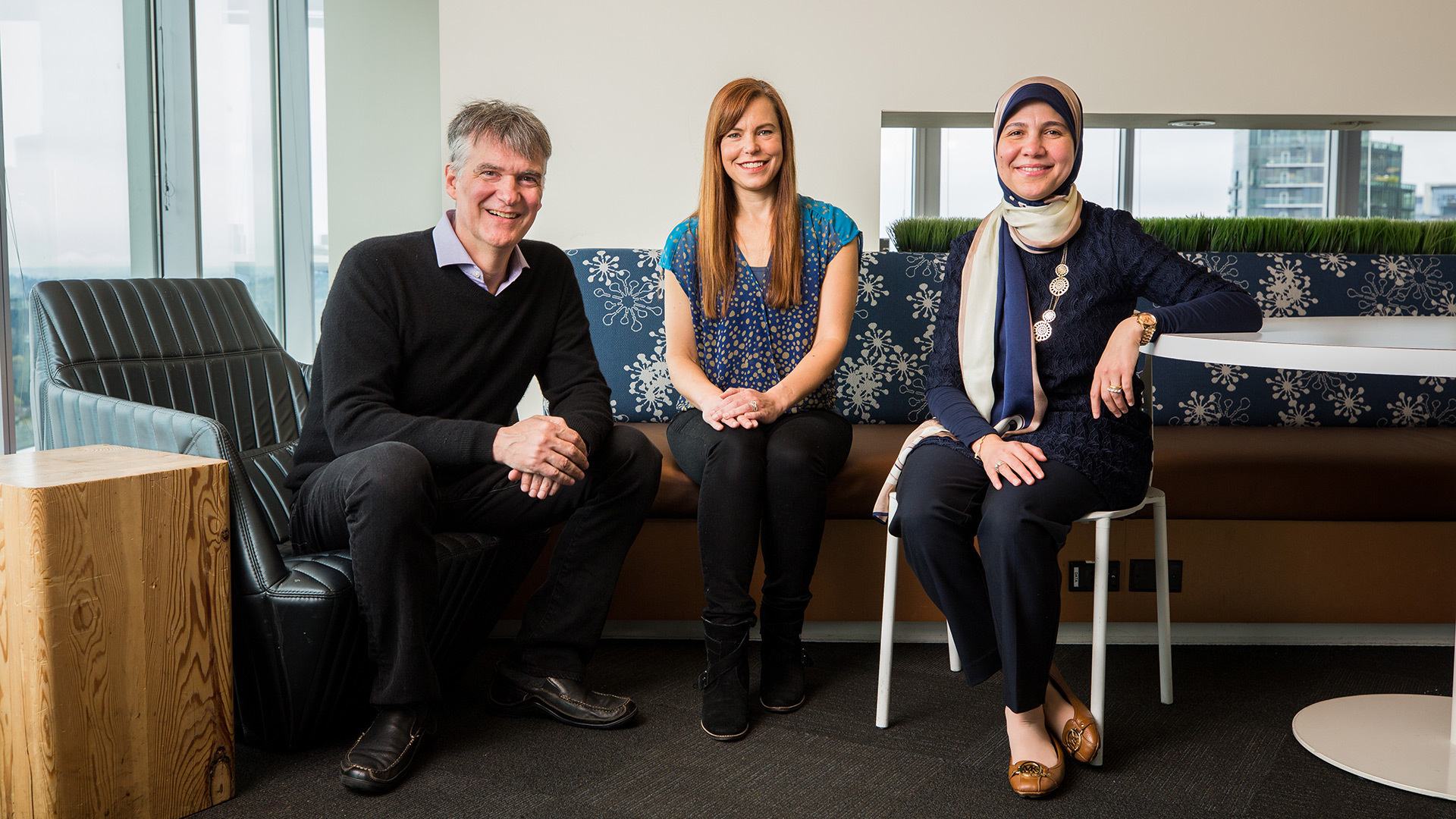
Microsoft researchers Patrice Simard, Alicia Edelman Pelton and Riham Mansour (left to right) are working to infuse machine teaching into Microsoft products. Photo by Dan DeLong for Microsoft.
Millions of potential AI users
Simard first started thinking about a new paradigm for building AI systems when he noticed that nearly all the papers at machine learning conferences focused on improving the performance of algorithms on carefully curated benchmarks. But in the real world, he realized, teaching is an equally or arguably more important component to learning, especially for simple tasks where limited data is available.
If you wanted to teach an AI system how to pick the best car but only had a few examples that were labeled “good” and “bad,” it might infer from that limited information that a defining characteristic of a good car is that the fourth number of its license plate is a “2.” But pointing the AI system to the same characteristics that you would tell your teenager to consider — gas mileage, safety ratings, crash test results, price — enables the algorithms to recognize good and bad cars correctly, despite the limited availability of labeled examples.
In supervised learning scenarios, machine teaching improves models by identifying these high-level meaningful features. As in programming, the art of machine teaching also involves the decomposition of tasks into simpler tasks. If the necessary features do not exist, they can be created using sub-models that use lower level features and are simple enough to be learned from a few examples. If the system consistently makes the same mistake, errors can be eliminated by adding features or examples.
One of the first Microsoft products to employ machine teaching concepts is Language Understanding, a tool in Azure Cognitive Services that identifies intent and key concepts from short text. It’s been used by companies ranging from UPS and Progressive Insurance to Telefonica to develop intelligent customer service bots.
“To know whether a customer has a question about billing or a service plan, you don’t have to give us every example of the question. You can provide four or five, along with the features and the keywords that are important in that domain, and Language Understanding takes care of the machinery in the background,” said Riham Mansour, principal software engineering manager responsible for Language Understanding.
Microsoft researchers are exploring how to apply machine teaching concepts to more complicated problems, like classifying longer documents, email and even images. They’re also working to make the teaching process more intuitive, such as suggesting to users which features might be important to solving the task.
Imagine a company wants to use AI to scan through all its documents and emails from the last year to find out how many quotes were sent out and how many of those resulted in a sale, said Alicia Edelman Pelton, principal program manager for the Microsoft Machine Teaching Group.
As a first step, the system has to know how to identify a quote from a contract or an invoice. Oftentimes, no labeled training data exists for that kind of task, particularly if each salesperson in the company handles it a little differently.
If the system was using traditional machine learning techniques, the company would need to outsource that process, sending thousands of sample documents and detailed instructions so an army of people can attempt to label them correctly — a process that can take months of back and forth to eliminate error and find all the relevant examples. They’ll also need a machine learning expert, who will be in high demand, to build the machine learning model. And if new salespeople start using different formats that the system wasn’t trained on, the model gets confused and stops working well.
By contrast, Pelton said, Microsoft’s machine teaching approach would use a person inside the company to identify the defining features and structures commonly found in a quote: something sent from a salesperson, an external customer’s name, words like “quotation” or “delivery date,” “product,” “quantity,” or “payment terms.”
It would translate that person’s expertise into language that a machine can understand and use a machine learning algorithm that’s been preselected to perform that task. That can help customers build customized AI solutions in a fraction of the time using the expertise that already exists within their organization, Pelton said.
Pelton noted that there are countless people in the world “who understand their businesses and can describe the important concepts — a lawyer who says, ‘oh, I know what a contract looks like and I know what a summons looks like and I can give you the clues to tell the difference.’”
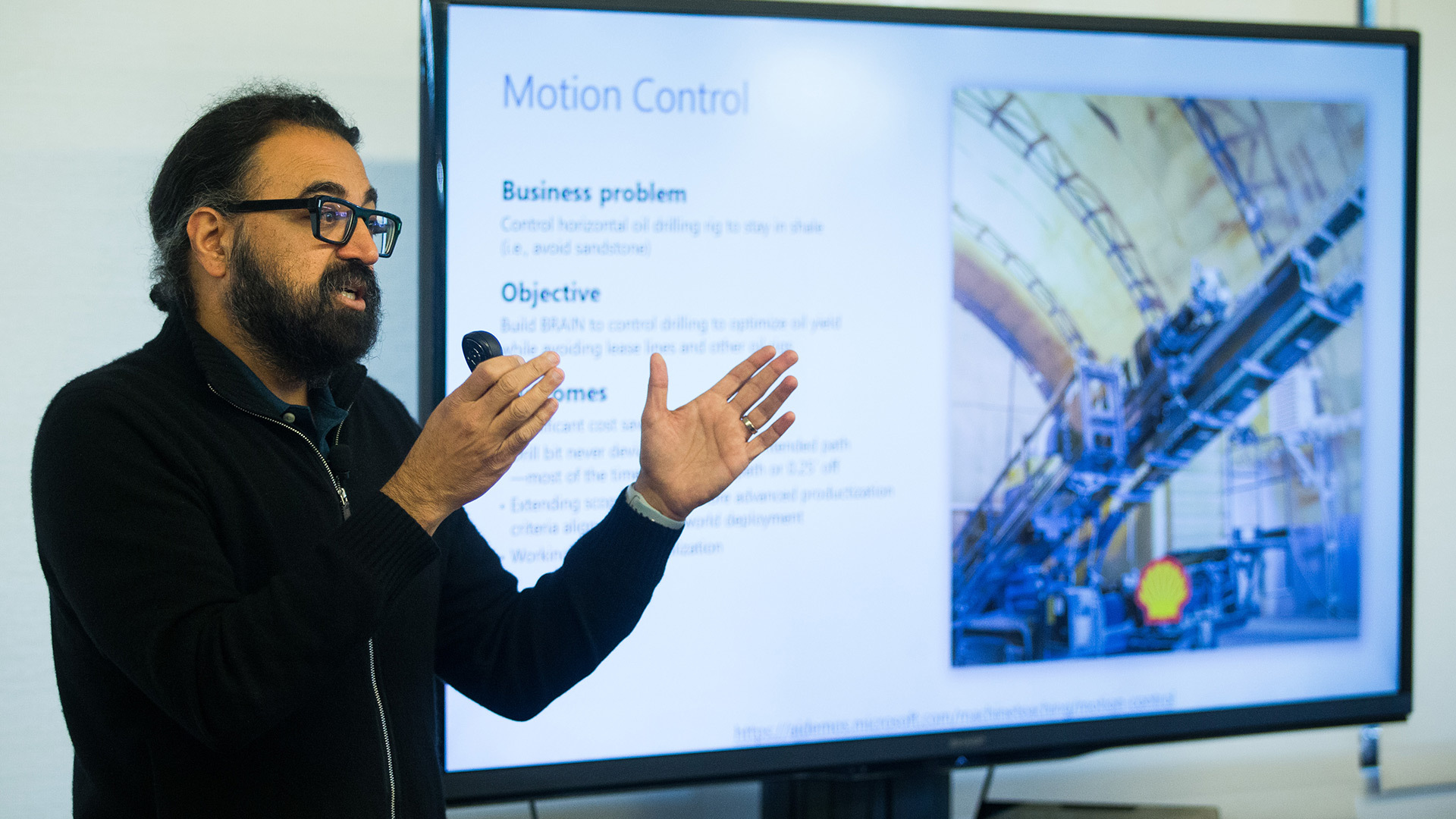
Microsoft Corporate Vice President for Business AI Gurdeep Pall talks at a recent conference about autonomous systems solutions that employ machine teaching. Photo by Dan DeLong for Microsoft.
Making hard problems truly solvable
More than a decade ago, Hammond was working as a systems programmer in a Yale neuroscience lab and noticed how scientists used a step-by-step approach to train animals to perform tasks for their studies. He had a similar epiphany about borrowing those lessons to teach machines.
That ultimately led him to found Bonsai, which was acquired by Microsoft last year. It combines machine teaching with deep reinforcement learning and simulation to help companies develop “brains” that run autonomous systems in applications ranging from robotics and manufacturing to energy and building management. The platform uses a programming language called Inkling to help developers and even subject matter experts decompose problems and write AI programs.
Deep reinforcement learning, a branch of AI in which algorithms learn by trial and error based on a system of rewards, has successfully outperformed people in video games. But those models have struggled to master more complicated real-world industrial tasks, Hammond said.
Adding a machine teaching layer — or infusing an organization’s unique subject matter expertise directly into a deep reinforcement learning model — can dramatically reduce the time it takes to find solutions to these deeply complex real-world problems, Hammond said.
For instance, imagine a manufacturing company wants to train an AI agent to autonomously calibrate a critical piece of equipment that can be thrown out of whack as temperature or humidity fluctuates or after it’s been in use for some time. A person would use the Inkling language to create a “lesson plan” that outlines relevant information to perform the task and to monitor whether the system is performing well.
Armed with that information from its machine teaching component, the Bonsai system would select the best reinforcement learning model and create an AI “brain” to reduce expensive downtime by autonomously calibrating the equipment. It would test different actions in a simulated environment and be rewarded or penalized depending on how quickly and precisely it performs the calibration.
Telling that AI brain what’s important to focus on at the outset can short circuit a lot of fruitless and time-consuming exploration as it tries to learn in simulation what does and doesn’t work, Hammond said.
“The reason machine teaching proves critical is because if you just use reinforcement learning naively and don’t give it any information on how to solve the problem, it’s going to explore randomly and will maybe hopefully — but frequently not ever — hit on a solution that works,” Hammond said. “It makes problems truly solvable whereas without machine teaching they aren’t.”
Some independent research I conducted in testing what’s going on in the memory of the DNC when trained to learn a predictive model of the environment for Reinforcement Learning. Unfortunately, the experiments didn’t find anything strongly positive. The memory appears to be a black-box, at least when examined in this way. Read more at: http://blog.adeel.io/2019/03/10/differentiable-neural-computer-memory-testing-using-dsprites/
Would love to hear the thoughts of the ML community.
Deep Learning (e.g. Find new data science, machine learning and AI opportunities; Collaborate with dozens of data scientists, machine learning scientists and… From Thomson Reuters – Tue, 23 Apr 2019 10:25:08 GMT – View all Toronto, ON jobs
We are pleased to announce the 6th Workshop on Fine-Grained Visual Categorization at CVPR 2019 in June. The purpose of the workshop is to bring together researchers to explore visual recognition across the continuum between basic level categorization (object recognition) and identification of individuals (face recognition, biometrics) within a category population.
Short Papers We invite submission of extended abstracts describing work in fine-grained recognition. For more details check out the workshop website. https://sites.google.com/view/fgvc6/home
Challenges In conjunction with the workshop we are also hosting a series of competitions on Kaggle. These range from classification of different species of plants and animals in images through to predicting fine-grained visual attributes in fashion images. https://www.kaggle.com/FGVC6/competitions
With webpages like this freely accessible to all, I assume everybody here already knows that there is a tidal wave of former IMO/IPhO/Part III “mega-hotshots” (who got tired of doing QFT problem sets) set to finish up their ~Machine learning in Physics~ PhDs (or similar) within the next 2-3 years. Look into the eyes of every single individual on this list — (and if you look them up, about half of them are doing ML stuff) — you can literally feel their scintillating intellects, and they’re coming for your ML jobs soon. How is everyone planning to keep up with advancements in ML once these “monster minds” finish their PhDs? Is ML over for ordinary folks?
(And by the way, this isn’t a troll post. If you think you’re on the same level as these folks, that first guy I linked has literally been to fucking space — that’s the level of hotshot you’re dealing with here. What I’m describing is therefore a real, actual “phenomenon”, which has to be contended with, that is, the existence of “mega-hotshots”, currently walking the halls of the Stanford physics building, and elsewhere, set to burst onto the scene. )
Little background about me, I am soon to graduate with a BS Software Engineering from a decent university. This is my final semester I am in and I just took a class on AI. Now, my math background is significantly better than the bare minimum of any degree program. However, I still feel I don’t have enough math knowledge to pursue AI with a full understanding. Currently I have taken Calc 1, Calc 2, Discrete, and Probability Theory (have to take that last one over the summer). I understand python really well so I can make assumptions on different aspects of code. However when it comes to the real analysis of it all (the models, activation possibilities, etc) I am really lost. I REALLY REALLY want to do this for a living because I think its super cool, but real hard. What would be your advice on being more versed in this realm. Would you go into a masters program and if so where (Looking for best value so not expensive nor dirt cheap). I will add edits as I may have forgotten to add somethings. Thanks in advance.