Capturing memories: GeoSnapShot uses Amazon Rekognition to identify athletes
If you’ve ever competed in a sporting event and painstakingly sifted through event photos to find yourself later, you’ll appreciate GeoSnapShot’s innovative solution powered by Amazon Rekognition.
GeoSnapShot founder Andy Edwards was first introduced to the world of sports photography when he started accompanying his wife, a competitive equestrian, to her riding events and photographing her and her friends.While he enjoyed taking great photos of everyone, he was frustrated by the manual, time-intensive process required post-event to identify each rider and distribute the photos to them. He noticed many other photographers in the same situation, and the sad consequence was a loss of the special memories they captured simply because the sorting process was too hard.
Setting out to solve this challenge – and indeed, multiple related challenges for photographers and sports organizations worldwide – Andy started GeoSnapShot in 2013. The company partners with event organizers to enable any athlete who opts in and uploads a selfie to find images of themselves quickly and easily. It does this by using Amazon Rekognition in two ways: for direct comparisons of users’ selfies to the photos from an event, and for optical character recognition to identify their competition bib numbers. With those inputs, GeoSnapShot is able to process thousands of event photos in near real-time, expediting an effort that used to require event organizers to spend many hours manually matching bib numbers to athlete names and sorting the photos by athlete.
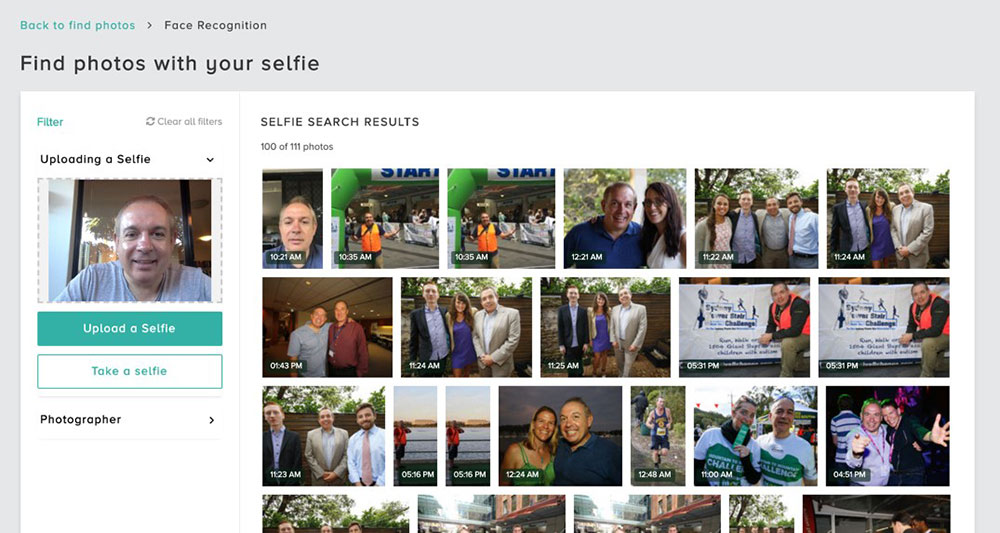
This heavy lifting meant that athletes used to wait days or weeks for their photos to be available. Now, GeoSnapShot’s unique solution for sports photography makes it possible for athletes to start reviewing their photos before the sweat has even dried. As a result, photography sales for event organizers have increased by almost 30 percent, and customer satisfaction has increased substantially.
GeoSnapShot’s solutions are being used across 92 countries, where amateur photographers and professionals alike laud the user-friendly solution built on AWS. Perhaps the truest testimony of the power of the technology is that the popular global endurance event company Tough Mudder recently started using GeoSnapShot. Tough Mudder participants are often barely recognizable due to the unavoidable head-toe coating of mud inherent to the competition, and yet GeoSnapShot’s participant identification is successful. (No, competitors don’t need to upload a mud-covered selfie for it to work either; a more glamorous image works fine too!)
Tough Mudder’s VP of Live Events, Johnny Little, comments, “Reliving the memories made is vital to our participants and GeoSnapShot have an outstanding global photography platform that provides the best solution for every Tough Mudder event worldwide.”
Andy lauds AWS AI as the underpinning of that solution. “AWS provided us with the most flexible technology platform as we started building our business. As GeoSnapShot is a platform, it’s important we use leading technology to deliver the very best experience for all our customers. AWS continues to provide us with a world-leading technology. We are delighted with the access we have to the technology and business teams to drive future solutions.”
GeoSnapShot has chosen AWS as their primary AI/ML platform, and the company’s tech stack will get even deeper in the coming months, as the company is currently in the process of implementing a video solution in addition to the still photos. GeoSnapShot believes that providing athletes with memories of their achievements in stills and video, all using recognition technology, is the future of sports media.
Ultimately, GeoSnapShot wants every event and every photographer globally to have the opportunity to use its platform. Andy comments, “After all, memories of our lives and those of our loved ones are very precious and should be captured.”
To learn more about Amazon Rekognition, visit https://aws.amazon.com/rekognition/.
About the Author
 Marisa Messina is on the AWS AI marketing team, where her job includes identifying the most innovative AWS-using customers and showcasing their inspiring stories. Prior to AWS, she worked on consumer-facing hardware and then university-facing cloud offerings at Microsoft. Outside of work, she enjoys exploring the Pacific Northwest hiking trails, cooking without recipes, and dancing in the rain.
![[P] 1 million AI generated fake faces for download](https://b.thumbs.redditmedia.com/6TMteJDREHjIKbruEOkivQCpmUDhBT7hG1iwBSrkeBo.jpg "[P] 1 million AI generated fake faces for download")
![[R] (ICML’19 AutoML workshop) InstaNAS: Instance-aware Neural Architecture Search](https://b.thumbs.redditmedia.com/1LBR20S_azBkGorPrQjYJe_6pDov1LRrj3_bJoygCgI.jpg "[R] (ICML’19 AutoML workshop) InstaNAS: Instance-aware Neural Architecture Search")