
Blog

Learn About Our Meetup

5000+ Members

MEETUPS

LEARN, CONNECT, SHARE

Join our meetup, learn, connect, share, and get to know your Toronto AI community. 

JOB POSTINGS

INDEED POSTINGS

Browse through the latest deep learning, ai, machine learning postings from Indeed for the GTA.

CONTACT

CONNECT WITH US

Are you looking to sponsor space, be a speaker, or volunteer, feel free to give us a shout.

Author: torontoai

[P] Does anyone know of anywhere I can find good data regarding addiction treatment?

I want to do a machine learning project to gain insight into and then perhaps even be able to contribute ideas to the area of addiction treatment, something I think is extremely important for society. In order to begin, I have been scouring the Internet for places where I can gather data for building datasets, and maybe even existing datasets I’ll be able to utilize.

So, in this spirit, I was wondering if anyone else has any suggestions or knowledge of where I can gather data that has to do with addiction treatment, or maybe even existing datasets about the subject? Please let me know if you do – it’d be immensely helpful!

P.S. – If you are interested in using some of your free time to help me out with the project, feel free to message me. Especially now, during the data sourcing part of the project, it’s the best part! (Lmao I’m obviously kidding I hate this part, but your help would actually be seriously awesome)

submitted by /u/that_one_ai_nerd
[link] [comments]

[Discussion] Suggestions for organizing related work research

Hello Everyone,

I am looking for suggestions to organize my related work research. It will be great if the method (or system) can give the ability to organize the related work in a web-based tool, where I can keep pdf’s , annotate them online (as well as offline), add comments, write summaries next to them. It will be great if I can share these features with my collaborators as well.

I had been trying to use Trello and Github’s Project Management Tool ( along with “Issues” for comments) for this.

It will be helpful if others can share how they organize their research.

Thanks,

Anurag Koul

submitted by /u/HeavyStatus4
[link] [comments]

AWS DeepRacer Scholarship Challenge from Udacity is now open for enrollment

The race is on! Start your engines! The AWS DeepRacer Scholarship Challenge from Udacity is now open for enrollment.

As mentioned in our previous post, the AWS DeepRacer Scholarship Challenge program introduces you—no matter what your developer skill levels are—to essential machine learning (ML) concepts in a fun and engaging way. Each month, you put your skills to the test in the world’s first global autonomous racing league, the AWS DeepRacer League, and compete for top spots in each month’s unique race course.

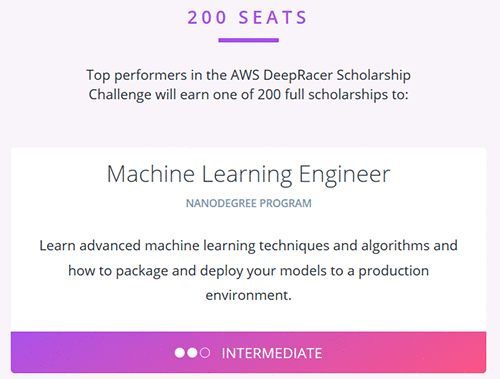
Students that record the top lap times in August, September, and October 2019 qualify for one of 200 full scholarships to the Machine Learning Engineer nanodegree program, sponsored by Udacity.
What is AWS DeepRacer?

In November 2018, Jeff Barr announced the launch of AWS DeepRacer on the AWS News Blog as a new way to learn ML. With AWS DeepRacer, you have an opportunity to get hands-on with a fully autonomous 1/18th-scale race car driven by reinforcement learning (RL), a 3D-racing simulator, and a global racing league.

How does the AWS DeepRacer Scholarship Challenge work?

The program begins today, August 1, 2019 and runs through October 31, 2019. You can join the scholarship community at any point during these three months for free.
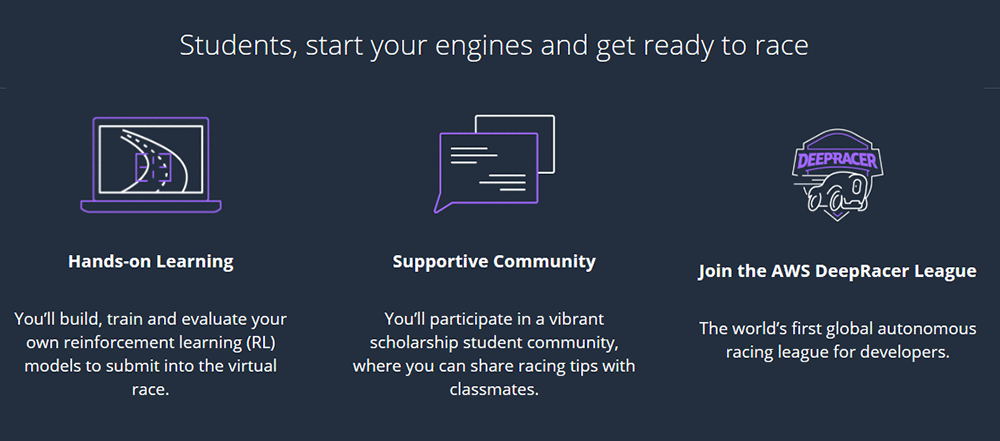
After enrollment, you go through the AWS DeepRacer: Driven by Reinforcement Learning course developed by AWS Training and Certification. The course consists of short, step-by-step modules (90 minutes in total). The modules prepare you to create, train, and fine-tune an RL model in the AWS DeepRacer 3D racing simulator.

After you complete the course, you can enter the AWS DeepRacer virtual league. The enrolled students who record the top lap times in August, September, and October 2019 qualify for one of 200 full scholarships to the Udacity Machine Learning Engineer nanodegree program.

Throughout the program and during each race, you have access to a supportive community to get pro tips from experts and exchange ideas with your classmates.

“Developers have a great opportunity here to follow a focused learning curriculum designed to get started in Reinforcement Learning”- “Sunil Mallya, principal deep learning scientist, ML Solution Labs AWS”

Expert tips and tricks

Now that you have enrolled and are racing, you may benefit from expert racing tricks to race to the top. In the pit stop, you learn great racing tips and access valuable tools like the log analysis tool. Also, there’s a hack you can use, developed by an AWS DeepRacer participant ARCC, for running the training jobs locally in a Docker container.

You can clone your previous model to train a better model. I know this sounds complicated but, if you clone a previously trained model as the starting point of a new round of training, you could improve the training efficiency. To do this, you can modify the hyper-parameters to make use of already learned knowledge. “- Law Mei Ching Pearly Jean, youngest AWS DeepRacer League competitor

The tips and tools help you submit a performant model for the challenge—eventually increasing your chance of topping the leaderboard and winning one of the 200 ML nanodegree scholarships from Udacity.

“The AWS DeepRacer League has become quite addictive as the competition is pretty intense. What’s great though is that even though everyone is trying to win, that hasn’t kept people from sharing what they have learned. There is a great community around this product and it’s cool to see the impact it’s having with helping people get introduced to the field of Machine Learning.” – Alex Schultz, machine learning software engineer

You can add more code to the AWS DeepRacer workshop repository on GitHub, and create more tools and tips for the community to make model development using RL easy and useful. To learn more about ML on AWS, see Get Started with Machine Learning – No PhD Required.

Next steps

Developers, register now! The first challenge starts August 1, 2019. For a program FAQ, see AWS DeepRacer Scholarship Challenge.


About the Author

Tara Shankar Jana is a Senior Product Marketing Manager for AWS Machine Learning. Currently he is working on building unique and scalable educational offerings for the aspiring ML developer communities- to help them expand their skills on ML. Outside of work he loves reading books, travelling and spending time with his family.



Financially empowering Generation Z with behavioral economics, banking, and AWS machine learning

This is a guest blog post by Dante Monaldo, co-founder and CTO of Pluto Money

Pluto Money, a San Francisco-based startup, is a free money management app that combines banking, behavioral economics, and machine learning (ML) to guide Generation Z towards their financial goals in college and beyond. We’re building the first mobile bank designed to serve the financial needs of Gen Z college students and grow with them beyond graduation.

The importance of establishing healthy financial habits early on is something that I and my co-founders Tim Yu and Susie Kim deeply believe in, having founded Pluto based on our own experiences. We apply financial rigor to our business in the same way. Using the cloud was a natural choice for us, as cloud services have lowered costs and brought flexibility previously unimaginable to rapidly growing companies.

We chose to use AWS as our primary cloud platform, from core compute to ML, because the AWS solutions are robust and work seamlessly together. Our team is growing, and—as is the case with many startups—we all wear many hats. As such, we rely on the AWS offerings to save us time while giving us an enterprise-grade tech stack to build on as we scale our team.

The heart of Pluto Money is our client API, which serves all requests originating from the Pluto Money mobile app. Written in Node.js, it runs on Amazon Elastic Compute Cloud (EC2) instances behind a Classic Load Balancer. This was architected before AWS released the Network Load Balancer and Application Load Balancer options. However, the Classic Load Balancer serves the same purpose for us as an Application Load Balancer, and we will likely migrate to it in the near future. The instances scale based on a combination of CPU utilization and the number of concurrent requests.

All persistent data—such as user accounts, saving goals and financial transactions—is stored in an encrypted MongoDB replica set. To minimize latency, many requests are pulled from a Redis cache that is stored locally on the NodeJS Amazon EC2 instances (because why make a 10 ms MongoDB request when a 1ms cache request will do?). The cache expires and refreshes periodically to protect against stale data.

Some calculation-intensive requests take longer to process and are not as time-sensitive as requests originating from the mobile app, such as communicating with a user’s bank when they have new transactions or re-training models on new financial data. We push these requests into an Amazon Simple Queue Service (SQS) and have a group of AWS Elastic Beanstalk workers chip away at the queue. This prevents any increase in calculation-intensive requests from slowing down the client API.

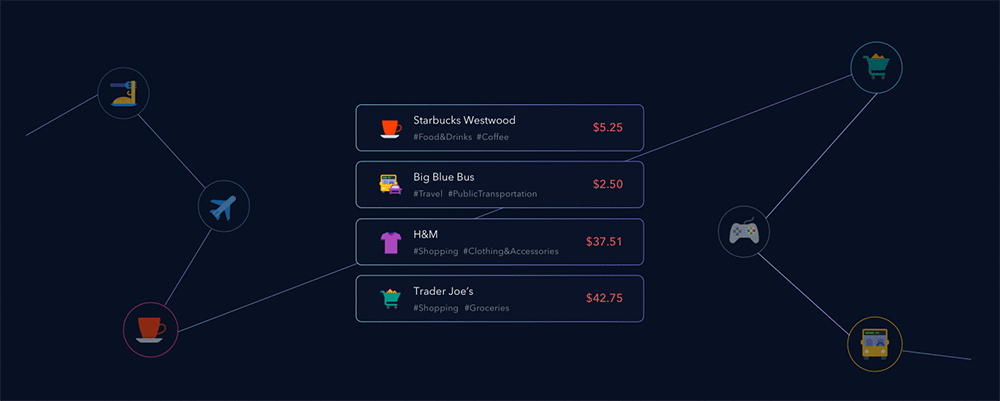
Of course, we use Amazon SageMaker to train, test, and deploy our ML models. One such model uses anonymized spending data from users that opt-in to compare their finances to similar peers—based on criteria set in their user profiles. For example: Sarah, a 21-year-old college student at UCLA, can see how her spending anonymously compares to other 21-year-old female UCLA students’ spending across different categories and merchants. This comparison provides important context for college students who are trying to better understand their own spending behavior.

Models are trained and tested in Jupyter notebooks on Amazon SageMaker, using both proprietary algorithms and the built-in algorithms that are available. We love that we can train and test ML models at scale the same way any data scientist does locally on their machine. When it comes time to deploy a model, that same data scientist can create an endpoint and provide the request and response parameters to an engineer on the team. This handoff is much more efficient than having the engineer go back and forth with the data scientist trying to understand the intricacies of the model. When revisions are needed, we point the requests (originating from the group of EC2 instances mentioned before) to the new endpoint. This allows us to have multiple endpoints live for testing in different sandbox and development environments. Moreover, when the model is revised, the engineer doesn’t need to know that anything changed, so long as the request and response parameters stayed the same. This workflow has allowed Pluto Money to iterate quickly with new datasets, an important requirement for building accurate ML models.

Since Pluto Money’s public beta launch in late 2017, we have helped tens of thousands of students across more than 1,500 college campuses save money and form better financial habits. And we are excited to continue to scale our technology with the support of AWS. Gen Z will account for 40% of U.S. consumer spending by 2020. We at Pluto Money are building the bank of the future for Gen Z—one that is radically aligned with their financial wellness more than anything else.

[P] 700x faster Node2Vec embeddings by CSR graph representation

Blog post here

Code here

I recently rewrote node2vec, which took a severely long time to generate random walks on a graph, by representing the graph as a CSR sparse matrix, and operating directly on the sparse matrix’s data arrays.

The result is a speedup from 30 hours to 3 minutes for a small sized graph (nodes and edges in the hundreds of thousands).

This raises bigger questions about graph representation for graph analytics — representing graphs as sparse matrices prevents node insertion, but makes operations much more efficient (though admitedly harder to write). More importantly, we can hold fairly huge graphs in RAM because the data usage is so lean.

If we’re analyzing graphs, we don’t care so much about adding nodes, so I think the future of graph analytics is in CSR representation.

submitted by /u/VodkaHaze
[link] [comments]

[R] Contextual Emotion Detection in Textual Conversations Using Neural Networks

Nowadays, talking to conversational agents is becoming a daily routine, and it is crucial for dialogue systems to generate responses as human-like as possible. As one of the main aspects, primary attention should be given to providing emotionally aware responses to users. In this article, we are going to describe the recurrent neural network architecture for emotion detection in textual conversations, that participated in SemEval-2019 Task 3 “EmoContext”, that is, an annual workshop on semantic evaluation. The task objective is to classify emotion (i.e. happy, sad, angry, and others) in a 3-turn conversational data set.

The rest of the article is organized as follows. Section 1 gives a brief overview of the EmoContext task and the provided data. Sections 2 and 3 focus on the texts pre-processing and word embeddings, consequently. In section 4, we described the architecture of the LSTM model used in our submission. In conclusion, the final performance of our system and the source code are presented. The model is implemented in Python using Keras library.

https://habr.com/en/company/mailru/blog/439850/

submitted by /u/pvl18
[link] [comments]

Creating magical listening experiences with BlueToad and Amazon Polly

This is a guest blog post by Paul DeHart, co-owner and CEO, BlueToad.

BlueToad, one of the leading global providers of digital content solutions, prioritizes innovation. Since 2017, we have enabled publishers (our customers) to provide audio versions of articles found in their digital magazines using Amazon Polly.

We see that novel content experiences engage today’s audience. In addition to the significant growth seen in mobile content engagement, audio has emerged as a preferred content consumption method. A 2019 Infinite Dial study found that U.S. consumers reported an average of 17 hours of listening a week. Nearly 40%+ of Americans now own smart speakers like Amazon Echo. Furthermore, the time that Americans spend commuting is on the rise and most vehicles can easily access and play audio from a mobile device. As a result, 90 million Americans said they listened to a podcast last month.

Given this trend towards audio, we at BlueToad developed a solution to help publishers easily turn any article into a listening experience using Amazon Polly. When a reader opens a digital edition on their phone, they can choose the audio icon on the story to begin listening. From a publisher perspective, this feature is simple to implement, as it only requires checking a box on the BlueToad platform. BlueToad and Amazon Polly do all the heavy lifting.

We selected Amazon Polly for this solution because of its ease of use as well as its unmatched performance. When first implementing audio solutions, we tested Amazon Polly and a few other voice services and we ultimately found that Polly was the most consistently accurate.

With Polly’s newly released Neural Text-to-Speech (NTTS) Newscaster style voice, we are able to help publishers engage their audiences with realistic listening experiences at the touch of a button. (Amazon Polly released NTTS and Newscaster speaking styles on July 30, 2019; check out the documentation.)

The diverse set of Polly voices helps our customers deliver captivating audio experiences to their audiences, including matching publications’ local languages and accents. We work with many international publications, such as Estetica Magazine, whose hair and fashion magazine publishes 26 international editions distributed in 60 different countries. To help international readers enjoy the magazine, we provide narrations in different languages using Amazon Polly, such as the French-speaking Polly voices Mathieu, Céline, and Léa.

BlueToad offers U.S.-based customer SUCCESS Magazine a wide array of valuable audio, mobile, and other solutions powered by AWS. SUCCESS Magazine’s audience is interested in personal and professional development, and the magazine aims to reach those self-starter individuals in convenient ways amid their inevitably busy lives. Amazon Polly’s voice solutions form a large part of the answer, enabling a seamlessly hands-free content consumption experience.

The owner and CEO of SUCCESS Magazine, Stuart Johnson, comments, “The trends increasingly show that consumers are gravitating towards audio content. With the exceedingly high-quality speech that Amazon Polly now offers, we’re even better equipped to deliver these exceptional listening experiences to our audience.”

We also help SUCCESS by providing a mobile-optimized experience for their written content, enabling readers to engage wherever they are. The results speak for themselves: Over three years (2016-2019), article engagement on mobile phones increased by nearly 300%.

From a technical perspective, our implementation is straightforward. Using the Amazon Polly APIs, we generate MP3 audio files as soon as a new article publishes on our platform. Then, we store the resulting files in Amazon Simple Storage Service (Amazon S3) buckets. To always maintain the best possible narration quality, we automatically discard older audio files by setting lifecycle policies on the Amazon S3 buckets, which prompts the narrations to be regenerated with the latest set of Polly updates included. We have found that the Amazon Polly listening quality is extremely high and only keeps getting better.

Going forward, we’re excited about the opportunities to continue delighting our customers and their customers with the latest advances in the media industry. Thanks to AWS and Amazon Polly, we’re already able to deliver a best-in-class solution for our customers. We’re primed to keep improving and pushing the boundaries of what’s possible.