
Blog

Learn About Our Meetup

5000+ Members

MEETUPS

LEARN, CONNECT, SHARE

Join our meetup, learn, connect, share, and get to know your Toronto AI community. 

JOB POSTINGS

INDEED POSTINGS

Browse through the latest deep learning, ai, machine learning postings from Indeed for the GTA.

CONTACT

CONNECT WITH US

Are you looking to sponsor space, be a speaker, or volunteer, feel free to give us a shout.

Author: torontoai

Anyone can learn Machine Learning with this blog, regardless of their educational background

If you want to learn Machine Learning but you’re worried you don’t have the math or the software background to master it, or you don’t know where to begin, this blog could be “one-stop shopping” for you: (it’s written in Google Colaboratory):

Why did I write this humorous, comprehensive blog? Because I have been where you are now. As a Humanities major (who once worked for “Saturday Night Live”), I suffered through two years of hell as I taught myself ML with online courses and blogs, and it was like drinking from a fire hose–too much information from too many experts with too many conflicting approaches, and my head was filled with confusion and self-doubt. Could I really learn this stuff?

IMO, today’s AI books and online courses suffer from “Expert Blindness.” Most of the experts have been experts for so long, and so deeply, that they forgot how a beginner sees the material. My blog skips no steps as I use analogies, pictures, examples and humor to break the concepts down into bite-size, user-friendly pieces, with minimal expert blindness. And every phrase has been double-checked by my mentor, who is a Stanford PhD in aerospace engineering.

It would make me happy to know I helped other folks to avoid the hell I went through. Please pass this blog on to any ML rookies, and I welcome all constructive comments to improve this as a resource for all future ML engineers!

Warmly,

David Code (yes, that really is my last name–what are the odds, right? 🙂

submitted by /u/DavidCode
[link] [comments]

[D] Can someone explain to me how in the reinforcement learning algorthim, A3C, how the multiple workers enusre they won’t retrieve the same parameters from the global network they just updated?

I understand that the multiple workers do gradient update to the global network is done asynchronously in A3C ( https://arxiv.org/abs/1602.01783 ).

But how do the workers ensure that they won’t retrieve the same parameters from the global network they just updated?

Thank you.

submitted by /u/ml4564
[link] [comments]

[D] use LSTM to predict feature from a pretrained network

Hey, I am currently working on the sequential feature prediction using LSTM (the sequential feature can be extracted by a pretrained VGG or the latent space from an autoencoder), so basically the extracted feature is considered as “ground truth”, and I am using LSTM to predict the future features.

The feature space is always not constrained to a specific interval, sometimes the values vary between [-10,50], but the tanh activation layer in LSTM will constrain the output between [-1,1] (If I understand correct?). I have also played with adding fc layer with leakyrelu or deconv layers after the LSTM layer, but the output is still in a much smaller interval, so the scale mismatch between my ground truth feature and predicted latent space make it really hard to train this model. I am wondering has anyone faced this issue before? And do you have some ideas about how to solve it?

Thanks in advance!!

submitted by /u/desperate_ano
[link] [comments]

[P] Complete Guide to Designing, Assembling, and Programming an Arduino Based Neural Network Robot (45 Minute Video)

I had a really good response to my video over at /r/learnmachinelearning (https://www.reddit.com/r/learnmachinelearning/comments/ckoy0k/want_to_build_your_own_machine_learning_robot/) so I thought I would share it here. Its a video guide that will help you build your first machine learning robot. It starts from basic breadboard prototyping all the way to PCB design, surface mount soldering, and finally programming. It uses an ARM microcontroller and an Arduino bootloader. The finished robot is designed to avoid light and a Neural Network is what controls the motors. It also fits in the palm of your hand (great for classrooms!).

https://youtu.be/wtNaPLmpy1I

I have a few more ML projects coming out over the next couple of months as well. Not as extensive as this, but I think really interesting topics.

edit: Forgot to mention its all open source, and all of the resources can be found here: https://github.com/IdleHandsProject/makennbot

submitted by /u/seanhodgins
[link] [comments]

[D] TRAINS – one month later. We got some *real* nice feedback from r/ML, here is what we did since then.

Hi Everyone,

Context: Our previous [N]ews post

Since the response was good, I thought you will have something to say about the first Medium post about TRAINS

Specifically, I am looking for more feedback and feature requests from actual or would-be users.

PS: I am aware we do not have a comparison matrix set up yet, in the meantime you can go over the feature list in the medium post, they are quite comprehensive…
PS/2: And as before, only two lines of integration code 🙂

submitted by /u/LSTMeow
[link] [comments]

[D] What exploration-exploitation strategy do you employ as a human navigating ML?

For me it seems e-greedy with a high alpha, as in reading lots of random abstracts or wikis or blogs, feels the most appropriate since I am getting a very low reward signal for my long term goals.

Has anyone put much thought into their process of acquiring new information and how deeply they need to go on a topic before they can rate its relative importance? And further, the risk of bias causing a dismissal of fruitful lines of inquiry?

The meta aspect of learning is fascinating to me and I am curious which modes of thought work best for people.

submitted by /u/AbitofAsum
[link] [comments]

Announcing two new AWS DeepLens sample projects with step-by-step instructions

We are excited to announce the launch of two new sample projects: “Build a worker safety system” and “Who drinks the most coffee?” for AWS DeepLens. These sample projects provide guided instructions on how to use computer vision to build a complete machine learning application on AWS. The applications span the edge and the cloud, integrating models running on the device with the AWS services on the cloud. The sample projects consist of step-by-step instructions, complete with code and a video tutorial for developers to build the application from scratch.

AWS DeepLens is the world’s first deep learning enabled video camera built to help developers of all skill levels to get started with deep learning. The new (2019) edition of the AWS DeepLens can now be purchased in six countries (USUKGermanyFranceSpainItaly, and Canada), and preordered in Japan. The 2019 edition is easier to set up, and (thanks to Amazon SageMaker Neo) runs machine learning models up to twice as fast as the earlier edition.

To get started with these fully guided sample projects, navigate to the AWS DeepLens management console. On the left navigation, navigate to Recipes to access the latest step-by-step tutorials. Choose a Recipe and follow the instructions provided to build the machine learning application. AWS DeepLens management console is available in Asia Pacific (Tokyo), EU (Frankfurt), and US-East (N. Virginia) Regions.
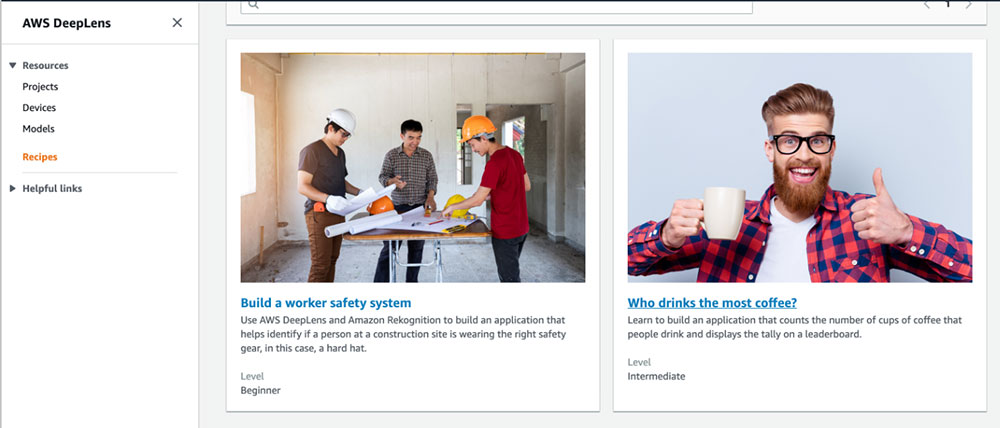
The following Recipes are available:

1) Build a worker safety system:

Use AWS DeepLens and Amazon Rekognition to build an application that helps identify if a person at a construction site is wearing the right safety gear, in this case, a hard hat. In this Recipe, developers learn to use the face detection model available on AWS DeepLens to detect a face and upload it to S3 for further processing. Developers learn to write a Lambda function that gets triggered on an S3 upload and integrates with Amazon Rekognition to detect if the person is not wearing a helmet. If no helmet is detected, the Lambda function sends a violation log to Amazon CloudWatch and alerts via AWS IoT. Developers also learn to build a web portal that shows the alert live.

2) Who drinks the most coffee?

Learn to build an application that counts the number of cups of coffee that people drink and displays the tally on a leaderboard. This Recipe uses face detection to track the number of people that drink coffee. As part of this Recipe, developers learn to write a Lambda function that gets triggered when a face is detected. Then, Amazon Rekognition is used to detect the presence of a coffee mug, and the face is added to a DynamoDB database that is maintained by (and private to) the developer. The Recipe also features a leaderboard that tracks the number of coffees over time.

If you have any questions regarding Recipes, please reach out to us on AWS DeepLens developer forum. For project inspiration, visit the AWS DeepLens Community Projects to find videos, descriptions, and links to GitHub repos.

Happy building!


About the Author

Jyothi Nookula is a Senior Product Manager for AWS DeepLens. She loves to build products that delight her customers. In her spare time, she loves to paint and host charity fund raisers for her art exhibitions.