Blog

Learn About Our Meetup

5000+ Members

MEETUPS

LEARN, CONNECT, SHARE

Join our meetup, learn, connect, share, and get to know your Toronto AI community. 

JOB POSTINGS

INDEED POSTINGS

Browse through the latest deep learning, ai, machine learning postings from Indeed for the GTA.

CONTACT

CONNECT WITH US

Are you looking to sponsor space, be a speaker, or volunteer, feel free to give us a shout.

Author: torontoai

[D] Interviewing as researcher with big tech companies

Hi all,

I have a couple of interviews coming up for research scientist roles with FAANG-like companies and since it’s my first time going through this process (finishing grad school, never applied to industry positions before) I was wondering how the interviews are conducted and what they look at the most. I can find tons of information on the recruitment process for SWE at big N companies, and how you have to grind leetcode for months to pass the coding bar, but not much info on the more research oriented roles. Do they have the same bar for coding? Do they put more emphasis on your performance during the ML and design interviews? What “signal” do they look for, presumably outside of your research portfolio, which they’d know already by the time you come for an onsite?

Finally, in case anyone here works at a the research groups in major tech companies, what’s been in your experience the interview:offer ratio, is it as bad as for developer roles (I read that for Google it is about 1:7)? I would imagine that for research roles, it is easier to see if there is a good fit on data outside of algo&ds / design interview performance, like research interests and publication record, but maybe I am naive.

Sorry for the many questions, just a scared grad student trying to understand what his chances are 😀

Thanks.

submitted by /u/urhen1512
[link] [comments]

[D] What if AlphaZero search was restricted to human level?

In the Alphazero blog post, there is a graphic comparing the amount of search per decision between grand-master humans, Alphazero and traditional chess engines. Alphazero is in the middle. At first glance, the implication seems to be that humans are still better at “intuitive” play than Alphazero. But then again, Alphazero is significantly stronger than any human player, and so I wonder how well Alphazero would perform if restricted to the same amount of search as a human player.

There is a plot in the AlphaGo Zero nature paper that shows that the raw network on Go with no search has an elo of 3000, almost as high as AlphaGo Fan. That seems to indicate that AlphaZero with the same amount of search as a human player might already be super-human. Especially since I suspect that there might be diminishing returns to search.

Am I missing anything? Might AlphaZero have beaten humans at “intuitive” chess as well?

submitted by /u/samuelknoche
[link] [comments]

[D] How to load subset of large Oracle table into Dask dataframe?

Here’s what I tried:

dask_rf = dd.from_pandas(pd.read_sql('select ...)', conn_cx_Oracle), npartitions = 10) 

This gives me a ‘large object’ warning and recommends using client.scatter. Problem is that it appears that client.scatter requires data to be loaded into a Pandas dataframe first, which is why I’m using Dask in the first place because of RAM limitations.

The Oracle table is too large to read using Dask’s read_sql_table because read_sql_table does not filter the table in any way.

Ideas? Dask not applicable to my use case?

submitted by /u/Professionalsimracin
[link] [comments]

[P] NLP Problem

Hi all, I am a beginner stage ML practitioner. I need help.

I have a large dataset of free text for work orders for a power plant. I need to identify the cause, symptom and damage by these work order data. I do have the list of causes, symptoms and damage which is to be used to classify each work order. The issue is I do not have a labelled data set so I have to take the unsupervised approach. But I am not getting useful results.

Could you help me with approaches I can work on to get better results.

Thanks.

submitted by /u/raesharma
[link] [comments]

[N] Awesome Artificial Intelligence Research and Projects on Computer Vision News (with codes!) August 2019

[N] Awesome Artificial Intelligence Research and Projects on Computer Vision News (with codes!) August 2019

The August issue of Computer Vision News: 38 pages about AI and Deep Learning through both research and practical applications.

Newly improved graphics for easier reading. Don’t miss the review of the new Google Research paper and the interview with Julia Elliott, the leader of the competitions team at Kaggle.

HTML5 version (recommended)

PDF version

Subscribe for free on page 38.

https://i.redd.it/mjt15zb4k7g31.jpg

submitted by /u/Gletta
[link] [comments]

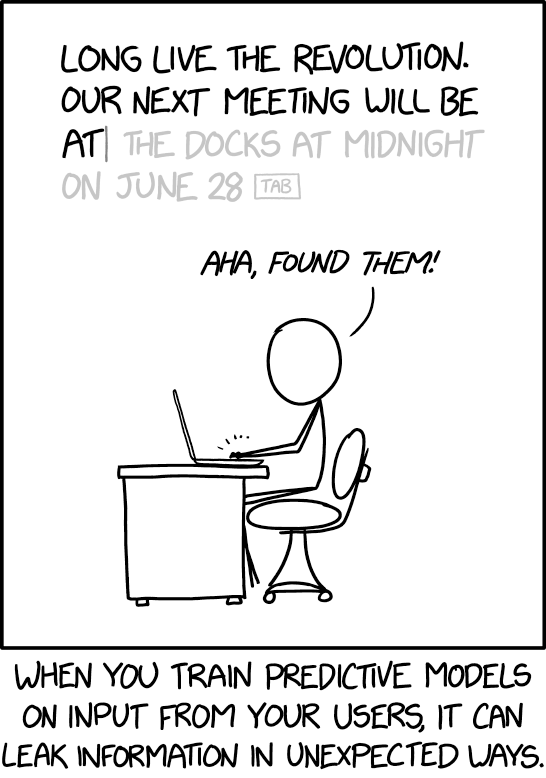
Evaluating and Testing Unintended Memorization in Neural Networks

It is important whenever designing new technologies to ask “how will this
affect people’s privacy?” This topic is especially important with regard to
machine learning, where machine learning models are often trained on sensitive
user data and then released to the public. For example, in the last few years
we have seen models trained on users’ private emails, text
messages
,
and medical records.

This article covers two aspects of our upcoming USENIX Security
paper that investigates to what extent
neural networks memorize rare and unique aspects of their training data.

Specifically, we quantitatively study to what extent following
problem
actually occurs in practice:

Continue reading

[D] python – how can I solve gradient divergence problem?

[D] python - how can I solve gradient divergence problem?

here is my code

for _ in range(10): K.clear_session() model = Sequential() model.add(LSTM(256, input_shape=(None, 1))) model.add(Dropout(0.2)) model.add(Dense(256)) model.add(Dropout(0.2)) model.add(Dense(1)) model.compile(loss='mean_squared_error', optimizer='adam', metrics=['accuracy']) hist = model.fit(x_train, y_train, epochs=20, batch_size=64, verbose=0, validation_data=(x_val, y_val)) p = model.predict(x_test) print(mean_squared_error(y_test, p)) plt.plot(y_test) plt.plot(p) plt.legend(['testY', 'p'], loc='upper right') plt.show() 

dataset is stock time series

`Total params` : 330,241

`samples` : 2264

just same code for loop ten times

and below is the result

https://i.redd.it/jngtf9xx47g31.png

I haven’t changed anything.

I only ran for loop.

But the MSE difference in the results is very large.

I think the reason for this the weights are initialized randomly;

So, I increased the size of epochs and batch_size, but the gradient divergence problem was not solved.

I wonder how we should solve this problem.

Your valuable opinions and thoughts will be very much appreciated.

if you want to see full source here is link https://gist.github.com/Lay4U/e1fc7d036356575f4d0799cdcebed90e

submitted by /u/GoBacksIn
[link] [comments]

[D] RNN for time varying covariates

Hi reddit,

I am currently working on a problem and I would like to ask for your advice on the best way to handle it.

So, the goal here is to predict the time of resolution of what we will call “incidents”. Namely, an incident is like an issue that is opened and needs to be fixed. The status of an incident varies with time – for instance, comments may be added or the priority may change from “Not important” to “Critical”.

My dataset looks like this : a row corresponds to the status of an incident at a given time. A single incident, identified by its ID, is then made of several rows. Some features do not change while others change every time there is a modification (see table below).

id var1 var2
1 a NaN
1 a x
1 b x

The idea would be to be able to give a prediction at any time in the life of an incident. I would like to make use of this sequential form to use recurrent neural networks, but I don’t know how to do it exactly.

There is a new row every time there is a change in status. So this means that the time between first and second row might be a day while the time between second and third row might be a week or a month.

I was thinking of treating the problem as a NLP problem, i.e. for a single ID, each row corresponds to one word (the embedded word). This would mean that the input to the RNN would be something like x = [x1, x2, …, xN] where xi = [xi1, …, xiM] a row of the dataset.

Would that make sense, and if not, how would you proceed ?

Thank you and have a nice day.

submitted by /u/lazywiing
[link] [comments]

[P] Integrating Human and Machine Intelligence for efficient and fast annotations

Title: Active Annotation: bootstrapping annotation lexicon and guidelines for supervised NLU learning

Abstract: Natural Language Understanding (NLU) models are typically trained in a supervised learning framework. In the case of intent classification, the predicted labels are predefined and based on the designed annotation schema while the labelling process is based on a laborious task where annotators manually inspect each utterance and assign the corresponding label. We propose an Active Annotation (AA) approach where we combine an unsupervised learning method in the embedding space, a human-in-the-loop verification process, and linguistic insights to create lexicons that can be open categories and adapted over time. In particular, annotators define the y-label space on-the-fly during the annotation using an iterative process and without the need for prior knowledge about the input data. We evaluate the proposed annotation paradigm in a real use-case NLU scenario. Results show that our Active Annotation paradigm achieves accurate and higher quality training data, with an annotation speed of an order of magnitude higher with respect to the traditional human-only driven baseline annotation methodology.

Link: https://arxiv.org/abs/1908.04092

submitted by /u/feedmari
[link] [comments]

[P] Handout: A potential alternative to Jupyter Notebooks

This is not my project, but I think it’s great and it hasn’t been shared here yet.

Introducing Handout

“Turn Python scripts into handouts with Markdown comments and inline figures. An alternative to Jupyter notebooks without hidden state that supports any text editor.”

In a sense this is the best of both worlds, as you get the visual benefits of notebooks while having your code run as scripts and make it much easier to reproduce results.

It would be interesting to hear from those that love their notebooks if a tool like this can be a real alternative? If not, why not?

submitted by /u/PhYsIcS-GUY227
[link] [comments]