
Blog

Learn About Our Meetup

5000+ Members

MEETUPS

LEARN, CONNECT, SHARE

Join our meetup, learn, connect, share, and get to know your Toronto AI community. 

JOB POSTINGS

INDEED POSTINGS

Browse through the latest deep learning, ai, machine learning postings from Indeed for the GTA.

CONTACT

CONNECT WITH US

Are you looking to sponsor space, be a speaker, or volunteer, feel free to give us a shout.

Author: torontoai

AI Goes to Washington: Top 5 Things to See at GTC DC

The center of the AI ecosystem shifts to D.C. this fall, when the GPU Technology Conference arrives at the Reagan Center in Washington, from Nov. 4-6.

GTC DC will bring together some 3,000 attendees from government and industry for three days of networking and more than 100 sessions, including presentations, panel talks and workshops focused on implementing AI in government and business.

Here are five of the top reasons to attend:

Keynote

Ian Buck, vice president of accelerated computing at NVIDIA, will be giving this year’s keynote at GTC DC.

This is a rare chance to receive concrete advice on how organizations can use AI to boost competitiveness and improve services from the man who invented CUDA, the world’s leading platform for accelerated parallel computing.

Buck has devoted his career to helping many of the world’s leading organizations accelerate critical compute workloads. He’s testified before Congress on AI and advised the White House.

100+ Sessions

Leading thinkers from the White House Office of Science and Technology, National Institute of Standards and Technology, NASA Langley Research Center, the Pacific Northwest National Laboratory and more will be discussing their technology and the future of AI in a series of over 100 sessions.

With a heavy focus on autonomous machines, cybersecurity and disaster relief, there will be panels on “The National AI Strategy: What’s Happening, What to Expect and How to Engage” and “AI and Cybersecurity: Opportunities and Threats to Businesses, Government and Individuals,” among others.

A few of the confirmed speakers include:

  • Suzette Kent, U.S. chief information officer — U.S. Office of Management and Budget
  • Lynne E. Parker, assistant director for AI — White House Office of Science and Technology Policy
  • Gregg Cohen, CTO and staff scientist — National Institutes of Health
  • Elham Tabassi, chief of staff in the Information Technology Laboratory — National Institute of Standards and Technology
  • Kimberly Powell, vice president of healthcare — NVIDIA
  • Sertac Karaman, associate professor of aeronautics and astronautics — MIT
  • John Ferguson, CEO — Deepwave Digital
  • Joshua Patterson, director of AI infrastructure — NVIDIA
  • Moira Bergin, subcommittee director — U.S. House of Representatives Committee on Homeland Security

Exhibits

GTC DC won’t be all talk and no action, though — attendees will have access to demos of the latest innovations in AI. Over 50 companies will be exhibiting their technology in AI, robotics and high performance computing, including Booz Allen Hamilton, Lockheed Martin and Dell.
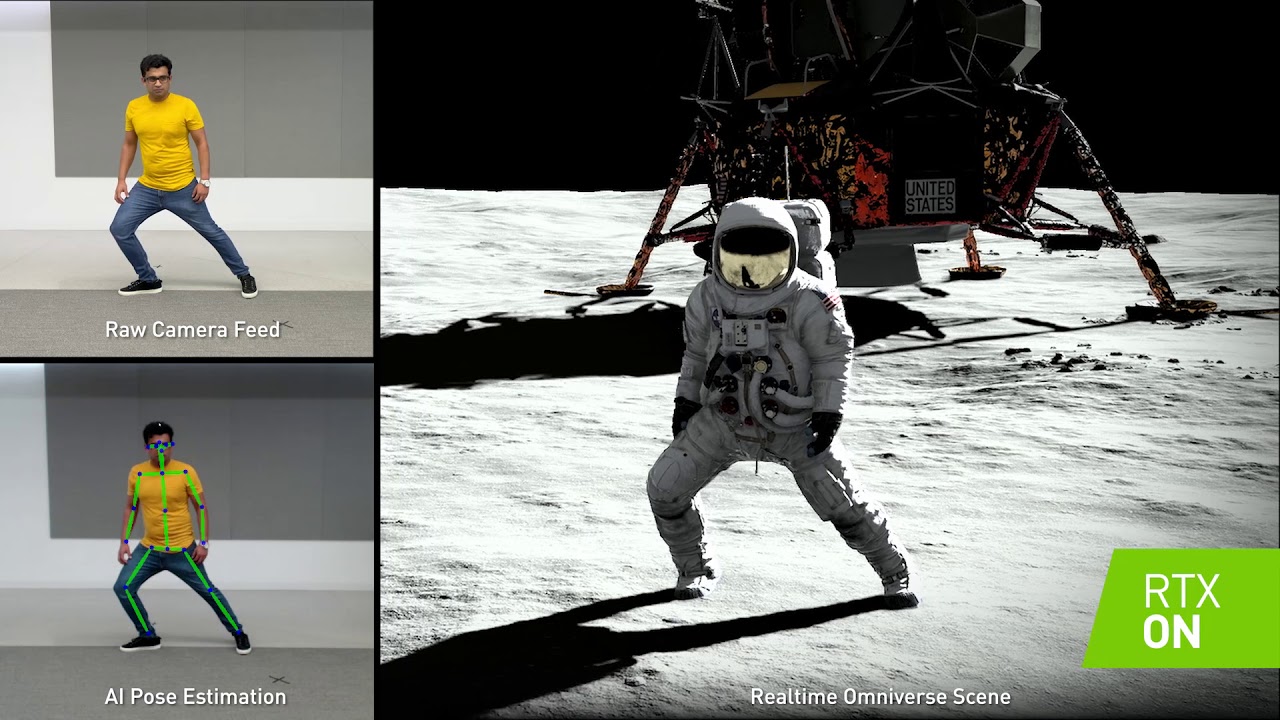
NVIDIA will demonstrate its RTX-powered lunar landing demo, which stole the show at SIGGRAPH earlier this year.

A celebration of the Apollo 11 moon landing, the demo uses a single camera to capture a participant’s movement and match it using AI pose estimation technology to a 3D-rendered astronaut in real time.
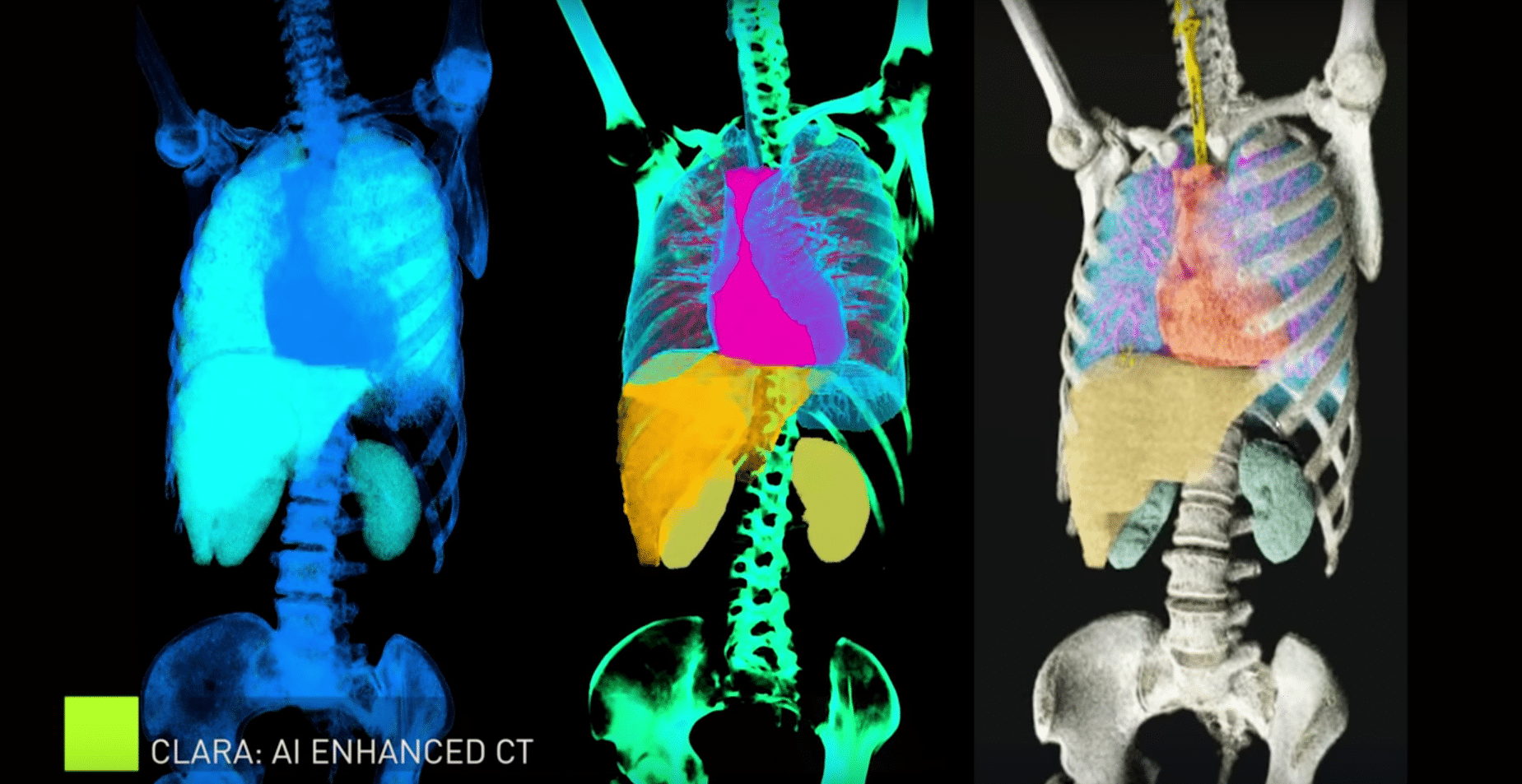
Also in the spotlight will be NVIDIA Clara AI, in a demo called “Enhancing Radiology with Cinematic Rendering and AI.” Clara uses NVIDIA GPUs and AI to enable views of the body that traditional medical imaging techniques cannot produce. These cinematic 3D renderings of medical images can transform the way we diagnose and recommend treatment.

Training

GTC DC is offering both AI beginners and experts the chance to work on their skills with seven day-long NVIDIA Deep Learning Institute workshops that will take place on Nov. 4. Led by certified DLI instructors, participants can earn a certificate of competency by completing the built-in assessment at the end of each session. Workshops include: “Getting Started with AI on Jetson Nano,” “Deep Learning for Intelligent Video Analytics” and “Deep Learning for Healthcare Image Analysis.”

There will also be dozens of two-hour hands-on training sessions throughout GTC DC. Instructors will train participants in the application of data science and accelerated computing to address the most difficult governmental and industrial challenges. Popular sessions available for registration are “Accelerating Data Science Workflows with RAPIDS” and “Introduction to CUDA Python with Numba.”

Networking

For many, the biggest benefit of GTC DC is being able to talk with a unique cross-section of technical experts, elected representatives, agency and department heads, staffers, corporate executives and academic leaders.

Attendees can engage with representatives from the White House, Department of Energy, Oak Ridge National Laboratory, Microsoft, Carnegie Mellon University, Amazon Web Services and many others in government, research and business.

The conference also hosts an annual Women in AI breakfast, bringing together women speakers from a variety of industries and research fields.

After hours, evening receptions offer attendees the chance to continue networking.

To see all of this and more, come join us at GTC DC from Nov. 4 to Nov. 6.

The post AI Goes to Washington: Top 5 Things to See at GTC DC appeared first on The Official NVIDIA Blog.

[D] Looking for an advice about Human Activity Recognition.

Hi r/MachineLearning. I hope this post is welcomed here because I couldn’t think of another better place and I really believe that you guys can help me. In the coming year I will start writing my dissertation. The topic I’m interested in is about Human Activity Recognition. I talked with my advisor professor and we agreed about two approaches:

  1. Research oriented. For example coming with different architectures, see what kind of videos are hard for current state of the art methods, etc. From what I saw the datasets are quite big and the current neural networks require few weeks to train and I don’t have access to such computational power. And here comes my first question: given this situation, what are the things you think that I should focus on if I want to go on this route?
  2. Doing something practical. For example to recognize the fine-grained actions from a specific sport/activity and to do something with them. The problem here is that there are not too many datasets, and I thought that maybe you know some interesting datasets regarding this aspect.

I have to mention that I personally prefer the first option, but I’m open to suggestions.

Thanks for the help and sorry if I posted in the wrong place.

submitted by /u/IonutCalofir
[link] [comments]

[P] Stylegan Music Video

We made a music video using NVIDIA’s styleGAN. You can check it out here: https://youtu.be/bCJXnRFGoSE .

Methodology

We first produced a mel-scaled spectrogram for the piece of music. We tweaked the arguments such that each time-step of the spectrogram corresponds to 16.7ms (duration of a frame @60fps). The frequency dimension of the spectrogram is scaled to match styleGAN’s input dimension.

Then we explored a pre-trained (on faces) styleGAN’s input space for interesting output images. The way we performed the exploration was to compute the gradient of the mean squared error between styleGAN’s output image and a real image (which we had chosen), with respect to a random input. Then with steps of gradient descent we search for inputs which produce outputs similar to our real image. We wanted “non-realistic, creepy faces”, which we got by using extreme hyper-parameters in this exploration phase, by swapping the colors of the output and by carefully choosing the custom target image. For each generated image we also saved the input vector (512 dimensional) which lead to it.

Finally, we made a large spreadsheet in which each row is a beat of the song (175 bpm for most parts). We assigned various generated images we liked at different parts of the song (usually at intervals 4 beats). We turned this spreadsheet into a large input array of dimensions equal to the mel-scaled spectrogram, by linearly interpolating between the pre-chosen generated images at the intervals dictated by the spreadsheet. We add this input matrix to the spectrogram with some weights and feed it to the pre-trained styleGAN. The outputs are the frames of the video.

(For the first few seconds of the song we also used some real footage which we morphed with generated faces)

Discussion

Throughout the project we felt that there must be a better way to do targeted searches of the input space. For styleGAN there is some interpretability to each dimension of the input, however we found it hard to make use of this, especially when the target image was not strictly a face (a skull for example). What are other ways in which we can answer the question “what inputs of this (differentiable) black box lead to a desired output?”

submitted by /u/kinezodin
[link] [comments]

[R] Enriching BERT with Knowledge Graph Embeddings for Document Classification

In this paper, we focus on the classification of books using short descriptive texts (cover blurbs) and additional metadata. Building upon BERT, a deep neural language model, we demonstrate how to combine text representations with metadata and knowledge graph embeddings, which encode author information. Compared to the standard BERT approach we achieve considerably better results for the classification task. For a more coarse-grained classification using eight labels we achieve an F1- score of 87.20, while a detailed classification using 343 labels yields an F1-score of 64.70. We make the source code and trained models of our experiments publicly available.

Paper: https://arxiv.org/abs/1909.08402

Code: https://github.com/malteos/pytorch-bert-document-classification

submitted by /u/muwnd
[link] [comments]

[N] Google starts AI research lab in Bangalore, India

Google Research India will be led by Manish Gupta, a renowned computer scientist and ACM Fellow with a background in deep learning across video analysis and education, compilers and computer systems. We’re also excited to have Professor Milind Tambe join us on a joint appointment from Harvard University as Director of AI for Social Good. Professor Tambe will build a research program around applying AI to tackle big problems in areas like healthcare, agriculture, or education.

The lab in Bangalore will be part of and support Google’s global network of researchers: participating in conferences, publishing research in scientific papers, and collaborating closely with one another. We’re also exploring the potential for partnering with India’s scientific research community and academic institutions to help train top talent and support collaborative programs, tools and resources.

https://blog.google/around-the-globe/google-asia/google-research-india-ai-lab-bangalore/

submitted by /u/hardmaru
[link] [comments]

A Deep Learning Approach to Data Compression

We introduce Bit-Swap, a scalable and effective lossless data compression
technique based on deep learning. It extends previous work on practical
compression with latent variable models, based on bits-back coding and
asymmetric numeral systems. In our experiments Bit-Swap is able to beat
benchmark compressors on a highly diverse collection of images. We’re releasing
code for the method and optimized models such that people can explore and
advance this line of modern compression ideas. We also release a demo and
a pre-trained model for Bit-Swap image compression and decompression on your
own image. See the end of the post for a talk that covers how bits-back coding
and Bit-Swap works.

Continue reading

[P] How we made landmark recognition in Cloud Mail.ru, and why

With the advent of mobile phones with high-quality cameras, we started making more and more pictures and videos of bright and memorable moments in our lives. Many of us have photo archives that extend back over decades and comprise thousands of pictures which makes them increasingly difficult to navigate through.

For this purpose, we at Mail.ru Computer Vision Team have created and implemented systems for smart image processing, including landmark recognition. Photos with landmarks are essential because they often capture highlights of our lives (journeys, for example). These can be pictures with some architecture or wilderness in the background. This is why we seek to locate such images using Deep Learning, and make them readily available to users.

https://medium.com/@andrei.boiarov/how-we-made-landmark-recognition-in-cloud-mail-ru-and-why-715b5f72e6d4

submitted by /u/pvl18
[link] [comments]

[D] Neural Architecture Search

Recently, Neural Architecture Search is coming back to the research spotlight. Elsken et al. published a survey on this topic (https://arxiv.org/pdf/1808.05377.pdf ) but the development is fast and many new works are emerging. For example, there is Weight Agnostic Neural Network (WANN) https://arxiv.org/abs/1906.04358 that demonstrates that Neural Architectures can be more significant than the weights of the network. You can read of the list of paper in this topic at https://www.automl.org/automl/literature-on-neural-architecture-search/ . Nevertheless, this type of topic is already researched in 1990 ( https://pdfs.semanticscholar.org/2118/55f1de279c452858177331860cbc326351ab.pdf ), are there still significance in improvement? If so, how much?

Are researchers just making up new Neural Architecture Search methods for publication, or is there really a big difference? Are there any work that focused on a detailed comparison for Neural Architecture Search.

submitted by /u/RTengx
[link] [comments]