Author: torontoai
[D] Using deep learning models and advanced sports statistics to predict daily fantasy football scores for my capstone project
Hello again. Like I mentioned in another post I’m currently working on my capstone project proposal and I was interesting in researching deep learning models and do something about that. I appreciate the feedback I got regarding the stock price prediction proposal and in fact I got more or less the same feedback from my teachers.
I came up with the following project proposal and I was wondering if you can give me any further feedback about it, since my teachers have been stonewalling me on this matter: I want to use advanced sports statistics (basically FootballOutsiders’ statistics) along with traditional statistics and RNN to predict how many fantasy football points each player is going to score for a given week. I’m focusing on daily fantasy football since it’s easier to do without great point fluctuations that I would get trying to predict their season-long performance (due to injury, scheme change, coaching changes, etc). Then I would apply an optimization algorithm to come up with an optimal team that meets the salary cap constraint that most DFF competitions have.
I’ve researched a bit and didn’t find many studies dealing with this subject, and those that did focused on more basic models like linear regression.
Do you think it’s a worthwhile subject to work on?
Thank you
submitted by /u/BL7599
[link] [comments]
[News] Free GPUs for ML/DL Projects
Hey all,
Just wanted to share this awesome resource for anyone learning or working with machine learning or deep learning. Gradient Community Notebooks from Paperspace offers a free GPU you can use for ML/DL projects with Jupyter notebooks. With containers that come with everything pre-installed (like fast.ai, PyTorch, TensorFlow, and Keras), this is basically the lowest barrier to entry in addition to being totally free.
They also have an ML Showcase where you can use runnable templates of different ML projects and models. I hope this can help someone out with their projects 🙂
Comment
submitted by /u/nevereallybored
[link] [comments]
[D] How should I format my cover letter for Google AI Residency Program 2020?
Hi,
I am an undergrad student at Tier 1 college in India, with a major in Material Science. I want to apply for this year’s residency program and was wondering how should I write my cover letter, since I think that being from a non-CS major can be harmful for my application. I do research experience though, and have authored 2 papers, 1 submitted to a journal and the other accepted as NeurIPS workshop paper.
I was also wondering which location to apply for, like MV, Seattle, Cambridge or NYC! Or is it, that I apply for 1 location and it is automatically considered for all the locations?
Thanks!
submitted by /u/sinashish
[link] [comments]
[D] How to , concretly, measure a model’s robustness against adversarial/perturbations examples? … I mean concretly.
We know that we can measure a model’s robustness to perturbation by applying perturbation to training points and checking if the outputs are the same:
The
lpball around an image is said to be the adversarial ball, and a network is said to beE-robustaroundxif every point in the adversarial ball aroundxclassifies the same. source, Part 3
But how is this done concretely?
submitted by /u/data-soup
[link] [comments]
[D] What does it mean for a machine to “understand”? (by @tdietterich)
An excerpt from Thomas Dietterich’s recent blog post:
In order for a system to understand, it must create linkages between different concepts, states, and actions. Today’s language translation systems correctly link “water” in English to “agua” in Spanish, but they don’t have any links between “water” and “electric shock”.
Much of the criticism of the latest AI advances stems from two sources. First, the hype surrounding AI (generated by researchers, the organizations they work for, and even governments and funding agencies) has reached extreme levels. It has even engendered fear that “superintelligence” or the “robot apocalypse” is imminent. Criticism is essential for countering this nonsense.
Second, criticism is part of the ongoing debate about future research directions in artificial intelligence research and to allocation of government funding. On the one side are the advocates of connectionism who developed deep learning and who support continuing that line of research. On the other side are the advocates of AI methods based on the construction and manipulation of symbols (e.g., using formal logic). There is also a growing community arguing for systems that combine both approaches in a hybrid architecture. Criticism is also essential for this discussion, because the AI community must continually challenge our assumptions and choose how to invest society’s time and money in advancing AI science and technology. However, I object to the argument that says “Today’s deep learning-based systems don’t exhibit genuine understanding, and therefore deep learning should be abandoned”. This argument is just as faulty as the argument that says “Today’s deep learning-based systems have achieved great advances, and pursuing them further will `solve intelligence’.” I like the analysis by Lakatos (1978) that research programmes tend to be pursued until they cease to be fruitful. I think we should continue to pursue the connectionist programme, the symbolic representationalist programme, and the emerging hybrid programmes, because they all continue to be very fruitful.
Criticism of deep learning is already leading to new directions. In particular, the demonstration that deep learning systems can match human performance on various benchmark tasks and yet fail to generalize to superficially very similar tasks has produced a crisis in machine learning (in the sense of Kuhn, 1962). Researchers are responding with new ideas such as learning invariants (Arjovsky, et al., 2019; Vapnik & Ismailov, 2019) and discovering causal models (Peters, et al., 2017). These ideas are applicable to both symbolic and connectionist machine learning.
submitted by /u/milaworld
[link] [comments]
Look then Listen: Pre-Learning Environment Representations for Data-Efficient Neural Instruction Following
When learning to follow natural language instructions, neural networks tend to
be very data hungry – they require a huge number of examples pairing language
with actions in order to learn effectively. This post is about reducing those
heavy data requirements by first watching actions in the environment before
moving on to learning from language data. Inspired by the idea that it is
easier to map language to meanings that have already been formed, we introduce
a semi-supervised approach that aims to separate the formation of abstractions
from the learning of language. Empirically, we find that pre-learning of
patterns in the environment can help us learn grounded language with much less
data.
Before we dive into the details, let’s look at an example to see why neural
networks struggle to learn from smaller amounts of data. For now, we’ll use
examples from the SHRDLURN block stacking task, but later we’ll look at
results on another environment.
Let’s put ourselves in the shoes of a model that is learning to follow
instructions. Suppose we are given the single training example below, which
pairs a language command with an action in the environment:

This example tells us that if we are in state (a) and are trying to follow the
instruction (b), the correct output for our model is the state (c). Before
learning, the model doesn’t know anything about language, so we must rely on
examples like the one shown to figure out the meaning of the words. After
learning, we will be given new environment states and new instructions, and the
model’s job is to choose the correct output states from executing the
instructions. First let’s consider a simple case where we get the exact same
language, but the environment state is different, like the one shown here:

On this new state, the model has many different possible outputs that it could
consider. Here are just a few:
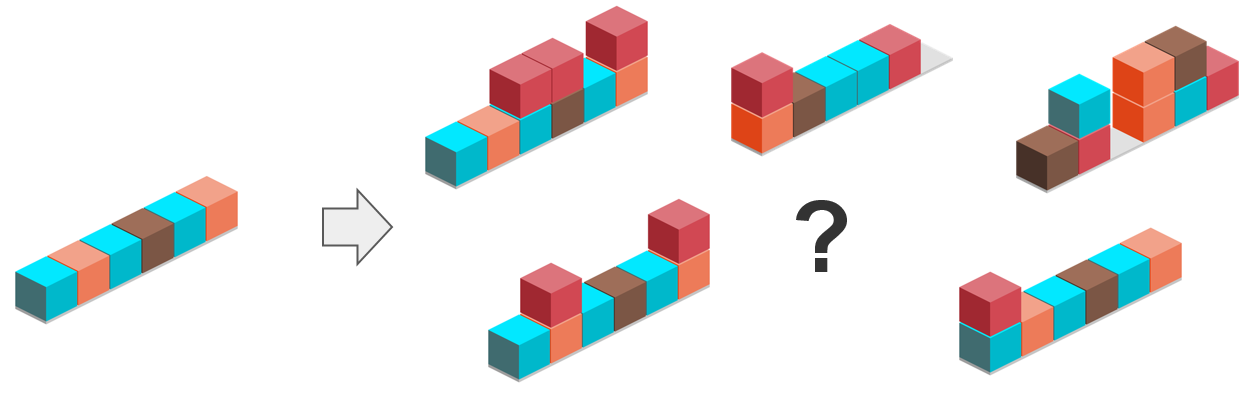
Some of these outputs seem reasonable to a human, like stacking red blocks on
orange blocks or stacking red blocks on the left, but others are kind of
strange, like generating a completely unrelated configuration of blocks. To a
neural network with no prior knowledge, however, all of these options look
plausible.
A human learning a new language might approach this task by reasoning about
possible meanings of the language that are consistent with the given example
and choosing states that correspond to those meanings. The set of possible
meanings to consider comes from prior knowledge about what types of things
might happen in an environment and how we can talk about them. In this
context, a meaning is an abstract transformation that we can apply to states to
get new states. For example, if someone saw the training instance above paired
with language they didn’t understand, they might focus on two possible meanings
for the instruction: it could be telling us to stack red blocks on orange
blocks, or it could be telling us to stack a red block on the leftmost
position.

Although we don’t know which of these two options is correct – both are
plausible given the evidence – we now have many fewer options and might easily
distinguish between them with just one or two more related examples. Having a
set of pre-formed meanings makes learning easier because the meanings constrain
the space of possible outputs that must be considered.
In fact, pre-formed meanings do even more than just restricting the number of
choices, because once we have chosen a meaning to pair with the language, it
specifies the correct way to generalize across a wide variety of different
initial environment states. For example, consider the following transitions:

If we know in advance that all of these transitions belong together in a single
semantic group (adding a red block on the left), learning language becomes
easier because we can map to the group instead of the individual transitions.
An end-to-end network that doesn’t start with any grouping of transitions has a
much harder time because it has to learn the correct way to generalize across
initial states. One approach used by a long line of past work has been to
provide the learner with a manually defined set of abstractions called logical
forms. In contrast, we take a more data-driven approach where we learn
abstractions from unsupervised (language-free) data instead.
In this work, we help a neural network learn language with fewer examples by
first learning abstractions from language-free observations of actions in an
environment. The idea here is that if the model sees lots of actions happening
in an environment, perhaps it can pick up on patterns in what tends to be done,
and these patterns might give hints at what abstractions are useful. Our
pre-learned abstractions can make language learning easier by constraining the
space of outputs we need to consider and guiding generalization across
different environment states.
We break up learning into two phases: an environment learning phase where our
agent builds abstractions from language-free observation of the environment,
and a language learning phase where natural language instructions are mapped to
the pre-learned abstractions. The motivation for this setup is that
language-free observations of the environment are often easier to get than
interactions paired with language, so we should use the cheaper unlabeled data
to help us learn with less language data. For example, a virtual assistant
could learn with data from regular smartphone use, or in the longer term robots
might be able to learn by watching humans naturally interact with the world.
In the environments we are using in this post, we don’t have a natural source
of unlabeled observations, so we generate the environment data synthetically.
Method
Now we’re ready to dive into our method. We’ll start with the environment
learning phase, where we will learn abstractions by observing an agent, such as
a human, acting in the environment. Our approach during this phase will be to
create a type of autoencoder of the state transitions (actions) that we see,
shown below:
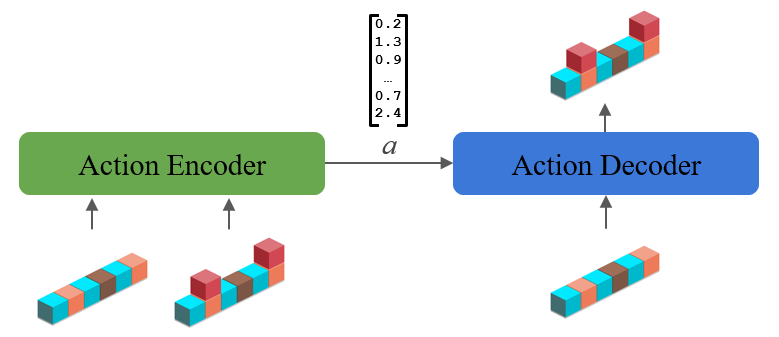
The encoder takes in the states before and after the transition and computes a
representation of the transition itself. The decoder takes that transition
representation from the encoder and must use it to recreate the final state
from the initial one. The encoder and decoder architectures will be task
specific, but use generic components such as convolutions or LSTMs. For
example, in the block stacking task states are represented as a grid and we use
a convolutional architecture. We train using a standard cross-entropy loss on
the decoder’s output state, and after training we will use the representation
passed between the encoder and decoder as our learned abstraction.
One thing that this autoencoder will learn is which type of transitions tend to
happen, because the model will learn to only output transitions like the ones
it sees during training. In addition, this model will learn to group
different transitions. This grouping happens because the representation
between the encoder and decoder acts as an information bottleneck, and its
limited capacity forces the model to reuse the same representation vector for
multiple different transitions. We find that often the groupings it chooses
tend to be semantically meaningful because representations that align with the
semantics of the environment tend to be the most compact.
After environment learning pre-training, we are ready to move on to learning
language. For the language learning phase, we will start with the decoder that
we pre-trained during environment learning (“action decoder” in the figures
above and below). The decoder maps from our learned representation space to
particular state outputs. To learn language, we now just need to introduce a
language encoder module that maps from language into the representation space
and train it by backpropagating through the decoder. The model structure is
shown in the figure below.
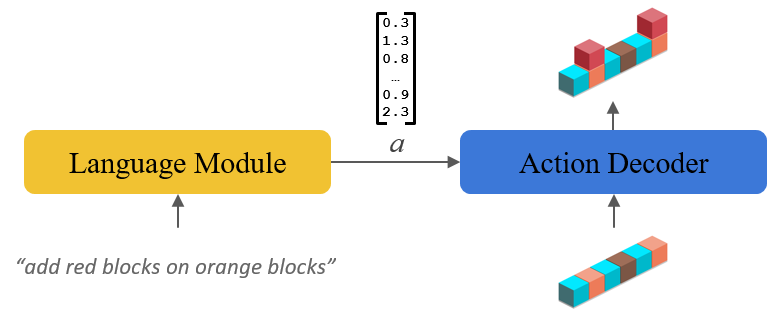
The model in this phase looks a lot like other encoder-decoder models used
previously for instruction following tasks, but now the pre-trained decoder can
constrain the output and help control generalization.
Results
Now let’s look at some results. We’ll compare our method to an end-to-end
neural model, which has an identical neural architecture to our ultimate
language learning model but without any environment learning pre-training of
the decoder. First we test on the SHURDLURN block stacking task, a task
that is especially challenging for neural models because it requires learning
with just tens of examples. A baseline neural model gets an accuracy of 18% on
the task, but with our environment learning pre-training, the model reaches
28%, an improvement of ten absolute percentage points.
We also tested our method on a string manipulation task where we learn to
execute instructions like “insert the letters vw after every vowel” on a string
of characters. The chart below shows accuracy as we vary the amount of data
for both the baseline end-to-end model and the model with our pre-training
procedure.
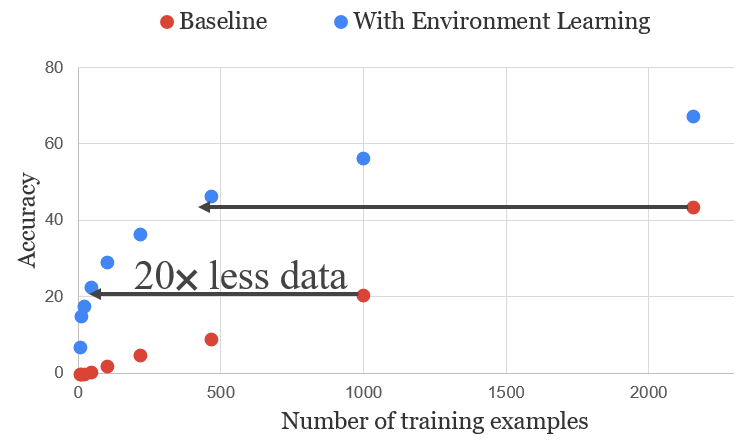
As shown above, using our pre-training method leads to much more data-efficient
language learning compared to learning from scratch. By pre-learning
abstractions from the environment, our method increases data efficiency by more
than an order of magnitude. To learn more about our method, including some
additional performance-improving tricks and an analysis of what pre-training
learns, check out our paper from ACL 2019:
https://arxiv.org/abs/1907.09671.
[D] Which advances in deep learning is actually inspired by biology?
I work in a research department where one of my seniors are authoring a position paper on trustworthy AI, and we came into a discussion regarding the phrase “…understanding the theoretical basis for (human) intelligence has gone hand in hand with improvements in the capabilities of real systems.” Even though it was referenced to Russel and Norvigs book, I think the statement is misleading and a bit sensationalist, as more or less none of the recent advances in deep learning I can think of are inspired by neuroscience. In fact, the two seems more detached now than ever.
I’ve tried searching for good papers to back my claim on this, but I have not been able to find any. Am I wrong? Are there any good material on the subject of the connection between applied AI and the theory of human intelligence?
submitted by /u/Morteriag
[link] [comments]
[R] Recent advances in physical reservoir computing: A review
Abstract
Reservoir computing is a computational framework suited for temporal/sequential data processing. It is derived from several recurrent neural network models, including echo state networks and liquid state machines. A reservoir computing system consists of a reservoir for mapping inputs into a high-dimensional space and a readout for pattern analysis from the high-dimensional states in the reservoir. The reservoir is fixed and only the readout is trained with a simple method such as linear regression and classification. Thus, the major advantage of reservoir computing compared to other recurrent neural networks is fast learning, resulting in low training cost. Another advantage is that the reservoir without adaptive updating is amenable to hardware implementation using a variety of physical systems, substrates, and devices. In fact, such physical reservoir computing has attracted increasing attention in diverse fields of research. The purpose of this review is to provide an overview of recent advances in physical reservoir computing by classifying them according to the type of the reservoir. We discuss the current issues and perspectives related to physical reservoir computing, in order to further expand its practical applications and develop next-generation machine learning systems.
Links to article (open-access): https://www.sciencedirect.com/science/article/pii/S0893608019300784
Direct PDF link: https://www.sciencedirect.com/science/article/pii/S0893608019300784/pdfft
submitted by /u/hardmaru
[link] [comments]