
Blog

Learn About Our Meetup

5000+ Members

MEETUPS

LEARN, CONNECT, SHARE

Join our meetup, learn, connect, share, and get to know your Toronto AI community. 

JOB POSTINGS

INDEED POSTINGS

Browse through the latest deep learning, ai, machine learning postings from Indeed for the GTA.

CONTACT

CONNECT WITH US

Are you looking to sponsor space, be a speaker, or volunteer, feel free to give us a shout.

Author: torontoai

[D] Statistical Physics and Neural Networks question.

If you look at the theoretical physics literature, there’s a ton of research being done on the statistical physics of neural networks and the statistical physics of deep learning, etc…where they use analogies between spin glasses and condensed matter models to get to all sorts of theoretical results about neural networks.

To be clear, I’m not talking about studies were neural nets were used to model and solve a problem in statistical physics. I’m thinking about the line of research were the mathematics of statistical physics and spin glasses are used as frameworks to analyze the behavior of neural nets, and then arrive at conclusions like “The loss surface of neural nets have this particular topological property” or “CNN show a phase transition when the number of classes jumps from x to y”, etc…..

My question is: Did any of these theoretical results from the analysis of neural nets using methods from physics ever lead to any practical results, such as a faster training algorithm, or improved generalization ability, etc….?

As far as I can tell: No, none of the popular NNet models incorporate results from these physics inspired studies. All the improvements come from purely mathematical insights, or originally from biological insights.

But I might be wrong: Did any of the significant practical developments in NNets and Deep Learning (better activation functions, training algorithms, regularizations methods,…) stem from the statistical physics approaches?

submitted by /u/AlexSnakeKing
[link] [comments]

At GTC DC, Experts Describe Why Diversity in AI Makes a World of Difference

When Megan Gray, CEO of Moment AI, first tested one of her company’s services — a tool using AI to determine facial signs indicating a driver may have fallen asleep or suffered a medical issue — it didn’t work.

“The technology worked on our CTO, who is a white male. But then I tried it, and it couldn’t detect that my eyes were closed,” Gray said. “It didn’t work on me as an African-American woman.” This is just one example of how a lack of diversity in the field of AI affects the technologies that are created.

At GTC DC, this week’s Washington edition of the GPU Technology Conference, a range of events focused on sharing ideas on how workplaces can become more inclusive, and how researchers can improve their AI technology to avoid bias.

One of Forbes’ top conferences for women in tech, this year’s GTC DC was the most diverse yet. Over 20 percent of its 3,500 attendees were women.

The conference also featured an inaugural reception celebrating attendees from historically black colleges and universities and the Black in AI and LatinX in AI community groups.

As he opened the reception, Kevyn Orr, partner-in-charge at Jones Day, said, “You are the first generation that has the opportunity to make sure that development, that research and that algorithms are appropriately inclusive.”

‘Who’s Like Me?’: Finding Diverse Role Models

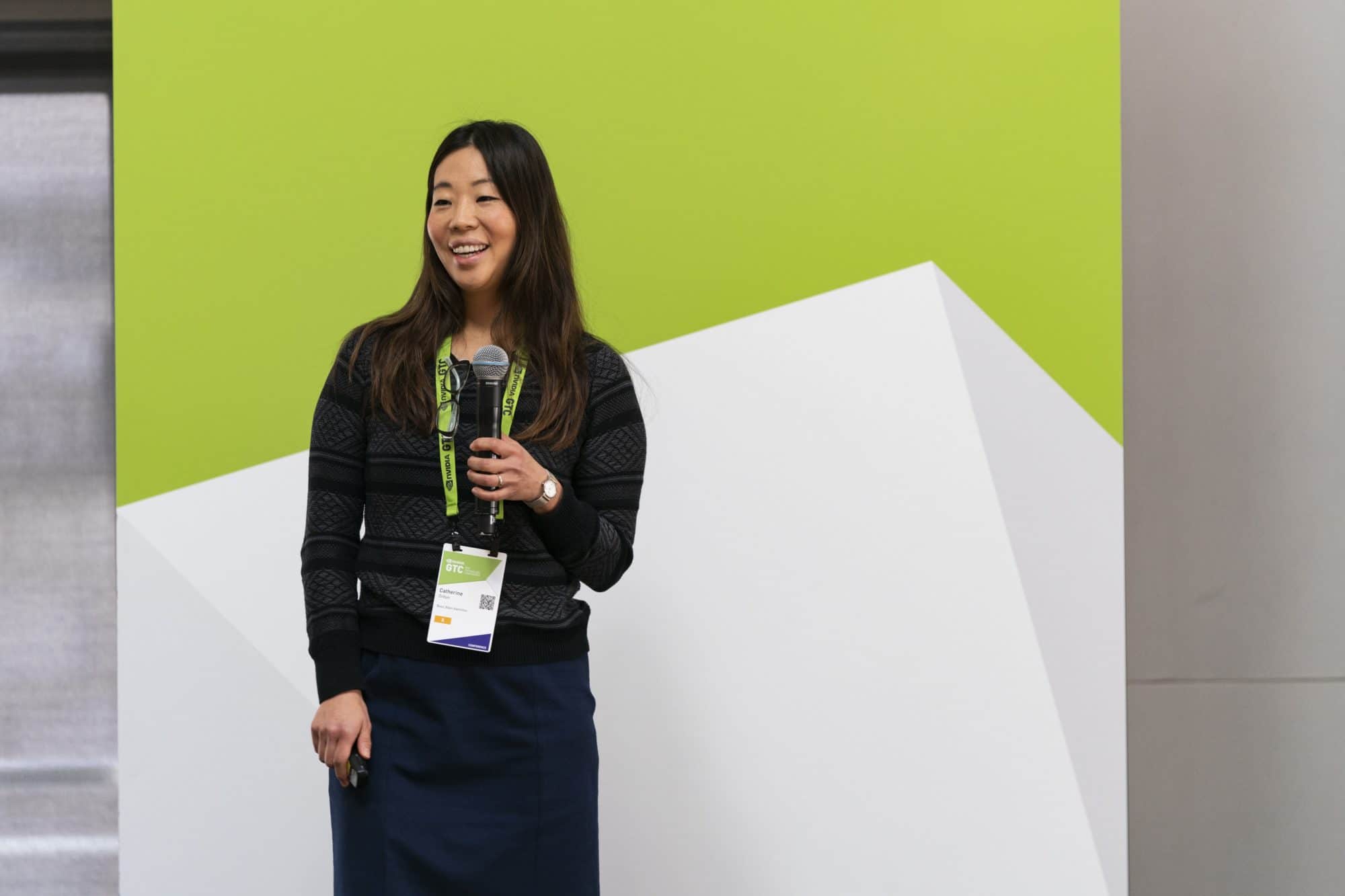
Catherine Ordun, senior data scientist at Booz Allen Hamilton, delivered the keynote at the GTC DC Women’s Early Career Accelerator.

GTC DC kicked off with the Women’s Early Career Accelerator, a day-long, invitation-only training and networking event attended by nearly 60 graduate students and early-career professionals.

Catherine Ordun, a senior data scientist at Booz Allen who presented the keynote at the accelerator, was honest about the challenges of being a woman in the field of AI.

“You’ll find yourself asking, ‘Who’s like me?’ And the truth is, there’s not a lot. Only 12 percent of people who do AI are women,” said Ordun, referencing a WIRED survey.

Events like the accelerator are helping to change that. After Ordun’s address, participants spent the day completing the NVIDIA Deep Learning Institute’sFundamentals of Deep Learning for Computer Vision” workshop, taught by Alex Qi, an enterprise solutions architect at NVIDIA.

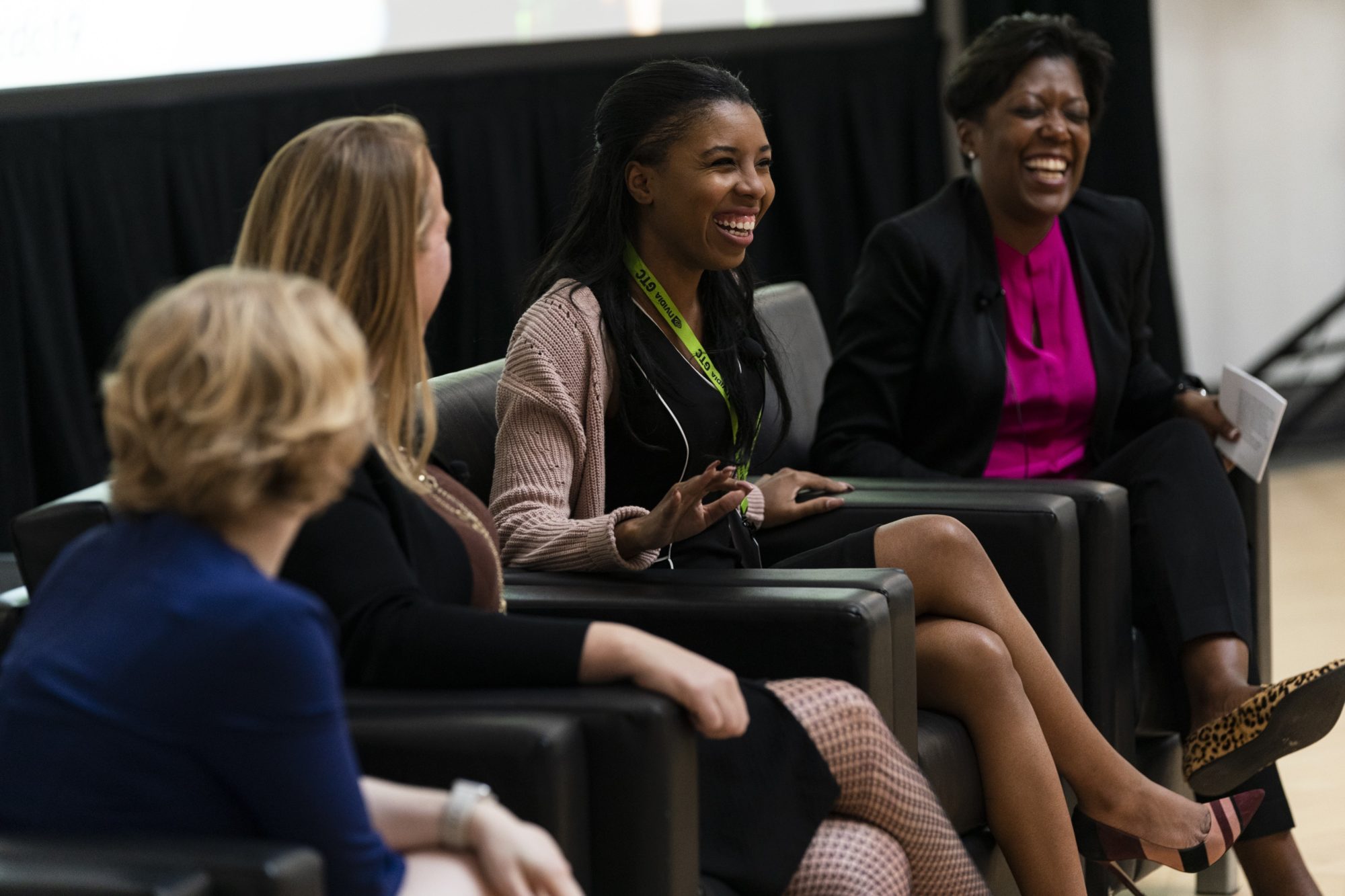
The Women in AI Breakfast featured an AI ethics panel, with speakers (from left) Svetlana Matt, Emily Tait, Megan Gray and Tiffany Moore.

GTC DC also featured the third annual Women in AI Breakfast, hosted by Dell Technologies. Over quiche and coffee, a panel of experts in research, law and more discussed AI ethics.

Emily Tait, an intellectual property partner at Jones Day, provided a legal perspective on how companies can counter issues like the one Gray described. “The best companies are creating dedicated personnel and policies and cultures around diversity.” From there, they’re able to come up with more robust algorithms and identify biases in their technology.

And nearly 75 people filled out the eighth floor of the Ronald Reagan Building and International Trade Center to attend the Black and Latinx Communities Reception, sponsored by Jones Day.

The reception recognized the 50 students that were selected from historically black colleges and universities, Black in AI and LatinX in AI. They received full passes to DLI courses and the entirety of GTC DC.

Addressing a Changing Workforce

Andrew Ko, managing director for global education at AWS, spoke at the Workforce of the Future panel.

NVIDIA Senior Director of Corporate Social Responsibility Tonie Hansen moderated a panel of executives from government, nonprofits and business. They shared examples of how educational institutions, trade associations and companies can help employees prepare for modern jobs that incorporate AI and data science.

Andrew Ko, the managing director for global education at AWS, provided a corporate perspective and gave examples of career programs implemented by Amazon that help employees reskill.

Another panelist was former chief of staff for U.S. Representative Alma Adams and founder of diversity innovation house HBCU House Rhonda Foxx. She gave insight on how the federal government can help support HBCUs — historically black colleges and universities — which produce 47 percent of all black women engineers.

“With emerging technology and AI, we are on the precipice of the fourth revolution,” she said. “We all need to lean in right now and make sure there’s diversity of thought at the table as we move forward in these technological advances.”

The post At GTC DC, Experts Describe Why Diversity in AI Makes a World of Difference appeared first on The Official NVIDIA Blog.

AWS DeepRacer League: The Championship lineup is complete, making for an exciting re:Invent 2019 final!

The AWS DeepRacer League is the world’s first autonomous racing league, open to anyone. Announced at re:Invent 2018, it puts machine learning in the hands of every developer in a fun and exciting way. Since March 2019, thousands of developers of all skill levels have competed for the chance to advance to the Championship Cup at re:Invent 2019.

2019 League wrap-up

As well as racing at AWS Summits around the world, participants have been racing virtually via the AWS DeepRacer console. Developers have been testing their skills on different tracks in simulation throughout the year, and competing in monthly competitions with the hope of winning an expenses-paid trip to re:Invent 2019. The final Virtual Circuit race concluded on October 31, completing the Championship Cup lineup.

Two champions were named: the winner of the final virtual race of the year, as well as 18 top point scorers who have been competing in multiple races throughout the year. “Eric” from Taiwan won the Toronto Turnpike race with a lap time of 7.172 seconds, which is the fastest time recorded on any of the virtual tracks, and beats the world record set at the Summits. The next challenge for Eric is transitioning his models from simulation to the real world when he gets to Las Vegas!

Lyndon Leggate, an early AWS DeepRacer enthusiast and the founder of the AWS DeepRacer Slack community, was victorious in the overall virtual leaderboard and is joined by 17 other skilled racers from the Virtual Circuit. Each of the 18 racers competed in all six virtual races, racking up points along the way with very consistent models, and clocking times ranging between 9.4–14.6 seconds. We will see each of these developers at re:Invent 2019, when the in-person and virtual worlds collide in the Championship Cup knock-out rounds.

The AWS DeepRacer 2019 Summit Circuit results

The AWS DeepRacer Virtual Circuit results

Get ready to race at re:Invent

re:Invent 2019 is the final destination on the journey to crown the 2019 AWS DeepRacer Championship Cup winner. The November Championship Cup warm-up race is now open. On the newly revealed track shape, developers can train models on the official track to be used during the Championship Cup! You can take part in this friendly warm-up race via the AWS DeepRacer console and compete for up to $500 in AWS credits. See how your model performs on the official Championship Cup track today, and bring that model with you to re:Invent and race at the MGM Grand Garden Arena. There will be prizes up for grabs, all while getting a trackside seat to witness the best racers from around the world compete in the knock-outs.

The Championship Cup

The Championship Cup competition includes a set of elimination rounds at the MGM Grand Garden Arena, where 64 of the League’s best face off in a knock-out tournament in the hopes of taking home the glory! Starting on Tuesday, December 3, the field will whittle down from 64 to 3, who will go on to compete onstage in the Grand Final at Werner Vogel’s keynote on Thursday, December 5. The League will hold one final chance for in-person racers to advance to the knock-out rounds on Monday, December 2, from 4–7 PM, at the Quad in the Aria hotel. Open to all re:Invent attendees, you can race on the iconic 2019 track for a chance to advance to the finals where not one but three contestants will go through!

Learn and grow

New racers not competing for the 2019 cup can attend one of the 10 AWS DeepRacer workshops to learn how to build the best model to compete in the 2020 League and learn from AWS DeepRacer experts.

The AWS DeepRacer workshops provide customers with hands-on training, enabling them to build their models and learn more about what’s next for AWS DeepRacer. The sessions are open for registration now, so don’t miss out on your chance to learn and get ready to race!

AWS customers who want to learn and prepare for the 2020 season will benefit from the AWS DeepRacer Expert Boot Camp. This two-day event offers unprecedented access to AWS DeepRacer experts, including AWS DeepRacer data scientists, 2019 AWS Summit winners, and developer experts sharing best practices and racing tips. With a full track for practicing in real time, this is one event you do not want to miss.

The home stretch of 2019!

In less than a year, AWS DeepRacer has seen a dramatic evolution in the speeds developers are clocking on the tracks, from Rick Fish’s championship-winning time of 51.50 seconds to the world record of 7.44 seconds set by SOLA at the Tokyo Summit in June. Developers around the world have embraced the challenge, testing their models for days and weeks at a time, playing with speed and other parameters to push the car to its physical (and virtual) limits. The Championship Cup is set to be the most exciting yet. Register for re:Invent 2019 today, and start training your models to win prizes in the warm-up challenge!


About the Author

Alexandra Bush is a Senior Product Marketing Manager for AWS AI. She is passionate about how technology impacts the world around us and enjoys being able to help make it accessible to all. Out of the office she loves to run, travel and stay active in the outdoors with family and friends.


[D] Is Neural Magic a scam?

I recently learned about this new startup which advertises that they can provide GPU level learning using a CPU. There are already CPU versions of neural network training algorithms. Is neural magic doing false advertisement? What approach are they taking specifically to make the ‘magic’ happen?

submitted by /u/isthataprogenjii
[link] [comments]

Less stress, less time: How a Brazilian startup is using Azure AI to make car repairs easier

SÃO PAOLO, Brazil For most people, the worst part of getting into a minor car accident is figuring out how to get your car repaired.

There’s the trouble of figuring out who to call, the hassle of driving around to get estimates and the constant worry that whoever you work with will end up taking advantage of you.

That’s where Car10 comes in. The Brazilian startup has created an app that allows customers to take a picture of the damage, submit the photo and get three to five estimates from nearby car repair shops that Car10 has pre-screened for quality and reliability. The startup even guarantees it will make the repair for free if you aren’t satisfied.

“We take the fear out of the process, the worry that you’ll be taken advantage of,” said Jose Tafner, Car10’s chief financial officer.

Now, the São Paolo-based company is using artificial intelligence to make the process faster. The startup announced that it is using Microsoft’s Azure Cognitive Services Custom Vision Service to almost immediately give the user a rough sense of what they expect the repair to cost.

With the current system, users who submit a photo will get a quote within 30 minutes to an hour. With the new AI tools, Tafner said they can get a general sense of how much the repair will cost within about 30 seconds.

“It goes back to the customer need. When you have a small accident or crash, the thing you want to know is how much it’s going to cost,” Tafner said. “The first need is speed and some level of accuracy.”

The AI system uses a machine learning model to compare the damage to the customer’s car with other examples of similar damage to come up with a reasonably close estimate. Then, the company works with car repair shops to get firmer bids.

The AI system may speed up the quote process, but it doesn’t replace the hands-on involvement that Car10 has in ensuring customers feel comfortable throughout the process of getting their car repaired.

Tafner said Car10 works with customers on everything from providing the estimate to scheduling the visit and even paying through Car10’s digital platform. The customer then has the opportunity to rate the experience and the shop where the repair was made.

“The digital part of the journey is small. The largest part is analog,” Tafner said.

Focus on quality

Car10 has about 100,000 customers and works with about 4,000 auto body shops throughout Brazil, ranging from big businesses to small mom-and-pop shops. Tafner said the company initially focused only on larger shops, thinking that was what the customer would prefer. But they found that customers didn’t care whether the shop was being run out of someone’s garage or a fancy office.

“They care about the quality of the service,” he said.

Car10 was started in 2014 by three brothers who had previously worked for their father’s insurance adjustment business. When that business was sold, they decided to use their experience in the car repair industry to plunge into the startup world. Tafner joined a couple of years later, after decades of global experience in the corporate world. The service is designed for people who are paying for repairs themselves, instead of relying on insurance.

From the beginning, the four-person leadership team has been highly reliant on technology and data. They run on Microsoft’s Azure cloud service, use Power BI dashboards and built the app on the .NET framework.

“The four of us are data freaks. We’re constantly using it to improve the business,” Tafner said.

Still, Tafner said that like many businesses swimming in data, it can be challenging to figure out which pieces of data are useful.

One clear winner: The photos of car repairs. Car10 was able to use that data to train the machine learning model to automatically detect what kind of repair a person needs and what it would generally cost. Car10 doesn’t sell customer data, and it protects people’s personal information using Azure security protections.

Car10, which has received startup investment funds from Microsoft, first started building the AI solution when the company participated in an industry hackfest. Although it has an IT staff, none of the people who work for Car10 have a particular expertise in AI. Azure Cognitive Services are designed so that even people without any formal AI training can use them.

Future plans

Car10 is about five years old now, and it expects to break even within a quarter. Now, Tafner said the company is seeking more funding so that it can expand into other areas of business, and potentially other markets outside of Brazil.

“What we can do for car crashes we can do for a number of things,” he said.

For Tafner, the small team and fast pace is both invigorating and enlightening. Like any startup, he notes, the company is constantly trying new things, making mistakes and adjusting – all while trying to run the core business. He likens it to race car driving.

“We’re changing the tires while the car is running,” Tafner said. “There are no pit stops for us.”

Related:

Allison Linn writes about AI and innovation. Follow her on Twitter.

The post Less stress, less time: How a Brazilian startup is using Azure AI to make car repairs easier appeared first on The AI Blog.
[D] why softmax+CE over sigmoid+BCE?

Most of the popular neural network language models use softmax+cross entropy loss during training, which is based on the assumption that only the target label is true, and everything else is false. But isn’t language modeling a multilabel classification task? why sigmoid+BCE isn’t used often?

submitted by /u/DeMorrr
[link] [comments]

[D] Please help me find this paper (Foundations of DL)!

Dear all,

I have been searching for some time now for a paper I read a while ago but misplaced.

The paper was very interesting and showed that finding optimisation with with deep neural networks is, in some sense, easier than with shallow neural networks.

The authors generated a data set by generating random input data and then using the predictions of a shallow neural network (A) to provide the ground truth labels of those data. They then tried to train another shallow network (B) with same architecture as (A) the one that created the labels, but with different initializations. It was shown that it was very difficult to find the optimal solution for this dataset. They then tried the same task with a deeper network (C) and found the optimal solution.

If anyone knows the name of this paper then please let me know where I can find it. I would be eternally grateful!

Many thanks!

submitted by /u/HenryWJReeve
[link] [comments]

[R] New Graph Classification Data Sets

Graph classification has been popular recently, which led to rich development of Graph Kernels and Graph Neural Networks. All papers more or less verify the results on 10-15 benchmark data sets. We found that these data sets (and 40 others) have a lot of isomorphic graphs which leads to (1) train-to-test leakage and (2) incorrect validation comparison. Absurdly, some isomorphic graphs have different classification labels, making it impossible to classify correctly such instances. We explain the reasons why these isomorphic instances appear in data sets in the first place (e.g. meta-data, sizes of graphs, or origin of a data set) and open-source new clean data sets, both in GitHub and in PyTorch-Geometric.

Here is a link to the paper: https://arxiv.org/abs/1910.12091

Here is more informal blog post about findings.

submitted by /u/nd7141
[link] [comments]