Blog

Learn About Our Meetup

5000+ Members

MEETUPS

LEARN, CONNECT, SHARE

Join our meetup, learn, connect, share, and get to know your Toronto AI community. 

JOB POSTINGS

INDEED POSTINGS

Browse through the latest deep learning, ai, machine learning postings from Indeed for the GTA.

CONTACT

CONNECT WITH US

Are you looking to sponsor space, be a speaker, or volunteer, feel free to give us a shout.

Category: Reddit MachineLearning

[P] MachinesGoneWrong – a primer to algorithmic bias

[P] MachinesGoneWrong - a primer to algorithmic bias

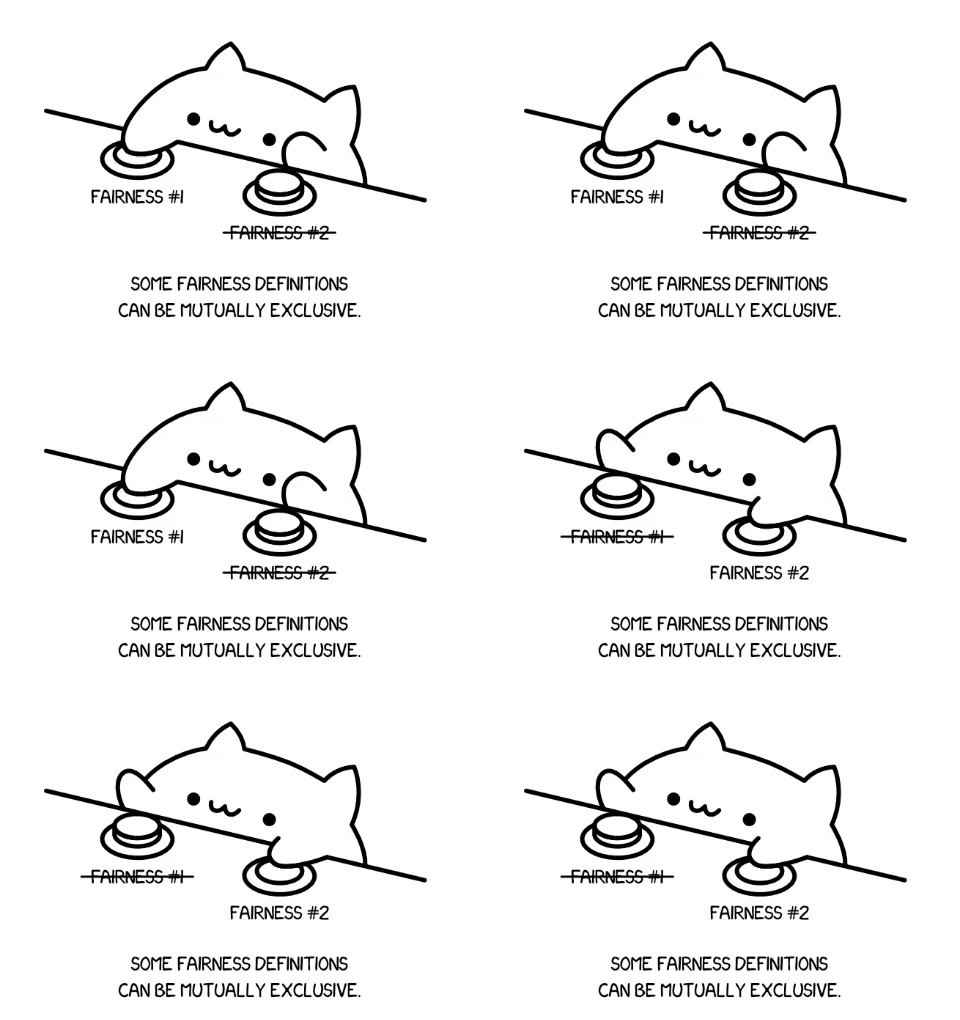
Hey all, am a graduate student working on AI and AI ethics. As part of a 3-month final project, I built an online primer/beginner’s guide to algorithmic bias. It contains:

– xkcd-style comics (a tribute and thanks to the esteemed Randall Munroe!)

– an explorable for fairness definitions

a Bongo Cat

Check it out here: https://machinesgonewrong.com

(A few of my friends got a 403 error when trying to access it – if that happens to you, try this link instead: https://greentfrapp.github.io/project-asimov/guide/ ; also do let me know if anyone has a fix, I’ve been stuck on this bug for awhile now – if anyone is interested in helping, the website is built on GitHub Pages with Jekyll)

I’m still about two weeks away from submission so let me know if you have any feedback (I’ve previously posted this on r/AIethics and r/artificial)! I’m also intending to continue this as a long-term project so I’m open to collaborations on this, just drop me a message!

submitted by /u/greentfrapp
[link] [comments]

[D] Ideas on how can I implement a ML based solution to treat patterns according to training data

[D] Ideas on how can I implement a ML based solution to treat patterns according to training data

Hello everyone,

This is my very first post on this thread. I apologize if this question sounds dumb, I am new to machine learning and CNNs. I am trying to implement a machine learning-based solution, where if I input a pattern with rough edges into the model, it will output a treated pattern based on the training data pairs.

10 examples of an input and an expected output pair are shown below, where the inputs are shown by the patterns outlined in black lines and the expected outputs are in blue.

https://i.redd.it/zg4qf0hvzrd31.png

I would greatly appreciate any suggestions/help on how can I go about implementing this?

Thank you

submitted by /u/Pepe_thelord
[link] [comments]

[D] Has anyone figured out why Adam, RMSProp, And Adadelta don’t do well for training word embedding models, often worse than SGD?

It’s something I’ve heard here and there but never really got an explanation.

From online, I found this and this

https://hackernoon.com/various-optimisation-techniques-and-their-impact-on-generation-of-word-embeddings-3480bd7ed54f

https://stats.stackexchange.com/questions/288658/better-performance-with-gradient-descent-than-adam-on-word2vec

Optimizers that build upon Adagrad aim to fix the vanishing learning rate problem, so why would they do worse?

Perhaps minimas are really unstable, and would benefit from the smaller learning rates. Could this issue then be alleviated by increasing the window of past gradients?

submitted by /u/Research2Vec
[link] [comments]

[D] Can I use named entity recognition and multitext classification to train spacy to link key value pairs from form data?

Like the title asks, if I have a string like “address 1234 home street”, can I get spacy to recognize that the key is address and the value is 1234 home street? Or I guess the better question is, if I just have a string like 1234 home street, can i get spacy to recognize that as an address without further context around the string? It’s not in a sentence since it’s derived from form data extracted via OCR. More difficult, get spacy to recognize a string that isn’t a traditional category like an address, but a custom category?

How do I start researching this?

submitted by /u/bigdbag999
[link] [comments]

[D] do you agree “The research on how to deal with time-series data is almost finished”?

here is my question in quora

https://www.quora.com/Why-is-RNN-less-progress-research-than-CNN-especially-the-time-series

question is

Why is RNN less progress research than CNN (especially the time series)?

and answer is

Any problem concerning the images is incredibly harder than that concerns a time series. This is why the research on CNN and its derivatives (U-Net, GAN) are still continuing.

The research on how to deal with time-series data is almost finished. It looks like researchers are trying to come up with better and better techniques, but what is actually happening is people are trying to predict dependencies that are actually not present in the data or using insufficient data!

A good example is the stock value prediction. The simple truth is that the stock prices depend on many more variables that are not present in the typical input time series’ used with RNN or LSTM.

My personal opinion is now LSTM is SOTA but I think another SOTA network will be created.

how about think of this topic?

submitted by /u/GoBacksIn
[link] [comments]

[D]All Things Interesting Podcast: Kasian Franks of Vectorspace AI

Hi everyone,

I’m those host of the All Things Interesting Podcast and wanted to drop in to share my first interview with blockchain startup technical cofounder Kasian Franks.

Kasian and his team at Vectorspace AI are working on bridging blockchain with context controlled vector based NLP/NLU to power AI and machine learning. In this episode, we talk about all things AI, ML, NLP/NLU, and blockchain.

All Things Interesting Podcast #1: Kasian Franks of Vectorspace AI

submitted by /u/Teshercohen
[link] [comments]

[D] Machine Learning Infrastructure with Amazon SageMaker and Terraform — A Case of Fraud Detection

Good day!

Here’s an article I wrote on setting up Amazon SageMaker with Terraform, based on the example from AWS Solutions.

https://medium.com/@qtangs/machine-learning-infrastructure-with-amazon-sagemaker-and-terraform-a-case-of-fraud-detection-ab6896144781

Source code can be found here: https://github.com/qtangs/tf-fraud-detection-using-machine-learning

I’d love to hear feedback from the community.

Please note, though, that I’m a noob in machine learning, so pardon my ignorance in many areas.

Original AWS example: https://aws.amazon.com/solutions/fraud-detection-using-machine-learning/

Thanks!

submitted by /u/qtangs
[link] [comments]