
Blog

Learn About Our Meetup

5000+ Members

MEETUPS

LEARN, CONNECT, SHARE

Join our meetup, learn, connect, share, and get to know your Toronto AI community. 

JOB POSTINGS

INDEED POSTINGS

Browse through the latest deep learning, ai, machine learning postings from Indeed for the GTA.

CONTACT

CONNECT WITH US

Are you looking to sponsor space, be a speaker, or volunteer, feel free to give us a shout.

Category: NVIDIA

Snack Shacks: Startup Shows Off Self-Service Stores

A credit card swipe gets you into the checkout-free miniature convenience store. After that, just grab Oreos, Pringles or other munchies, check your receipt and go.

Startup AiFi presented its automated retail store, dubbed the NanoStore, at the GPU Technology Conference this week.

The Silicon Valley-based company uses image recognition powered by a single NVIDIA T4 GPU to automatically capture customers’ shopping items and charge them.

AiFi — an NVIDIA Inception winner last year — is now in pilot tests with its NanoStores and offers its store technology to retailers of all sizes.

The NVIDIA Inception program is a virtual accelerator that helps startups get to market faster.

AiFi’s NanoStores are built into a shipping container that can hold more than 500 different products. The NanoStore concept fills a niche in the market between a vending machine and a convenience store, said co-founder and CEO Steve Gu.

“There’s a gap between vending machines and convenience stores. We believe this will be the next big thing,” said Gu.

Snack Tracking

NanoStores pack cameras inside to capture a customer’s merchandise choices, which are identified by AiFi’s image recognition algorithms and then put on the tab.

It’s not easy to recognize the merchandise and connect it with the customer, and the startup continues to work on this, Gu said.

Detecting more than 500 different products was made easier by using 3D simulations. That made it possible to create about thousands of images from different angles for each product to refine their training set.

Training time was accelerated by using workstations sporting NVIDIA TITAN series GPUs, Gu said.

NanoStore Pilots

AiFi’s NanoStore offers retailers an easy way to try out a fully automated store that is always open, extending hours and sales, Gu told attendees of his GTC talk.

“It creates a new line of business for convenience stores.”

The company is working with Valora, based in Switzerland, on a pilot of its NanoStores located at European railway stations. The startup is also working on a pilot with Carrefour, a French retail giant with more than 12,000 stores, for its technology.

Closer to home, AiFi is in discussions with some universities to place pilots of its NanoStores, which could operate 24/7 on their campuses.

“Students never sleep and neither does the NanoStore,” Gu said.

The post Snack Shacks: Startup Shows Off Self-Service Stores appeared first on The Official NVIDIA Blog.

Error Parer: How AI Could Help Cardiologists Detect Heart Defects Without Skipping a Beat

Nearly a third of physicians will be sued at least once in their careers — most commonly for an error in diagnosis. Medical errors are also the third-leading cause of death in the United States, according to a study by Johns Hopkins Medicine.

Deep learning has the potential to help doctors cut down on diagnostic errors, said cardiologist Rima Arnaout in a talk at the GPU Technology Conference.

An assistant professor of medicine at the University of California, San Francisco, Arnaout is focusing on the potential of AI to analyze cardiac ultrasounds and detect congenital heart disease from fetal ultrasounds.

“In medicine, a picture is worth more than a thousand words,” she said. “It really can be worth a patient’s life, in some cases.”

What Can AI Do to Help?

Arnaout outlined a few key challenges for humans analyzing medical images. For one, people sometimes make mistakes. There’s also a physical limit to how much data cardiac imaging specialists like cardiologists and radiologists can analyze.

“We cannot allow those kinds of shortcomings,” she said. “We need accuracy, precision, and we need it delivered at scale.”

While AI models are not without their limitations, Arnaout said, they can help clinicians use medical imaging techniques like ultrasound to their full potential.

She turned to echocardiogram data because “it’s balanced in terms of information richness and clinical volume compared to other cardiovascular imaging tools.” Since echocardiograms can be used for the diagnosis and management of almost every cardiovascular disease, she said, there’s very little selection bias in the datasets.

Echocardiograms are a challenging training dataset, however, because one ultrasound study consists of still images and videos captured from over a dozen angles. A study Arnaout’s team published in npj Digital Medicine used deep learning to classify 15 of these standard views, achieving 91.7 percent accuracy on low-resolution images.

Detecting Congenital Heart Disease in Utero

Recent work by Arnaout focused on the detection of congenital heart disease from fetal ultrasounds. While in theory more than 90 percent of complex congenital heart disease cases can be diagnosed through traditional fetal screening ultrasounds, the actual detection rate is under 50 percent.

This gap occurs in part because fetal hearts are small and fast beating. Since the fetus itself is often moving, diagnostic-quality images can be difficult to obtain. And although it’s the most common birth defect, congenital heart disease affects just one percent of live births. Since it’s so rare, the condition can easily go overlooked by human readers.

That’s where an algorithm can help: once trained, it could reliably catch congenital heart disease in perpetuity.

Using hundreds of fetal echocardiograms from 18 to 24 weeks of gestational age, the UCSF researchers developed convolutional neural networks to distinguish two varieties of congenital heart disease. The deep learning model, trained on NVIDIA GPUs hosted on Amazon Web Services, was able to classify the two kinds of defects at well above the average diagnostic rate.

Catching heart defects early can lead to better outcomes for patients after birth. And if certain types of lesions are spotted in a fetal ultrasound, doctors can recommend in-utero therapies that significantly improve the heart’s condition by birth.

Arnaout said, “This has the potential to really affect the natural history of an entire life.”


Main image is of an echocardiogram showing a ventricular septal defect, or hole in the heart — a common congenital heart defect. Photo by Kjetil Lenes/Ekko, licensed under public domain on Wikimedia Commons.

The post Error Parer: How AI Could Help Cardiologists Detect Heart Defects Without Skipping a Beat appeared first on The Official NVIDIA Blog.

Seeing Stars: Astronomers Turn to AI to Track Galaxies as New Telescopes Come Online

Good news: astronomers are getting new tools to let them see further, better than ever before. The bad news: they’ll soon be getting more data than humans can handle.

To turn the vast quantities of data that will be pouring out of these instruments into world-changing scientific discoveries, Brant Robertson, a visiting professor at Princeton’s Institute for Advanced Studies and an associate professor of astronomy at UC Santa Cruz, is turning to AI.

“Astronomy is on the cusp of a new data revolution,” he said told a packed room at this week’s GPU Technology Conference in Silicon Valley.

Better Eyes on the Sky

Within a few years the range of instruments available to the world’s star-gazers will give them once unimaginable capabilities. Measuring an enormous 6.5 meters across, the James Webb Space Telescope — which will be deployed by NASA, the U.S. space agency, will be sensitive enough to give us a peek back at galaxies formed just a few hundred million years after the Big Bang.

The Large Synoptic Survey Telescope gets less press, but it has astronomers equally excited. The telescope, largely funded by the U.S. National Science Foundation and the Department of Energy, and being built on a mountaintop in Chile, will let astronomers survey the entire southern sky every three nights. This will produce a massive amount of data — 10 terabytes a night.

The Large Synoptic Survey Telescope, on Cerro Pachón, in Chile, will give astronomers the ability to survey the entire southern sky every three nights when it is completed in 2020.

Finally, the Wide Field Infrared Survey Telescope puts an enormous digital camera into space. With origins in the U.S. spy satellite program, the satellite’s features will include a 288-megapixel, multi-band, near-infrared camera with a field of view 100x larger than that of the Hubble Space Telescope.

‘Richly Complex’ Data

Together, these three instruments will generate vast quantities of “richly complex” data, Robertson said. “We want to take that information and learn as much as we can,” he said. “Both from individual pixels and by aggregating them together.”

It’s a task far too large for humans alone. To keep up, Robertson is turning to AI. Created by Ryan Hausen, a Ph.D. student in UC Santa Cruz’s computer science department, Morpheus — a deep learning framework classifies astronomical objects, such as galaxies, based on the raw data streaming out of telescopes — such as the Hubble — on a pixel by pixel basis.

“In astronomy, we really do care about the technological advances that people in this room are engineering,” Robertson told his audience at GTC.

Translation: to find new stars in outer space, this prominent astrophysicist is looking, first, to deep learning stars here on Earth for help.

Image credit: NASA. 

The post Seeing Stars: Astronomers Turn to AI to Track Galaxies as New Telescopes Come Online appeared first on The Official NVIDIA Blog.

AI and Clinicians a ‘Winning Combination,’ Healthcare Luminary Eric Topol Says at GTC

Deep learning is putting the “care” back in healthcare.

“It used to be we just talked about deep sequencing. Now we talk about deep everything in medicine,” healthcare luminary Eric Topol told a packed audience Tuesday morning at the 10th annual GPU Technology Conference, in San Jose.

With advances in AI and healthcare, he said, medical professionals will need to spend less time entering and looking at data on computers. This will give them “the gift of time” to provide patients with personal care and bring back the strong doctor-patient bond that existed decades ago.

“A common enemy of the patient and the doctors and the nurses is the keyboard, because it interferes with their relationship,” he said. “It makes doctors data clerks.”

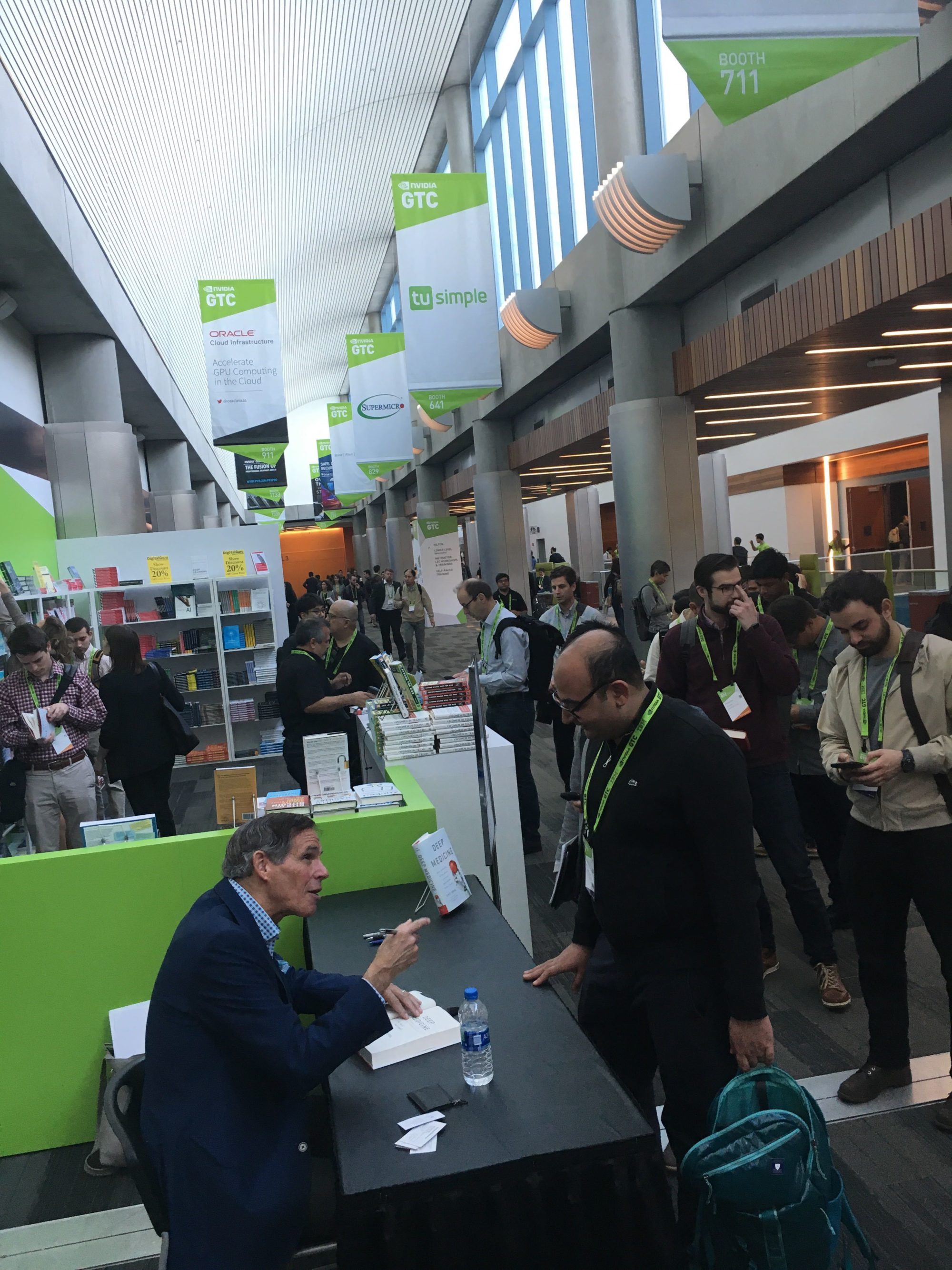
The founder and director of the Scripps Research Translational Institute, Topol released last week a new book, “Deep Medicine: How Artificial Intelligence Can Make Healthcare Human Again.” His talk outlining how AI will transform everything doctors do was followed by a book signing.

“Every single type of health professional” will be impacted by AI, Topol said. Bringing AI into the medical workflow can help healthcare institutions provide “better, faster, cheaper” care by augmenting what clinicians can do.

After the talk, Topol signed copies of his new book, “Deep Medicine: How Artificial Intelligence Can Make Healthcare Human Again.”

“When you put the two together — machine algorithm plus the radiologist — you start getting a really winning combination.”

But humans will always remain integral to healthcare.

“We’re not going to get to the point where all medical diagnosis will not require human backup. Ever,” he said. “But we may get to a point where some of them, routine things like a sore throat or an ear infection or skin rash can be done completely algorithmically — both diagnosis and recommendations for treatment.”

Scripps Translational Institute focuses on genomics, a field that “is starting to go medical mainstream. Finally,” Topol said. NVIDIA and Scripps recently established a center of excellence for AI in genomics and digital sensors.

Topol showed initial results of the joint work, which included deep learning applications for genomics that improve accuracy, decrease costs and produce results faster.

“I said at the time that eventually, eventually, it would markedly improve accuracy, efficiency and workflow,” he said. “But I didn’t realize that just five months later, we’d do that. I thought it was going to take years.”

Healthcare at GTC

GTC features more than 40 healthcare sessions with innovators in AI and medicine, including:

  • Brandon Fornwalt, associate professor and chair of the imaging science and innovation department at Geisinger, and Aalpen Patel, chair of Geisinger System Radiology
  • Sunita Chandrasekaran, assistant professor at the University of Delaware
  • Dima Rekesh, senior distinguished engineer, and Julie Zhu, chief data scientist and distinguished engineer, at Optum — the health services platform of UnitedHealth Group
  • Rima Arnaout, assistant professor, and Christopher Hess, professor and chair of radiology and biomedical imaging, at the University of California, San Francisco
  • Neil Tenenholtz, director of machine learning at the MGH & BWH Center for Clinical Data Science
  • Tessa Cook, assistant professor of radiology at Penn Medicine
  • Richard Tobias, CEO of Cephasonics Ultrasound Solutions
  • Gerald Quon, assistant professor at the University of California, Davis

The full lineup of healthcare speakers at GTC, which runs through March 21, is available here.

The post AI and Clinicians a ‘Winning Combination,’ Healthcare Luminary Eric Topol Says at GTC appeared first on The Official NVIDIA Blog.