
Blog

Learn About Our Meetup

5000+ Members

MEETUPS

LEARN, CONNECT, SHARE

Join our meetup, learn, connect, share, and get to know your Toronto AI community. 

JOB POSTINGS

INDEED POSTINGS

Browse through the latest deep learning, ai, machine learning postings from Indeed for the GTA.

CONTACT

CONNECT WITH US

Are you looking to sponsor space, be a speaker, or volunteer, feel free to give us a shout.

Author: torontoai

[R] Task-Oriented Language Grounding for Language Input with Multiple Sub-Goals of Non-Linear Order

arxiv: https://arxiv.org/abs/1910.12354

github: https://github.com/vkurenkov/language-grounding-multigoal

Abstract:

In this work, we analyze the performance of general deep reinforcement learning algorithms for a task-oriented language grounding problem, where language input contains multiple sub-goals and their order of execution is non-linear.We generate a simple instructional language for the GridWorld environment, that is built around three language elements (order connectors) defining the order of execution: one linear – “comma” and two non-linear – “but first”, “but before”. We apply one of the deep reinforcement learning baselines – Double DQN with frame stacking and ablate several extensions such as Prioritized Experience Replay and Gated-Attention architecture.Our results show that the introduction of non-linear order connectors improves the success rate on instructions with a higher number of sub-goals in 2-3 times, but it still does not exceed 20%. Also, we observe that the usage of Gated-Attention provides no competitive advantage against concatenation in this setting. Source code and experiments’ results are available at this https URL

submitted by /u/Lua_b
[link] [comments]

[P] Improving Music Recommendations – looking for users to take part!

I’m looking for user data for my Computer Science Masters project “Using Community Detection to Improve Music Recommendations”.

I’ll be using machine learning to examine user music data from Spotify with the aim of improving the songs people are recommended.

I’ve produced a web app where you can consent to data being (anonymously) sampled from your Spotify account. It only takes about 1 minute to log in and would really help me out.

Thanks!

https://james-atkin-spotify-project.herokuapp.com/

submitted by /u/FeldsparKnight
[link] [comments]

[D] Self-training with Noisy Student improves ImageNet classification (STNS)

A few questions about this paper:

  1. If you train an ensemble of SOTA architectures on Imagenet and average their results, do you beat STNS?
  2. Why not fine tune the teacher? Why involve the student at all? Why not have the teacher fine tune with noisy labels and get rid of the student completely?
  3. The noisy part to the student seems odd to me. Why would this work other than the fact of adding noise you sort of anneal the solution. Why not add noise to the gradient or do what i suggest in 2.

I see Q Le has investigated noisy gradients already. https://arxiv.org/pdf/1511.06807.pdf

submitted by /u/idg101
[link] [comments]

[P] Predict figure skating world championship ranking from season performances (part 6: rank aggregation)

I’m trying to predict the ranking of figure skaters in the annual world championship by their scores in earlier competition events in the season. The obvious method to do is by average the scores for each skater across past events and rank them by those averages. However, since no two events are the same, the goal for my project is to separate the skater effect, the intrinsic ability of each skater, by the event effect, how an event influence the score of a skater.

In the previous 5 parts of my projects, I’ve developed several models to predict the ranking of skaters (as outlined in an earlier Reddit post). In this last part of my project, I try to combine these rankings into a final ranking that hopefully will be more accurate than any of the previous rankings individually. You can read the write-up for it here.

I used two different approach to combine the rankings:

  • An unsupervised approach using the centuries-old method of Borda count that is used to tally ranked votes.

  • A supervised approach using logistic regression to combine the scores from each model more intelligently, using the world championship itself as a guide.

Finally, all of the 7 ranking models that I developed in my project are benchmarked on the 5 seasons in the test set. I won’t spoil the details and explanations of the final result (you can see a glimpse of it here), but let’s just say that predicting sports is hard AF!

You can check out the Github repo of the project for all my analyses. I’m more than happy to answer any question or feedback you might have for my project. Thank you for taking the time to read it.

submitted by /u/seismatica
[link] [comments]

[D] What is the state of the art for disentanglement?

I just found out about disentangled variational autoencoders and they seem pretty exciting to me.

I was wondering if there was something similar with GANs and so I searched and found this https://arxiv.org/abs/1906.06034 “InfoGAN-CR: Disentangling Generative Adversarial Networks with Contrastive Regularizers”.

What should I search for in order to find papers that have the best performance, or is there a new technique for disentanglement (or something along those lines)?

Thanks.

submitted by /u/runvnc
[link] [comments]

[D] Has anyone used context to improve object detection and image classification?

We do a lot of image classification using the Tensorflow Object Detection API.

Our images often appear in groups, e.g. a cluster of fish swimming by a camera. Ofter our model will recognize some of the fish – but not all of them. This is obviously a mistake a human would never make.

I am researching whether there are any examples of object detectors/image classifiers using context to improve results? I.e. knowing that there are three fish swimming through would increase the model’s propensity to find a fourth nearby?

Another way to potentially attack this problem would be to identify clusters of objects -> then reexamine the cluster only to identify the number of objects within the cluster. The complexity with this issue is that some of the objects we are examining appear in clusters, while others do not.

So to summarize, my two questions are:

  • Is there research on, and how would you suggest I go about improving an object detector by using contextual features within an image?
  • In situations where there are clusters of objects, would you recommend recognizing those clusters as individual images and then subsequently processing them to identify the number of images within the cluster? Are there examples / is there research on this?

Thanks in advance – obviously doing my own research as well, but keen to hear if the community has any thoughts/examples!

submitted by /u/nitrodolphin
[link] [comments]

[Project] faces4coco dataset released: Face bounding box annotations for the MSCOCO Images dataset

Github: https://github.com/ACI-Institute/faces4coco

Over half of the 120,000 images in the 2017 COCO(Common Objects in Context) dataset contain people, and while COCO’s bounding box annotations include some 90 different classes, there is only one class for people. Those bounding boxes encompass the entire body of the person (head, body, and extremities), but being able to detect and isolate specific parts is useful and has many applications in machine learning. Detecting faces in particular is useful, so we’ve created a dataset that adds faces to COCO.

submitted by /u/frankcarey
[link] [comments]

Amazon Forecast now supports the generation of forecasts at a quantile of your choice

We are happy to announce that Amazon Forecast can now generate forecasts at a quantile of your choice.

Launched at re:Invent 2018, and generally available since Aug 2019, Forecast is a fully managed service that uses machine learning (ML) to generate highly accurate forecasts, without requiring any prior ML experience. Forecast is applicable in a wide variety of use cases, including estimating product demand, supply chain optimization, energy demand forecasting, financial planning, workforce planning, computing cloud infrastructure usage, and traffic demand forecasting.

Based on the same technology used at Amazon.com, Forecast is a fully managed service, so there are no servers to provision. Additionally, you only pay for what you use, and there are no minimum fees or upfront commitments. To use Forecast, you only need to provide historical data for what you want to forecast, and optionally any additional data that you believe may impact your forecasts. The latter may include both time-varying data such as price, events, and weather, and categorical data such as color, genre, or region. The service automatically trains and deploys ML models based on your data, and provides you a custom API from which to download forecasts.

Unlike most other forecasting solutions that generate point forecasts (p50), Forecast generates probabilistic forecasts at three default quantiles: 10% (p10), 50% (p50), and 90% (p90). You can choose the forecast that suits your business needs depending on the trade-off between the cost of capital (over-forecasting) or missing customer demand (under-forecasting) in your business. For the p10 forecast, the true value is expected to be lower than the predicted value 10% of the time. If the cost of invested capital is high (for example, being overstocked with product), the p10 quantile forecast is useful to order relatively fewer items. Similarly, with the p90 forecast, the true value is expected to be lower than the predicted value 90% of the time. If missing customer demand would result in either a significant amount of lost revenue or a poor customer experience, the p90 forecast is more useful. For more information, see Evaluating Predictor Accuracy.

While the three existing quantiles supported by Forecast are useful, they can also be limiting for two reasons. Firstly, the fixed quantiles may not always meet specific use case requirements. For example, if meeting customer demand is imperative at all costs, a p99 forecast may be more useful than p90.

Secondly, because Forecast always generates forecasts at three different quantiles by default, you are billed for three quantiles, even if only one quantile is relevant for your decision making processes. Forecast now allows you to override the default quantiles, and choose up to five quantiles of your choice (any quantile between 1% and 99%, including mean). You can achieve this by passing an optional parameter in the CreateForecast API or specifying the override quantiles directly in the AWS Management Console. You can continue to query your forecasts via the console or the QueryForecast API.

This post looks at how to use this new feature via the console. You can also access this feature via the CreateForecast API.

To demonstrate this functionality, we use the same example from the earlier blog post Amazon Forecast – Now Generally Available. The example uses the individual household electric power consumption dataset from the UCI Machine Learning Repository. For more information about creating a predictor in Forecast, see the preceding post.

Once the predictor is active, go to the console to generate forecasts or use the CreateForecast API. On the Create a forecast page, there is a new optional parameter called Forecast types, where you can override the default quantiles of .10, .50, and .90.

For this post, we add the custom quantiles of .10, .35, mean, .75, and .99.

Accepted values include any value between .01 to .99 (in increments of .01), including the mean. The mean forecast is different from the median (.50) when the distribution is not symmetric (for example, Beta and Negative Binomial). In this case, because you specified five quantiles, you are billed for all five. For example, if you generated forecasts for 5,000 time series, you are billed for 25,000 unique forecasts. Because the service bills in units of 1,000, this results in a total bill of 25 x $0.60 = $15. For more information on the latest pricing plan, see Amazon Forecast Pricing.

When the forecast is active, you can query and visualize the forecast using the Forecast lookup tool from the console.
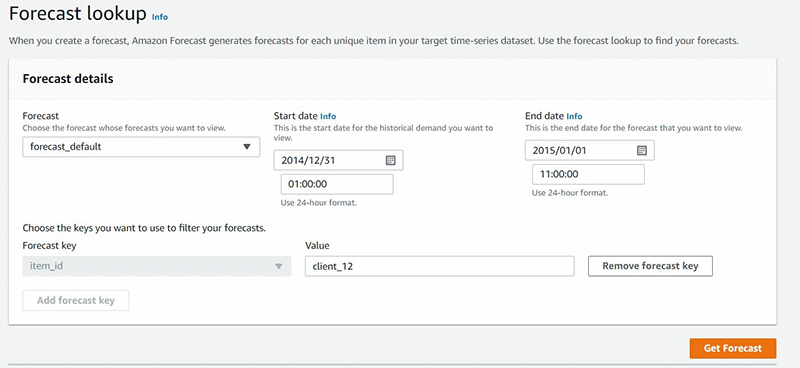

The following graph shows the historical demand and forecasts for a specific time series, in this case “client_12”. All the quantiles specified during CreateForecast (in this case, .10, .35, mean, .75, and .99) are displayed here.

In addition to querying a forecast in the console, you can also export forecasts as a .csv file in an Amazon S3 bucket of your choice. The exported .csv file contains the forecasts for all your time series and the quantiles selected. In our specific example, this is the energy demand forecasts for each client, for the five quantiles chosen. To export your forecast, you can use the CreateForecastExportJob API or via the “Create forecast export” button in the console, as displayed in the screenshot below.
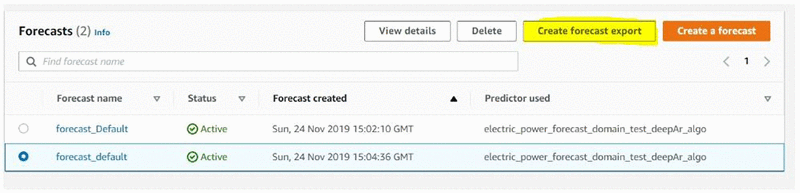
Once you click ‘Create forecast export’, you are taken to the detail page below. Here you specify the name for your export job, specify the forecast, IAM role and the S3 bucket where you want the file to be stored.

When the export job is complete, you can navigate to S3 (via the console) and verify that the file has been created in the relevant S3 bucket.
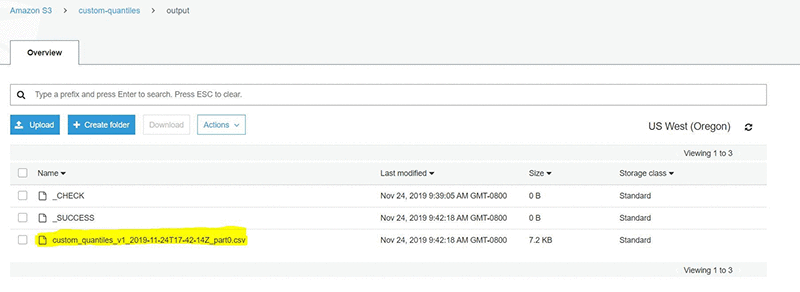
The following table shows the content of the csv, corresponding to the generated forecasts for each client for all quantiles specified over the entire forecast horizon.

item_id

date p10 p35 mean p75

p99

client_111 2015-01-01T01:00:00Z 48.89389038 69.03968811 75.33065033 88.43639374 174.2510834
client_111 2015-01-01T02:00:00Z 49.26203156 67.66025543 72.34096527 85.50863647 148.0922241
client_111 2015-01-01T03:00:00Z 46.06879807 67.83860016 76.61499786 83.54689789 225.3299561
client_111 2015-01-01T04:00:00Z 45.66434097 65.45301056 73.38169098 88.51142883 138.77005
client_111 2015-01-01T05:00:00Z 43.5483017 66.55085754 70.6720047 88.17260742 144.4982605
client_111 2015-01-01T06:00:00Z 50.08174133 67.60101318 75.05982971 83.4147644 206.5582886
client_111 2015-01-01T07:00:00Z 50.79389954 66.47422791 78.7857666 90.23943329 222.6696167
client_111 2015-01-01T08:00:00Z 58.11802673 67.99427795 76.23995209 88.22603607 185.4029236
client_111 2015-01-01T09:00:00Z 42.96152878 74.78701019 80.14347839 96.66455841 142.397644
client_111 2015-01-01T10:00:00Z 59.34168243 72.34555054 80.24354553 94.45916748 164.3058929
client_111 2015-01-01T11:00:00Z 53.01160049 72.67097473 79.31721497 90.48171234 208.0553894
client_111 2015-01-01T12:00:00Z 47.87768173 69.18990326 77.85028076 89.63658905 143.6833801
client_111 2015-01-01T13:00:00Z 46.98330688 71.60288239 86.48907471 87.89906311 1185.726318

Summary

You can now use Forecast to generate probabilistic forecasts at any quantile of your choice. This allows you to build forecasts that are specific to your use case, and reduce your bills by choosing and paying for precisely the quantiles you need. You can start using this feature today in all Regions in which Forecast is available. Please share feedback either via the AWS forum or your regular AWS Support channels.


About the author

Rohit Menon is a senior product manager for Amazon Forecast at AWS.



Ammar Chinoy is a senior software development manager for Amazon Forecast at AWS.


[Discussion] Comparing UK ML-Neuro Labs: Deepmind, Google Brain, Microsoft Cambridge, etc.

I’m a masters student in the UK hoping to get 1-2 years of research experience at the intersection of machine learning and neuroscience (so not so much image recognition, speech recognition, etc.)

The two academic options that immediately came to mind were the Gatsby Comp. Neuroscience at UCL and Cambridge’s Computational Biological Learning group. I’m not familiar with industry labs and would like your help in comparing Deepmind, Google Brain (UK site), Microsoft Research Cambridge, etc. Which one of these offers the most relevant research in terms of machine learning applied to neuroscience as I am hoping to enter academia for computational neuroscience? A lab that publishes well is also a nice plus as always. Thanks.

submitted by /u/Napoleon-1804
[link] [comments]