Author: torontoai
[Research] End to End AutoML for Tabular Data at Kaggle Days
Google’s AutoML efforts aim to make ML more scalable and accelerate both research and industry applications. Our initial efforts of neural architecture search have enabled breakthroughs in computer vision with NasNet, and evolutionary methods such as AmoebaNet and hardware-aware mobile vision architecture MNasNet further show the benefit of these learning-to-learn methods. Recently, we applied a learning-based approach to tabular data, creating a scalable end-to-end AutoML solution that meets three key criteria:
-
Full automation: Data and computation resources are the only inputs, while a servable TensorFlow model is the output. The whole process requires no human intervention.
-
Extensive coverage: The solution is applicable to the majority of arbitrary tasks in the tabular data domain.
-
High quality: Models generated by AutoML has comparable quality to models manually crafted by top ML experts.
submitted by /u/cdossman
[link] [comments]
[N] Pythia: open-source framework for multimodal AI models
Facebook just open sourced a new framework called Pythia for multitask learning in vision and language domains. Pythia is built on top of PyTorch. Here are a few resources:
- Blogpost: https://code.fb.com/ai-research/pythia/
- GitHub: https://github.com/facebookresearch/pythia
They’ve been releasing a lot of these new PyTorch based frameworks recently. First BoTorch + Ax and now this.
submitted by /u/iyaja
[link] [comments]
[P] These Pokémon Do Not Exist (StyleGAN + RNN card generator)
I had the idea after seeing a couple examples of Pokémon GANs being created and decided I’d tie the whole process together into a card generator.
Images were created using a couple variations of StyleGAN on images of Pokemon. Text was created using multi-layered RNNs.
Cards were created using a horrifying amount of ImageMagick logic…
Blog Post: https://devopstar.com/2019/05/21/stylegan-pokemon-card-generator/
Website: https://thesepokemondonotexist.com/
Repo: https://github.com/t04glovern/stylegan-pokemon
Many thanks to a couple great examples including:
- MichaelFriese10 – https://twitter.com/MichaelFriese10/status/1127614400750346240
- ahsenk/stylegan-pokemon – https://www.kaggle.com/ahsenk/stylegan-pokemon
submitted by /u/t04glovern
[link] [comments]
Intel Highlighted Why NVIDIA Tensor Core GPUs Are Great for Inference
It’s not every day that one of the world’s leading tech companies highlights the benefits of your products.
Intel did just that last week, comparing the inference performance of two of their most expensive CPUs to NVIDIA GPUs.
To achieve the performance of a single mainstream NVIDIA V100 GPU, Intel combined two power-hungry, highest-end CPUs with an estimated price of $50,000-$100,000, according to Anandtech. Intel’s performance comparison also highlighted the clear advantage of NVIDIA T4 GPUs, which are built for inference. When compared to a single highest-end CPU, they’re not only faster but also 7x more energy-efficient and an order of magnitude more cost-efficient.
Inference performance is crucial, as AI-powered services are growing exponentially. And Intel’s latest Cascade Lake CPUs include new instructions that improve inference, making them the best CPUs for inference. However, it’s hardly competitive with NVIDIA deep learning-optimized Tensor Core GPUs.
Inference (also known as prediction), in simple terms, is the “pattern recognition” that a neural network does after being trained. It’s where AI models provide intelligent capabilities in applications, like detecting fraud in financial transactions, conversing in natural language to search the internet, and predictive analytics to fix manufacturing breakdowns before they even happen.
While most AI inference today happens on CPUs, NVIDIA Tensor Core GPUs are rapidly being adopted across the full range of AI models. Tensor Core, a breakthrough innovation has transformed NVIDIA GPUs to highly efficient and versatile AI processors. Tensor Cores do multi-precision calculations at high rates to provide optimal precision for diverse AI models and have automatic support in popular AI frameworks.
It’s why a growing list of consumer internet companies — Microsoft, Paypal, Pinterest, Snap and Twitter among them — are adopting GPUs for inference.
Compelling Value of Tensor Core GPUs for Computer Vision
First introduced with the NVIDIA Volta architecture, Tensor Core GPUs are now in their second generation with NVIDIA Turing. Tensor Cores perform extremely efficient computations for AI for a full range of precision — from 16-bit floating point with 32-bit accumulate to 8-bit and even 4-bit integer operations with 32-bit accumulate.
They’re designed to accelerate both AI training and inference, and are easily enabled using automatic mixed precision features in the TensorFlow and PyTorch frameworks. Developers can achieve 3x training speedups by adding just two lines of code to their TensorFlow projects.
On computer vision, as the table below shows, when comparing the same number of processors, the NVIDIA T4 is faster, 7x more power-efficient and far more affordable. NVIDIA V100, designed for AI training, is 2x faster and 2x more energy efficient than CPUs on inference.
Table 1: Inference on ResNet-50.
| Two-Socket Intel Xeon 9282 |
NVIDIA V100 (Volta) |
NVIDIA T4 (Turing) |
|
|---|---|---|---|
| ResNet-50 Inference (images/sec) | 7,878 | 7,844 | 4,944 |
| # of Processors | 2 | 1 | 1 |
| Total Processor TDP | 800 W | 350 W | 70 W |
| Energy Efficiency (Taking TDP) | 10 img/ sec/W | 22 img/ sec/W | 71 img/ sec/W |
| Performance per Processor (images/sec) | 3,939 | 7,844 | 4,944 |
| GPU Performance Advantage | 1.0 (baseline) | 2.0x | 1.3x |
| GPU Energy-Efficiency Advantage | 1.0 (baseline) | 2.3x | 7.2x |
Source: Intel Xeon performance; NVIDIA GPU performance
Compelling Value of Tensor Core GPUs for Understanding Natural Language
AI has been moving at a frenetic pace. This rapid progress is fueled by teams of AI researchers and data scientists who continue to innovate and create highly accurate and exponentially more complex AI models.
Over four years ago, computer vision was among the first applications where AI from Microsoft was able to perform at superhuman accuracy using models like ResNet-50. Today’s advanced models perform even more complex tasks like understanding language and speech at superhuman accuracy. BERT, a highly complex AI model open-sourced by Google last year, can now understand prose and answer questions with superhuman accuracy.
A measure of the complexity of AI models is the number of parameters they have. Parameters in an AI model are the variables that store information the model has learned. While ResNet-50 has 25 million parameters, BERT has 340 million, a 13x increase.
On an advanced model like BERT, a single NVIDIA T4 GPU is 56x faster than a dual-socket CPU server and 240x more power-efficient.
Table 2: Inference on BERT. Workload: Fine-Tune Inference on BERT Large dataset.
| Dual Intel Xeon Gold 6240 |
NVIDIA T4 (Turing) |
|
|---|---|---|
| BERT Inference, Question-Answering (sentences/sec) |
2 | 118 |
| Processor TDP | 300 W (150 Wx2) | 70 W |
| Energy Efficiency (using TDP) | 0.007 sentences/ sec/W | 1.7 sentences/ sec/W |
| GPU Performance Advantage | 1.0 (baseline) | 59x |
| GPU Energy-Efficiency Advantage | 1.0 (baseline) | 240x |
CPU server: Dual-socket Xeon Gold 6240@2.6GHz; 384GB system RAM; FP32 precision; with Intel’s TF Docker container v. 1.13.1. Note: Batch-size 4 results yielded the best CPU score.
GPU results: T4: Dual-socket Xeon Gold 6240@2.6GHz; 384GB system RAM; mixed precision; CUDA 10.1.105; NCCL 2.4.3, cuDNN 7.5.0.56, cuBLAS 10.1.105; NVIDIA driver 418.67; on TensorFlow using automatic mixed precision and XLA compiler; batch-size 4 and sequence length 128 used for all platforms tested.
Compelling Value of Tensor Core GPUs for Recommender Systems
Another key usage of AI is in recommendation systems, which are used to provide relevant content recommendations on video sharing sites, news feeds on social sites and product recommendations on e-commerce sites.
Neural collaborative filtering, or NCF, is a recommender system that uses the prior interactions of users with items to provide recommendations. When running inference on the NCF model that is a part of the MLPerf 0.5 training benchmark, NVIDIA T4 brings 12x more performance and 24x higher energy efficiency than CPUs.
Table 3: Inference on NCF.
| Single Intel Xeon Gold 6140 |
NVIDIA T4 (Turing) |
|
|---|---|---|
| Recommender Inference Throughput (MovieLens)(thousands of samples/sec) | 2,860 | 27,800 |
| Processor TDP | 150 W | 70 W |
| Energy Efficiency (using TDP) | 19 samples/ sec/W | 397 samples/ sec/W |
| GPU Performance Advantage | 1.0 (baseline) | 10x |
| GPU Energy-Efficiency Advantage | 1.0 (baseline) | 20x |
CPU server: Single-socket Xeon Gold 6240@2.6GHz; 384GB system RAM; Used Intel Benchmark for NCF on TensorFlow with Intel’s TF Docker container version 1.13.1; FP32 precision. Note: Single-socket CPU config used for CPU tests as it yielded a better score than dual-socket.
GPU results: T4: Single-socket Xeon Gold 6140@2.3GHz; 384GB system RAM; CUDA 10.1.105; NCCL 2.4.3, cuDNN 7.5.0.56, cuBLAS 10.1.105; NVIDIA driver 418.40.04; on TensorFlow using automatic mixed precision and XLA compiler; batch-size: 2,048 for CPU, 1,048,576 for T4; precision: FP32 for CPU, mixed precision for T4.
Unified Platform for AI Training and Inference
The use of AI models in applications is an iterative process designed to continuously improve their performance. Data scientist teams constantly update their models with new data and algorithms to improve accuracy. These models are then updated in applications by developers.
Updates can happen monthly, weekly and even on a daily basis. Having a single platform for both AI training and inference can dramatically simplify and accelerate this process of deploying and updating AI in applications.
NVIDIA’s data center GPU computing platform leads the industry in performance by a large margin for AI training, as demonstrated by the standard AI benchmark, MLPerf. And the NVIDIA platform provides compelling value for inference, as the data presented here attests. That value increases with the growing complexity and progress of modern AI.
To help fuel the rapid progress in AI, NVIDIA has deep engagements with the ecosystem and constantly optimizes software, including key frameworks like TensorFlow, Pytorch and MxNet as well as inference software like TensorRT and TensorRT Inference Server.
NVIDIA also regularly publishes pre-trained AI models for inference and model scripts for training models using your own data. All of this software is freely made available as containers, ready to download and run from NGC, NVIDIA’s hub for GPU-accelerated software.
Get the full story about our comprehensive AI platform.
The post Intel Highlighted Why NVIDIA Tensor Core GPUs Are Great for Inference appeared first on The Official NVIDIA Blog.
[D] Is there any point in using Bootstrapping/Arcing with NNs to improve performance?
We just covered these topics in our course and I was wondering why no one’s adopting these strategies. is it because of too much work for not enough reward?
submitted by /u/HecknBamBoozle
[link] [comments]
ACR AI-LAB and NVIDIA Make AI in Hospitals Easy on IT, Accessible to Every Radiologist
For radiology to benefit from AI, there needs to be easy, consistent and scalable ways for hospital IT departments to implement the technology. It’s a return to a service-oriented architecture, where logical components are separated and can each scale individually, and an efficient use of the additional compute power these tools require.
AI is coming from dozens of vendors as well as internal innovation groups, and needs a place within the hospital network to thrive. That’s why NVIDIA and the American College of Radiology (ACR) have published a Hospital AI Reference Architecture Framework. It helps hospitals easily get started with AI initiatives.
A Cookbook to Make AI Easy
The Hospital AI Reference Architecture Framework was published at yesterday’s annual ACR meeting for public comment. This follows the recent launch of the ACR AI-LAB, which aims to standardize and democratize AI in radiology. The ACR AI-LAB uses infrastructure such as NVIDIA GPUs and the NVIDIA Clara AI toolkit, as well as GE Healthcare’s Edison platform, which helps bring AI from research into FDA-cleared smart devices.
The Hospital AI Reference Architecture Framework outlines how hospitals and researchers can easily get started with AI initiatives. It includes descriptions of the steps required to build and deploy AI systems, and provides guidance on the infrastructure needed for each step.
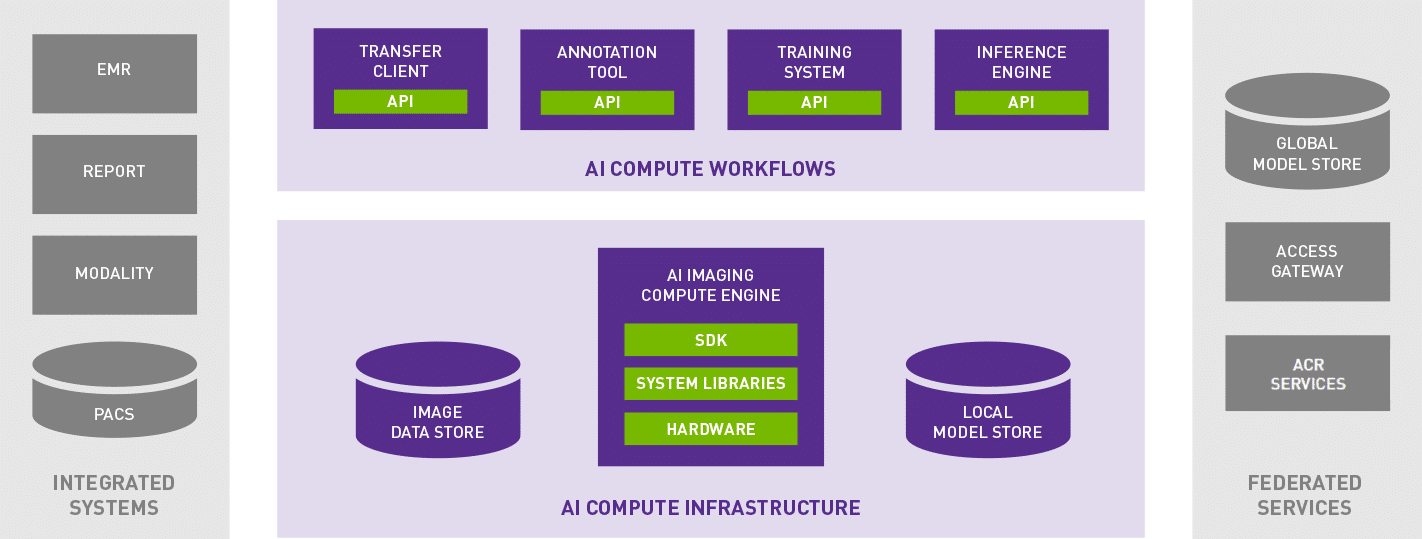
To drive an effective AI program within a healthcare institution, there must first be an understanding of the workflows involved, compute needs and data required. It comes from a foundation of enabling better insights from patient data with easy-to deploy compute at the edge.
Using a transfer client, seed models can be downloaded from a centralized model store. A clinical champion uses an annotation tool to locally create data that can be used for fine-tuning the seed model or training a new model. Then, using the training system with the annotated data, a localized model is instantiated. Finally, an inference engine is used to conduct validation and ultimately inference on data within the institution.
These four workflows sit atop AI compute infrastructure, which can be accelerated with NVIDIA GPU technology for best performance, alongside storage for models and annotated studies. These workflows tie back into other hospital systems such as PACS, where medical images are archived.
Three Magic Ingredients: Hospital Data, Clinical AI Workflows, AI Computing
Healthcare institutions don’t have to build the systems to deploy AI tools themselves.
This scalable architecture is designed to support and provide computing power to solutions from different sources. GE Healthcare’s Edison platform now uses NVIDIA’s TRT-IS inference capabilities to help AI run in an optimized way within GPU-powered software and medical devices. This integration makes it easier to deliver AI from multiple vendors into clinical workflows — and is the first example of the AI-LAB’s efforts to help hospitals adopt solutions from different vendors.
Together, Edison with TRT-IS offers a ready-made device inferencing platform that is optimized for GPU-compliant AI, so models built anywhere can be deployed in an existing healthcare workflow.
Hospitals and researchers are empowered to embrace AI technologies without building their own standalone technology or yielding their data to the cloud, which has privacy implications.
The post ACR AI-LAB and NVIDIA Make AI in Hospitals Easy on IT, Accessible to Every Radiologist appeared first on The Official NVIDIA Blog.
[D] GPT-2 for Patents
Hi everyone,
We are fine-tuning GPT-2 for generating patent claims as a new way to innovate. The results are [available](aipatent.wordpress.com) while training, if you are interested.
submitted by /u/js_lee
[link] [comments]