Do you work on, with or around machine learning or AI systems and products? Please fill out the following survey to help us with a research study on AI and ethics in practice! It’s anonymous and shouldn’t take more than 10 minutes. Link: https://mit.co1.qualtrics.com/jfe/form/SV_0Ck1iHi1zFzWahf
I was wondering if anyone has experience using transformer architectures for time series forecasting? Did it work well or if it didn’t why not? In particular has anyone used Transformer-XL? Just intuitively I was thinking it could work well for handling really long term dependencies in time series data. However, I haven’t seen any recent research mentioning it being used outside of NLP.
I’m working on a project in digital signal processing (DSP). To put it simply, I’m trying to create a model that can mimic effects applied to a musical signal. For instance, the domain, X, is clean guitar signal and the range, f(X), is the same guitar signal under some effect, f. This function f could be distortion, chorus, delay, reverb, etc…. All that matters is that f maps a clean guitar signal to some altered signal f: X -> f(X).
My modeling task is to model f without know what the function, f, is exactly. I’ve successfully trained a LSTM model to mimic the effect of chorus and I’m sure I could train a model to model other effects such as delay or reverb.
My issue is that the predictions on new signals take so long. A couple seconds of audio can end up taking minutes to predict. I currently make predictions on a sample-by-sample level (an average sampling rate is 22,000 per second). I’m trying to find a solution that could make predictions (i.e. alter the input signal) in near real-time. Is there a specific type of modeling I can try that will results in a model that can make fast predictions? Or do you have any ideas on how to take a model and allow it to make near real-time predictions? The thing is that in reality these affects can be applied so quickly because they are simple transformations. For instance, chorus is just a result of phase-shifting a signal and adding it back to the original signal. Any help is appreciated. Thanks!
The Goldman Sachs Group, Inc. is a leading global investment banking, securities and investment management firm that provides a wide range of financial services to a substantial and diversified client base that includes corporations, financial institutions, governments and individuals. Goldman Sachs makes key decisions by taking a calculated risk, based on data and evidence. As a Data Science practitioner, your analysis might have first hand impact to make millions of dollars. The FAST (Franchise Analytics Strategy and Technology) team at Goldman Sachs is a group of data scientists and engineers who are responsible for generating insights and creating products that turn big data into easily digestible takeaways. In essence, the FAST team is comprised of data experts who help other professionals at Goldman Sachs act on relevant insights.
The first step is the phone screen with hiring manager person. There is usually a hackerank/coderpad coding assignment involved for an ML/Data Engineer type of role. If that goes well, there is an onsite interview. The onsite interview is usually 4–6 people deep dive into analysis, probability and stats, coding and data science concepts.
How to treat missing and null values in a dataset?
Given N noodles in a bowl and randomly attaching ends. What is the expected number of loops you will have in the end?
How to remove duplicates without distinct from a database table?
When is value at risk inappropriate?
What is the Wiener process?
A = [-2 -1] [9 4]. What is A¹⁰⁰⁰?
Write an algorithm for a tree traversal.
Write a program for Levenshtein Distance calculation.
Count the total number of trees in the states.
Reflecting on the Questions
GS is one of the best places to work for because they really take care of their people. The questions reflect a mix of puzzles and analysis based questions which form the basis of financial investments in general. Thinking on your feet is very important as puzzles can get complicated. A great presence of mind and ample preparation can surely land you a job with one of the most prestigious investment banks in the world!
Subscribe to our Acing AI newsletter, I promise not to spam and its FREE!
Thanks for reading! 😊 If you enjoyed it, test how many times can you hit 👏 in 5 seconds. It’s great cardio for your fingers AND will help other people see the story.
The Leaders Prize will award $1 million to the team who can best use artificial intelligence to automate the fact-checking process and flag whether a claim is true or false. Not many teams have signed up yet, so we are posting about the competition here to encourage more teams to participate.
The words “data science” often inspire feelings of dread or confusion.
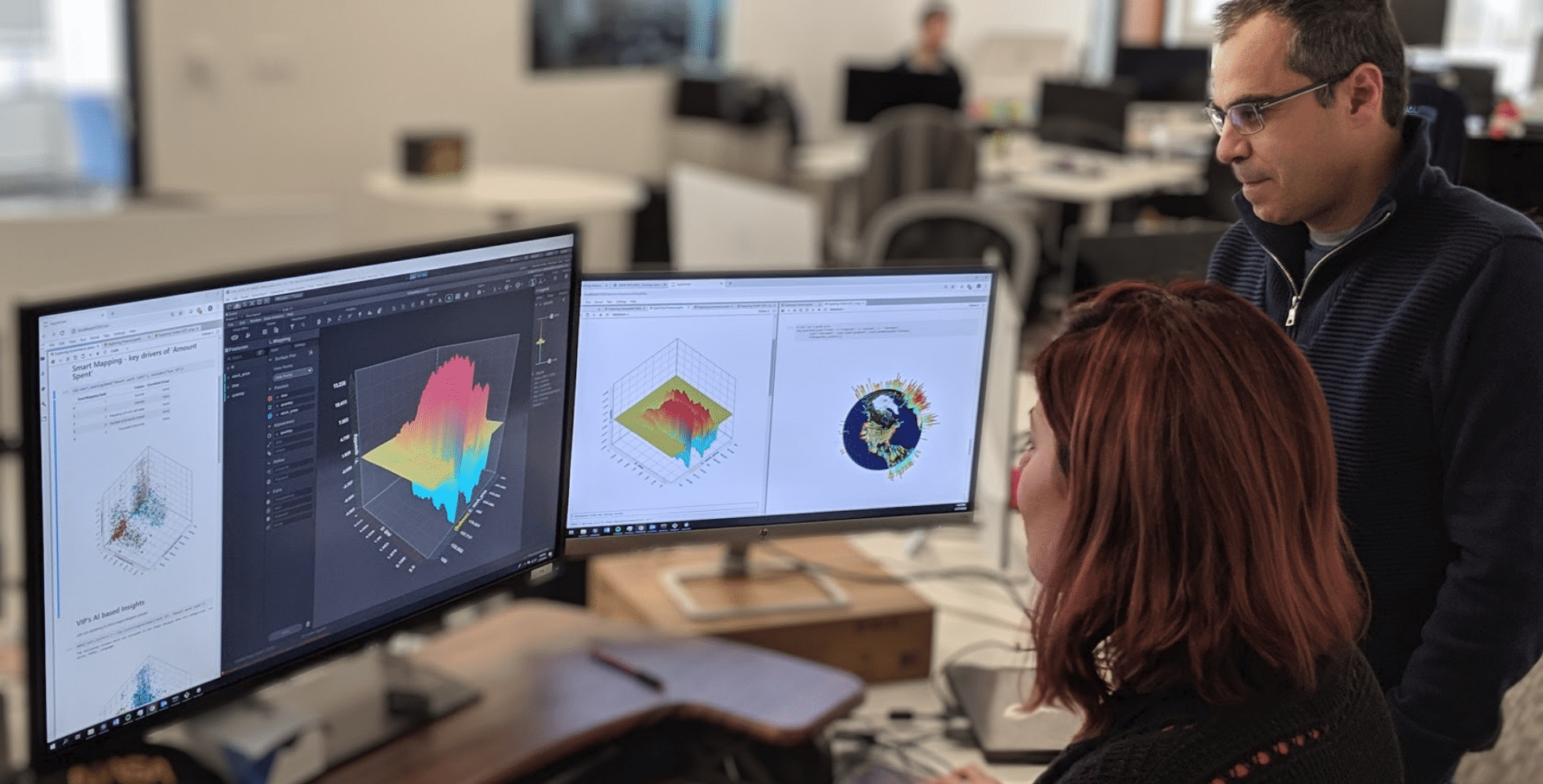
But Virtualitics, an AI-based analytics platform, is bringing creativity and excitement to the field through machine learning and immersive visualization.
Head of Machine Learning Projects Aakash Indurkhya spoke with AI Podcast host Noah Kravitz about why combining AI and VR can be so useful.
“Just comparing two variables against each other is no longer good enough,” Indurkhya says.
Virtualitics, an AI-based analytics platform, is bringing creativity and excitement to the data analytics through machine learning and immersive visualization.
And as datasets grow, it is no longer intuitive what variables should be plotted against each other.
Even expert data scientists could take hours — or even weeks — trying to ascertain the most useful visualizations and models to make sense of the data.
Virtualitics Immersive Platform, or VIP, has a two-pronged approach to simplifying data science.
First, there are embedded machine learning routines, which includes a Smart Mapping tool that determines the best way of plotting data and identifies drivers of the client’s Key Performance Indicator — or KPI.
Indurkhya explains that, using AI, the software “immediately ranks your features in terms of which ones matter to your KPI and then also automatically generates a visualization so you can start looking at how those different combinations of features actually shape the relationship with the KPI.”
The second part of Virtualitics’ solution is their Shared Virtual Office, or SVO, in both Desktop and Virtual Reality. The technology is built on top of the Unity engine, and works with all major VR providers, such as Oculus and Windows MR devices.
VIP not only creates interactive and colorful visuals, but allows clients to have their own avatars through which they can, “like Iron Man,” collaboratively interact with their data.
For those who are less experienced with data science, this bridges the gap created by a lack of formal training, allowing them to identify clusters or detect anomalies on their own in a matter of seconds. And for expert data scientists, who deal with high demand and complex tasks, it gives them the technology to demonstrate to what they are doing to stakeholders.
In the future, Virtualitics will be working on visualizing networks, which are the common thread between technologies like IoT, blockchain, and social media.
“Network data is all around us but we lack intuitive and visual tools to properly make sense of them.” Indurkhya says, “With VR, we get the depth perception and interaction that’s lost when constrained to 2D screens. This is going to change how people think about networks.”
The applications go so far as improving disease classification, monitoring cybersecurity threats, and the identification of bad actors in social networks.
To learn more about Virtualitics, sign up for a demo, or watch their webinars, visit their website.
Your answers will help us learn more about our audience, which will help us deliver podcasts that meet your needs, what we can do better, and what we’re doing right.
Hello, I’ve stumbled upon an extremely interesting dataset http://www2.informatik.uni-freiburg.de/~cziegler/BX/ regarding book recommendation engine. The dataset has been already uploaded on Kaggle but it’s not public. Thus, I’d like to share it here for those who want to try by themself or are open to co-operate on the project with me. I’ve already done some construct on collaborative filtering, content-based filtering, svd and matrix factorization, …