
Blog

Learn About Our Meetup

5000+ Members

MEETUPS

LEARN, CONNECT, SHARE

Join our meetup, learn, connect, share, and get to know your Toronto AI community. 

JOB POSTINGS

INDEED POSTINGS

Browse through the latest deep learning, ai, machine learning postings from Indeed for the GTA.

CONTACT

CONNECT WITH US

Are you looking to sponsor space, be a speaker, or volunteer, feel free to give us a shout.

Author: torontoai

[P] Deploy GPT-2 on AWS

I wrote a post about how I deployed OpenAI’s GPT-2 as a web API on my AWS account. I used code from the OpenAI repo to download and export the model and Cortex to run it on AWS.

You can use this command to test out the API:

curl -k -X POST -H "Content-Type: application/json" -d '{"samples":[{"text": "machine learning"}]}' https://aefa719d5c44011e9adc30ea9bac8e9a-1873012518.us-west-2.elb.amazonaws.com/text/generator 

submitted by /u/ospillinger
[link] [comments]

Making daily dinner easy with Deliveroo meals and Amazon Rekognition

When Software Engineer Florian Thomas describes Deliveroo, he is talking about a rapidly growing, highly in-demand company. Everyone must eat, after all, and Deliveroo is, in his words, “on a mission to transform the way you order food.”  Specifically, Deliveroo’s business is partnering with restaurants to bring customers their favorite eats, right to their doorsteps.

Deliveroo started in 2013 when Will Shu, the company’s founder and CEO, moved to London. He discovered a city full of great restaurants, but to his dismay, few of them delivered food. He made it his personal mission to bring the best local restaurants directly to people’s doors. Now, Deliveroo’s team is 2,000 strong and operates across not only the UK but also in 14 other global markets, including Australia, the United Arab Emirates, Hong Kong, and most of Europe.

As they’ve grown, Deliveroo has always kept customers at the center. Delivering their chosen meals in a convenient and timely way is not all that Deliveroo has to offer, though. They’re equally timely, responsive, and creative if something has gone awry with a customer’s order (such as a spilled item). Their service portal allows customers to share an image-based report of the issue.

“We’ve learned that, when things go wrong, customers don’t just want to tell us, they want to show us,” remarked Thomas. In addition to enabling the customer care team to provide a solution for each customer, these images are shared with Deliveroo’s restaurant partners to help them continue to improve customers’ experiences.

What Thomas and his team soon realized, though, was that not all of the images that customers uploaded were appropriate. To protect the customer care team from having to sift through any inappropriate images, Deliveroo uses Amazon Rekognition. This easy-to-use content moderation solution has become integral to Deliveroo’s customer care flow, as hundreds of photos per week (about 1.7% of all images submitted) are rejected.

“With Amazon Rekognition, we’re able to quickly and accurately process all those photos in real time, which helps us serve our customers promptly when real issues have arisen. That also lets us free our agents’ time so they can focus on the customer problems that matter,” Thomas explained. “Amazon Rekognition allows our agents to safely respond to important customer issues in a timely manner and ensures that legitimate customer claims are handled automatically.”

The choice to use Amazon Rekognition was a natural one for Deliveroo, as the company has been using AWS for a long time. The team originally selected AWS because of their trust in the service. Now, they use Amazon Simple Storage Service (Amazon S3) to store the photos that go into the customer service queue, which streamlines their flow into analysis with Amazon Rekognition. This flow is pictured in the diagram. In addition, the Deliveroo customer care team is using Amazon DynamoDB and AWS Lambda to achieve resolutions faster, as well as Amazon Aurora to manage customer issues.
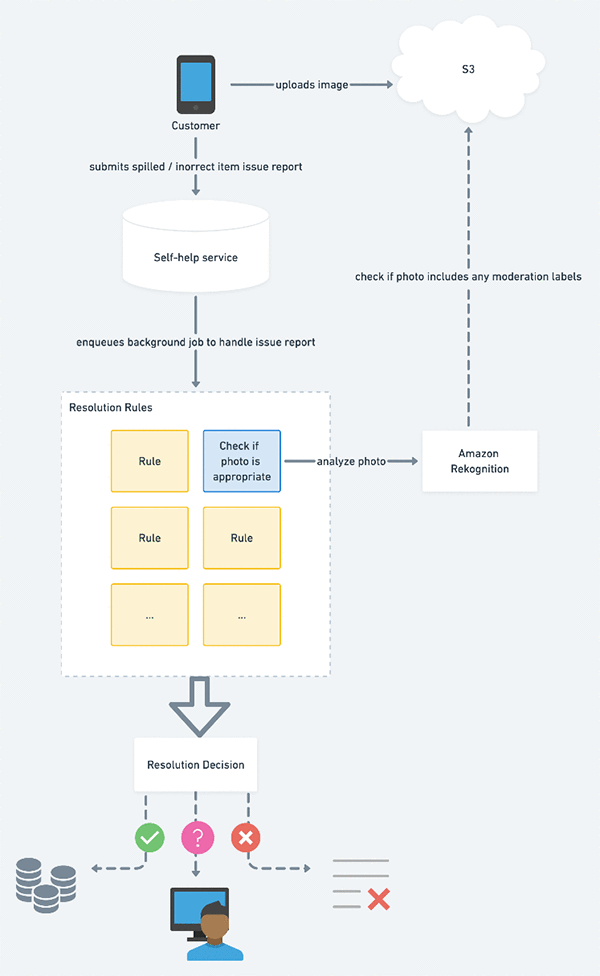
Going forward, Deliveroo’s customer care team plans to use additional AWS machine learning services, such as Amazon Comprehend, to personalize the post-order care experience for each Deliveroo customer. “We’re hungry for what’s next,” Thomas said laughingly.


About the Author

Marisa Messina is on the AWS ML marketing team, where her job includes identifying the most innovative AWS-using customers and showcasing their inspiring stories. Prior to AWS, she worked on consumer-facing hardware and then university-facing cloud offerings at Microsoft. Outside of work, she enjoys exploring the Pacific Northwest hiking trails, cooking without recipes, and dancing in the rain.


[Discussion] What tools and techniques do you use for neural network research? (can range from software to hardware stack)

I will take two examples to illustrate the discussion.

So from the hardware accelerator design perspective
If you take a look at the BitFusion Paper : Github –> https://github.com/hsharma35/bitfusion
: ArXiv –> https://arxiv.org/pdf/1712.01507

If you look at the Quantized Neural networks example
Github — > https://github.com/MatthieuCourbariaux/BinaryNet
https://github.com/itayhubara/BinaryNet
ArXiv — > https://arxiv.org/pdf/1609.07061

So one can see from reading the papers and the code what tools were used for the experimentation. Here the first one uses some hardware modelling tools (like CACTI) to get preliminary results. In the case of the latter they use torch and theano and modify it to get the results (as far as I understand).

So are there any other suggestions that the Machine learning community would like to mention?

submitted by /u/elhiruko
[link] [comments]

[P] Robustness: a library for training and experimenting with standard and robust training

Hi all,

Robustness is a library we made for use in our research that has evolved over several projects we have used it in. The result is a library for standard and robust (adversarial) training that is designed to be super extendible/customizable with very minimal effort. For example, the library allows us to train networks with custom loss functions, adversaries, logging, data loaders, etc, and also to perform a variety of input manipulation tasks using pretrained networks. Finally we provide a CLI interface for training standard and robust models.

Code is here: https://github.com/MadryLab/robustness

Full documentation, walkthroughs, and examples are here: https://robustness.readthedocs.io/

submitted by /u/andrew_ilyas
[link] [comments]

[Discussion] Scikit-Learn vs mlr for Machine Learning

Just curious what most people use/prefer here? I assume that ‘python is eating the data science world‘ so i would lean towards Scikit Learn. Could I be wrong? Does it depend on the user? Does it even matter?

“Scikit-Learn is known for its easily understandable API and for Python users and MLR became and alternative to the popular Caret package with more a large suite of algorithms available and an easy way of tuning hyperparameters. These two packages are somewhat in competition due to the debate where many people involved in analytics turn to Python for machine learning and R for statistical analysis.

One of the reasons for a preference to Python could be because that current R packages for machine learning are provided via other packages that contain the algorithm. The packages are called through MLR but still requires extra installation. Even external feature selection libraries are needed and they will have other external dependencies that need to be satisfied as well.”

– source https://blog.exxactcorp.com/scikitlearn-vs-mlr-for-machine-learning/

submitted by /u/exxact-jm
[link] [comments]

[R] Acting without Rewards

Hello,

Here is our latest blog post. It is an “aside” from our regular demos – we have two new ones in the works, but we thought it would be interesting to share some research we did in the meantime.

Link the the post: https://ogma.ai/2019/08/acting-without-rewards/

The post talks about unsupervised behavior learning (UBL), a method for having an agent learn from every interaction with its environment. This method is similar in purpose to hindsight experience replay (HER), but functions very differently and offers different advantages.

Let us know what you think!

submitted by /u/CireNeikual
[link] [comments]