 With less than 40 days to re:Invent 2019, the excitement is building up and we are looking forward to seeing you all soon! Continuing our journey on artificial intelligence and machine learning, we are bringing a lot of technical content this year, with over 200 breakout sessions, deep-dive chalk talks, hands-on exercises with workshops featuring Amazon SageMaker, AWS DeepRacer, and deep learning frameworks such as TensorFlow, PyTorch, and more. You’ll hear from many customers including Vanguard, BBC, Autodesk, British Airways, Fannie Mae, Thermo Fisher, Intuit, and many more. We are also hosting the Machine Learning Summit again this year, where you will hear from researchers and entrepreneurs about the latest breakthroughs today and the future possibilities tomorrow.
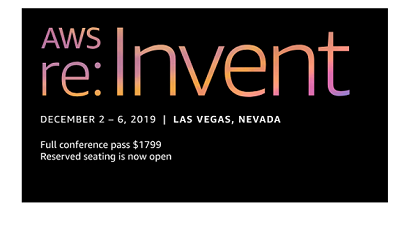
To get you started on planning, here are a few highlights for the AI and ML sessions from the re:Invent 2019 session catalog. The reserved seating is now open, so get your seats in advance for your favorite sessions.
Getting started
If you are new to AI and ML, we have some sessions for you to get started and learn these concepts. These sessions cover the basics including overviews and demos for Amazon SageMaker, the different AI services for many applications, and the popular AWS DeepLens and AWS DeepRacer to help you learn, while having fun.
Leadership session: Machine Learning (Session AIM218-L)
As we embark on the golden age of machine learning, we are seeing the constraints and blockers disappear, and the value extending across different industries. In this leadership session, learn about the latest machine learning offerings from AWS as we explore the democratization of machine learning. We will discuss the breadth and depth of our machine learning services and you will hear from customers who are partnering with AWS on this journey.
Amazon SageMaker deep dive: A modular solution for machine learning (Session AIM307)
Amazon SageMaker is a fully managed service enabling all developers and data scientists with every aspect of the machine learning workflow. In this session, we will discuss the technical details of Amazon SageMaker to help you with your machine learning journey to get your ML models from experimentation to production at scale. We will also discuss practical deployments through real-world customer examples.
Starting the enterprise machine learning journey (Session AIM205)
Amazon has been investing in machine learning for more than 20 years, innovating in areas such as fulfillment and logistics, personalization and recommendations, forecasting, fraud prevention, and supply chain optimization. During this session, we take this expertise and show you how to identify business problems that can be solved with machine learning. We discuss considerations including selecting the right use case for a machine learning pilot, nurturing skills, and measuring the success of such pilots.
Finding a needle in a haystack: Use AI to transform content management (Session AIM206)
Finding digital content, from documents to media, can be frustrating and time-consuming. Across your employees or customers, this challenge can waste hours, derail projects, and create poor experiences. In this breakout session, learn how to use language and vision AI services to extract data, insights, and trends from all of your digital content, with a focus on how to more effectively manage your documents and find what you need.
Get started with AWS DeepRacer (Workshop AIM207)
Get behind the keyboard for an immersive experience with AWS DeepRacer. Developers with no prior machine learning experience learn new skills and apply their knowledge in a fun and exciting way. With the help of the AWS pit crew, build and train a reinforcement learning model that you can race on the tracks and win special AWS prizes, in this one of many workshops for AWS DeepRacer. See the “Advanced topics in machine learning” section for an advanced version of this workshop.
Start using computer vision with AWS DeepLens (Workshop AIM229)
If you’re new to deep learning, this workshop is for you. Learn how to build and deploy computer-vision models using the AWS DeepLens deep-learning-enabled video camera. Also learn how to build a machine learning application and a model from scratch using Amazon SageMaker. Finally, learn to extend that model to Amazon SageMaker to build an end-to-end AI application. See the “Advanced topics in machine learning” section for an advanced version of this workshop.
Improve machine learning model quality in response to changes in data (Session AIM213)
Machine learning models are typically trained and evaluated using historical data. But the real-world data may not look like the training data, especially as models age over time and the distribution of data changes. This gradual variance of the model from the real world is known as model drift, and it can have a big impact on prediction quality. This session explores techniques you can use to monitor prediction quality in production, as well as effective corrective actions such as auditing and iterative retraining.
Practical applications of machine learning
The biggest value for machine learning is its applicability across different industries. In these sessions, chalk talks, and workshops, we will dive deep into the practical aspects of machine learning for specific industries including finance, healthcare, retail, media and entertainment, manufacturing, and more.
Transforming Healthcare with AI (Session AIM210)
Improving patient care, making treatment decisions, managing clinical trials, and more are all moving into a new age due to advancements in AI. In this session, we cover AI solutions specific to the Healthcare industry, from extracting relevant medical information from patient records and clinical trial reports to automating the clinical documentation process with automatic speech recognition. Hear directly from our customers and come away with answers on how to get started immediately.
ML in retail: Solutions that add intelligence to your business (Session AIM212)
Machine learning is ranked the number-one “game changer” for the retail market segment by chief experience officers (CXOs), yet it’s only number eight on top spending priorities. So which scenarios are real? In this session, we dive into how AWS puts machine learning in the hands of every developer, without the need for deep machine learning experience. Learn about personalized product recommendations, inventory forecasting, new in-store experiences, and more. Learn from our experience at Amazon.com and hear from our customers today.
AI document processing for business automation (Session AIM211)
Millions of times per day, customers from the Finance, Healthcare, public, and other sectors rely on information that is locked in documents. Amazon Textract uses artificial intelligence to “read” such documents as a person would, to extract not only text but also tables, forms, and other structured data without configuration, training, or custom code. In this session, we demonstrate how you can use Amazon Textract to automate business processes with AI. You also hear directly from our customers about how they accelerated their own business processes with Amazon Textract.
Predict future business outcomes using Amazon Forecast (Session AIM312)
Based on the same technology used at Amazon.com, Amazon Forecast uses machine learning and time-series data to build accurate business forecasts. In this session, learn how machine learning can improve accuracy in demand forecasting, financial planning, and resource allocation while reducing your forecasting time from months to hours.
Build accurate training datasets with Amazon SageMaker Ground Truth (Session AIM308)
Successful machine learning models are built on high-quality training datasets. Typically, the task of data labeling is distributed across a large number of humans, adding significant overhead and cost. This session explains how Amazon SageMaker Ground Truth reduces cost and complexity using techniques designed to improve labeling accuracy and reduce human effort. We will walk through best practices for building highly accurate training datasets and discuss how you can use Amazon SageMaker Ground Truth to implement them.
Build predictive maintenance systems with Amazon SageMaker (Chalk Talk AIM328)
Across a wide spectrum of industries, customers are starting to use prediction maintenance models to proactively fix problems before they impact production. The result is an optimized supply chain and improved working conditions. In this session, learn how to use data from equipment to build, train, and deploy predictive models. We dive deep into the architecture for using the turbofan degradation simulation dataset to train the model to recognize potential equipment failures and share details.
Build a fraud detection system with Amazon SageMaker (Workshop AIM359)
In this workshop, we will explore the new AWS Fraud Detection Solution. We show you how to build, train, and deploy a fraud detection machine learning model. The fraud detection model recognizes fraud patterns, and is self-learning that enables it to adapt to new, unknown fraud patterns. We will show you how to execute automated transaction processing, and how to the Fraud Detection solution flags that activity for review.
Delight your customers with ML-based personalized recommendations (Session AIM323)
Recommendation engines make targeted marketing campaigns, re-ranking of items, personalized notifications, and personalized search possible. In this session, we deep-dive into using Amazon Personalize to create and manage personalized recommendations efficiently, letting you focus on the real value of the data for your business. We discover how these deep learning techniques have a direct impact on the bottom line of your business by increasing engagement, click-through, satisfaction, and revenue. Learn from customer examples and dive into some live demonstrations.
Accelerate time-series forecasting with Amazon Forecast (Workshop AIM335)
Based on the same technology used at Amazon.com, Amazon Forecast uses machine learning to combine time-series data with additional variables to build up to 50% more accurate forecasts. In this workshop, prepare a dataset, build models based on that dataset, evaluate a model’s performance based on real observations, and learn how to evaluate the value of a forecast compared with another. Gain the skills to make decisions that will impact the bottom line of your business.
Build a content-recommendation engine with Amazon Personalize (Workshop AIM304)
Machine learning is being used increasingly to improve customer engagement by powering personalized product and content recommendations. Amazon Personalize lets you easily build sophisticated personalization capabilities into your applications, using machine learning technology perfected from years of use on Amazon.com. In this workshop, you build your own recommendation engine by providing training data, building a model based on the algorithm of your choice, testing the model by deploying your Amazon Personalize campaign, and integrating it into your own application.
Advanced topics in machine learning
We have a number of sessions that will dive deep into the technical details of machine learning across our service portfolio as well as deep learning frameworks including TensorFlow, PyTorch, and Apache MXNet. These code-level sessions and hands-on workshops will enable the advanced developer or data scientist in you to customize, integrate, and solve many challenges with deep technical solutions.
Deep learning with TensorFlow (Session AIM410, Workshop AIM401)
TensorFlow is of the most popular open-source deep learning frameworks used in machine learning development. The advanced breakout session will dive deep into training machine learning models with TensorFlow using Amazon SageMaker, including distributed training, cost-effective inference, and workflow management. The code-level workshop will include hands-on exercises where we will train and deploy TensorFlow models, apply automatic model tuning using Amazon SageMaker, and make predictions in production.
Deep learning with PyTorch (Session AIM412, Workshop AIM402)
PyTorch is rapidly gaining popularity in the industry as a deep learning framework used to transition seamlessly from research prototyping to production deployment. In the breakout session, you will lern how to develop deep learning models with PyTorch using Amazon SageMaker for multiple use cases including using a BERT model and instance segmentation for fine-grain computer vision. In the workshop, you will build a natural language processing model to analyze text.
Deep learning with Apache MXNet (Session AIM411, Workshop AIM403)
Apache MXNet has been a widely used deep learning framework on diverse applications such as computer vision, speech recognition, and natural language processing (NLP). The breakout session will discuss on building computer vision and NLP models using MXNet to automatically extract information from documents. In the workshop, we will build a computer vision model using MXNet and train the model for high accuracy, and finally deploy it to production using Amazon SageMaker.
Deep dive on Project Jupyter (Session AIM413)
Amazon SageMaker offers fully managed Jupyter notebooks that you can use in the cloud so you can explore and visualize data and develop your machine learning model. In this session, we explain why we picked Jupyter notebooks, and how and why AWS is contributing to Project Jupyter. We dive deep into our overall strategy for Jupyter and explain different use cases for Jupyter, including data science, analytics, and simulation.
Under the hood of AWS DeepRacer: Advanced RL driving course (Workshop AIM428)
This technical deep dive is suitable for advanced machine learning developers looking to learn more complex reinforcement learning concepts using AWS DeepRacer and Amazon SageMaker RL. AWS data scientists help you build models that require innovations in neural network architecture, expand the algorithms, and help you customize your AWS DeepRacer model for performance. We also dive deep into the technology under the hood that powers the AWS DeepRacer car.
Optimize deep learning models for edge deployments with AWS DeepLens (Workshop AIM405)
In this workshop, learn how to optimize your computer vision pipelines for edge deployments with AWS DeepLens and Amazon SageMaker Neo. Also learn how to build a sample object detection model with Amazon SageMaker and deploy it to AWS DeepLens. Finally, learn how to optimize your deep learning models and code to achieve faster performance for use cases where speed matters.
Take an ML model from idea to production using Amazon SageMaker (Workshop AIM427)
Come build the most accurate text-classification model possible with Amazon SageMaker. This service lets you build, train, and deploy ML models using built-in or custom algorithms. In this workshop, learn how to leverage Keras/TensorFlow deep-learning frameworks to build a text-classification solution using custom algorithms on Amazon SageMaker. We walk you through packaging custom training code in a Docker container, testing it locally, and then using Amazon SageMaker to train a deep-learning model. You then try to iteratively improve the model to achieve high accuracy. Finally, you deploy the model in production so applications can leverage the classification service.
Implement ML workflows with Kubernetes and Amazon SageMaker (Session AIM326)
Until recently, data scientists have spent much time performing operational tasks, such as ensuring that frameworks, runtimes, and drivers for CPUs and GPUs work well together. In addition, data scientists needed to design and build end-to-end machine learning (ML) pipelines to orchestrate complex ML workflows for deploying ML models in production. With Amazon SageMaker, data scientists can now focus on creating the best possible models while enabling organizations to easily build and automate end-to-end ML pipelines. In this session, we dive deep into Amazon SageMaker and container technologies, and we discuss how easy it is to integrate such tasks as model training and deployment into Kubernetes and Kubeflow-based ML pipelines.
Security for ML environments with Amazon SageMaker (Session AIM327)
Amazon SageMaker is a modular, fully managed platform that enables developers and data scientists to quickly and easily build, train, and deploy machine learning models at any scale. In this session, we dive deep into the security configurations of Amazon SageMaker components, including notebooks, training, and hosting endpoints. Vanguard joins us to discuss the company’s use of Amazon SageMaker and its implementation of key controls in a highly regulated environment, including fine-grained access control, end-to-end encryption in transit, and comprehensive audit trails for resource and data access. If you want to build secure ML environments, this session is for you.
Machine Learning Summit
Whether you are a data scientist, machine learning practitioner, or business professional, you’ll enjoy the Machine Learning Summit at this year’s re:Invent, which will showcase advances in machine learning as well as the emerging trends. From disaster management to pediatrics, from fighting fake news to indoor farming, you will hear experts share their knowledge and perspectives.
Some of the sessions include:
Deep Learning for Disaster Management and Response
Cornelia Caragea, Associate Professor, Science and Engineering Offices,
Computer Science, University of Illinois at Chicago
Fighting Fake News and Deep Fakes with Machine Learning
Delip Rao, Vice President of Research at the AI Foundation
Deep Learning in Deep Nets: Helping Fish Farmers Feed the World
Bryton Shang, Founder and CEO, Aquabyte
Big Data for Tiny Patients: Applying ML to Pediatrics
Dr. Judith Dexheimer, Associate Professor, UC Department of Pediatrics,
Cincinnati Children’s Hospital Medical Center
Machine Learning and Society: Bias, Fairness and Explainability
Pietro Perona, Amazon Fellow, AWS
From Seed to Store: Using AI to Optimize the Indoor Farms of the Future
Henry Sztul, SVP, Science and Technology, Bowery Farming
The Machine Learning Summit will inform you about what’s on the horizon for machine learning. The event is scheduled for Tuesday, December 3, 2019, from 1:30 PM to 6 PM at the Venetian Theater. Visit the summit home page and register today.
About the Author
 Shyam Srinivasan is on the AWS Machine Learning marketing team. He cares about making the world a better place through technology and loves being part of this journey. In his spare time, Shyam loves to run, travel, and have fun with his family and friends.
![[P] 10K Downloads Special 🎉: gpt2-client accepting all feature requests!](https://b.thumbs.redditmedia.com/_lAcaaoBRBFW22FJK8_6_wOVz_lCx77MNGOSXx2Afms.jpg "[P] 10K Downloads Special 🎉: gpt2-client accepting all feature requests!")
![[R] AI Benchmark: All About Deep Learning on Smartphones in 2019](https://b.thumbs.redditmedia.com/zRI6wmwZoDv2EnOHERHMzBzq9hE1Oop7zqPuhHi7r4Y.jpg "[R] AI Benchmark: All About Deep Learning on Smartphones in 2019")