Blog

Learn About Our Meetup

5000+ Members

MEETUPS

LEARN, CONNECT, SHARE

Join our meetup, learn, connect, share, and get to know your Toronto AI community. 

JOB POSTINGS

INDEED POSTINGS

Browse through the latest deep learning, ai, machine learning postings from Indeed for the GTA.

CONTACT

CONNECT WITH US

Are you looking to sponsor space, be a speaker, or volunteer, feel free to give us a shout.

Author: torontoai

AWS Machine Learning Research Awards Call for Proposal

Academic research and open-source software development are at the forefront of machine learning (ML) technology development. Since 2017, the AWS Machine Learning Research Awards (MLRA) has been aiming to advance machine learning by funding innovative research, training students, and providing researchers with access to the latest technology. MLRA has supported over 100 cutting-edge ML projects, with topics such as ML algorithms, computer vision, natural language processing, medical research, neuroscience, social science, physics, and robotics. Many of the MLRA-backed projects have received media coverage, for example, Researchers are Using Machine Learning to Screen for Autism in Children, The Robotic Future: Where Bots Operate Together and Learn from Each Other, Autonomous Vehicles: The Answer to Our Growing Traffic Woes, Amazon Gives AI to Harvard Hospital in Tech’s Latest Health Push, and Facebook’s Fight to Prevent Deepfake Dystopia Gets a Powerful Partner in Amazon Web Services.

AWS is pleased to announce that MLRA is now calling for proposals for the Q4 2019 cycle, and welcomes faculty members at accredited (Ph.D. granting) academic institutions and researchers at non-profit organizations to apply. The following types of projects are eligible for MLRA funding:

MLRA may provide unrestricted cash funds, AWS Promotional Credit, and training resources, including tutorials on how to run ML on AWS and hands-on sessions with Amazon scientists and engineers.

The average awarded amount is no more than $70,000 cash and $100,000 AWS Promotional Credits for individual projects. The actual amount awarded depends on the nature of the project. An internal advisory board at AWS reviews the proposals and makes funding decisions based on potential impact to the ML community, quality of the scientific content, and extent of usage of AWS AI/ML Services.

The submission deadline is at 11:59 PM (PST), December 8, 2019, and decision letters are sent out approximately three months after the submission deadline.

To get started with your application, please consult the MLRA website or send an email to aws-ml-research-awards@amazon.com. We look forward to receiving your applications!


About the Author

An Luo, PhD, is a Senior Technical Program Manager at AWS. An spent many years applying machine learning to biomedical research. Now, she focuses on enabling and accelerating machine learning research leveraging AWS AI/ML technologies.


[D] Is there any AI capable of playing a simulation racing Game like iRacing or Asseto Corsa?

I’m looking for resources/papers where someone has tried to create an AI that can play a simulation racing game like IRacing, Assetto Corsa or Project Cars 2. I know that there are nets that can play basic racing games like mario kart but I was wondering if there are ones that can play in a complex physics environment where you need to employ real strategies to win at a competitive level.

submitted by /u/andymus1
[link] [comments]

[D] Code examples in paper (instead of pseudo code)

I’m a PhD candidate and not that experienced in research yet, so forgive me for a somewhat basic question.

I’m reviewing a paper that includes a short (~15 lines) code example in Julia. I’m not a big fan of this, I think they should consider using pseudo code and connect it to the math used in the paper.

Is it acceptable to use actual code examples in a paper?

submitted by /u/schludy
[link] [comments]

[Discussion] A Questionable SIGIR 2019 Paper

I recently read the paper “Adversarial Training for Review-Based Recommendations” published on the SIGIR 2019 conference. I noticed that this paper is almost exactly the same as the paper “Why I like it: Multi-task Learning for Recommendation and Explanation” published on the RecSys 2018 conference.

At first, I thought it is just a coincidence. It is likely for researchers to have similar ideas. Therefore it is possible that two research groups independently working on the same problem come up with the same solution. However, after thoroughly reading and comparing the two papers, now I believe that the SIGIR 2019 paper is plagiarizing the RecSys 2018 paper.

The model proposed in the SIGIR 2019 paper is almost a replicate of the model in the RecSys 2018 paper. (1) Both papers used an adversarial sequence-to-sequence learning model on top of the matrix factorization framework. (2) For the generator and discriminator part, both papers use GRU for generator and CNN for discriminator. (3) The optimization methodology is the same, i.e. alternating optimization between two parts. (4) The evaluations are the same, i.e. evaluating MSE for recommendation performance and evaluating the accuracy for discriminator to show that the generator has learned to generate relevant reviews. (5) The notations and also the formulas that have been used by the two papers look extremely similar.

While ideas can be similar given that adversarial training has been prevalent in the literature for a while, it is suspicious for the SIGIR 2019 paper to have large amount of text overlaps with the RecSys 2018 paper.

Consider the following two sentences:

(1) “The Deep Cooperative Neural Network (DeepCoNN) model user-item interactions based on review texts by utilizing a factorization machine model on top of two convolutional neural networks.” in Section 1 of the SIGIR 2019 paper.

(2) “Deep Cooperative Neural Network (DeepCoNN) model user-item interactions based on review texts by utilizing a factorization machine model on top of two convolutional neural networks.” in Section 2 of the RecSys 2018 paper.

I think this is the most obvious sign of plagiarism. If you search Google for this sentence using “exact match”, you will find that this sentence is only used by these two papers. It is hard to believe that the authors of the SIGIR 2019 paper could come up with the exact same sentence without reading the RecSys 2018 paper.

As another example:

(1) “The decoder employs a single GRU that iteratively produces reviews word by word. In particular, at time step $t$ the GRU first maps the output representation $z_{ut-1}$ of the previous time step into a $k$-dimensional vector $y_{ut-1}$ and concatenates it with $bar{U_{u}}$ to generate a new vector $y_{ut}$. Finally, $y_{ut}$ is fed to the GRU to obtain the hidden representation $h_{t}$, and then $h_{t}$ is multiplied by an output projection matrix and passed through a softmax over all the words in the vocabulary of the document to represent the probability of each word. The output word $z_{ut}$ at time step $t$ is sampled from the multinomial distribution given by the softmax.” in Section 2.1 of the SIGIR 2019 paper.

(2) “The user review decoder utilizes a single decoder GRU that iteratively generates reviews word by word. At time step $t$, the decoder GRU first embeds the output word $y_{i, t-1}$ at the previous time step into the corresponding word vector $x_{i, t-1} in mathcal{R}^{k}$, and then concatenate it with the user textual feature vector $widetilde{U_{i}}$. The concatenated vector is provided as input into the decoder GRU to obtain the hidden activation $h_{t}$. Then the hidden activation is multiplied by an output projection matrix and passed through a softmax over all the words in the vocabulary to represent the probability of each word given the current context. The output word $y_{i, t}$ at time step $t$ is sampled from the multinomial distribution given by the softmax.” in Section 3.1.1 of the RecSys 2018 paper.

In this example, the authors of the SIGIR 2019 paper has replaced some of the phrases in the writing so that the two texts are not exactly the same. However, I believe the similarity of the two texts still shows that the authors of the SIGIR 2019 paper must have read the RecSys 2018 paper before writing their own paper.

I do not intend to go through all the text overlaps between the two papers, but let us see a final example:

(1) “Each word of the review $r$ is mapped to the corresponding word vector, which is then concatenated with a user-specific vector. Notice that the user-specific vectors are learned together with the parameters of the discriminator $D_{theta}$ in the adversarial training of Section 2.3. The concatenated vector representations are then processed by a convolutional layer, followed by a max-pooling layer and a fully-connected projection layer. The final output of the CNN is a sigmoid function which normalizes the probability into the interval of $[0, 1]$”, expressing the probability that the candidate review $r$ is written by user $u$.” in Section 2.2 of the SIGIR 2019 paper.

(2) “To begin with, each word in the review is mapped to the corresponding word vector, which is then concatenated with a user-specific vector that identifies user information. The user-specific vectors are learned together with other parameters during training. The concatenated vector representations are then processed by a convolutional layer, followed by a max-pooling layer and a fully-connected layer. The final output unit is a sigmoid non-linearity, which squashes the probability into the $[0, 1]$ interval.” in Section 3.1.2 of the RecSys 2018 paper.

There is one sentence (“The concatenated vector representations are …… a fully-connected projection layer.”) that is exactly the same in the two papers. Also, I think concatenating the user-specific vectors to every word vector in the review is a very unintuitive idea. I do not think ideas from different research groups can be the same in that granularity of detail. If I were the authors, I will just concatenate the user-specific vectors to the layer before the final projection layer, as it saves computational cost and should lead to better generalization.

As a newbie in information retrieval, I am not sure if such case should be considered as plagiarism. However, as my professor told me that the SIGIR conference is the premier conference in the IR community, I believe that this paper definitely should not be published at a top conference such as SIGIR.

What makes me feel worse is that the two authors of this paper, Dimitrios Rafailidis from Maastricht University, Maastricht, Netherlands and Fabio Crestani from Università della Svizzera italiana (USI), Lugano, Switzerland, are both professors. They should be aware that plagiarism is a big deal in academia.

The link to the papers are https://dl.acm.org/citation.cfm?id=3331313 and https://dl.acm.org/citation.cfm?id=3240365

submitted by /u/joyyeki
[link] [comments]

Bumper Crop of AI Helps Farmers Whack Weeds, Pesticide Use

Weeds compete with neighboring crops for light, water and nutrients, costing the farming industry billions each year in agricultural yield.

To keep a better eye on fields, improve crop yields and reduce the use of pesticides, farmers and agriculture researchers are turning to AI.

“We believe the digital agriculture revolution will help in reducing the use of chemical products in agriculture,” said Adel Hafiane, an associate professor at the Institut National des Sciences Appliquées, in France’s Centre Val de Loire. Hafiane is working with colleagues from the University of Orléans to develop AI that detects weeds from drone images of beet, bean and spinach crops.

“If farmers can map the location of weeds,” he said, “they don’t need to spray chemical products over an entire field — they can just target specific areas, intervening at the right time and site.”

Using the georeferenced coordinates of where an aerial image was captured, farmers can determine the location of weeds in a field. The insights provided by the researchers’ deep learning network could then be deployed in agricultural robots on the ground that can remove or spray weeds in large fields.

Hafiane and his colleagues used a cluster of NVIDIA Quadro GPUs to train the neural networks. Their work was supported by France’s Centre-Val de Loire region.

Deep Learning on Cropped Images

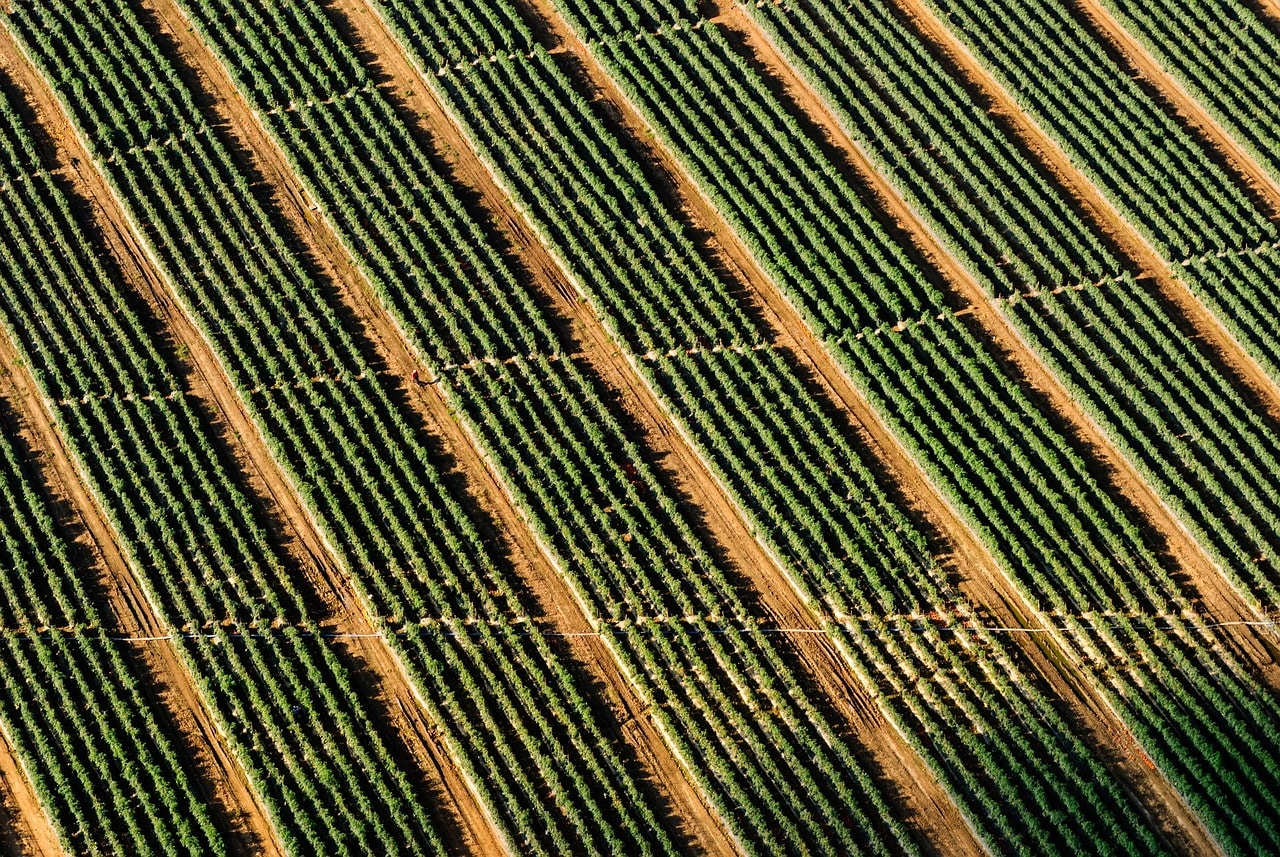
From a few hundred feet in the air, using low-resolution images, it’s not easy to tell the difference between weeds and crops — both are green and leafy. But with sufficient image resolution and enough training data, neural networks can learn to differentiate the two.

Using a dataset of tens of thousands of images for each crop (some labeled, some unlabeled), the team relied on transfer learning based on the popular ImageNet model to develop its deep learning models.

To partially automate the data labeling process, the researchers developed an algorithm that used geometric information in the images to label weeds and crops. Crops are often arranged in neat lines, with open patches of soil between the rows. When spots of green are visible in the space between crop rows, the AI knows it’s likely a weed.

A more complex challenge is detecting weeds within the crop rows. The researchers are working to improve their model’s results on spotting these trickier pests.

Developed using the TensorFlow and Caffe deep learning frameworks, the model recognizes weeds in fields of beets, spinach and beans. At a precision of 93 percent, the AI produced the best results analyzing beet crops.

Hafiane says using NVIDIA Quadro GPUs shrunk training time from one week on a high-end CPU down to a few hours. While the dataset used large, 36-megapixel images, the researchers say further increasing the image resolution captured by the drones would help boost the performance of their neural networks.

The researchers are also using NVIDIA GPUs to train neural networks to detect crop diseases in vineyards, and plan to collaborate with international colleagues to develop similar solutions to monitor other crops.

The post Bumper Crop of AI Helps Farmers Whack Weeds, Pesticide Use appeared first on The Official NVIDIA Blog.

[Discussion] CNN Binary Classifier returning same accuracy in several epochs….

….what do I do?

I have 2000 images each of classes “Mobile” and “Cake”, with a validation split of 0.3. This is the code of the model..

—————————————————————————————-

model = keras.models.Sequential()

model.add(keras.layers.Conv2D(32, (3, 3), activation=’relu’, input_shape=(150, 150, 3)))
model.add(keras.layers.MaxPooling2D((2, 2)))

model.add(keras.layers.Conv2D(64, (3, 3), activation=’relu’))
model.add(keras.layers.MaxPooling2D((2, 2)))

model.add(keras.layers.Conv2D(128, (3, 3), activation=’relu’))
model.add(keras.layers.MaxPooling2D((2, 2)))
model.add(keras.layers.Conv2D(128, (3, 3), activation=’relu’))
model.add(keras.layers.MaxPooling2D((2, 2)))
model.add(keras.layers.Flatten())
model.add(keras.layers.Dropout(0.5))
model.add(keras.layers.Dense(512, activation=’relu’))
model.add(keras.layers.Dense(1, activation=’sigmoid’))
model.compile(loss=’binary_crossentropy’,optimizer=keras.optimizers.RMSprop(lr=((1e-4)/10)),metrics=[‘acc’])
history=model.fit(Xnew,Ynew,1,10,validation_split=0.3)

—————————————————————————————-

Can anyone help me out? The accuracy gets stuck on 0.5280 right from the second epoch. I am a beginner in CNN, and would appreciate some guidance with this. Thanks!

submitted by /u/kirasama16997
[link] [comments]