
Blog

Learn About Our Meetup

5000+ Members

MEETUPS

LEARN, CONNECT, SHARE

Join our meetup, learn, connect, share, and get to know your Toronto AI community. 

JOB POSTINGS

INDEED POSTINGS

Browse through the latest deep learning, ai, machine learning postings from Indeed for the GTA.

CONTACT

CONNECT WITH US

Are you looking to sponsor space, be a speaker, or volunteer, feel free to give us a shout.

Author: torontoai

Robots that Learn to Use Improvised Tools

In many animals, tool-use skills emerge from a combination of observational
learning and experimentation. For example, by watching one another, chimpanzees
can learn how to use twigs to “fish” for insects. Similarly, capuchin
monkeys
demonstrate the ability to wield sticks as sweeping tools to pull
food closer to themselves. While one might wonder whether these are just
illustrations of “monkey see, monkey do,” we believe these tool-use abilities
indicate a greater level of intelligence.
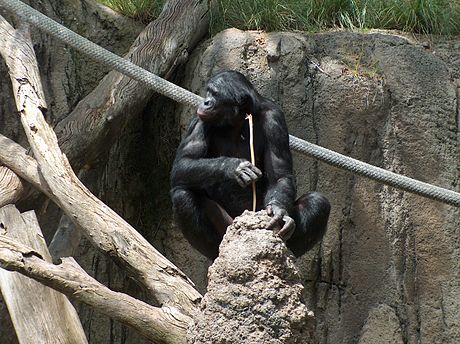
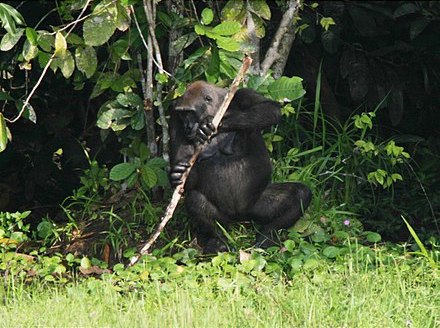

Left: A chimpanzee fishing for termites. Right: A gorilla using a stick to
gather herbs. (source)

The question our new work explores is: can we enable robots to use tools in the
same way — through observation and experimentation?

A requisite for performing complex multi-object manipulation tasks, such as
those involved in tool use, is an understanding of physical cause-and-effect
relationships. Therefore, the ability to predict how one object might
interact with another is crucial. Our prior work has investigated how
visual predictive models of cause-and-effect can be learned from unsupervised
robot interaction with the world. After learning such a model, the robot can
plan to accomplish a diverse set of simple tasks, including cloth folding and
object arrangement. However, if we consider the more complex interactions that
occur in tool-use tasks, such as how a broom can sweep dirt into a dustpan,
undirected experimentation isn’t enough.

Hence, taking inspiration from how animals learn, we designed an algorithm that
allows robots to learn tool-use skills through a similar paradigm of imitation
and interaction. In particular, we show that, with a mix of demonstration data
and unsupervised experience, a robot can use novel objects as tools and even
improvise tools in the absence of traditional ones. Further, depending on the
demands of the task, our method demonstrates the ability to decide whether to
use the provided tools. In this post, we will describe how this works.

Continue reading

[D] Measuring statistical modelling capabilities of neural networks?

Hey,

Does anybody know a method of measuring how well a neural network (theoretically) models a distribution? I’m especially interested in neural machine translation, as there are many ways to model the same distribution but no theoretical framework (as far as I found) to find out which approach is actually more capable. For example one could model p(y|x), with x being the raw data, or being the representation after performing many non linearities on x. Statistically, it is the same (or at least there are many papers where authors claim they are the same), but in practise they give completely different capabilities in the distribution.

Thanks!

submitted by /u/ggNikita
[link] [comments]

[D] Saddle-free Newton method for SGD and other actively repelling saddles – advantages, weaknesses, improvements?

While 2nd order methods have many advantages, e.g. natural gradient (e.g. in L-BFGS) attracts to close zero gradient point, which is usually saddle. Other try to pretend that our very non-convex function is locally convex (e.g. Gauss-Newton, Levenberg-Marquardt, Fisher information matrix e.g. in K-FAC, gradient covariance matrix in TONGA – overview) – again attracting rather not only to local minima (how bad it is?).

There is a belief that the number of saddles is ~exp(dim) larger than of minima. Actively repelling them (instead of attracting) requires control of sign of curvatures (as Hessian eigenvalues) – e.g. negating step sign in these directions.

It is e.g. done in saddle-free Newton method (SFN) ( https://arxiv.org/pdf/1406.2572 ) – 2014, 600+ citations, recent github. They claim to get a few times(!) lower error e.g. on MNIST this way, other methods got stuck on some plateaus with strong negative eigenvalues: https://i.imgur.com/xJLBGgl.png

Here is another very interesting paper: https://arxiv.org/pdf/1902.02366 investigating evolution of eigenvalues of Hessian for 3.3M parameters (~20 terabytes!), for example showing that rare negative curvature directions allow for relatively huge improvements: https://i.imgur.com/SwUasvc.png

So it looks great – it seems that we all should use SFN or other methods actively repelling saddles … but it didn’t happen – why is it so? What are the weaknesses?

What are other promising 2nd order approaches handling saddles?

How can we improve SFN-like methods? For example what I mostly don’t like is directly estimating Hessian from noisy data, what is very problematic numerically. Instead, we are really interested in linear behavior of 1st derivative – we can optimally estimate it with (online) linear regression of gradients: with weakening weights of old gradients. Another issue is focusing on Krylov subspace due to numerical method (Lanczos) – it should be rather based on gradient statistics like their PCA, what again can be made online to get local statistically relevant directions.

submitted by /u/jarekduda
[link] [comments]

[N] Springer publishes journal using ML to generate summaries of research papers ?

Springer published a journal about Li-Batteries which uses ML to generate summaries (with citations) of multiple peer reviewed papers in the subject.

https://link.springer.com/book/10.1007/978-3-030-16800-1

I’m not an Li-battery expert, but the sentences do seem grammatically correct (and sufficiently winding to be scientific publications )

What did you guys think of it ?

submitted by /u/pinkflamingo16
[link] [comments]

[D] Hyperparam optimisation using RandomSearch with argparse scripts?

I tend to write complex model/training scripts in pure python using argparse to pass huge amounts of hyperparameters to the model, and then run these python scripts on multi-gpu EC2s.

I was wondering if anyone knows of any tools out there what would allow me to do hyperparam optimisation by passing different sets of hyperparams to these scripts via the argparse/commandline system? So imagine you have a process which generates hyperparam sets, then kicks off a subprocess which is the python training script with hyperparams passed in via commandline/argparse, then gets the metrics back, stores them, then kicks off the next set, etc, etc.

For basic grid search, you could easily accomplish this via a unix shell script, but for random search it’s trickier. One possible solution would be to write a python script which uses sklearn’s ParameterSampler and the subprocess module to accomplish all this, but I was curious if there is an already made solution out there which I could use? Would hate to reinvent the wheel if this particular wheel already exists out there somewhere.

Would greatly appreciate any help/tips.

submitted by /u/trias10
[link] [comments]

[N] Google launches an end-to-end AI platform

https://cloud.google.com/ai-platform/

And a TC article, which did a decent job explaining what this is about.

https://techcrunch.com/2019/04/10/google-expands-its-ai-services/

Google launches an end-to-end AI platform. It promises the ability to handle the whole lifecycle of an ML project, from prototyping to production serving. There’s also a new labeling service.

What do you guys think?

submitted by /u/szopa
[link] [comments]