
Blog

Learn About Our Meetup

5000+ Members

MEETUPS

LEARN, CONNECT, SHARE

Join our meetup, learn, connect, share, and get to know your Toronto AI community. 

JOB POSTINGS

INDEED POSTINGS

Browse through the latest deep learning, ai, machine learning postings from Indeed for the GTA.

CONTACT

CONNECT WITH US

Are you looking to sponsor space, be a speaker, or volunteer, feel free to give us a shout.

Author: torontoai

As AI Universe Keeps Expanding, NVIDIA CEO Lays Out Plan to Accelerate All of It

With the AI revolution spreading across industries everywhere, NVIDIA founder and CEO Jensen Huang took the stage Wednesday to unveil the latest technology for speeding its mass adoption.

His talk — to more than 6,000 scientists, engineers and entrepreneurs gathered for this week’s GPU Technology Conference in Suzhou, two hours west of Shanghai — touched on advancements in AI deployment, as well as NVIDIA’s work in the automotive, gaming, and healthcare industries.

“We build computers for the Einsteins, Leonardo di Vincis, Michaelngelos of our time,” Huang told the crowd, which overflowed into the aisles. “We build these computers for all of you.”
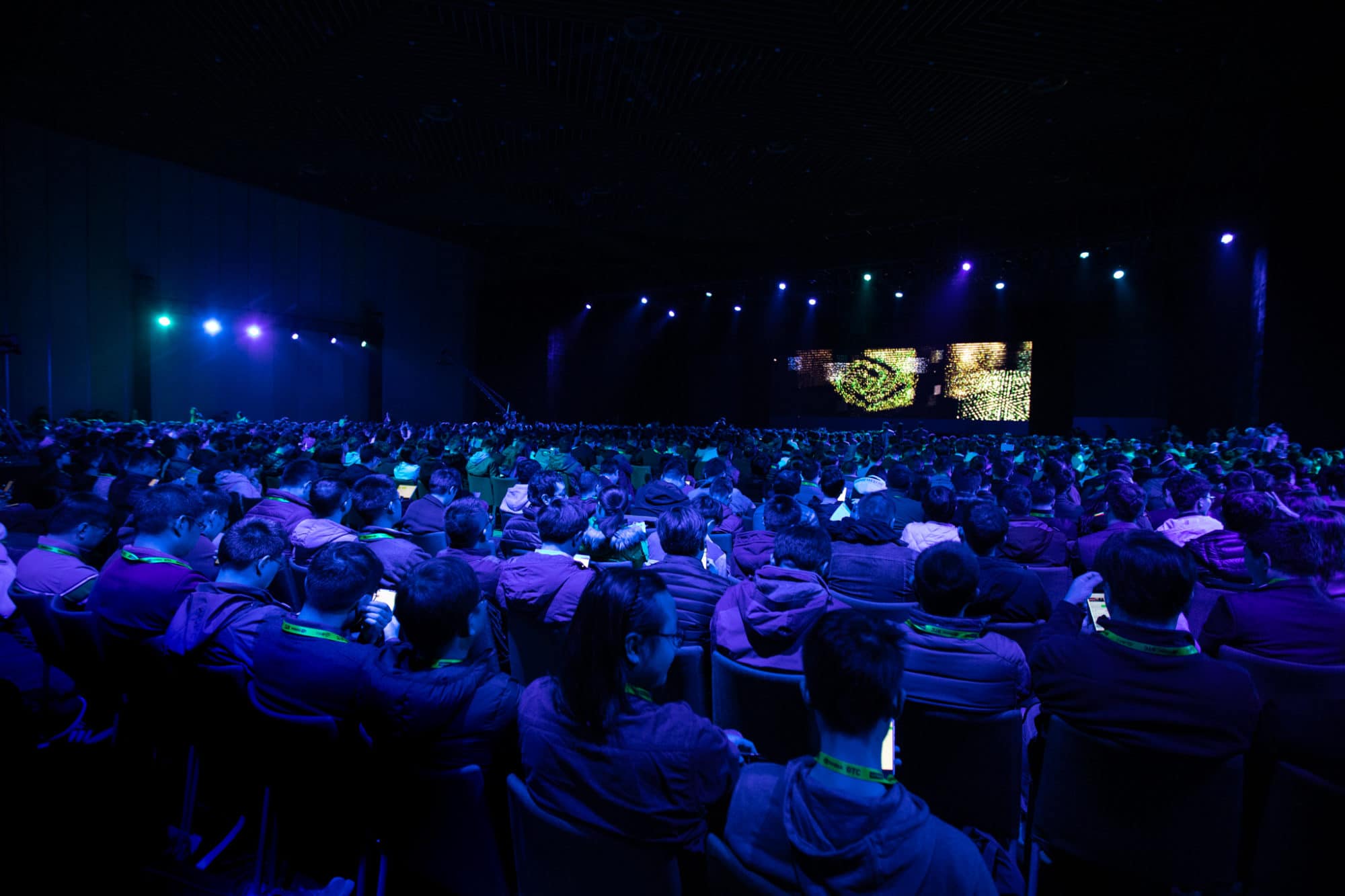
Huang explained that demand is surging for technology that can accelerate the delivery of AI services of all kinds. And NVIDIA’s deep learning platform — which the company updated Wednesday with new inferencing software — promises to be the fastest, most efficient way to deliver these services.

It’s the latest example of how NVIDIA achieves spectacular speedups by applying a combination of GPUs optimized for parallel computation, work across the entire computing stack, and algorithm and ecosystem expertise in focused vertical markets.

“It is accepted now that GPU accelerated computing is the path forward as Moore’s law has ended,” Huang said.

Real-Time Recommendations: Baidu and Alibaba

The latest challenge for accelerated computing: driving a new generation of powerful systems, known as recommender systems, able to connect individuals with what they’re looking for in a world where the options available to them is spiraling exponentially.

“The era of search has ended: if I put out a trillion, billion million things and they’re changing all the time, how can you find anything,” Huang asked. “The era of search is over. The era of recommendations has arrived.

Baidu — one of the world’s largest search companies – is harnessing NVIDIA technology to power advanced recommendation engines.

“It solves this problem of taking this enormous amount of data, and filtering it through this recommendation system so you only see 10 things,” Huang said.

With GPUs, Baidu can now train the models that power its recommender systems 10x faster, reducing costs, and, over the long term, increasing the accuracy of its models, improving the quality of its recommendations.

Another example such systems’ power: Alibaba, which relies on NVIDIA technology to help power the recommendation engines behind the success of Single’s Day.

This new shopping festival which takes place on Nov. 11 — or 11.11 — generated $38 billion in sales last month. That’s up by nearly a quarter from last year’s $31 billion, and more than double the online sales on Black Friday and Cyber Monday combined.

Helping to drive its success are recommender systems that display items that match user preferences, improving the click-through rate — which is closely watched in the e-commerce industry as a key sales driver. Its systems need to run in real-time and at an incredible scale, something that’s only possible with GPUs.

“Deep learning inference is wonderful for deep recommender systems and these recommender systems will be the engine for the Internet,” Huang said. “Everything we do in the future, everything we do now, passes through a recommender system.”

Real-Time Conversational AI

Huang also announced groundbreaking new inference software enabling smarter, real-time conversational AI.

NVIDIA TensorRT 7 — the seventh generation of the company’s inference software development kit — features a new deep learning compiler designed to automatically optimize and accelerate the increasingly complex recurrent and transformer-based neural networks needed for complex new applications, such as AI speech.
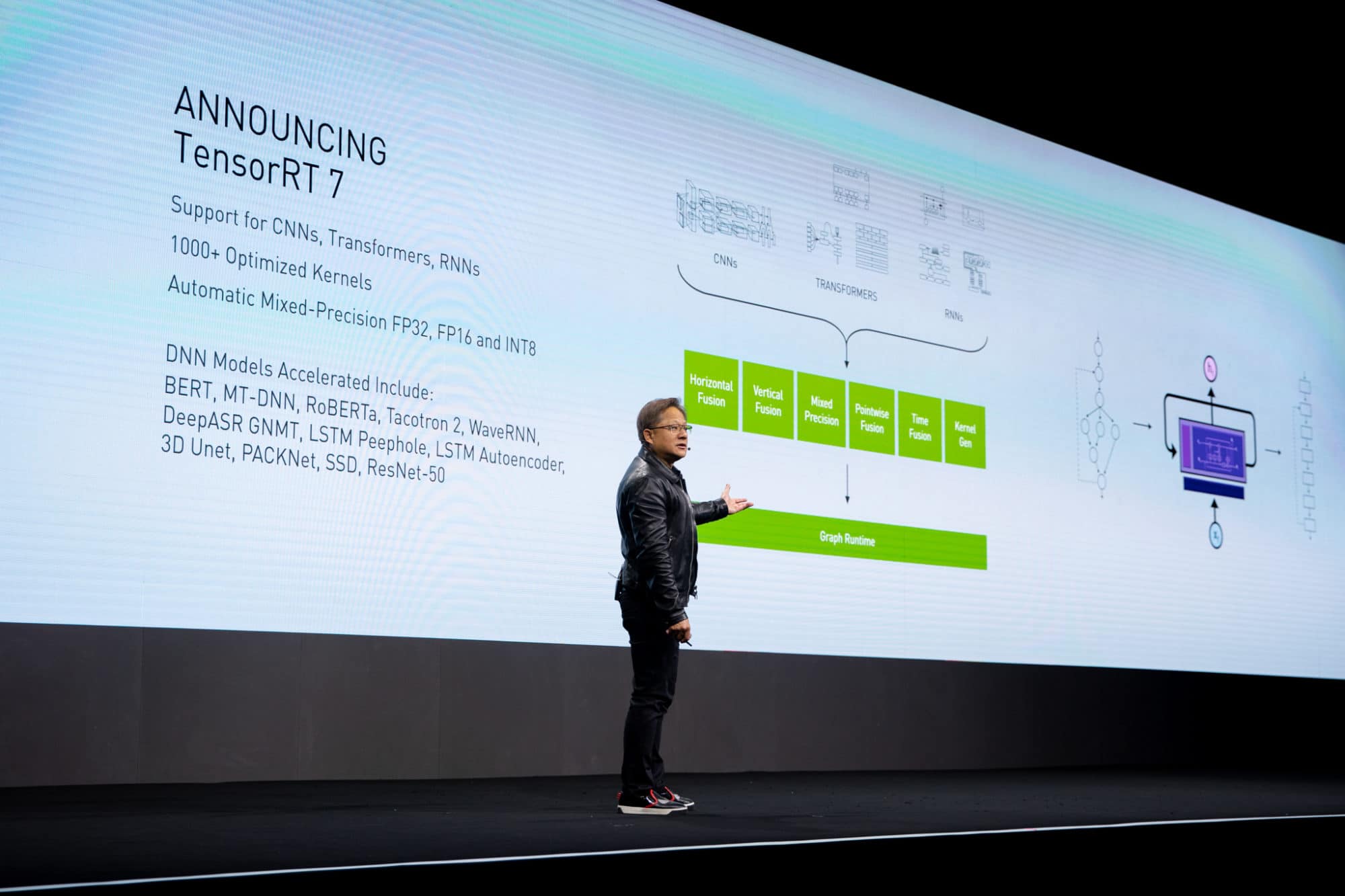
This speeds the components of conversational AI by 10x compared to CPUs, driving latency below the 300-millisecond threshold considered necessary for real-time interactions.

“To have the ability to understand your intention, make recommendations, do searches and queries for you, and summarize what they’ve learned to a text to speech system… that loop is now possible,” Huang said. “It is now possible to achieve very natural, very rich, conversational AI in real time.”

Accelerating Automotive Innovations

Huang also announced NVIDIA will provide the transportation industry with source access to its NVIDIA DRIVE deep neural networks (DNNs) for autonomous vehicle development.

NVIDIA DRIVE has become a de facto standard for AV development, used broadly by automakers, truck manufacturers, robotaxi companies, software companies and universities.

Now, NVIDIA is providing source access of it’s pre-trained AI models and training code to AV developers. Using a suite of NVIDIA AI tools, the ecosystem can freely extend and customize the models to increase the robustness and capabilities of their self-driving systems.

In addition to providing source access to the DNNs, Huang announcing the availability of a suite of advanced tools so developers can customize and enhance NVIDIA’s DNNs, utilizing their own data sets and target feature set. These tools allow the training of DNNs utilizing active learning, federated learning and transfer learning, Huang said.

Haung also announced NVIDIA DRIVE AGX Orin, the world’s highest performance and most advanced system-on-a-chip. It delivers 7x the performance and 3x the efficiency per watt of Xavier, NVIDIA’s previous-generation automotive SoC. Orin — which will be available to be incorporated in customer production runs for 2022 — boasts 17 billion transistors, 12 CPU cores, and is capable of over 200 trillion operations per second.
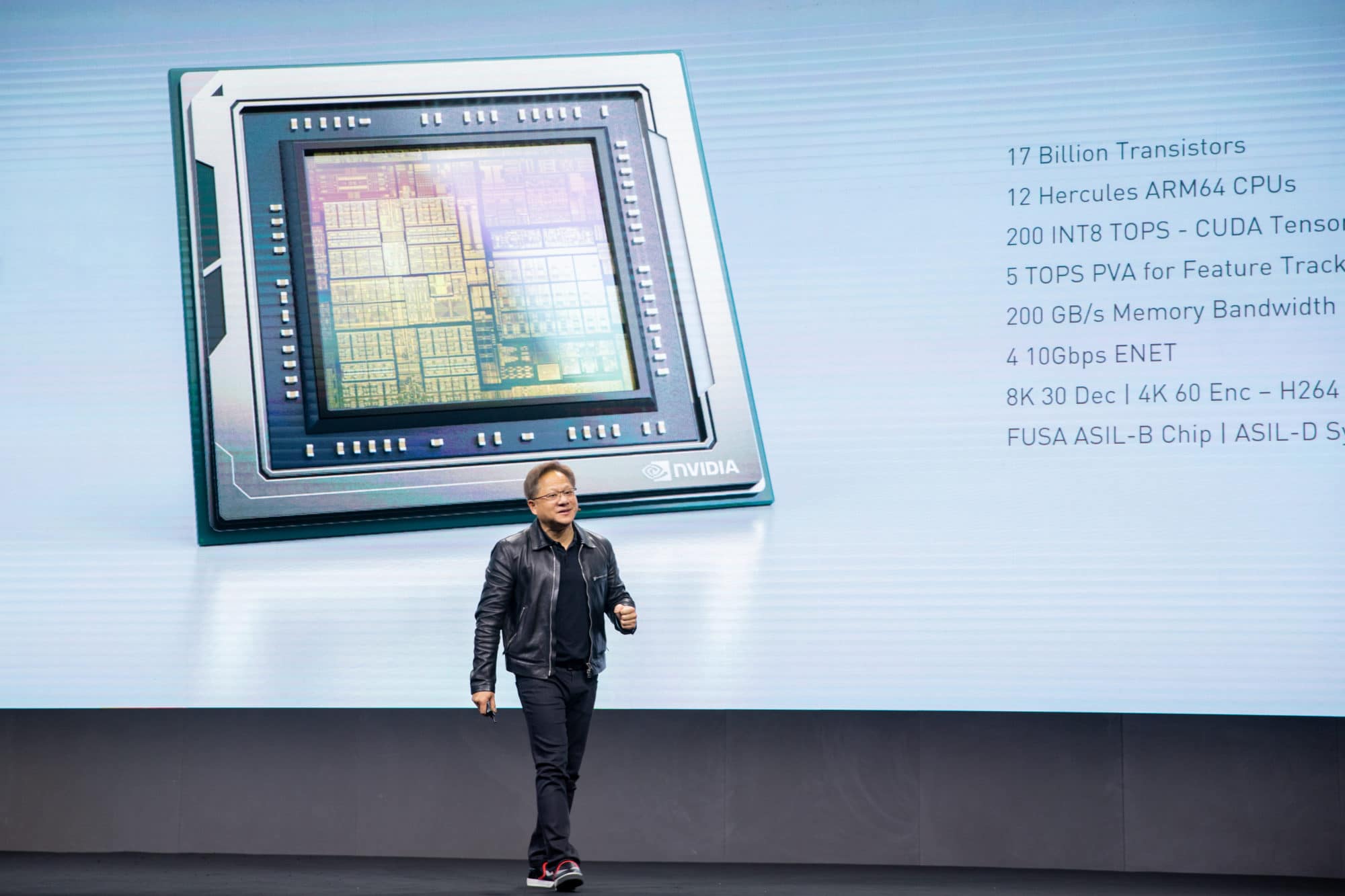
Orin will be woven into a stack of products — all running a single architecture and compatible with software developed on Xavier — able to scale from simple level 2 autonomy, all the way up to full Level 5 autonomy.

And Huang announced that Didi — the world’s largest ride hailing company — will adopt NVIDIA DRIVE to bring robotaxis and intelligent ride-hailing services to market.

“We believe everything that moves will be autonomous some day,” Huang said. “This is not the work of one company, this is the work of one industry, and we’ve created an open platform so we can all team up together to realize this autonomous future.”

Game On

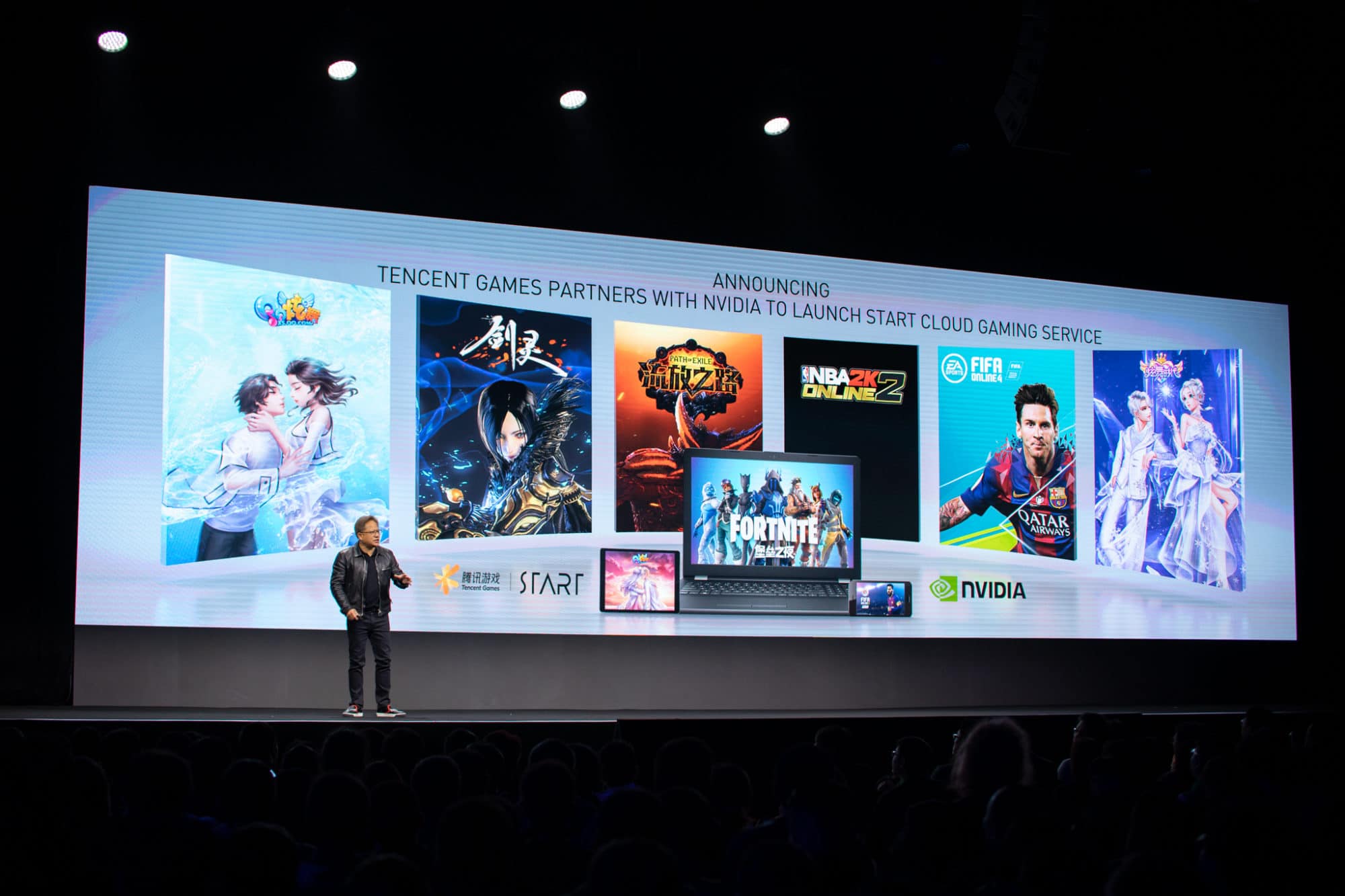
Adding to NVIDIA’s growing footprint in cloud gaming, Huang announced a collaboration with Tencent Games in cloud gaming.

“We are going to extend the wonderful experience of PC gaming to all the computers that are underpowered today, the opportunity is quite extraordinary,” Huang said. “We can extend PC gaming to the other 800 milliion gamers in the world.”

NVIDIA’s technology will power Tencent Games’ START cloud gaming service, which began testing earlier this year. START gives gamers access to AAA games on underpowered devices anytime, anywhere.
Huang also announced that six leading game developers will join the ranks of game developers around the world who have been using the realtime ray tracing capabilities of NVIDIA’s GeForce RTX to transform the image quality and lighting effects of their upcoming titles

Ray tracing is a graphics rendering technique that brings real-time, cinematic-quality rendering to content creators and game developers. NVIDIA GeForce RTX GPUs contain specialized processor cores designed to accelerate ray tracing so the visual effects in games can be rendered in real time.

The upcoming games include a mix of blockbusters, new franchises, triple-A titles and indie fare — all using real-time ray tracing to bring ultra-realistic lighting models to their gameplay.

They include Boundary, from Surgical Scalpels Studios; Convallarioa, from LoongForce;  F.I.S.T. from  Shanghai TiGames; an unnamed project from Mihyo; Ring of Elysium, from TenCent; and Xuan Yuan Sword VII from Softstar.

Accelerating Medical Advances, 5G

This year, Huang said, NVIDIA has added two major new applications to CUDA – 5G vRAN and genomic processing. With each, NVIDIA’s supported by world leaders in their respective industries – Ericsson in telecommunication and BGI in genomics.

Since the first human genome was sequenced in 2003, the cost of whole genome sequencing has steadily shrunk, far outstripping the pace of Moore’s law. That’s led to an explosion of genomic data, with the total amount of sequence data is doubling every seven months.

“The ability to sequence the human genome in its totality is incredibly powerful,” Huang said.

To put this data to work — and unlock the promise of truly personalized medicine — Huang announced that NVIDIA is working with Beijing Genomics Institute.

BGI is using NVIDIA V100 GPUs and software from Parabricks, an Ann Arbor, Michigan- based startup acquired by NVIDIA earlier this month — to build the highest throughput genome sequencer yet, potentially driving down the cost of genomics-based personalized medicine.

“It took 15 years to sequence the human genome for the first time,” Huang said. “It is now possible to sequence 16 whole genomes per day.”

Huang also announced the availability of the NVIDIA Parabricks Genomic Analysis Toolkit, and its availability on NGC, NVIDIA’s hub for GPU-optimized software for deep learning, machine learning, and high-performance computing.

Accelerated Robotics with NVIDIA Isaac

As the talk wound to a close, Huang announced a new version of NVIDIA’s Isaac software development kit. The Isaac SDK achieves an important milestone in establishing a unified robotic development platform — enabling AI, simulation and manipulation capabilities.

The showstopper: Leonardo, a robotic arm with exquisite articulation created by NVIDIA researchers in Seattle, that not only performed a sophisticated task — recognizing and rearranging four colored cubes — but responded almost tenderly to the actions of the people around it in real time. It purred out a deep squeak, seemingly out of a Steven Spielberg movie.

As the audience watched the robotic arm was able to gently pluck a yellow colored block from Hunag’s hand and set it down. It then went on to rearrange four colored blocks, gently stacking them with fine precision.

The feat was the result of sophisticated simulation and training, that allows the robot to learn in virtual worlds, before being put to work in the real world. “And this is how we’re going to create robots in the future,” Huang said.

Accelerating Everything

Huang finished his talk by by recapping NVIDIA’s sprawling accelerated computing story, one that spans ray tracing, cloud gaming, recommendation systems, real-time conversational AI, 5G, genomics analysis, autonomous vehicle and robotis, and more.

“I want to thank you for your collaboration to make accelerated computing amazing and thank you for coming to GTC,” Huang said.

The post As AI Universe Keeps Expanding, NVIDIA CEO Lays Out Plan to Accelerate All of It appeared first on The Official NVIDIA Blog.

[D] PhD in Machine Learning vs PhD in Statistics?

I currently hold a Master’s in Statistics and I know I want to go back and get a PhD, but I’m not quite sure which is the better option. I want to eventually do research with AI/ML type stuff, but I thought a PhD in Statistics would be more “respected” because it’s more theoretical? Also, because Statistics is more general (I think), would it perhaps keep more doors open?

Apologies if my question seems naive, I really don’t know very much so feel free to give your most brutally honest opinions!

submitted by /u/amlewa
[link] [comments]

AI, Accelerated Computing Drive Shift to Personalized Healthcare

Genomics is finally poised to go mainstream, with help from deep learning and accelerated-computing technologies from NVIDIA.

Since the first human genome was sequenced in 2003, the cost of whole genome sequencing has steadily shrunk, far faster than suggested by Moore’s law. From sequencing the genomes of newborn babies to conducting national population genomics programs, the field is gaining momentum and getting more personal by the day.

Advances in sequencing technology have led to an explosion of genomic data. The total amount of sequence data is doubling every seven months. This breakneck pace could see genomics in 2025 surpass by 10x the amount of data generated by other big data sources such as astronomy, Twitter and YouTube — hitting the double-digit exabyte range.

New sequencing systems, like the DNBSEQ-T7 from BGI Group, the world’s largest genomics research group, are pushing the technology into broad use. The system generates a whopping 60 genomes per day, equaling 6 terabytes of data.

With advancements in BGI’s flow cell technology and acceleration by a pair of NVIDIA V100 Tensor Core GPUs, DNBSEQ-T7 sequencing is sped up 50x, making it the highest throughput genome sequencer to date.

As costs decline and sequencing times accelerate, more use cases emerge, such as the ability to sequence a newborn in intensive care where every minute counts.

Getting Past the Genome Analysis Bottleneck: GPU-Accelerated GATK

NVIDIA Parabricks GPU-accelerated GATK

The genomics community continues to extract new insights from DNA. Recent breakthroughs include single-cell sequencing to understand mutations at a cellular level, and liquid biopsies that detect and monitor cancer using blood for circulating DNA.

But genomic analysis has traditionally been a computational bottleneck in the sequencing pipeline — one that can be surmounted using GPU acceleration.

To deliver a roadmap of continuing GPU acceleration for key genomic analysis pipelines, the team at Parabricks — an Ann Arbor, Michigan-based developer of GPU software for genomics — is joining NVIDIA’s healthcare team, NVIDIA founder and CEO Jensen Huang shared today onstage at GTC China.

Teaming up with BGI, the Parabricks’ software can analyze a genome in under an hour. Using a server with eight NVIDIA T4 Tensor Core GPUs, BGI showed the throughput could lower the cost of genome sequencing to $2 — less than half the cost of existing systems.

See More, Do More with Smart Medical Devices

New medical devices are being invented across the healthcare industry. United Imaging Healthcare has introduced two industry-first medical devices. The uEXPLORER is the world’s first total body PET-CT scanner. Its pioneering ability to image an individual in one position enables it to carry out fast, continuous tracking of tracer distribution over the entire body.

A full body PET/CT image from uEXPLORER. Courtesy of United Imaging.

The total-body coverage of uEXPLORER can significantly shorten scan time. Scans as brief as 30 seconds provide good image quality, compared to traditional systems requiring over 20 minutes of scan time. uEXPLORER is also setting a new benchmark in tracer dose — imaging at about 1/50 of the regular dose, without compromising image quality.

The FDA-approved system uses 16 NVIDIA V100 Tensor Core GPUs and eight 56 GB/s InfiniBand network links from Mellanox to process movie-like scans that can acquire up to a terabyte of data. The system is already deployed in the U.S. at the University of California, Davis, where scientists helped design the system. It’s also the subject of an article in Nature, as well as videos watched by nearly half a million viewers on YouTube.

United’s other groundbreaking system, the uRT-Linac, is the first instrument to support a full radiation therapy suite, from detection to prevention.

With this instrument, a patient from a remote village can make the long trek to the nearest clinic just once to get diagnostic tests and treatment. The uRT-Linac combines CT imaging, AI processing to assist in treatment planning, and simulation with the radiation therapy delivery system. Using multi-modal technologies and AI, United has changed the nature of delivering cancer treatment.

Further afield, a growing number of smart medical devices are using AI for enhanced signal and image processing, workflow optimizations and data analysis.

And on the horizon are patient monitors that can sense when a patient is in danger and smart endoscopes that can guide surgeons during surgery. It’s no exaggeration to state that, in the future, every sensor in the hospital will have AI-infused capabilities.

Our recently announced NVIDIA Clara AGX developer kit helps address this trend. Clara AGX comprises hardware based on NVIDIA Xavier SoCs and Volta Tensor Core GPUs, along with a Clara AGX software development kit, to enable the proliferation of smart medical devices that make healthcare both smarter and more personal.

Apply for early access to Clara AGX.

The post AI, Accelerated Computing Drive Shift to Personalized Healthcare appeared first on The Official NVIDIA Blog.

All the Way to 11: NVIDIA GPUs Accelerate 11.11, World’s Biggest Online Shopping Event

Putting AI to work on a massive scale, Alibaba recently harnessed NVIDIA GPUs to serve its customers on 11/11, the year’s largest shopping event.

During Singles Day, as the Nov. 11 shopping event is also known, it generated $38 billion in sales. That’s up by nearly a quarter from last year’s $31 billion, and more than double online sales on Black Friday and Cyber Monday combined.

Singles Day — which has grown from $7 million a decade ago — illustrates the massive scale AI has reached in global online retail, where no player is bigger than Alibaba.

Each day, over 100 million shoppers comb through billions of available products on its site. Activity skyrockets on peak shopping days, when Alibaba’s systems field hundreds of thousands of queries a second.

And AI keeps things humming along, according to Lingjie Xu, Alibaba’s director of heterogeneous computing.

“To ensure these customers have a great user experience, we deploy state-of-the-art AI technology at massive scale using the NVIDIA accelerated computing platform, including T4 GPUs, cuBLAS, customized mixed precision and inference acceleration software,” he said.

“The platform’s intuitive search capabilities and reliable recommendations allow us to support a model six times more complex than in the past, which has driven a 10 percent improvement in click-through rate. Our largest model shows 100 times higher throughput with T4 compared to CPU,” he said.

One key application for Alibaba and other modern online retailers: recommender systems that display items that match user preferences, improving the click-through rate — which is closely watched in the e-commerce industry as a key sales driver.

Every small improvement in click-through rate directly impacts the user experience and revenues. A 10 percent improvement from advanced recommender models that can run in real time, and at incredible scale, is only possible with GPUs.

Alibaba’s teams employ NVIDIA GPUs to support a trio of optimization strategies around resource allocation, model quantization and graph transformation to increase throughput and responsiveness.

This has enabled NVIDIA T4 GPUs to accelerate Alibaba’s wide and deep recommendation model and deliver 780 queries per second. That’s a huge leap from CPU-based inference, which could only deliver three queries per second.

Alibaba has also deployed NVIDIA GPUs to accelerate its systems for automatic advertisement banner-generating, ad recommendation, imaging processing to help identify fake products, language translation, and speech recognition, among others. As the world’s third-largest cloud service provider, Alibaba Cloud provides a wide range of heterogeneous computing products capable of intelligent scheduling, automatic maintenance and real-time capacity expansion.

Alibaba’s far-sighted deployment of NVIDIA’s AI platform is a straw in the wind, indicating what more is to come in a burgeoning range of industries.

Just as its tools filter billions of products for millions of consumers, AI recommenders running on NVIDIA GPUs will find a place among other countless other digital services — app stores, news feeds, restaurant guides and music services among them — keeping customers happy.

Learn more about NVIDIA’s AI inference platform.

The post All the Way to 11: NVIDIA GPUs Accelerate 11.11, World’s Biggest Online Shopping Event appeared first on The Official NVIDIA Blog.

[R] Peer to Peer Unsupervised Representation Learning

I have produced a prototype for an unsupervised representation learning model which trains over a p2p network and uses a blockchain to record the value of individual nodes in the network.
https://github.com/unconst/BitTensor

This project is open-source and ongoing. I wanted to share with reddit to see if anyone was interested in collaboration.

submitted by /u/unconst
[link] [comments]

[R] MetaInit: Initializing learning by learning to initialize

Abstract

Deep learning models frequently trade handcrafted features for deep features learned with much less human intervention using gradient descent. While this paradigm has been enormously successful, deep networks are often difficult to train and performance can depend crucially on the initial choice of parameters. In this work, we introduce an algorithm called MetaInit as a step towards automating the search for good initializations using meta-learning. Our approach is based on a hypothesis that good initializations make gradient descent easier by starting in regions that look locally linear with minimal second order effects. We formalize this notion via a quantity that we call the gradient quotient, which can be computed with any architecture or dataset. MetaInit minimizes this quantity efficiently by using gradient descent to tune the norms of the initial weight matrices. We conduct experiments on plain and residual networks and show that the algorithm can automatically recover from a class of bad initializations. MetaInit allows us to train networks and achieve performance competitive with the state-of-the-art without batch normalization or residual connections. In particular, we find that this approach outperforms normalization for networks without skip connections on CIFAR-10 and can scale to Resnet-50 models on Imagenet.

https://papers.nips.cc/paper/9427-metainit-initializing-learning-by-learning-to-initialize

submitted by /u/hardmaru
[link] [comments]

[D] Is Google Colab the future for reproducible research?

Colab and similar products can help with the reproducibility of code and more importantly the code underlying academic results. These free resources not only make code transparency easier, from here forward, it makes unpublished Python code highly suspect. There are no limitations to sharing code and data anymore and no limitation in accessing this code, the data and the necessary processing power to analyse the results.

from medium

submitted by /u/OppositeMidnight
[link] [comments]